2019 NISSAN LEAF warning light
[x] Cancel search: warning lightPage 48 of 610

Li-ion battery available charge gauge:
This indicator displays the available Li-ion
battery capacity remaining to drive the ve-
hicle.
For additional information, refer to “Li-ion
battery available charge gauge” in the “In-
struments and controls” section of this
manual.
The EV unique information is displayed on
the vehicle information display as well. For
additional information, refer to “Vehicle in-
formation display” in the “Instruments and
controls” section of this manual.
Warning and indicator lights
The EV system uses the following EV spe-
cific warning and indicator lights:
1. Master warning light (red)
2. Master warning light (yellow)3. 12-volt battery charge warning light
4. Plug-in indicator light
5. READY to Drive indicator light
6. Power limitation indicator light
7. EV system warning light
8. Electric shif t control system warning
light
9. Brake system warning light (yellow)
10. Approaching Vehicle Sound for Pedes- trians (VSP) system OFF warning light
For additional information, refer to “Warn-
ing lights, indicator lights and audible re-
minders” in the “Instruments and controls”
section of this manual.
EV OverviewEV-27
Page 49 of 610

APPROACHING VEHICLE SOUND
FOR PEDESTRIANS (VSP) SYSTEM
The Approaching Vehicle Sound for Pedes-
trians (VSP) system is a function that uses
sound to alert pedestrians of the presence
of the vehicle when it is being driven at a
low speed.
When the vehicle starts to move, it pro-
duces a sound.
The sound stops when the vehicle speed is
more than 19 mph (30 km/h) while acceler-
ating.The sound starts when the vehicle speed is
less than 16 mph (25 km/h) while deceler-
ating.
The sound stops when the vehicle stops.
The sound does not stop with the vehicle in
the R (Reverse) position even if the vehicle
stops.
WARNING
• If the sound cannot be heard, pedes- trians may not notice the oncoming
vehicle, which may cause an acci-
dent resulting in serious injury or
death. It is recommended that you
immediately visit a NISSAN certified
LEAF dealer for VSP system inspec-
tion. • If the VSP system OFF warning light
illuminates while the power switch
is in the ON position, or in the READY
to Drive position, it may indicate the
VSP system is not functioning prop-
erly. Have the VSP system checked. It
is recommended that you visit a
NISSAN certified LEAF dealer for this
service. For additional information,
refer to “Approaching Vehicle Sound
for Pedestrians (VSP) system OFF
warning light” in the “Instruments
and controls” section of this manual.
If you wish to make the sound of the VSP
system louder, it is recommended that you
visit a NISSAN certified LEAF dealer for this
service. It is not possible to make the sound
lower.
EV-28EV Overview
Page 53 of 610

WARNING
• If you use any medical electric de- vices, such as an implantable car-
diac pacemaker or an implantable
cardiovascular defibrillator, check
with the electric medical device
manufacturer concerning the ef-
fects that charging may have on im-
planted devices before starting the
charge operation. Charging may af-
fect the operation.
• Make sure there is no water or for- eign materials in the charge port,
charge connector, or electrical plug,
and that they are not damaged or
affected by rust or corrosion. If any
of these conditions are noticeable,
do not charge the Li-ion battery. This
may result in a short circuit or elec-
tric shock and could cause a fire
which may result in serious personal
injury or death.
• To avoid serious personal injury or death when the Li-ion battery is
charging, be aware of the following
precautions. – Do not touch the metal contacts
of the charge port, charge con-
nector, electrical plug or Genuine
NISSAN Adapter.
– Do not touch the vehicle and EVSE when there is lightning.
– Do not pull, twist, bend, step on, or drag the cable.
• Make sure the charge connector is removed from the charge port be-
fore starting your vehicle. If the
charge connector is only partially
engaged and the connector latch is
unlocked, it is possible to place the
EV in the READY to drive position.
• Do not touch the plug or the Genuine NISSAN Adapter if they are wet or
with wet hands. Do not put the plug
or the Genuine NISSAN Adapter in
water, liquid or snow. This may cause
an electric shock which may result in
serious personal injury or death.
• Do not disassemble or modif y the charge port, the EVSE or the Genuine
NISSAN Adapter. This may cause a
fire or an electric shock which may
result in serious personal injury or
death. • If you notice an unusual odor, smoke
or abnormal noises coming from the
vehicle, stop charging immediately.
• Be careful not to allow your hands, hair, jewelry or clothing to come into
contact with, or get caught in, the
traction motor cooling fan. The cool-
ing fan can start at any time during
charging.
• Do not use extension cords or adapters unless they are Genuine
NISSAN parts.
• Do not use the Genuine NISSAN Adapter with any devices except the
Genuine NISSAN EVSE.
• Do not allow an unattended child to handle or use this product.
•
Use the EVSE with outlet and wiring
installed according to the regulations/
standards.
• Pass the lower side belt of the EVSE case securely through the fastener
on the bottom of the luggage board.
If the case suddenly becomes loose,
it may cause serious injury or death.
PRECAUTIONS ON CHARGING
CH-2Charging
Page 62 of 610

4. Connect the charge connector to thecharge port. If it is connected normally, a
beep will sound once.
5. If charging has started or if the battery is waiting for the charging timer, a beep
will sound twice and the charging status
indicator light display will change. For
additional information, refer to “Charg-
ing status indicator lights” in this section. To stop normal charge:
1. Ensure that the charge connector lock is
not engaged. For additional information,
refer to “Charge connector lock system”
in this section.
2. Press the button on the charge connec- tor, release the lock and remove the
charge connector from the charge port
and properly store it.
3. Close the charge port cap.
4. Af ter closing the charge port cap on the charge port, close the charge port lid.
NOTE:
To stop charging mid-charge, remove
the charge connector. Charging auto-
matically stops.
HOW TO TRICKLE CHARGE
(AC 110–120 VOLT) BY L1 EVSE
WARNING
• If you wear a pacemaker or an im- plantable cardiovascular defibrilla-
tor (ICD), stay at least 6 in (15 cm)
away from the EVSE.
• If you wear a pacemaker or an im- plantable cardiovascular defibrilla-
tor (ICD), check with the electric
medical device manufacturer con-
cerning the effects that charging
may have on implanted devices be-
fore starting the charge operation.
Charging may affect the operation.
• In order to avoid an electric shock or fire due to a short circuit, connect to
a GFI (Ground Fault Interrupter) cir-
cuit breaker and use a waterproof
electrical ground socket.
ChargingCH-11
Page 108 of 610
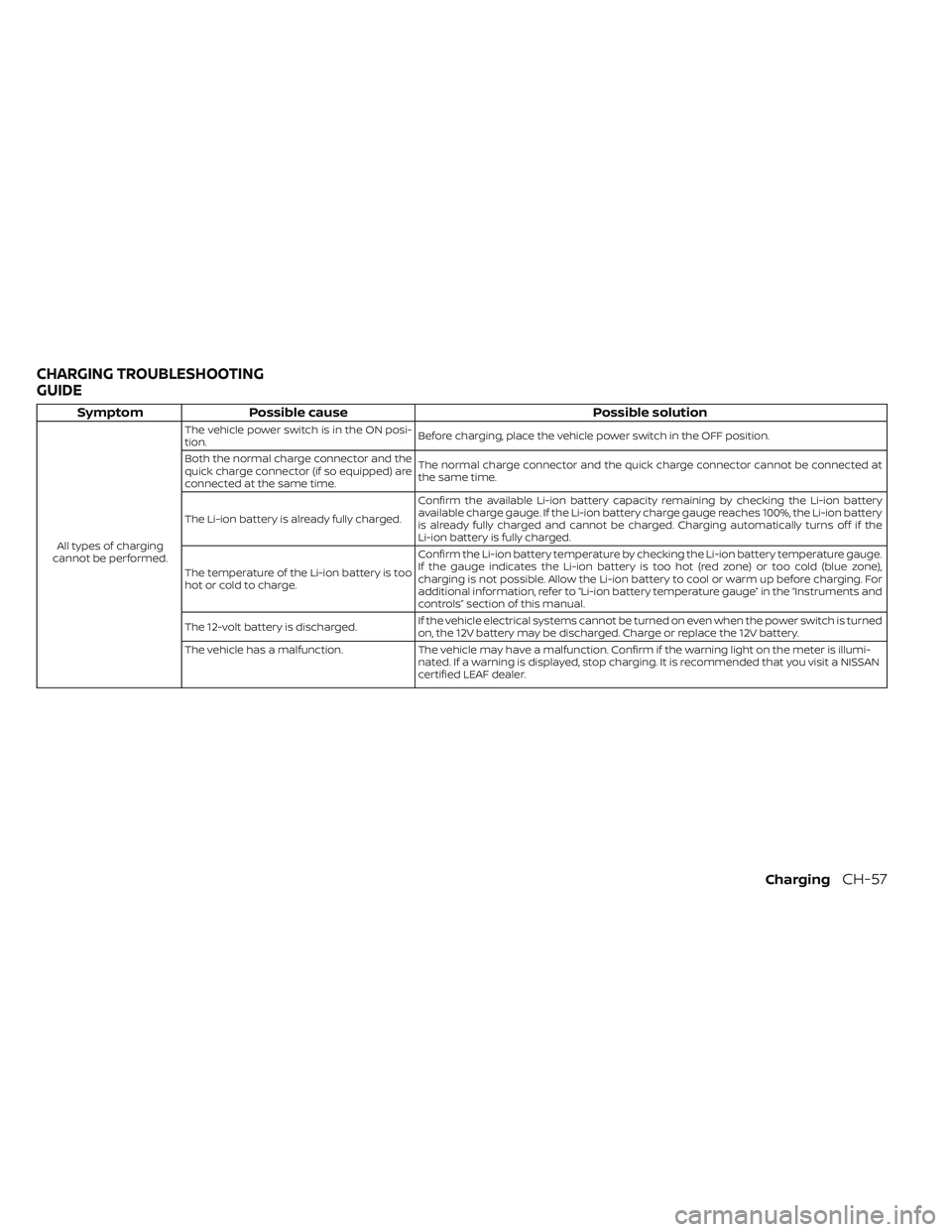
SymptomPossible cause Possible solution
All types of charging
cannot be performed. The vehicle power switch is in the ON posi-
tion.
Before charging, place the vehicle power switch in the OFF position.
Both the normal charge connector and the
quick charge connector (if so equipped) are
connected at the same time. The normal charge connector and the quick charge connector cannot be connected at
the same time.
The Li-ion battery is already fully charged. Confirm the available Li-ion battery capacity remaining by checking the Li-ion battery
available charge gauge. If the Li-ion battery charge gauge reaches 100%, the Li-ion battery
is already fully charged and cannot be charged. Charging automatically turns off if the
Li-ion battery is fully charged.
The temperature of the Li-ion battery is too
hot or cold to charge. Confirm the Li-ion battery temperature by checking the Li-ion battery temperature gauge.
If the gauge indicates the Li-ion battery is too hot (red zone) or too cold (blue zone),
charging is not possible. Allow the Li-ion battery to cool or warm up before charging. For
additional information, refer to “Li-ion battery temperature gauge” in the “Instruments and
controls” section of this manual.
The 12-volt battery is discharged. If the vehicle electrical systems cannot be turned on even when the power switch is turned
on, the 12V battery may be discharged. Charge or replace the 12V battery.
The vehicle has a malfunction. The vehicle may have a malfunction. Confirm if the warning light on the meter is illumi-
nated. If a warning is displayed, stop charging. It is recommended that you visit a NISSAN
certified LEAF dealer.
CHARGING TROUBLESHOOTING
GUIDE
ChargingCH-57
Page 112 of 610

1 Safety–Seats, seat belts and
supplemental restraint system
Seats..............................1-2Front manual seat adjustment (for passenger’s
seat and if so equipped for driver’s seat) .....1-3
Front power seat adjustment
(if so equipped for driver’s seat) ...........1-4
Rearseats ....................... .1-6
Head restraints/headrests ................1-7
Adjustable head restraint/headrest
components .......................1-8
Non-adjustable head restraint/headrest
components .......................1-8
Remove..........................1-9
Install ........................... .1-9
Adjust .......................... .1-9
Seatbelts.......................... .1-11
Precautions on seat belt usage ..........1-11
Seat belt warning light ................1-13
Pregnant women .................. .1-13
Injured persons .................... .1-13
Three-point type seat belt with retractor . . . .1-14
Seat belt extenders ................. .1-17
Seat belt maintenance ................1-18 Child safety
.........................1-18
Infants ......................... .1-19
Small children ......................1-19
Larger children .................... .1-20
Child restraints .......................1-21
Precautions on child restraints ...........1-21
LATCH (Lower Anchors and Tethers for CHildren)
system ......................... .1-23
Rear-facing child restraint installation using
LATCH.......................... .1-26
Rear-facing child restraint installation using
theseatbelts..................... .1-28
Forward-facing child restraint installation
using LATCH .......................1-31
Forward-facing child restraint installation
using the seat belts ................. .1-34
Booster seats ......................1-39
Supplemental Restraint System (SRS) ........1-43
Precautions on SRS ................. .1-43
Supplemental air bag warning labels ......1-61
Supplemental air bag warning light .......1-61
Page 123 of 610
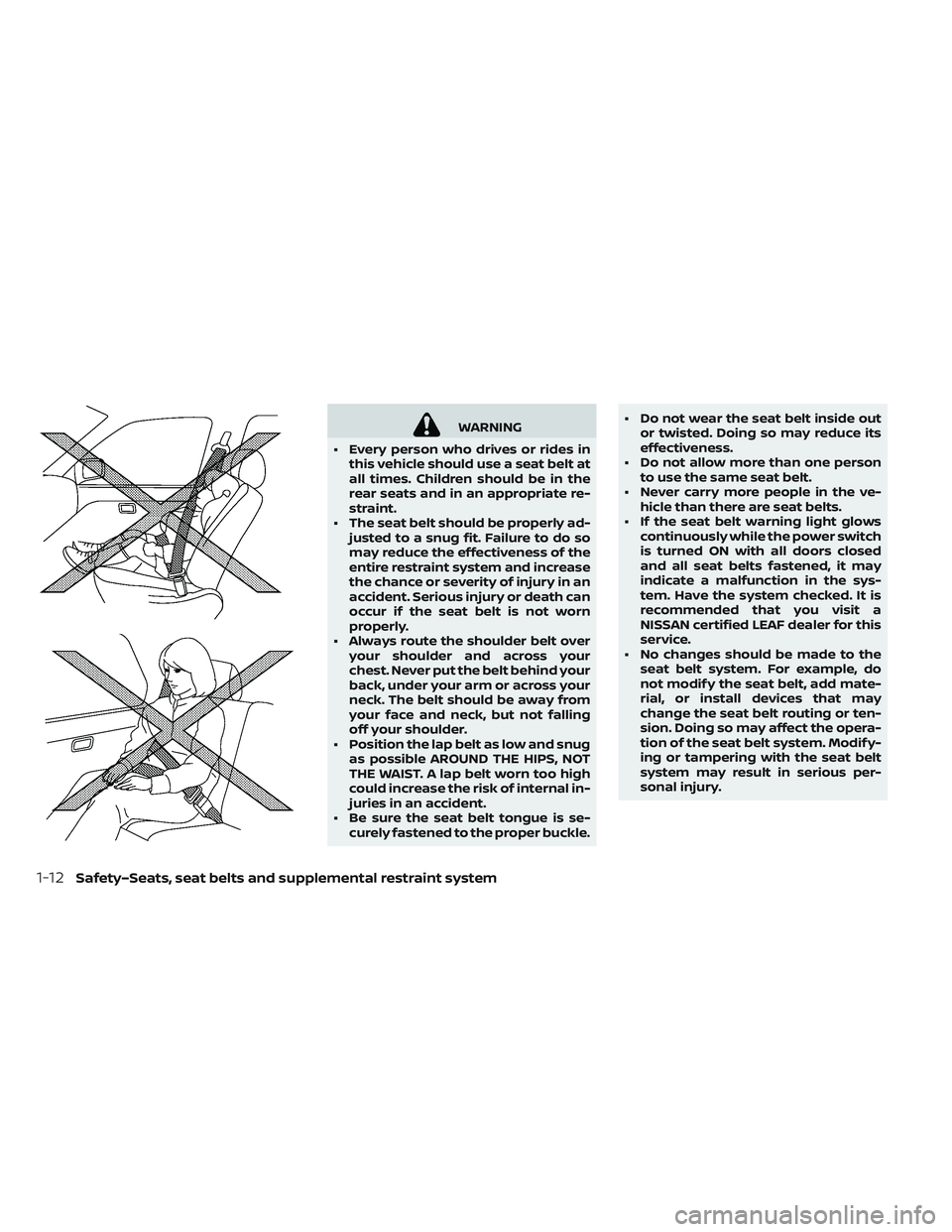
WARNING
• Every person who drives or rides in this vehicle should use a seat belt at
all times. Children should be in the
rear seats and in an appropriate re-
straint.
• The seat belt should be properly ad- justed to a snug fit. Failure to do so
may reduce the effectiveness of the
entire restraint system and increase
the chance or severity of injury in an
accident. Serious injury or death can
occur if the seat belt is not worn
properly.
• Always route the shoulder belt over your shoulder and across your
chest. Never put the belt behind your
back, under your arm or across your
neck. The belt should be away from
your face and neck, but not falling
off your shoulder.
• Position the lap belt as low and snug as possible AROUND THE HIPS, NOT
THE WAIST. A lap belt worn too high
could increase the risk of internal in-
juries in an accident.
• Be sure the seat belt tongue is se- curely fastened to the proper buckle. • Do not wear the seat belt inside out
or twisted. Doing so may reduce its
effectiveness.
• Do not allow more than one person to use the same seat belt.
• Never carry more people in the ve- hicle than there are seat belts.
• If the seat belt warning light glows continuously while the power switch
is turned ON with all doors closed
and all seat belts fastened, it may
indicate a malfunction in the sys-
tem. Have the system checked. It is
recommended that you visit a
NISSAN certified LEAF dealer for this
service.
• No changes should be made to the seat belt system. For example, do
not modif y the seat belt, add mate-
rial, or install devices that may
change the seat belt routing or ten-
sion. Doing so may affect the opera-
tion of the seat belt system. Modif y-
ing or tampering with the seat belt
system may result in serious per-
sonal injury.
1-12Safety–Seats, seat belts and supplemental restraint system
Page 124 of 610

• Once seat belt pretensioner(s) haveactivated, they cannot be reused
and must be replaced together with
the retractor. It is recommended
that you visit a NISSAN certified LEAF
dealer for this service.
• All seat belt assemblies, including retractors and attaching hardware,
should be inspected af ter any colli-
sion. It is recommended that you
visit a NISSAN certified LEAF dealer
for this service. NISSAN recom-
mends that all seat belt assemblies
in use during a collision be replaced
unless the collision was minor and
the belts show no damage and con-
tinue to operate properly. Seat belt
assemblies not in use during a colli-
sion should also be inspected and
replaced if either damage or im-
proper operation is noted.
• All child restraints and attaching hardware should be inspected af ter
any collision. Always follow the re-
straint manufacturer’s inspection
instructions and replacement rec-
ommendations. The child restraints
should be replaced if they are dam-
aged.
SEAT BELT WARNING LIGHT
Both the driver’s and passenger’s front
seats are equipped with a seat belt warn-
ing light. The warning light, located on the
instrument panel, will show the status of
the driver and passenger seat belt.
NOTE:
The front passenger seat belt warn-
ing light will not light up if the seat is
not occupied.
For additional information, refer to “Warn-
ing lights, indicator lights and audible re-
minders” in the “Instruments and controls”
section of this manual.
PREGNANT WOMEN
NISSAN recommends that pregnant
women use seat belts. The seat belt should
be worn snug, and always position the lap
belt as low as possible around the hips, not
the waist. Place the shoulder belt over your
shoulder and across your chest. Never put
the lap/shoulder belt over your abdominal
area. Contact your doctor for specific rec-
ommendations.
INJURED PERSONS
NISSAN recommends that injured persons
use seat belts, depending on the injury.
Check with your doctor for specific recom-
mendations.
Safety–Seats, seat belts and supplemental restraint system1-13