Page 360 of 444
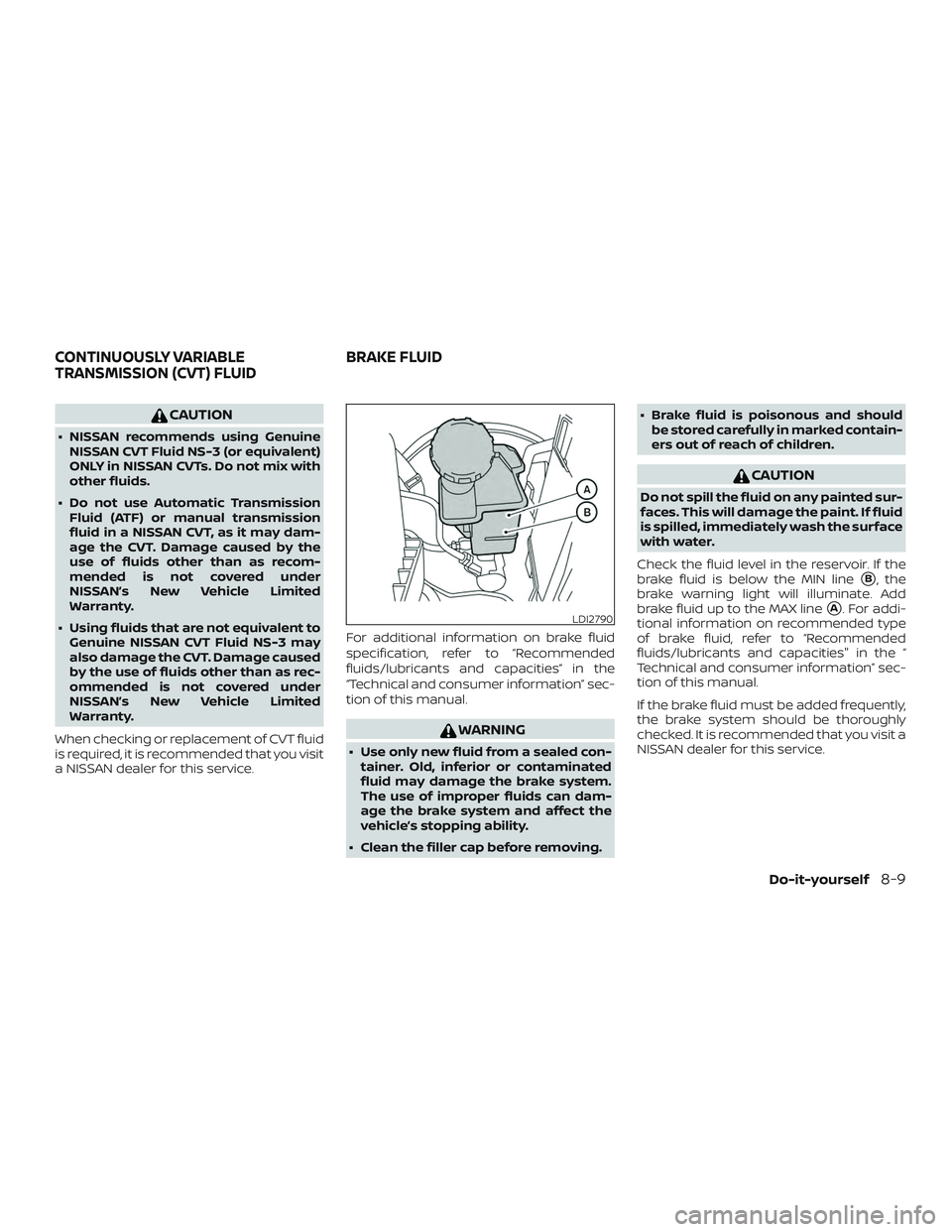
CHANGING ENGINE OIL FILTER
1. Park the vehicle on a level surface andapply the parking brake.
2. Turn the engine off. 3. Place a large drain pan under the oil
filter
�B.
4. Loosen the oil filter with an oil filter wrench by turning it counterclockwise.
Then remove the oil filter by turning it
by hand.
CAUTION
Be careful not to burn yourself. The en-
gine oil may be hot.
5. Wipe the engine oil filter sealing surface with a clean rag.
CAUTION
Be sure to remove any old gasket mate-
rial remaining on the sealing surface of
the engine. Failure to do so could lead to
engine damage.
6. Coat the gasket on the new filter with clean engine oil .
7. Screw on the oil filter until a slight resis- tance is felt, then tighten an additional
2/3 turn.
Oil filter tightening torque: 13 f t-lbs (18 N·m) 8. Start the engine and check for leakage
around the oil filter. Correct as required.
9. Turn the engine off and wait more than 10 minutes. Check the oil level. Add en-
gine oil by removing the oil filler cap
�A
if necessary.
LDI3027
8-8Do-it-yourself
Page 361 of 444
CAUTION
∙ NISSAN recommends using GenuineNISSAN CVT Fluid NS-3 (or equivalent)
ONLY in NISSAN CVTs. Do not mix with
other fluids.
∙ Do not use Automatic Transmission Fluid (ATF) or manual transmission
fluid in a NISSAN CVT, as it may dam-
age the CVT. Damage caused by the
use of fluids other than as recom-
mended is not covered under
NISSAN’s New Vehicle Limited
Warranty.
∙ Using fluids that are not equivalent to Genuine NISSAN CVT Fluid NS-3 may
also damage the CVT. Damage caused
by the use of fluids other than as rec-
ommended is not covered under
NISSAN’s New Vehicle Limited
Warranty.
When checking or replacement of CVT fluid
is required, it is recommended that you visit
a NISSAN dealer for this service. For additional information on brake fluid
specification, refer to “Recommended
fluids/lubricants and capacities” in the
“Technical and consumer information” sec-
tion of this manual.
WARNING
∙ Use only new fluid from a sealed con-
tainer. Old, inferior or contaminated
fluid may damage the brake system.
The use of improper fluids can dam-
age the brake system and affect the
vehicle’s stopping ability.
∙ Clean the filler cap before removing. ∙ Brake fluid is poisonous and should
be stored carefully in marked contain-
ers out of reach of children.
CAUTION
Do not spill the fluid on any painted sur-
faces. This will damage the paint. If fluid
is spilled, immediately wash the surface
with water.
Check the fluid level in the reservoir. If the
brake fluid is below the MIN line
�B, the
brake warning light will illuminate. Add
brake fluid up to the MAX line
�A. For addi-
tional information on recommended type
of brake fluid, refer to “Recommended
fluids/lubricants and capacities" in the “
Technical and consumer information” sec-
tion of this manual.
If the brake fluid must be added frequently,
the brake system should be thoroughly
checked. It is recommended that you visit a
NISSAN dealer for this service.LDI2790
CONTINUOUSLY VARIABLE
TRANSMISSION (CVT) FLUID BRAKE FLUID
Do-it-yourself8-9
Page 362 of 444
WINDSHIELD-WASHER FLUID
RESERVOIR
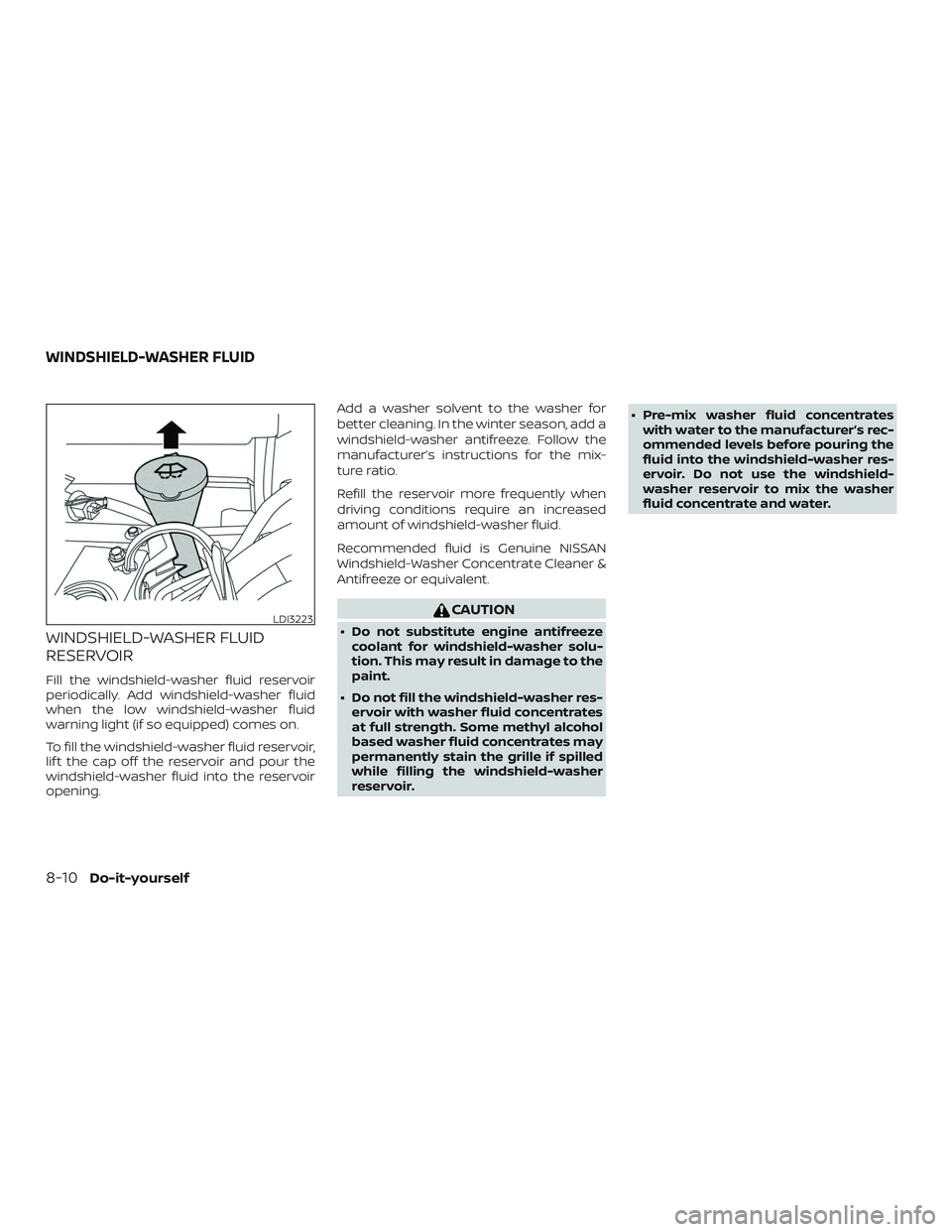
Fill the windshield-washer fluid reservoir
periodically. Add windshield-washer fluid
when the low windshield-washer fluid
warning light (if so equipped) comes on.
To fill the windshield-washer fluid reservoir,
lif t the cap off the reservoir and pour the
windshield-washer fluid into the reservoir
opening.Add a washer solvent to the washer for
better cleaning. In the winter season, add a
windshield-washer antifreeze. Follow the
manufacturer’s instructions for the mix-
ture ratio.
Refill the reservoir more frequently when
driving conditions require an increased
amount of windshield-washer fluid.
Recommended fluid is Genuine NISSAN
Windshield-Washer Concentrate Cleaner &
Antifreeze or equivalent.
CAUTION
∙ Do not substitute engine antifreeze
coolant for windshield-washer solu-
tion. This may result in damage to the
paint.
∙ Do not fill the windshield-washer res- ervoir with washer fluid concentrates
at full strength. Some methyl alcohol
based washer fluid concentrates may
permanently stain the grille if spilled
while filling the windshield-washer
reservoir. ∙ Pre-mix washer fluid concentrates
with water to the manufacturer’s rec-
ommended levels before pouring the
fluid into the windshield-washer res-
ervoir. Do not use the windshield-
washer reservoir to mix the washer
fluid concentrate and water.LDI3223
WINDSHIELD-WASHER FLUID
8-10Do-it-yourself
Page 370 of 444
Under some driving or climate conditions,
occasional brake squeak, squeal or other
noise may be heard. Occasional brake
noise during light to moderate stops is nor-
mal and does not affect the function or
performance of the brake system.
Proper brake inspection intervals should
be followed.For additional information re-
garding brake inspections, refer to the ap-
propriate maintenance schedule informa-
tion in the "Maintenance and schedules"
section of this manual.
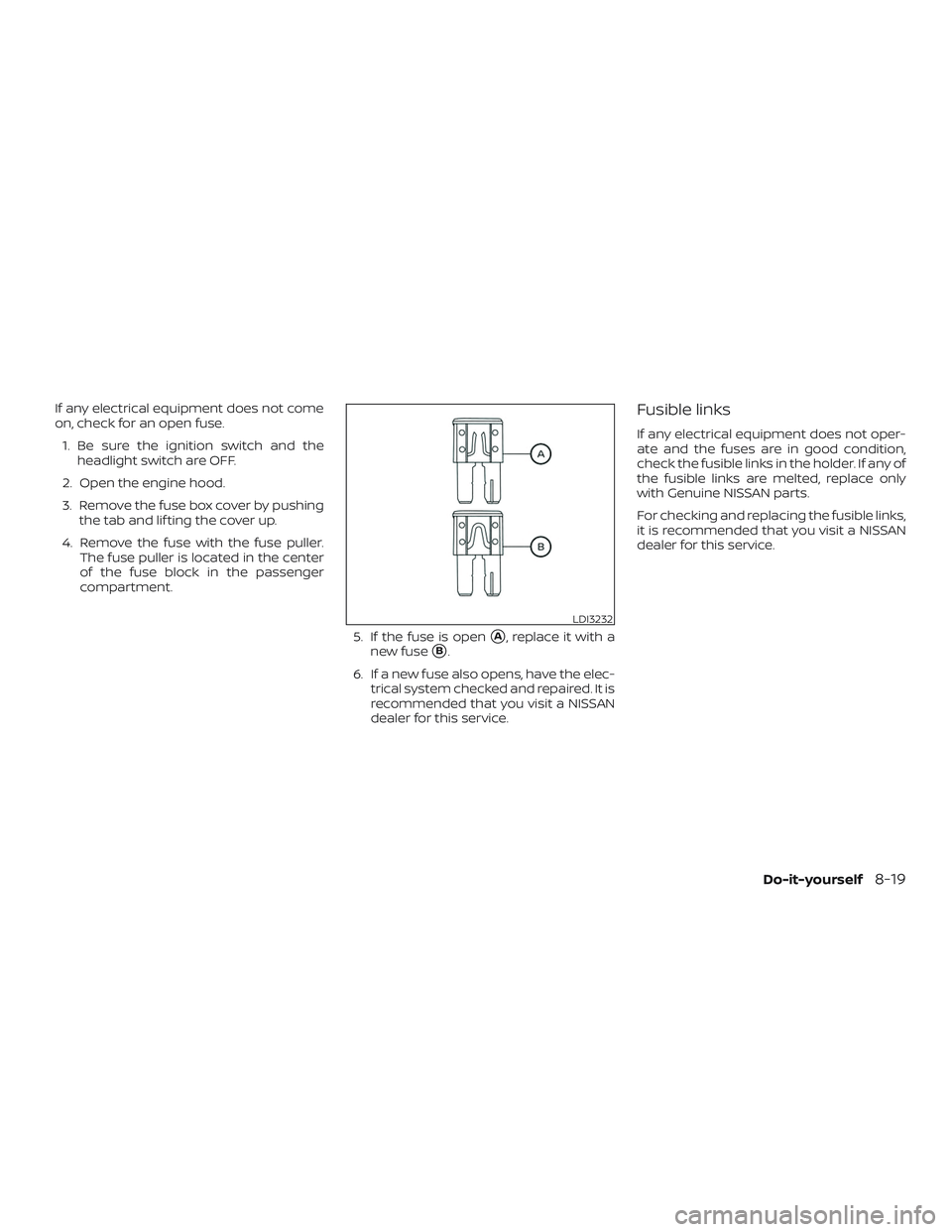
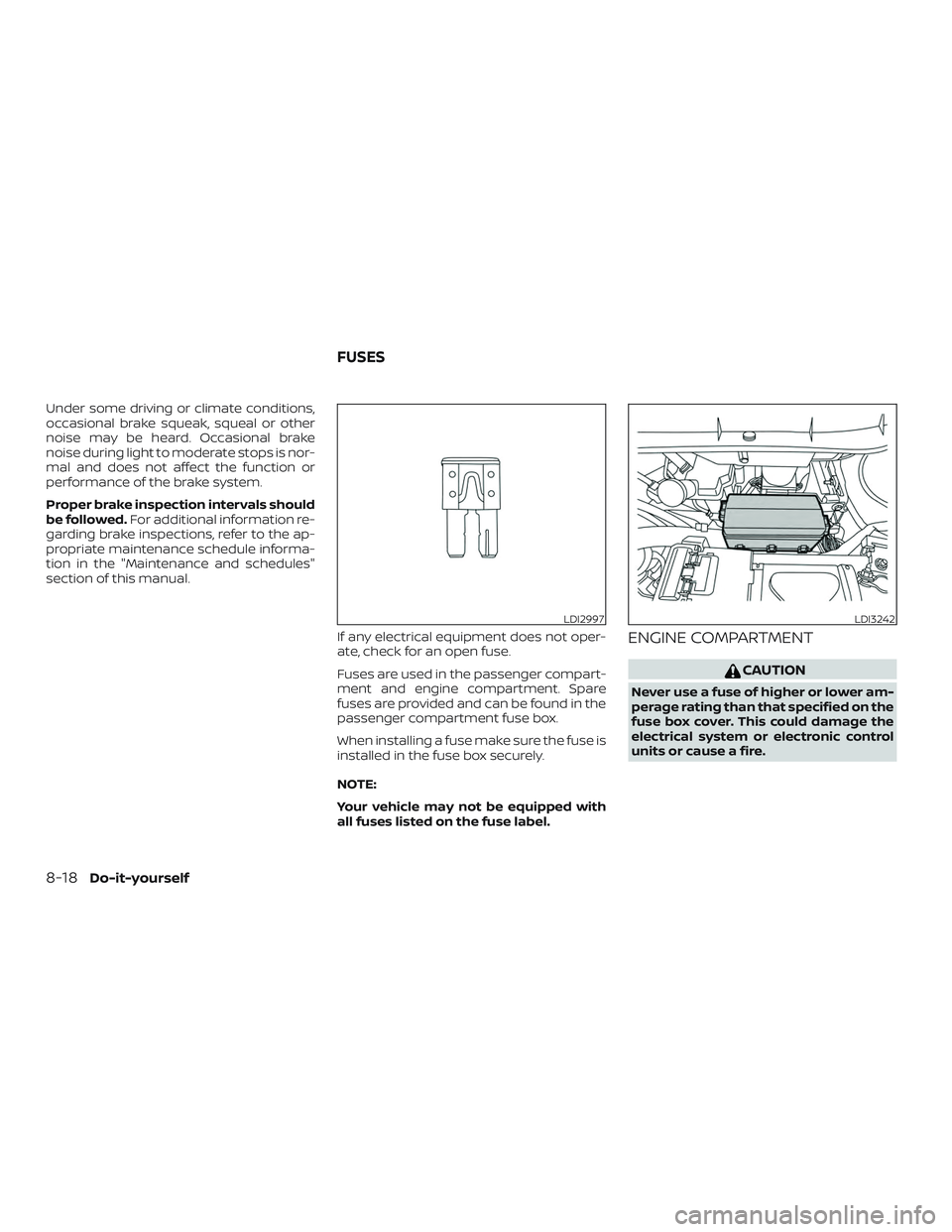
If any electrical equipment does not oper-
ate, check for an open fuse.
Fuses are used in the passenger compart-
ment and engine compartment. Spare
fuses are provided and can be found in the
passenger compartment fuse box.
When installing a fuse make sure the fuse is
installed in the fuse box securely.
NOTE:
Your vehicle may not be equipped with
all fuses listed on the fuse label.
ENGINE COMPARTMENT
CAUTION
Never use a fuse of higher or lower am-
perage rating than that specified on the
fuse box cover. This could damage the
electrical system or electronic control
units or cause a fire.
LDI2997LDI3242
FUSES
8-18Do-it-yourself
Page 371 of 444
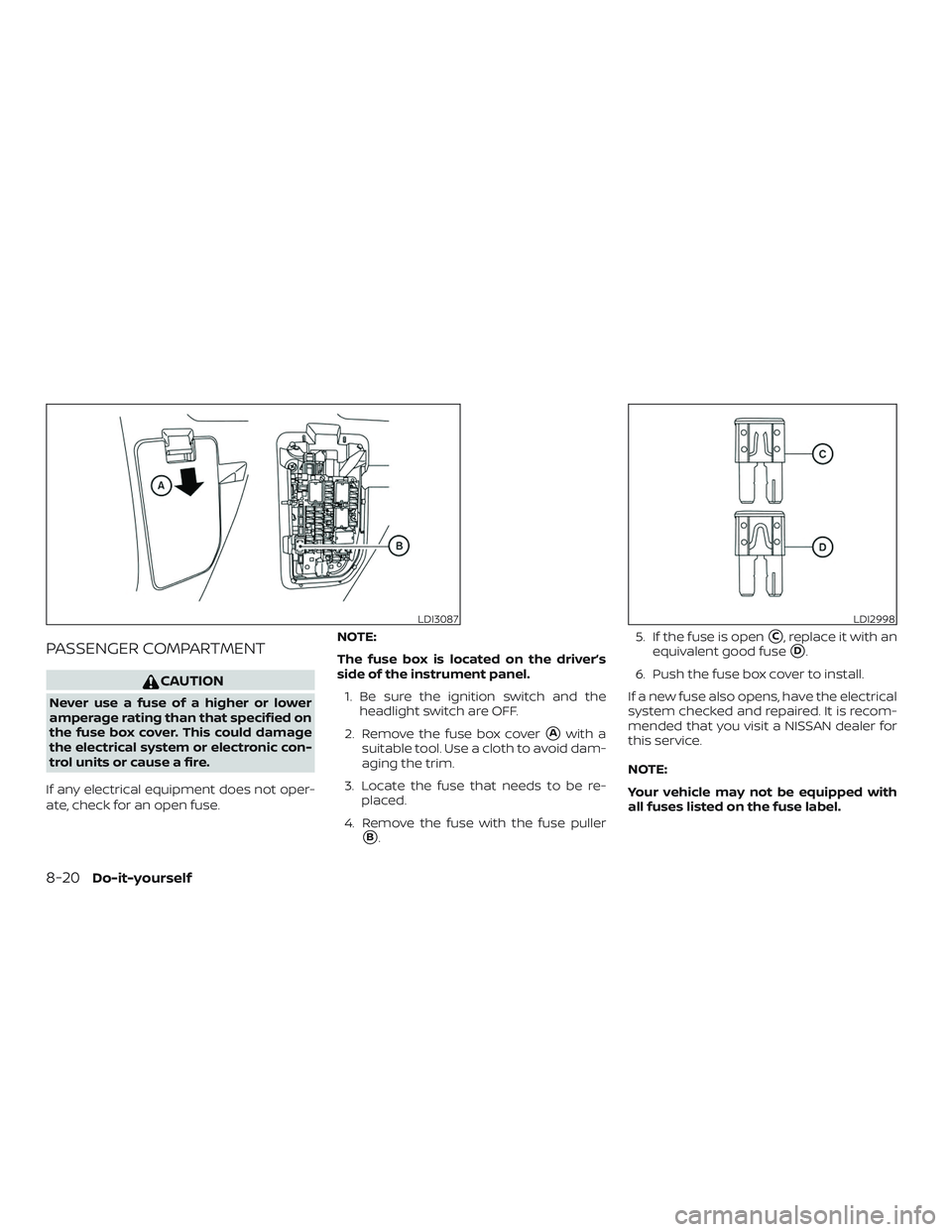
If any electrical equipment does not come
on, check for an open fuse.1. Be sure the ignition switch and the headlight switch are OFF.
2. Open the engine hood.
3. Remove the fuse box cover by pushing the tab and lif ting the cover up.
4. Remove the fuse with the fuse puller. The fuse puller is located in the center
of the fuse block in the passenger
compartment.
5. If the fuse is open
�A, replace it with a
new fuse
�B.
6. If a new fuse also opens, have the elec- trical system checked and repaired. It is
recommended that you visit a NISSAN
dealer for this service.
Fusible links
If any electrical equipment does not oper-
ate and the fuses are in good condition,
check the fusible links in the holder. If any of
the fusible links are melted, replace only
with Genuine NISSAN parts.
For checking and replacing the fusible links,
it is recommended that you visit a NISSAN
dealer for this service.
LDI3232
Do-it-yourself8-19
Page 372 of 444
PASSENGER COMPARTMENT
CAUTION
Never use a fuse of a higher or lower
amperage rating than that specified on
the fuse box cover. This could damage
the electrical system or electronic con-
trol units or cause a fire.
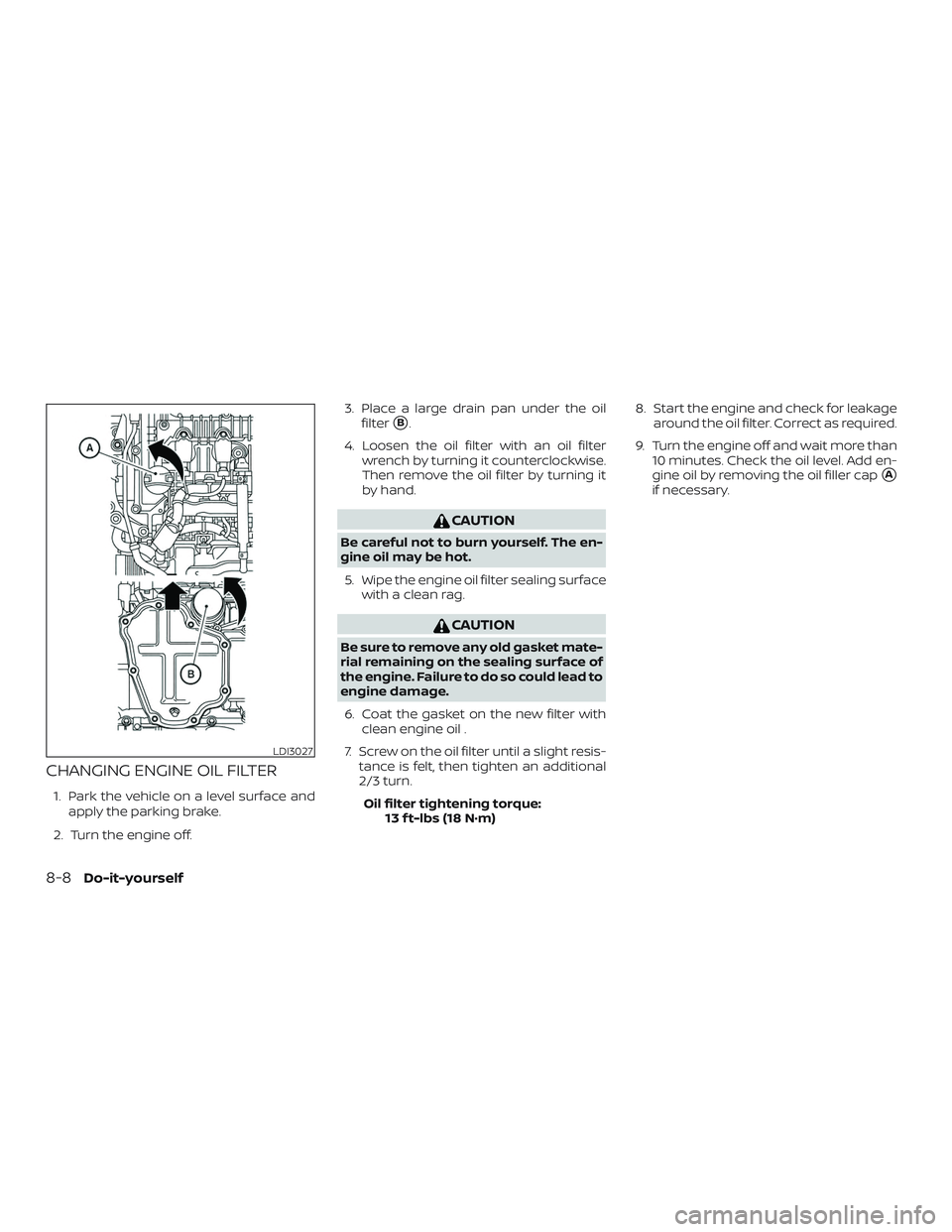
If any electrical equipment does not oper-
ate, check for an open fuse. NOTE:
The fuse box is located on the driver’s
side of the instrument panel.
1. Be sure the ignition switch and the headlight switch are OFF.
2. Remove the fuse box cover
�Awith a
suitable tool. Use a cloth to avoid dam-
aging the trim.
3. Locate the fuse that needs to be re- placed.
4. Remove the fuse with the fuse puller
�B. 5. If the fuse is open
�C, replace it with an
equivalent good fuse
�D.
6. Push the fuse box cover to install.
If a new fuse also opens, have the electrical
system checked and repaired. It is recom-
mended that you visit a NISSAN dealer for
this service.
NOTE:
Your vehicle may not be equipped with
all fuses listed on the fuse label.
LDI3087LDI2998
8-20Do-it-yourself
Page 375 of 444
HEADLIGHTS
For additional information on headlight
bulb replacement, refer to the instructions
outlined in this section.
Replacing the halogen headlight
bulb (if so equipped)
The headlight is a semi-sealed beam type
which uses a replaceable headlight (halo-
gen) bulb. They can be replaced from inside
the engine compartment without remov-
ing the headlight assembly.
If headlight bulb replacement is required, It
is recommended that you visit a NISSAN
dealer for this service.
CAUTION
∙ Aiming is not necessary af ter replac-ing the bulb. When aiming adjustment
is necessary, it is recommended that
you visit a NISSAN dealer for this
service. ∙ Do not leave the headlight assembly
open without a bulb installed for a
long period of time. Dust, moisture,
smoke, etc. entering the headlight
body may affect bulb performance.
Remove the bulb from the headlight
assembly just before a replacement
bulb is installed.
∙ Only touch the base when handling the bulb. Never touch the glass enve-
lope. Touching the glass could signifi-
cantly affect bulb life and/or head-
light performance.
∙ High pressure halogen gas is sealed inside the halogen bulb. The bulb may
break if the glass envelope is
scratched or the bulb is dropped.
∙ Use the same number and wattage as shown in the chart.
Fog may temporarily form inside the lens
of the exterior lights in the rain or in a car
wash. A temperature difference between
the inside and the outside of the lens
causes the fog. This is not a malfunction. If
large drops of water collect inside the lens,
it is recommended that you visit a NISSAN
dealer for this service.
Replacing the LED headlight bulb
(if so equipped)
If LED headlight bulb replacement is re-
quired, it is recommended that you visit a
NISSAN dealer for this service.
FOG LIGHTS (if so equipped)
For additional information on fog light bulb
replacement, refer to the instructions out-
lined in this section.
LIGHTS
Do-it-yourself8-23
Page 376 of 444
Replacing the fog light bulb (if so
equipped)
CAUTION
∙ High pressure halogen gas is sealedinside the halogen bulb. The bulb may
break if the glass envelope is
scratched or the bulb is dropped.
∙ When handling the bulb, do not touch the glass envelope.
∙ Use the same number and wattage as originally installed as shown in the
chart.
∙ Do not leave the bulb out of the fog light for a long period of time as dust,
moisture and smoke may enter the
fog light body and affect the perfor-
mance of the fog light.
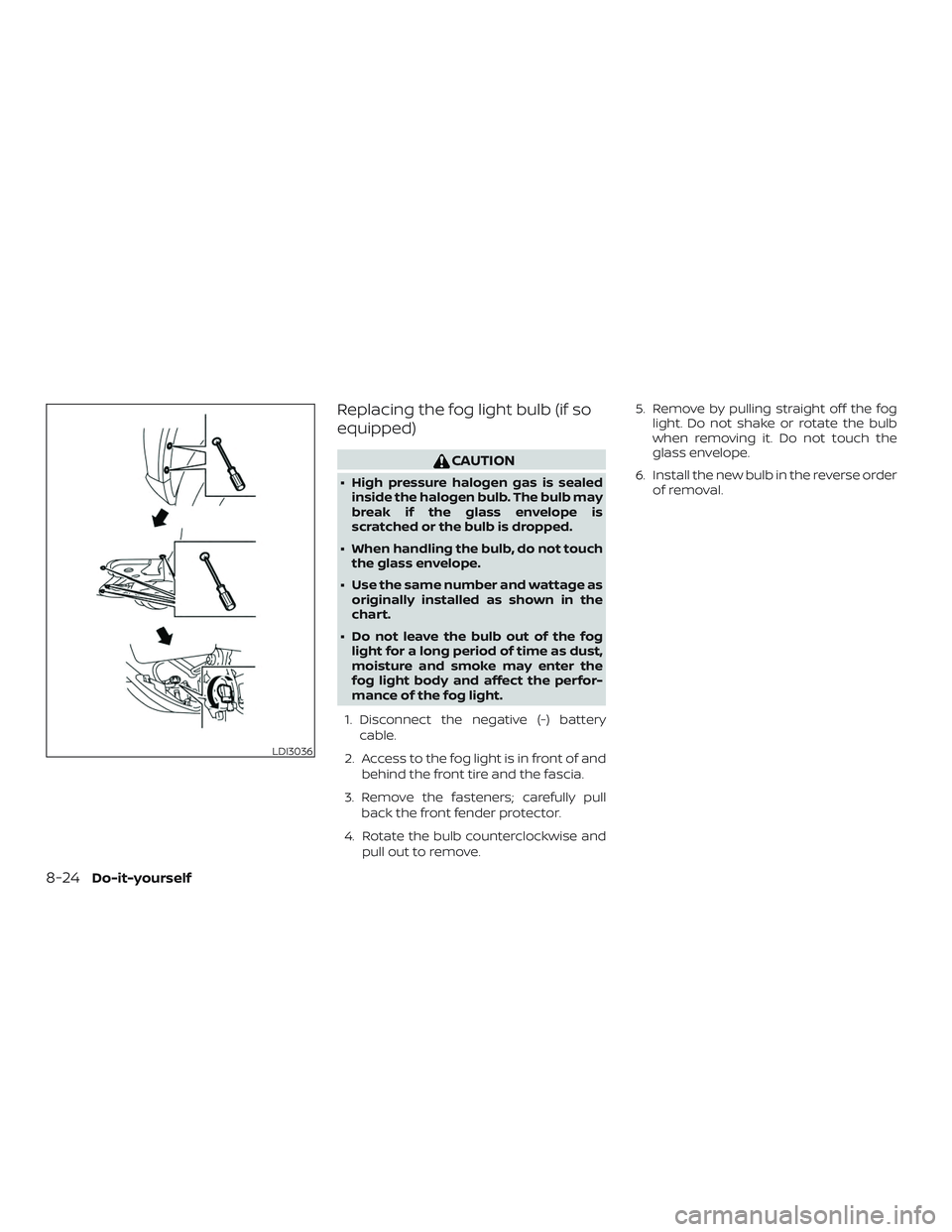
1. Disconnect the negative (-) battery cable.
2. Access to the fog light is in front of and behind the front tire and the fascia.
3. Remove the fasteners; carefully pull back the front fender protector.
4. Rotate the bulb counterclockwise and pull out to remove. 5. Remove by pulling straight off the fog
light. Do not shake or rotate the bulb
when removing it. Do not touch the
glass envelope.
6. Install the new bulb in the reverse order of removal.
LDI3036
8-24Do-it-yourself