Page 366 of 516

∙ If the low tire pressure warning lightilluminates while driving, avoid sud-
den steering maneuvers or abrupt
braking, reduce vehicle speed, pull off
the road to a safe location and stop
the vehicle as soon as possible. Driv-
ing with under-inflated tires may per-
manently damage the tires and in-
crease the likelihood of tire failure.
Serious vehicle damage could occur
and may lead to an accident and could
result in serious personal injury.
Check the tire pressure for all four
tires. Adjust the tire pressure to the
recommended COLD tire pressure
shown on the Tire and Loading Infor-
mation label to turn the low tire pres-
sure warning light OFF. If the light still
illuminates while driving af ter adjust-
ing the tire pressure, a tire may be flat
or the TPMS may be malfunctioning. If
you have a flat tire, replace it with a
spare tire as soon as possible. If no tire
is flat and all tires are properly in-
flated, have the vehicle checked. It is
recommended that you visit a NISSAN
dealer for this service. ∙ When replacing a wheel without the
TPMS such as the spare tire, the TPMS
will not function and the low tire pres-
sure warning light will flash for ap-
proximately 1 minute. The light will re-
main on af ter 1 minute. Have your
tires replaced and/or TPMS system
reset as soon as possible. It is recom-
mended that you visit a NISSAN dealer
for these services.
∙ Replacing tires with those not origi- nally specified by NISSAN could affect
the proper operation of the TPMS.
∙ Do not inject any tire liquid or aerosol tire sealant into the tires, as this may
cause a malfunction of the tire pres-
sure sensors.
CHANGING A FLAT TIRE
If you have a flat tire, follow the instructions
below:
Stopping the vehicle
1. Safely move the vehicle off the road and away from traffic.
2. Turn on the hazard warning flashers. 3. Park on a level surface and apply the
parking brake. Shif t the manual trans-
mission into R (Reverse), or the auto-
matic transmission into P (Park).
4. Turn off the engine.
5. Raise the hood to warn other traffic and to signal professional road assis-
tance personnel that you need assis-
tance.
6. Have all passengers get out of the ve- hicle and stand in a safe place, away
from traffic and clear of the vehicle.
Page 375 of 516
WARNING
Always follow the instructions below.
Failure to do so could result in damage
to the charging system and cause per-
sonal injury.1. If the booster battery is in another ve- hicle, position the 2 vehicles to bring
their batteries near each other.
Do not allow the two vehicles to
touch.
2. Apply the parking brake. Move the shif t lever to P (Park). Switch off all unneces- sary electrical systems (lights, heater,
air conditioner, etc.).
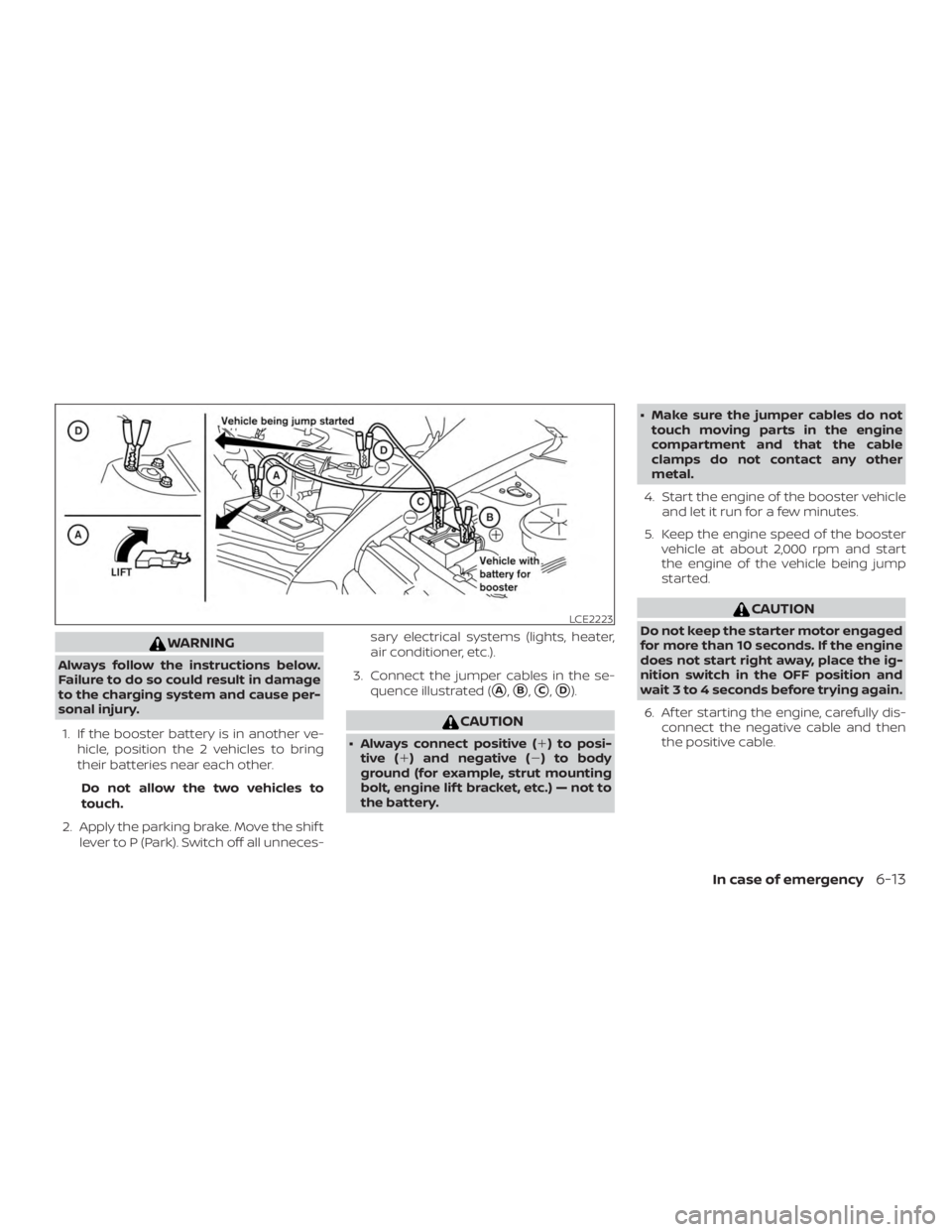
3. Connect the jumper cables in the se- quence illustrated (
�A,�B,�C,�D).
Page 377 of 516
WARNING
Be careful not to allow your hands, hair,
jewelry or clothing to come into contact
with, or get caught in, engine belts or
the engine cooling fan. The engine cool-
ing fan can start at any time.6. Af ter the engine cools down, check the coolant level in the engine coolant res-
ervoir tank with the engine running.
Add coolant to the engine coolant res-
ervoir tank if necessary. Have your ve-
hicle repaired. It is recommended that
you visit a NISSAN dealer for this ser-
vice. When towing your vehicle, all jurisdictional
and local regulations for towing must be
followed. Incorrect towing equipment
could damage your vehicle. Towing in-
structions are available from a NISSAN
dealer. Local service operators are gener-
ally familiar with the applicable laws and
procedures for towing. To assure proper
towing and to prevent accidental damage
to your vehicle, NISSAN recommends hav-
ing a service operator tow your vehicle. It is
advisable to have the service operator
carefully read the following precautions:
Page 404 of 516
CLUTCH (if so equipped) FLUID
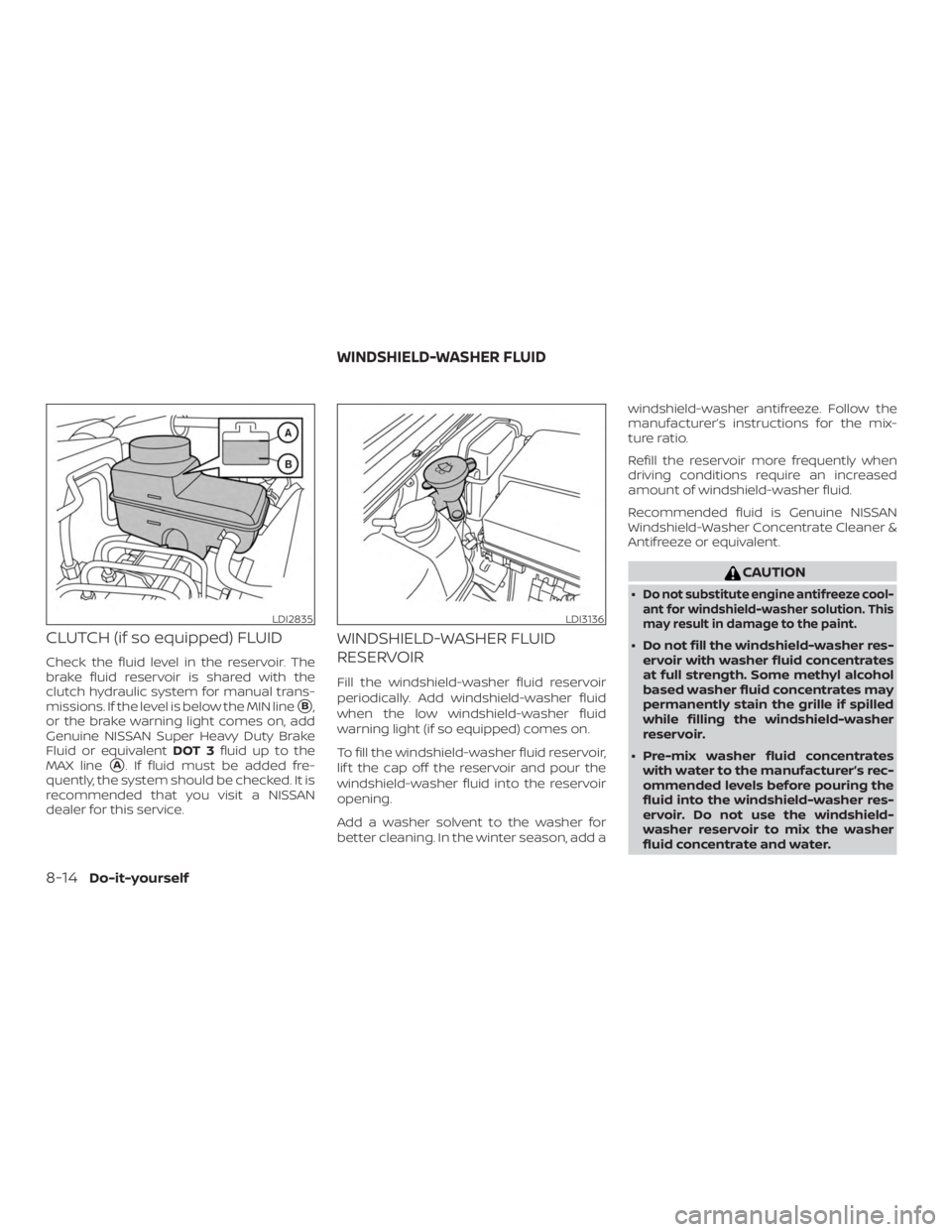
Check the fluid level in the reservoir. The
brake fluid reservoir is shared with the
clutch hydraulic system for manual trans-
missions. If the level is below the MIN line
�B,
or the brake warning light comes on, add
Genuine NISSAN Super Heavy Duty Brake
Fluid or equivalent DOT 3fluid up to the
MAX line
�A. If fluid must be added fre-
quently, the system should be checked. It is
recommended that you visit a NISSAN
dealer for this service.
WINDSHIELD-WASHER FLUID
RESERVOIR
Fill the windshield-washer fluid reservoir
periodically. Add windshield-washer fluid
when the low windshield-washer fluid
warning light (if so equipped) comes on.
To fill the windshield-washer fluid reservoir,
lif t the cap off the reservoir and pour the
windshield-washer fluid into the reservoir
opening.
Add a washer solvent to the washer for
better cleaning. In the winter season, add a windshield-washer antifreeze. Follow the
manufacturer’s instructions for the mix-
ture ratio.
Refill the reservoir more frequently when
driving conditions require an increased
amount of windshield-washer fluid.
Recommended fluid is Genuine NISSAN
Windshield-Washer Concentrate Cleaner &
Antifreeze or equivalent.
Page 410 of 516
WARNING
∙ Operating the engine with the aircleaner removed can cause you or
others to be burned. The air cleaner
not only cleans the air, it stops the
flame if the engine backfires. If it isn’t
there, and the engine backfires, you
could be burned. Do not drive with the
air cleaner removed, and be careful
when working on the engine with the
air cleaner removed.
∙ Never pour fuel into the throttle body or attempt to start the engine with
the air cleaner removed. Doing so
could result in serious injury.
IN-CABIN MICROFILTER
The in-cabin microfilter restricts the entry
of airborne dust and pollen particles and
reduces some objectionable outside
odors. The filter is located behind the glove
box. For additional information on change
intervals, refer to the "Maintenance and
schedules" section of this manual.
To replace the filter, perform the following
procedure:
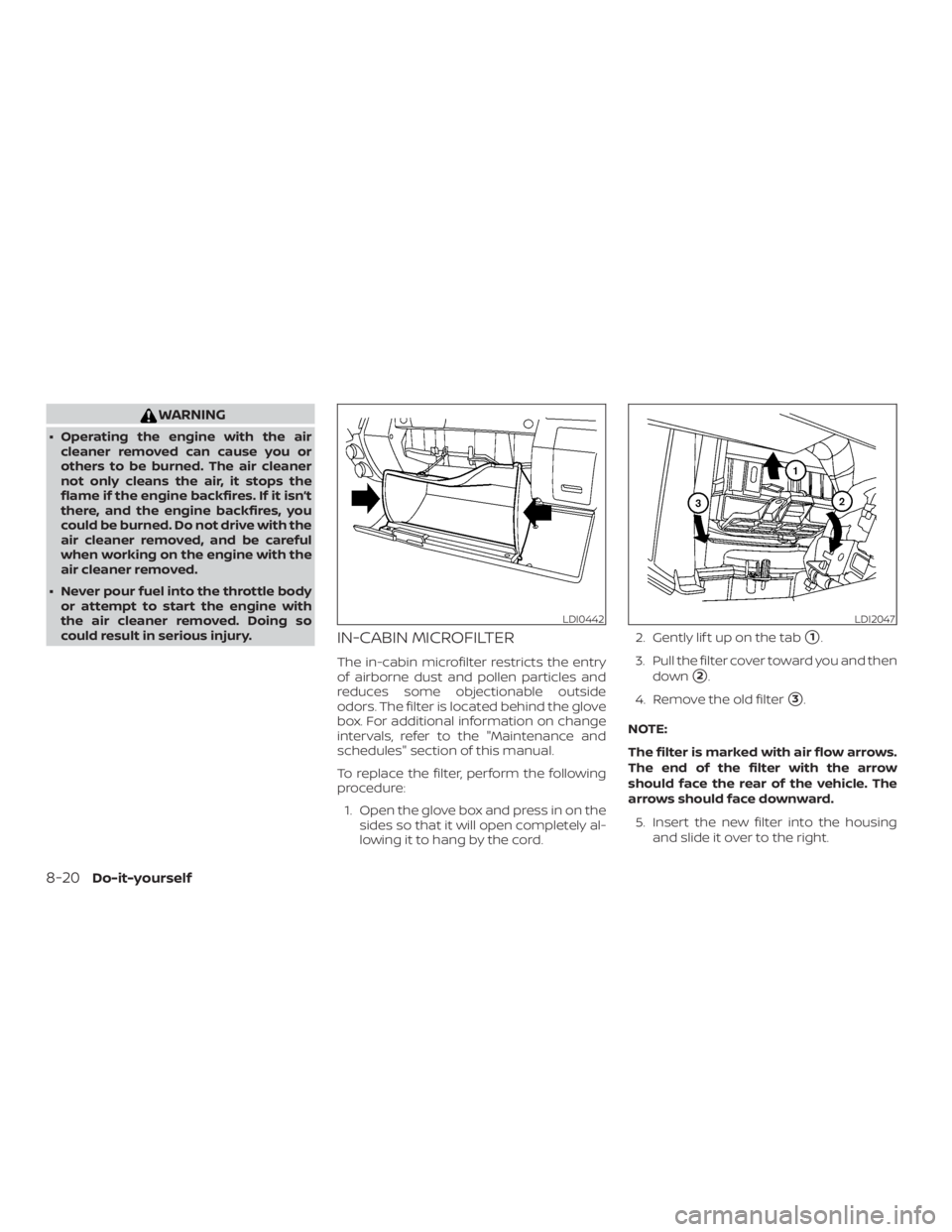
1. Open the glove box and press in on the sides so that it will open completely al-
lowing it to hang by the cord. 2. Gently lif t up on the tab
�1.
3. Pull the filter cover toward you and then down
�2.
4. Remove the old filter
�3.
NOTE:
The filter is marked with air flow arrows.
The end of the filter with the arrow
should face the rear of the vehicle. The
arrows should face downward. 5. Insert the new filter into the housing and slide it over to the right.
Page 423 of 516
If you have a flat tire, refer to “Flat tire” in
the “In case of emergency ” section of
this manual.
TIRE PRESSURE
Tire Pressure Monitoring System
(TPMS)
This vehicle is equipped with TPMS. It
monitors tire pressure of all tires ex-
cept the spare. When the low tire
pressure warning light is lit and the
CHECK TIRE PRES (pressure) warning
message is displayed in the odom-
eter, one or more of your tires is sig-
nificantly under-inflated.
TPMS will activate only when the ve-
hicle is driven at speeds above
16 mph (25 km/h). Also, this system
may not detect a sudden drop in tire
pressure (for example, a flat tire while
driving).
For additional information, refer to
“Low tire pressure warning light” in
the “Instruments and controls” sec-
tion, “Tire Pressure Monitoring Sys-
tem (TPMS)” in the “Starting and driv-ing” section, and “Flat tire” in the “In
case of emergency” section of this
manual.
Tire inflation pressure
Check the tire pressures (including
the spare) of ten and always prior to
long distance trips. The recom-
mended tire pressure specifications
are shown on the F.M.V.S.S./C.M.V.S.S.
certification label or the Tire and
Loading Information label under the
“Cold Tire Pressure” heading. The Tire
and Loading Information label is af-
fixed to the driver side center pillar.
Tire pressures should be checked
regularly because:
∙ Most tires naturally lose air over time.
∙ Tires can lose air suddenly when driven over potholes or other ob-
jects or if the vehicle strikes a
curb while parking. The tire pressures should be
checked when the tires are cold. The
tires are considered COLD af ter the
vehicle has been parked for 3 or
more hours, or driven less than 1 mile
(1.6 km) at moderate speeds.
Incorrect tire pressure, including
under inflation, may adversely af-
fect tire life and vehicle handling.
Page 433 of 516
∙ The TPMS sensor may be damaged ifit is not handled correctly. Be careful
when handling the TPMS sensor.
∙ When replacing the TPMS sensor, the ID registration may be required. It is
recommended that you visit a NISSAN
dealer for ID registration.
∙ Do not use a valve stem cap that is not specified by NISSAN. The valve stem
cap may become stuck.
∙ Be sure that the valve stem caps are correctly fitted. Otherwise the valve
may be clogged up with dirt and
cause a malfunction or loss of
pressure.
∙ Do not install a damaged or deformed wheel or tire even if it has been re-
paired. Such wheels or tires could
have structural damage and could fail
without warning.
∙ The use of retread tires is not recommended.
∙ For additional information regarding tires, refer to “Important Tire Safety
Information” (US) or “Tire Safety Infor-
mation” (Canada) in the Warranty In-
formation Booklet.
Page 462 of 516
WARNING
∙ Ethanol vapors are extremely flam-mable and could cause serious per-
sonal injury.
∙ Never have any smoking materials lit in or near the vehicle when removing
the fuel filler cap or filling the tank.
∙ Do not use E-85 as a cleaning agent and never use it near an open flame.
Fuel requirements
Your vehicle will operate on both unleaded
regular gasoline with an octane rating of at
least 87 AKI (Anti-Knock Index) number (Re-
search octane number 91), or E-85 fuel, or
any mixture of these two.
For the best starting and vehicle driveabil-
ity results, do not continually switch be-
tween E-85 and unleaded regular gasoline.
If you must switch fuels, NISSAN recom-
mends the following: ∙ do not switch when the fuel gauge indi- cates less than 1/4 full
∙ add more than 5 gallons of fuel
∙ operate the vehicle immediately af ter refueling for a period of at least 5 min-
utes NOTE:
When the ambient temperature is above
90°F (32°C), you may experience hard
starting and rough idle following start
up even if the above recommendations
are followed.
Starting
The characteristics of E-85 fuel make it un-
suitable for use when ambient tempera-
tures fall below 0°F (-18°C). In the range of
0°F (-18°C) to 32°F (0°C), you may experience
an increase in the time it takes for you en-
gine to start, and a deterioration in drivabil-
ity (sags and/or hesitations) until the en-
gine is fully warmed up.
Fuel consumption
Because E-85 fuel contains less energy per
gallon than gasoline, you will experience an
increase in fuel consumption. You can ex-
pect your fuel mileage to decrease by
about 30% compared to gasoline opera-
tion.
Replacement parts
Many components in your Flexible Fuel Ve-
hicle (FFV) are designed to be compatible
with ethanol. Always be sure that your ve-
hicle is serviced with correct ethanol com-
patible parts.