2019 NISSAN ALTIMA rab
[x] Cancel search: rabPage 385 of 592
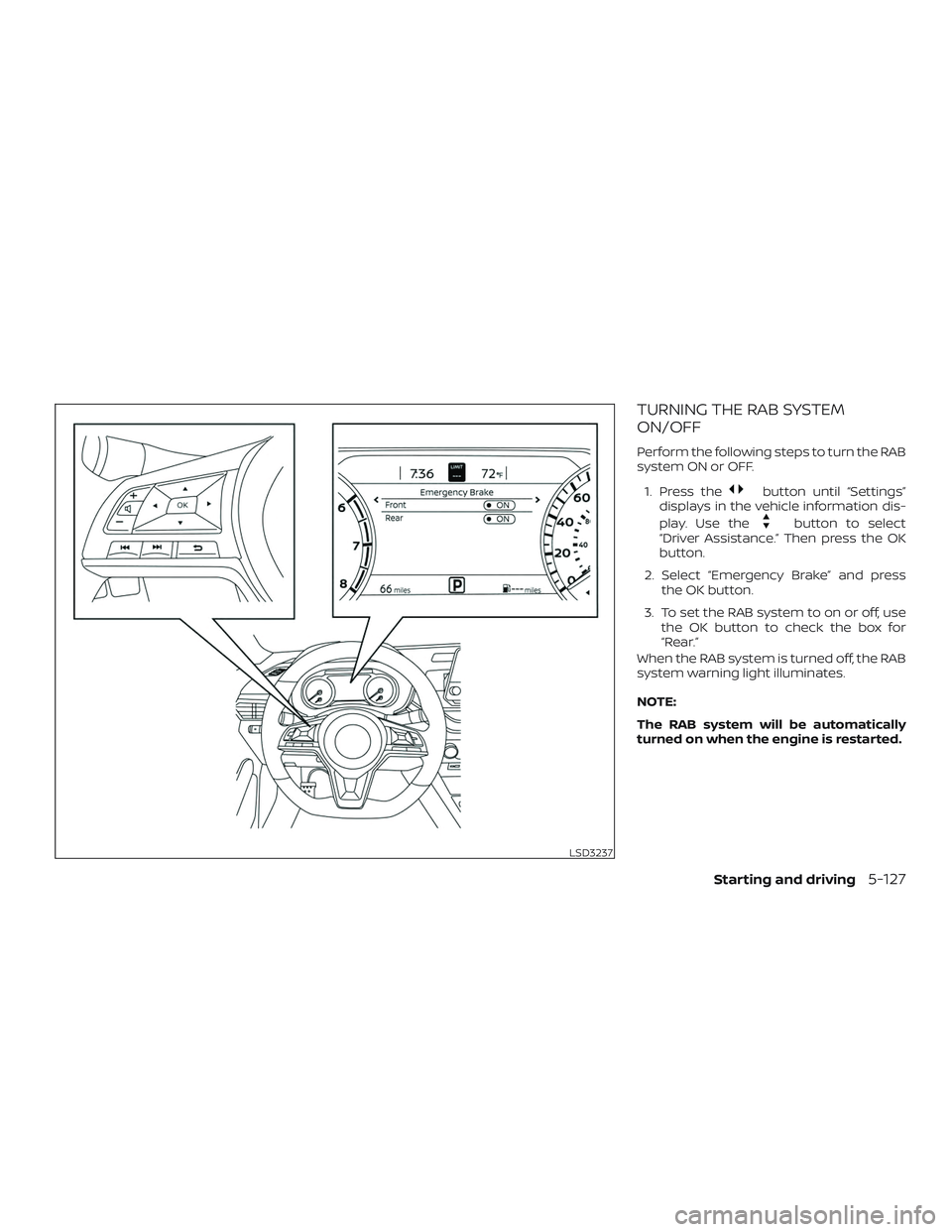
TURNING THE RAB SYSTEM
ON/OFF
Perform the following steps to turn the RAB
system ON or OFF.1. Press the
button until “Settings”
displays in the vehicle information dis-
play. Use the
button to select
“Driver Assistance.” Then press the OK
button.
2. Select “Emergency Brake” and press the OK button.
3. To set the RAB system to on or off, use the OK button to check the box for
“Rear.”
When the RAB system is turned off, the RAB
system warning light illuminates.
NOTE:
The RAB system will be automatically
turned on when the engine is restarted.
LSD3237
Starting and driving5-127
Page 386 of 592

RAB SYSTEM LIMITATIONS
WARNING
Listed below are the system limitations
for the RAB system. Failure to follow the
warnings and instructions for proper
use of the RAB system could result in
serious injury or death.
∙ When the vehicle approaches an ob-stacle while the accelerator or brake
pedal is depressed, the function may
not operate or the start of operation
may be delayed. The RAB system may
not operate or may not perform suffi-
ciently due to vehicle conditions, driv-
ing conditions, the traffic environ-
ment, the weather, road surface
conditions, etc. Do not wait for the
system to operate. Operate the brake
pedal by yourself as soon as
necessary.
∙ If it is necessary to override RAB op- eration, strongly press the accelerator
pedal. ∙ Always check your surroundings and
turn to check what is behind you be-
fore and while backing up. The RAB
system detects stationary objects be-
hind the vehicle. The RAB system does
not detect the following objects:
– Moving objects
– Low objects
– Narrow objects
– Wedge-shaped objects
– Objects close to the bumper (less than approximately 1 f t [30 cm])
– Objects that suddenly appear
– Thin objects such as rope, wire, chain, etc.
∙ The RAB system may not operate for the following obstacles:
– Obstacles located high off the ground
– Obstacles in a position offset from your vehicle
– Obstacles, such as spongy materi- als or snow, that have sof t outer
surfaces and can easily absorb a
sound wave ∙ The RAB system may not operate in
the following conditions:
– There is rain, snow, ice, dirt, etc., at- tached to the sonar sensors.
– A loud sound is heard in the area around the vehicle.
– The surface of the obstacle is di- agonal to the rear of the vehicle.
∙ The RAB system may unintentionally operate in the following conditions:
– There is overgrown grass in the area around the vehicle.
– There is a structure (e.g., a wall, toll gate equipment, a narrow tunnel, a
parking lot gate) near the side of
the vehicle.
– There are bumps, protrusions, or manhole covers on the road
surface.
– The vehicle drives through a draped flag or a curtain.
– There is an accumulation of snow or ice behind the vehicle.
– An ultrasonic wave source, such as another vehicle’s sonar, is near the
vehicle.
5-128Starting and driving
Page 387 of 592

∙ Once the automatic brake controloperates, it does not operate again if
the vehicle approaches the same
obstacle.
∙ The automatic brake control can only operate for a short period of time.
Therefore, the driver must depress
the brake pedal.
∙ In the following situations, the RAB system may not operate properly or
may not function sufficiently:
– The vehicle is driven in bad weather (rain, fog, snow, etc.).
– The vehicle is driven on a steep hill.
– The vehicle’s posture is changed (e.g., when driving over a bump).
– The vehicle is driven on a slippery road.
– The vehicle is turned sharply by turning the steering wheel fully.
– Snow chains are used.
– Wheels or tires other than NISSAN recommended are used. – The brakes are cold at low ambient
temperatures or immediately af ter
driving has started.
– The braking force becomes poor due to wet brakes af ter driving
through a puddle or washing the
vehicle.
∙ Turn the RAB system off in the follow- ing conditions to prevent the occur-
rence of an unexpected accident
resulting from sudden system
operation:
– The vehicle is towed.
– The vehicle is carried on a flatbed truck.
– The vehicle is on the chassis dynamometer.
– The vehicle drives on an uneven road surface.
– Suspension parts other than those designated as Genuine NISSAN
parts are used. (If the vehicle
height or the vehicle body inclina-
tion is changed, the system may
not detect an obstacle correctly.) ∙ Excessive noise (e.g., audio system
volume, an open vehicle window) will
interfere with the chime sound, and it
may not be heard.
SYSTEM MALFUNCTION
If the RAB system malfunctions, it will be
turned off automatically, the RAB system
warning light will illuminate, and the “Sys-
tem fault” warning message will appear in
the vehicle information display.
Action to take
If the warning light illuminates, park the ve-
hicle in a safe location, turn the engine off,
and restart the engine. If the warning light
continues to illuminate, have the RAB sys-
tem checked. It is recommended that you
visit a NISSAN dealer for this service.
NOTE:
If the RAB system cannot be operated
temporarily, the RAB system warning
light blinks.
Starting and driving5-129
Page 460 of 592
In order to maintain the appearance of
your vehicle, it is important to take proper
care of it.
To protect the paint surfaces, wash your
vehicle as soon as you can:∙ Af ter a rainfall to prevent possible dam- age from acid rain.
∙ Af ter driving on coastal roads.
∙ When contaminants such as soot, bird droppings, tree sap, metal particles or
bugs get on the paint surface.
∙ When dust or mud builds up on the sur- face.
Whenever possible, store or park your ve-
hicle inside a garage or in a covered area.
When it is necessary to park outside, park in
a shady area or protect the vehicle with a
body cover.
Be careful not to scratch the paint sur-
face when putting on or removing the
body cover.WASHING
Wash dirt off with a wet sponge and plenty
of water. Clean the vehicle thoroughly us-
ing a mild soap, a special vehicle soap or
general purpose dishwashing liquid mixed
with clean, lukewarm (never hot) water.
CAUTION
∙ Do not use car washes that use acid in the detergent. Some car washes, es-
pecially brushless ones, use some
acid for cleaning. The acid may react
with some plastic vehicle compo-
nents, causing them to crack. This
could affect their appearance, and
also could cause them not to function
properly. Always check with your car
wash to confirm that acid is not used.
∙ Do not wash the vehicle with strong household soap, strong chemical de-
tergents, gasoline or solvents.
∙ Do not wash the vehicle in direct sun- light or while the vehicle body is hot,
as the surface may become water-
spotted. ∙ Avoid using tight-napped or rough
cloths, such as washing mitts. Care
must be taken when removing
caked-on dirt or other foreign sub-
stances so the paint surface is not
scratched or damaged.
Rinse the vehicle thoroughly with plenty of
clean water.
Inside edges, seams and folds on the
doors, hatches and hood are particularly
vulnerable to the effects of road salt. There-
fore, these areas must be cleaned regularly.
Take care that the drain holes in the lower
edge of the door are open. Spray water
under the body and in the wheel wells to
loosen the dirt and wash away road salt.
A damp chamois can be used to dry the
vehicle to avoid water spots.
WAXING
Regular waxing protects the paint surface
and helps retain new vehicle appearance.
Polishing is recommended to remove
built-up wax residue and to avoid a weath-
ered appearance before re-applying wax.
It is recommended that you visit a NISSAN
dealer to assist you in choosing the proper
product.
CLEANING EXTERIOR
7-2Appearance and care
Page 497 of 592

If the tires are used at speeds above
100 mph (162 km/h) where it is legal
to do so (on a race track for ex-
ample), the cold tire inflation pres-
sure must be increased. For addi-
tional information, refer to “Checking
tire pressure” in this section.
Set the tire pressure to the normal
cold tire inflation pressure when the
vehicle speed or load is reduced.
Incorrect tire pressure, including
under inflation, may adversely af-
fect tire life and vehicle handling.WARNING
∙
Improperly inflated tires can fail
suddenly and cause an accident.
∙ The Gross Vehicle Weight Rat- ing (GVWR) is located on the
F.M.V.S.S./C.M.V.S.S. certifica-
tion label. The vehicle weight
capacity is indicated on the Tire
and Loading Information label.
Do not load your vehicle beyond
this capacity. Overloading your
vehicle may result in reduced
tire life, unsafe operating condi-
tions due to premature tire fail-
ure, or unfavorable handling
characteristics and could also
lead to a serious accident. Load-
ing beyond the specified capac-
ity may also result in failure of
other vehicle components.
∙
Before taking a long trip, or
whenever you heavily load your
vehicle, use a tire pressure gauge
to ensure that the tire pressures
are at the specified level.
∙ Increase the cold tire inflation pressure as indicated in "Check-
ing tire pressure" in this section
when using the tires specified
by NISSAN above 100 mph
(162 km/h) where it is legal to do
so (on a race track for example).
Failure to increase the cold tire
inflation pressure may result in
tire failure, loss of control and
possible injury. Af ter such use,
readjust tire pressure.
∙ For additional information re- garding tires, refer to “Impor-
tant Tire Safety Information”
(US) or “Tire Safety Information”
(Canada) in the Warranty Infor-
mation Booklet.
Do-it-yourself8-31
Page 561 of 592

O
Octane rating (See fuel octane rating) . .10-6
Odometer ....................2-5
Oil Capacities and recommended
fuel/lubricants...............10-2
Changing engine oil ............8-9
Changing engine oil filter .........8-9
Checking engine oil level .........8-8
Engine oil ...................8-8
Engine oil and oil filter
recommendation .............10-6
Engine oil viscosity .............10-7
Outsidemirrors................3-32
Overhead sunglasses holder ........2-58
Overheat Ifyourvehicleoverheats.........6-11
Owner's manual order form ........10-22
Owner's manual/service manual order
information..................10-22
P
Parking Parking brake operation .........5-25
Parking/parkingonhills.........5-169
Parkingbrake...........2-12,2-15,5-25
Personal lights .................2-65
Power Power door locks ..............3-6
Poweroutlet................2-54
Powerrearwindows ...........2-61
Power steering system .........5-169
Powerwindows..............2-60 Rearpowerwindows...........2-61
Poweroutlet..................2-54
Powersteering................5-169
Precautions Maintenance precautions .........8-2
Precautions on booster
seats............1-23, 1-31, 1-38, 1-43
Precautions on child
restraints .........1-23, 1-31, 1-38, 1-43
Precautions on seat belt usage .....1-12
Precautions on supplemental restraint
system ................... .1-46
Precautions when starting and
driving..................5-4,5-11
ProPILOT Assist .................5-91
Push starting ..................6-11
R
Radio Car phone or CB radio ..........4-42
Readiness for inspection maintenance
(I/M) test ....................10-20
Rear Automatic Braking (RAB) .......5-125
RearCrossTrafficAlert(RCTA) .......5-55
Rear Door Alert ..........2-36,2-37,2-53
Rearpowerwindows.............2-61
Rearseat.................... .1-5
Rear Sonar System (RSS) ..........5-176
Rearviewmirror ................3-31
RearViewMonitor................4-3
Rear window and outside mirror defroster
switch......................2-43
Recommended Fluids ............10-2 Recorders
EventData.............10-20,10-21
Refrigerant recommendation ........10-7
Registering a vehicle in another
country .....................10-10
Remote Engine Start ..........3-21,5-18
Reporting safety defects (US only) . . . .10-19
S
Safety Child safety rear door lock ........3-7
Childseatbelts......1-23, 1-31, 1-38, 1-43
Reporting safety defects (US only) . .10-19
Seat adjustment Front manual seat adjustment ......1-3
Front power seat adjustment ......1-4
Rear seat adjustment ...........1-5
Seatback pockets ...............
2-56
Seat belt Childsafety ................ .1-21
Infants and small children ........1-22
InjuredPerson............... .1-15
Largerchildren.............. .1-22
Precautionsonseatbeltusage.....1-12
Pregnant women ..............1-15
Seat belt extenders ............1-20
Seat belt maintenance ..........1-20
Seatbelts................1-12, 7-7
Shoulder belt height adjustment . . . .1-19
Three-pointtypewithretractor.....1-15
Seat belt extenders ..............1-20
Seatbeltwarninglight.........1-14, 2-14
Seats Adjustment ..................1-2
11-5