2019 MERCEDES-BENZ SL CLASS maintenance
[x] Cancel search: maintenancePage 276 of 330

a decorative film when the decorative film isremoved.
iHave work or repairs on decorative filmcarried out at a qualified specialist work-shop. Mercedes-Benz recommends that youuse an authorized Mercedes-Benz Center forthis purpose.
Cleaning the vehicle parts
Cleaning the wheels
GWARNING
The water jet from a circular jet nozzle (dirt
blasters) can cause invisible exterior dam-
age to the tires or chassis components.
Components damaged in this way may fail
unexpectedly. There is a risk of an accident.
Do not use power washers with circular jet
nozzles to clean the vehicle. Have damaged
tires or chassis components replaced imme-
diately.
!Do not use acidic wheel cleaning productsto remove brake dust. This could damagewheel bolts and brake components.
!Do not park your vehicle for a long periodof time directly after cleaning, particularlyafter cleaning the wheel rim with wheelcleaner. Wheel cleaner can lead to theincreased corrosion of the brake discs andpads. Therefore, drive for a few minutesafter cleaning. By heating up the brakes, thebrake discs and pads dry. The vehicle canthen be parked for a long period of time.
Cleaning the windows
GWARNING
You could become trapped by the wind-
shield wipers if they start moving while
cleaning the windshield or wiper blades.
There is a risk of injury.
Always switch off the windshield wipers and
the ignition before cleaning the windshield
or wiper blades.
!Only fold the windshield wipers away fromthe windshield when vertical. Otherwise, youwill damage the hood.
!Do not use dry cloths, abrasive products,solvents or cleaning agents containing sol-vents to clean the inside of the windows. Donot touch the insides of the windows withhard objects, e.g. an ice scraper or ring.There is otherwise a risk of damaging thewindows.
!Clean the water drainage channels of thewindshield and the rear window at regularintervals. Deposits such as leaves, petalsand pollen may under certain circumstancesprevent water from draining away. This canlead to corrosion damage and damage toelectronic components.
XClean the inside and outside of the windowswith a damp cloth and a cleaning productthat is recommended and approved byMercedes-Benz.
Cleaning wiper blades
GWARNING
If the windshield wipers are set in motion
while you are cleaning the windshield, you
can be trapped by the wiper arm. There is a
risk of injury.
Always switch off the windshield wipers and
the ignition before cleaning the windshield.
!Do not pull the wiper blade. Otherwise, thewiper blade could be damaged.
!Do not clean wiper blades too often anddo not rub them too hard. Otherwise, thegraphite coating could be damaged. Thiscould cause wiper noise.
!Hold the wiper arm securely when foldingback. The windshield could be damaged ifthe wiper arm smacks against it suddenly.
XFold the windshield wiper arms away fromthe windshield.
XCarefully clean the wiper blades with adamp cloth.
XFold the windshield wiper arms back againbefore switching on the ignition.
274Care
Maintenance and care
Page 277 of 330
Cleaning the exterior lighting
!Only use cleaning agents or cleaningcloths that are suitable for plastic lenses.Caustic, irritant or otherwise unsuitablecleaning agents or cleaning cloths couldscratch or damage the exterior lighting plas-tic lenses.
XClean the plastic lenses of the exterior lightswith a wet sponge and a mild cleaningagent, e.g. Mercedes-Benz car shampoo orcleaning cloths.
Cleaning the mirror turn signals
!Only use cleaning agents or cleaningcloths that are suitable for plastic lenses.Unsuitable cleaning agents or cleaningcloths could scratch or damage the plasticlenses of the mirror turn signals.
XClean the plastic lenses of the mirror turnsignals in the exterior mirror housing using awet sponge and mild cleaning agent, e.g.Mercedes-Benz car shampoo or with clean-ing cloths.
Cleaning the sensors
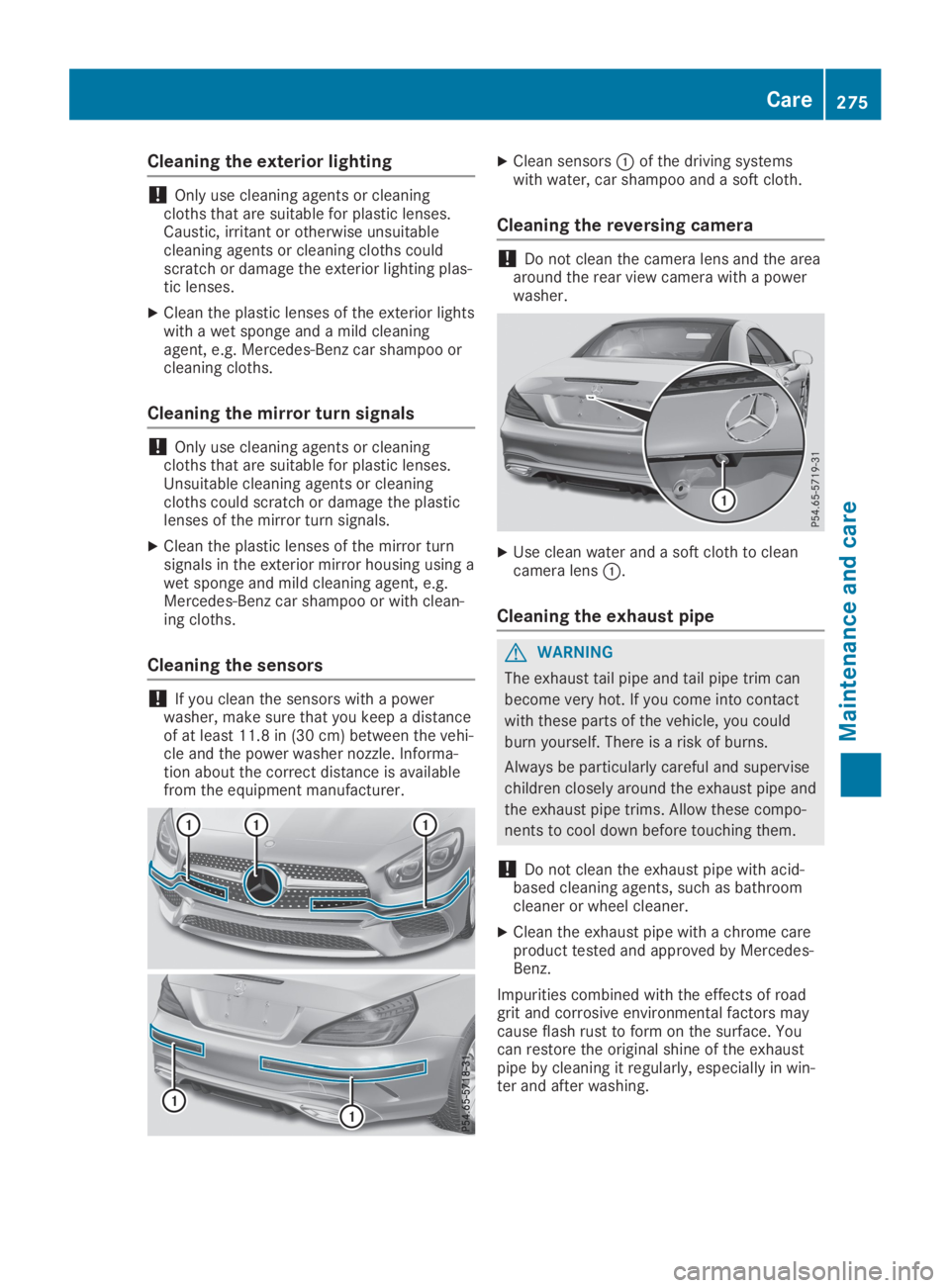
!If you clean the sensors with a powerwasher, make sure that you keep a distanceof at least 11.8 in(30 cm) between the vehi-cleand the power washer nozzle. Informa-tion about the correct distance is availablefrom the equipment manufacturer.
XClean sensorsCof the driving systemswith water, car shampoo and a soft cloth.
Cleaning the reversing camera
!Do not clean the camera lens and the areaaround the rear view camera with a powerwasher.
XUse clean water and a soft cloth to cleancamera lensC.
Cleaning the exhaust pipe
GWARNING
The exhaust tail pipe and tail pipe trim can
become very hot. If you come into contact
with these parts of the vehicle, you could
burn yourself. There is a risk of burns.
Always be particularly careful and supervise
children closely around the exhaust pipe and
the exhaust pipe trims. Allow these compo-
nents to cool down before touching them.
!Do not clean the exhaust pipe with acid-based cleaning agents, such as bathroomcleaner or wheel cleaner.
XClean the exhaust pipe with a chrome careproduct tested and approved by Mercedes-Benz.
Impurities combined with the effects of roadgrit and corrosive environmental factors maycause flash rust to form on the surface. Youcan restore the original shine of the exhaustpipe by cleaning it regularly, especially in win-ter and after washing.
Care275
Maintenance and care
Z
Page 286 of 330

!Have the battery regularly checked at aqualified specialist workshop.
Comply with the service intervals in theMaintenance Booklet, or contact a qualifiedspecialist workshop for more information.
!Always have work on batteries carried outat a qualified specialist workshop.
Should it, in exceptional circumstances, beabsolutely necessary to disconnect the 12-volt battery yourself, please observe the fol-lowing:
RSecure the vehicle to prevent it from roll-ing away.
RSwitch off the ignition.
RDisconnect the negative terminal first andthen the positive terminal.
After the work has been done, install thebattery and replace the cover of the positiveterminal clamp firmly.
Comply with safety precautions and take pro-tective measures when handling batteries.
Risk of explosion.
Fire, open flames and smoking areprohibited when handling the bat-tery. Avoid creating sparks.
Battery acid is caustic. Avoid con-tact with skin, eyes or clothing.
Wear suitable protective clothing,especially gloves, apron and face-guard.
Rinse any acid spills immediatelywith clear water. Contact a physi-cian if necessary.
Wear eye protection.
Keep children away.
Observe this Operator's Manual.
For safety reasons, Mercedes-Benz recom-mends that you only use batteries which have
been tested and approved for your vehicle byMercedes-Benz. These batteries provideincreased impact protection to prevent vehicleoccupants from suffering acid burns shouldthe battery be damaged in the event of anaccident.
In order for the battery to achieve the maxi-mum possible service life, it must always besufficiently charged.
Like other batteries, the vehicle battery maydischarge over time if you do not use the vehi-cle. In this case, have the battery disconnec-ted at a qualified specialist workshop. You canalso charge the battery with a charger recom-mended by Mercedes-Benz. Contact a quali-fied specialist workshop for further informa-tion.
Have the battery condition of charge checkedmore frequently if you use the vehicle mainlyfor short trips or if you leave it standing idlefor a lengthy period. Consult a qualified spe-cialist workshop if you wish to leave your vehi-cle parked for a long period of time.
Remove the SmartKey if you park the vehicleand do not require any electrical consumers.The vehicle will then use very little energy,thus conserving battery power.
After an interruption to the power supply, e.g.due to a discharged battery, you must resetthe clock (see the Digital Operator's Manual).
Charging the battery
GWARNING
During charging and jump-starting, explosive
gases can escape from the battery. There is
a risk of an explosion.
Particularly avoid fire, open flames, creating
sparks and smoking. Ensure there is suffi-
cient ventilation while charging and jump-
starting. Do not lean over a battery.
GWARNING
Battery acid is caustic. There is a risk of
injury.
Avoid contact with skin, eyes or clothing. Do
not inhale any battery gases. Do not lean
over the battery. Keep children away from
batteries. Wash away battery acid immedi-
284Battery (vehicle)
Breakdown assistance
Page 302 of 330

Important safety notes
GWARNING
Each tire, including the spare (if provided),
should be checked at least once a month
when cold and inflated to the pressure rec-
ommended by the vehicle manufacturer on
the Tire and Loading Information placard on
the driver's door B-pillar or the tire pressure
label on the inside of the fuel filler flap. If
your vehicle has tires of a different size than
the size indicated on the Tire and Loading
Information placard or the tire pressure
label, you should determine the proper tire
pressure for those tires.
As an added safety feature, your vehicle has
been equipped with a tire pressure monitor-
ing system (TPMS) that illuminates a low tire
pressure telltale when one or more of your
tires are significantly underinflated. Accord-
ingly, when the low tire pressure telltale illu-
minates, you should stop and check your
tires as soon as possible, and inflate them to
the proper pressure. Driving on a signifi-
cantly underinflated tire causes the tire to
overheat and can lead to tire failure. Under-
inflation also reduces fuel efficiency and tire
tread life, and may affect the vehicle's han-
dling and stopping ability.
Please note that the TPMS is not a substi-
tute for proper tire maintenance, and it is
the driver's responsibility to maintain cor-
rect tire pressure, even if underinflation has
not reached the level to trigger illumination
of the TPMS low tire pressure telltale.
USA only:
Your vehicle has also been equipped with a
TPMS malfunction indicator to indicate if the
system is not operating properly. The TPMS
malfunction indicator is combined with the
low tire pressure telltale. When the system
detects a malfunction, the warning lamp will
flash for approximately a minute and then
remain continuously illuminated. This
sequence will be repeated every time the
vehicle is started as long as the malfunction
exists.
When the malfunction indicator is illumina-
ted, the system may not be able to detect or
signal low tire pressure as intended. TPMS
malfunctions may occur for a variety of rea-
sons, including the mounting of incompati-
ble replacement or alternate tires or wheels
on the vehicle that prevent the TPMS from
functioning properly. Always check the
TPMS malfunction telltale after replacing
one or more tires or wheels on your vehicle
to ensure that the replacement or alternate
tires and wheels allow the TPMS to continue
to function properly.
It is the driver's responsibility to set the tirepressure to that recommended for cold tireswhich is suitable for the operating situation(Ypage 296). Note that the correct tire pres-sure for the current operating situation mustfirst be taught-in to the tire pressure monitor.If a substantial loss of pressure occurs, thewarning threshold for the warning message isaligned to the taught-in reference values.Restart the tire pressure monitor after adjust-ing the pressure of the cold tires(Ypage 301). The current pressures aresaved as new reference values. As a result, awarning message will appear if the tire pres-sure drops significantly.
The tire pressure monitor does not warn you ofan incorrectly set tire pressure. Observe thenotes on the recommended tire pressure(Ypage 296).
The tire pressure monitor is not able to warnyou of a sudden loss of pressure, e.g. if thetire is penetrated by a foreign object. In theevent of a sudden loss of pressure, bring thevehicle to a halt by braking carefully. Avoidabrupt steering movements.
The tire pressure monitor has a yellow warninglamp in the instrument cluster for indicatingpressure loss or a malfunction. Whether thewarning lamp flashes or lights up indicateswhether a tire pressure is too low or the tirepressure monitor is malfunctioning:
Rif the warning lamp is lit continuously, thetire pressure on one or more tires is signifi-cantly too low. The tire pressure monitor isnot malfunctioning.
Rif the warning lamp flashes for approx-imately a minute and then remains lit con-
300Tire pressure
Wheels and ti res
Page 325 of 330

!To ensure the longevity and full perform-ance of the engine, only premium-gradeunleaded gasoline must be used.
If standard unleaded gasoline is unavailableand you have to refuel with unleaded gaso-line of a lower grade, observe the followingprecautions:
ROnly fill the fuel tank to half full with regu-lar unleaded gasoline and fill the rest withpremium-grade unleaded gasoline as soonas possible.
RDo not drive at the maximum speed.
RAvoid sudden acceleration and enginespeeds over 3,000 rpm.
You will usually find information about the fuelgrade on the fuel pump. If you cannot find thelabel on the fuel pump, ask the gas stationstaff.
iFor further information, consult a qualifiedspecialist workshop or visithttp://www.mbusa.com (USA only).
As a temporary measure, if the recommendedfuel is not available, you may also use regularunleaded gasoline with an octane rating of87 AKI/91 RON. This may reduce engine per-formance and increase fuel consumption.Avoid driving at full throttle and sudden accel-eration. Never refuel using gasoline with alower AKI.
iThe fuels you can use in your vehicle maydiffer from the information in the Operator'sManual depending on the country. The fuelsthat have been approved for your vehiclecan be found on the instruction label on theinside of the fuel filler flap.
Information on refueling (Ypage 145).
Additives in gasoline
!Operating the engine with fuel additivesadded later can lead to engine failure. Donot mix fuel additives with fuel. This doesnot include additives for the removal andprevention of residue buildup. gasoline mustonly be mixed with additives recommendedby Mercedes-Benz. Comply with the instruc-tions for use on the product label. Moreinformation about recommended additivescan be obtained from any authorizedMercedes-Benz Center.
Mercedes-Benz recommends that you usebranded fuels that have additives.
The fuel quality available in some countriesmay not be sufficient. Residue could build upin the fuel injection system as a result. In suchcases, and in consultation with an authorizedMercedes-Benz Center, the fuel may be mixedwith the cleaning additive recommended byMercedes-Benz. You must observe the notesand mixing ratios specified on the container.
Engine oil
General notes
!Do not use engine oil or an oil filter withspecifications deviating from thoseexpressly required for the prescribed serviceintervals. Do not change the engine oil or oilfilter in order to set replacement intervalslonger than those prescribed. This couldotherwise cause damage to the engine orexhaust gas aftertreatment.
Follow the instructions on the service inter-val display for changing the engine oil. Thiscould otherwise cause damage to theengine or exhaust gas aftertreatment.
When handling engine oil, observe the impor-tant safety notes on service products(Ypage 321).
The engine oils are matched to the perform-ance of Mercedes-Benz engines and serviceintervals. You should therefore only use engineoils and oil filters that are approved for vehi-cles with maintenance systems.
For a list of approved engine oils and oil filters,consult an authorized Mercedes-Benz Center.Or visit the websitehttp://bevo.mercedes-benz.com.
The table shows which engine oils have beenapproved for your vehicle.
Service products and filling capacities323
Technical data
Z
Page 326 of 330

ModelMB-Freigabe or MB-Approval
All models229.5
Mercedes‑AMG vehicles:use onlySAE 0W-40 or SAE 5W-40 engine oils.
iMB approval is indicated on the oil con-tainers.
Filling capacities
The following values refer to an oil changeincluding the oil filter.
Missing values were not available at time ofgoing to print.
ModelCapacity
SL 4506.9 US qt (6.5l)
SL 5508.5 US qt (8.0l)
Mercedes-AMGSL 638.9 US qt (8.5l)
Additives
!Do not use any additives in the engine oil.This could damage the engine.
Brake fluid
GWARNING
The brake fluid constantly absorbs moisture
from the air. This lowers the boiling point of
the brake fluid. If the boiling point of the
brake fluid is too low, vapor pockets may
form in the brake system when the brakes
are applied hard. This would impair braking
efficiency. There is a risk of an accident.
You should have the brake fluid renewed at
the specified intervals.
When handling brake fluid, observe the impor-tant safety notes on service products(Ypage 321).
The brake fluid change intervals can be foundin the Maintenance Booklet.
Only use brake fluid approved by Mercedes-Benz in accordance with MB-Freigabe or MB-Approval 331.0.
Information about approved brake fluid can beobtained at any qualified specialist workshopor on the Internet athttp://bevo.mercedes-benz.com.
iHave the brake fluid regularly replaced at aqualified specialist workshop and thereplacement confirmed in the MaintenanceBooklet.
Coolant
Important safety notes
GWARNING
If antifreeze comes into contact with hot
components in the engine compartment, it
may ignite. There is a risk of fire and injury.
Let the engine cool down before you add
antifreeze. Make sure that antifreeze is not
spilled next to the filler neck. Thoroughly
clean the antifreeze from components
before starting the engine.
!Only add coolant that has been premixedwith the desired antifreeze protection. Youcould otherwise damage the engine.
You can find additional notes on the coolantin the following places:
Rin the Mercedes-Benz Specifications forService Products, MB BeVo 310.1
-on the Internet athttp://bevo.mercedes-benz.com
-on the Mercedes-Benz BeVo app
Ra qualified specialized workshop
!Always use a suitable coolant mixture,even in countries where high temperaturesprevail.
Otherwise, the engine cooling system is notsufficiently protected from corrosion andoverheating.
iHave the coolant regularly replaced at aqualified specialist workshop and thereplacement confirmed in the MaintenanceBooklet.
Comply with the important safety notes forservice products when handling coolant(Ypage 321).
324Service products and filling capacities
Technical data