Page 397 of 518

th
ese are ins talled on theve hicle, but does not
include passengers or luggage.
Maximum tire load: the maximum tire load is
th e maximum permissible weight in kilog rams or
lbs for which a tire is appr oved.
Maximum permissible tire pressure: maxi‐
mum permissible tire pressure for one tire.
Maximum load on one tire: maximum load on
one tire. This is calculated bydividing the maxi‐
mum axle load of one axle bytwo.
PSI (pounds per square in ch):standard unit of
measurement for tire pressu re.
Aspect ratio: ratio between tire height and tire
width in pe rcent.
Ti re pressure: pressure inside the tire applying
an outward forc eto eve rysquare inch of the tire.
The tire pressure is specified in pounds per
square inch (psi), in kilopascals (kPa) or in bar.
The tire pressure should only be cor rected when
th e tires are cold.
Cold tire pressure: the tires are cold when the
ve hicle has been par kedfo r at least 3 hours without direct sunlight on
the tires or theve hicle
has been driven for less than 1 mile (1.6 km).
Ti re contact sur face: the part of the tire that
comes into con tact wi th thero ad.
Ti re bead: the purpose of the tire bead is to
ensure that the tire sits securely on the wheel
ri m. There are se veral wire cores in the tire bead
to preve ntthe tire from changing length on the
wheel rim.
Side wall:the part of the tire between the tread
and the tire bead.
We ight of optional equipment: the combined
we ight of the optional equipment weighing more
th an there placed standard parts and more than
5 lbs (2.3 kg).This optional equipment, such as
high-per form ance brakes, le vel control sy stem, a
ro of luggage rack or high-per form ance bat teries,
is not included in the curb weight and thewe ight
of the accessories.
TIN (Tire Identification Number): a unique
identification number which can be used by a
tire manufactu rerto identify tires, forex ample,
in a product recall, and thus identify the pur‐
ch asers. The TIN is made up of the manufactur‐ er's identity code, tire size, tire type code and
th e manufacturing date.
Load-bearing index: the load-bearing index is a
code that con tains the maximum load-bearing
capacity of a tire.
Tr action: traction is the grip resulting from fric‐
tion between the tires and thero ad sur face.
We ar indicator: narrow bars (tread wear bars)
th at are distributed overth e tire conta ct surface.
If th e tire tread is le vel with the bars, thewe ar
limit of 1/ 16in (1.6 mm) has been reached.
Distribution of vehicle occupants: distribution
of vehicle occupants over designated seat posi‐
tions in a vehicle.
Maximum permissible pa yload weight: nomi‐
nal load and luggage load plus 150 lb (68 kg)
multiplied bythe number of seats in theve hicle. Wheels and tires
395
Page 410 of 518
There are no
restrictions when positioning the
antenna on the outside of theve hicle for some
wav ebands.
This applies tothefo llowing wavebands:
R Trunked radio sy stem/T etra
R 70 cm waveband
R 2G/3G/4G Ve
hicle identification plate, VIN and engine
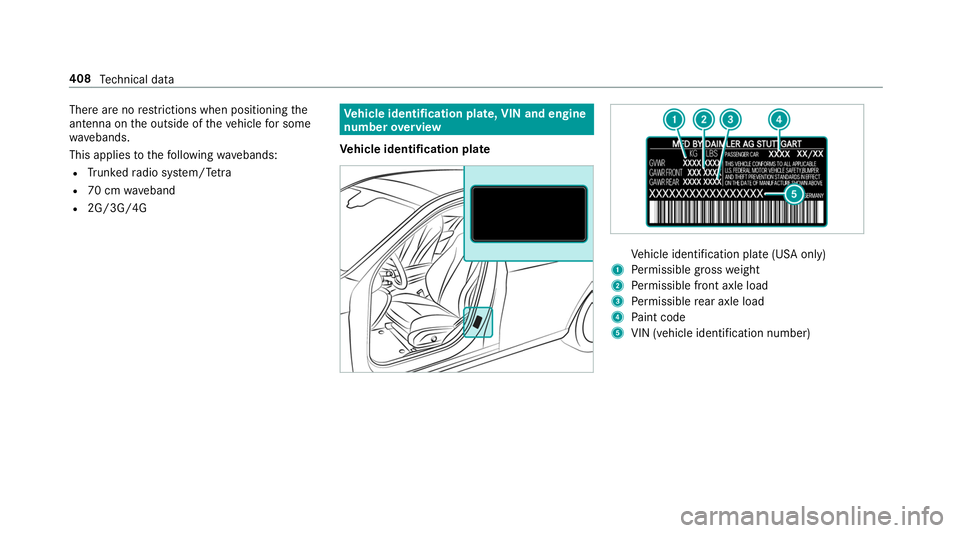
number overview
Ve hicle identification plate Ve
hicle identification plate (USA only)
1 Perm issible grossweight
2 Perm issible front axle load
3 Perm issible rear axle load
4 Paint code
5 VIN (vehicle identification number) 408
Tech nical da ta
Page 411 of 518
Ve
hicle identification plate (Canada only)
1 Perm issible grossweight
2 Perm issible front axle load
3 Perm issible rear axle load
4 Paint code
5 VIN (vehicle identification number)
The permissible gross vehicle weight is made up
of theve hicle weight, all vehicle occupants, the
fuel and the load. The maximum gross axle
we ight rating is the maximum weight that can be
car ried on one axle (front or rear axle). Ne
verexc eed the permissible gross vehicle
we ight or the maximum gross axle weight rating
fo rth e front or rear axle.
VIN in front of the front seat 1
VIN (vehicle identification number) Ad
ditional plates 1
Platewith information about emissions test‐
ing, including con firm ation of emissions
guidelines at theU. S. federal le vel as well as
fo r California
2 VIN (vehicle identification number)
3 Engine number (s tamp ed into the crankcase) Te
ch nical da ta409
Page 418 of 518
Wa
rning symbols 1advise you about:
R Possible dangers
R Having service workcar ried out at a qualified
specialist workshop
Re frigerant filling capacity and PAG oil Model
Refrigerant
S 560 23.3 ± 0.4 oz
(660 ± 10g) Model
PAG oil
S 560 3.9 ± 0.4 oz
(1 10 ±10 g) Ve
hicle data Ve
hicle dimensions The heights speci
fied may vary as a result of the:
R Tires
R Load
R Condition of the suspension R
Optional equipment Height when opened
1
1
Height
when
opened
S 560 65.5 in
(1663 mm) Ve
hicle dimensions S 560
Ve
hicle lengt h1 98.1 in
(5032 mm)
Ve hicle width including exte‐
ri or mir rors 83.0 in
(2 10 8 mm)
Ve hicle width without exterior
mir rors 74
.8 in
(1899 mm)
Ve hicle height 55.8 in
(1 41 7 mm)
Wheelbase 115.9 in
(2945 mm)
Tu rning radius 38.1ft
(1 1. 60 m) We
ights and loads Please no
tethat forth e specified vehicle data:
R items of optional equipment increase the
curb weight and reduce the pa yload. 416
Tech nical da ta
Page 431 of 518

Display messages
Possible causes/consequences and 0050
0050Solutions
Left Side Curtain Airbag
Malfunction Service
Required (Example) &
WARNING Risk of inju ryor fata l injury due tomalfunctions in the window airbag
If th e window airbag is malfunctioning, it might be triggered unintentionally or might not be triggered at all in
th eev ent of an accident with high deceleration. #
Have the window airbag checked and repaired immediately at a qualified specialist workshop. #
Visit a qualified specialist workshop immediatel y.
Front Passenger Airbag
Enabled See Operator's
Manual *T
he front passenger airbag and knee airbags are enabled during the journey:
R even when a child, a small adult or an object weighing less than the sy stem weight thre shold is located on the
front passenger seat
R even when the front passenger seat is not occupied
The sy stem may de tect objects or forc es that are adding tothewe ight applied tothe seat. &
WARNING Risk of inju ryor fata l injury when using a child restra int sy stem while the front passenger air bag
is enabled
If yo u secure a child in a child restra int sy stem on the front passenger seat and the front passenger air bag is
enabled, the front passenger air bag can deploy in theev ent of an accident.
The child could be stru ck bythe air bag. #
Ensure, bo thbefore and during the journe y,that thest atus of the front passenger air bag is cor rect. Display messages and
warning/indicator lamps 429
Page:
< prev 1-8 9-16 17-24