2019 MERCEDES-BENZ GLA warning
[x] Cancel search: warningPage 63 of 346

the stopping distance on off-road terrain. Thislimits steering capability.
BAS (Brake Assist System)
General information
BAS operates in emergency braking situations.If you depress the brake pedal quickly, BASautomatically boosts the braking force, thusshortening the stopping distance.
Important safety notes
iObserve the "Important safety notes" sec-tion (Ypage 60).
GWARNING
If BAS is malfunctioning, the braking dis-
tance in an emergency braking situation is
increased. There is a risk of an accident.
In an emergency braking situation, depress
the brake pedal with full force. ABS prevents
the wheels from locking.
Braking
XKeep the brake pedal firmly depressed untilthe emergency braking situation is over.ABS prevents the wheels from locking.
The brakes will function as usual once yourelease the brake pedal. BAS is deactivated.
Active Brake Assist
General information
iObserve the "Important safety notes" sec-tion (Ypage 60).
Active Brake Assist consists of a distancewarning function with an autonomous brakingfunction and a situation-dependent brakeboosting effect.
Active Brake Assist can help you to minimizethe risk of a collision with the vehicle travelingin front or reduce the effects of such a colli-sion.
If Active Brake Assist detects that there is arisk of collision, you will be warned visuallyand acoustically. If you do not react to the vis-
ual collision warning or the warning tone,autonomous braking can be initiated in criticalsituations. If you apply the brake yourself in acritical situation, Active Brake Assist supportsyou with a situation-dependent brake boostingeffect.
Important safety notes
Detection of hazardous situations can be par-ticularly impaired if:
RThere is dirt on the sensors or anything elsecovering the sensors
RThere is snow or heavy rain
RThere is interference by other radar sources
RThere are strong radar reflections, for exam-ple in parking garages
RA narrow vehicle is traveling in front, e.g. amotorbike
RA vehicle is traveling in front on a differentline
RYou are driving a new vehicle or servicing onthe Active Brake Assist system has justbeen carried out
Observe the important safety notes in the"Breaking-in notes" section (Ypage 124).
Following damage to the front end of the vehi-cle, have the configuration and operation ofthe radar sensor checked at a qualified spe-cialist workshop. This also applies to collisionsat low speeds where no visible damage to thefront of the vehicle is apparent.
Activating/deactivating
Active Brake Assist is active after every igni-tion cycle.
You can activate or deactivate Active BrakeAssist (Ypage 197) in the on-board com-puter. When deactivated, the distance warningfunction and the autonomous braking functionare also deactivated.
If Active Brake Assist is deactivated, the
Page 64 of 346

Distance warning function
General information
The distance warning function can help you tominimize the risk of a front-end collision with avehicle ahead or reduce the effects of such acollision. If the distance warning functiondetects that there is a risk of a collision, youwill be warned visually and acoustically.
Important safety notes
iObserve the "Important safety notes" sec-tion for driving safety systems (Ypage 60).
GWARNING
The distance warning function does not
react:
Rto people or animals
Rto oncoming vehicles
Rto crossing traffic
Rwhen cornering
The distance warning function may not give
warnings in all critical situations. There is a
risk of an accident.
Always pay careful attention to the traffic
situation and be ready to brake.
Always adapt your speed to suit the prevail-
ing road and traffic conditions.
GWARNING
The distance warning function cannot
always clearly identify objects and complex
traffic situations.
In such cases, the distance warning function
may:
Rgive an unnecessary warning
Rnot give a warning
There is a risk of an accident.
Always pay careful attention to the traffic
situation and do not rely solely on the dis-
tance warning function.
Function
Starting at a speed of approximately 4 mph(7 km/h),the distance warning function warnsyou if you rapidly approach a vehicle in front.An intermittent warning tone will then sound,
and the
Page 65 of 346
Situation-dependent braking assis-
tance
General information
iObserve the "Important safety notes" sec-tion (Ypage 60).
With the help of the radar sensor system,Active Brake Assist can detect obstacles thatare in the path of your vehicle for an extendedperiod of time.
If Active Brake Assist detects a risk of collisionwith the vehicle in front, it calculates the brakepressure necessary to avoid a collision. If youapply the brakes forcefully, situation-depend-ent braking assistance adapts to the situationand automatically increases the brake pres-sure to a degree appropriate to the traffic sit-uation.
Situation-dependent braking assistance pro-vides braking assistance in hazardous situa-tions at speeds above 4 mph (7 km/h). It usesradar sensor technology to assess the trafficsituation.
Situation-dependent braking assistance iscapable of reacting to moving objects thathave already been detected as such at leastonce over the period of observation, up tovehicle speeds of around 155 mph(250 km/h).
Situation-dependent braking assistance canalso detect stationary objects, up to vehiclespeeds of around 44 mph (70 km/h).
XKeep the brake pedal depressed until theemergency braking situation is over.ABS prevents the wheels from locking.
The brakes will work normally again if:
Ryou release the brake pedal
Rthere is no longer any danger of a collision
Rno obstacle is detected in front of your vehi-cle
Situation-dependent braking assistance is thendeactivated.
Important safety notes
iObserve the "Important safety notes" sec-tion for driving safety systems (Ypage 60).
GWARNING
Active Brake Assist does not react:
Rto persons, bicycles, motorcycles or ani-
mals
Rto approaching vehicles
Rto cross traffic
Ron bends
As a result, Active Brake Assist cannot inter-
vene in all critical situations. There is a risk
of an accident.
Always pay careful attention to the traffic
situation and be prepared to brake.
GWARNING
Adaptive Brake Assist cannot always clearly
identify objects and complex traffic situa-
tions.
In such cases, Adaptive Brake Assist might:
Rintervene unnecessarily
Rnot intervene
There is a risk of an accident.
Always pay careful attention to the traffic
situation and be ready to brake. Terminate
the intervention in a non-critical driving sit-
uation.
Due to the nature of the system, complex butnon-critical driving conditions may also causeActive Brake Assist to intervene.
Even if Active Brake Assist is not available dueto a malfunction in the radar sensor system,the brake system is still available with fullbrake boosting effect and BAS.
ESP®(Electronic Stability Program)
General notes
iObserve the "Important safety notes" sec-tion (Ypage 60).
ESP®monitors driving stability and traction,i.e. power transmission between the tires andthe road surface.
If ESP®detects that the vehicle is deviatingfrom the direction desired by the driver, one ormore wheels are braked to stabilize the vehi-
Driving safety systems63
Safety
Z
Page 66 of 346
cle. The engine output is also modified to keepthe vehicle on the desired course within physi-
cal limits. ESP®assists the driver when pulling
away on wet or slippery roads. ESP®can alsostabilize the vehicle during braking.
ETS/4ETS (Electronic Traction System)
iObserve the "Important safety notes" sec-tion (Ypage 60).
ETS traction control is part of ESP®. On vehi-
cles with 4MATIC, 4ETS is part of ESP®.
Traction control brakes the drive wheels indi-vidually if they spin. This enables you to pullaway and accelerate on slippery surfaces, forexample if the road surface is slippery on oneside. In addition, more drive torque is transfer-red to the wheel or wheels with traction.
Traction control remains active, even if you
deactivate ESP®.
Off-road 4ETS (Electronic Traction Sys-
tem)
A 4ETS system specifically suited to off-roadterrain is activated automatically once the off-road program is activated (Ypage 170).
Important safety notes
iObserve the "Important safety notes" sec-tion (Ypage 60).
GWARNING
If ESP®is malfunctioning, ESP®is unable to
stabilize the vehicle. Additionally, further
driving safety systems are deactivated. This
increases the risk of skidding and an acci-
dent.
Drive on carefully. Have ESP®checked at a
qualified specialist workshop.
Vehicles without 4MATIC:when towing yourvehicle with the front axle raised, it is impor-
tant that you observe the notes on ESP®
(Ypage 299).
If the
Page 68 of 346
Deactivating/activating ESP®
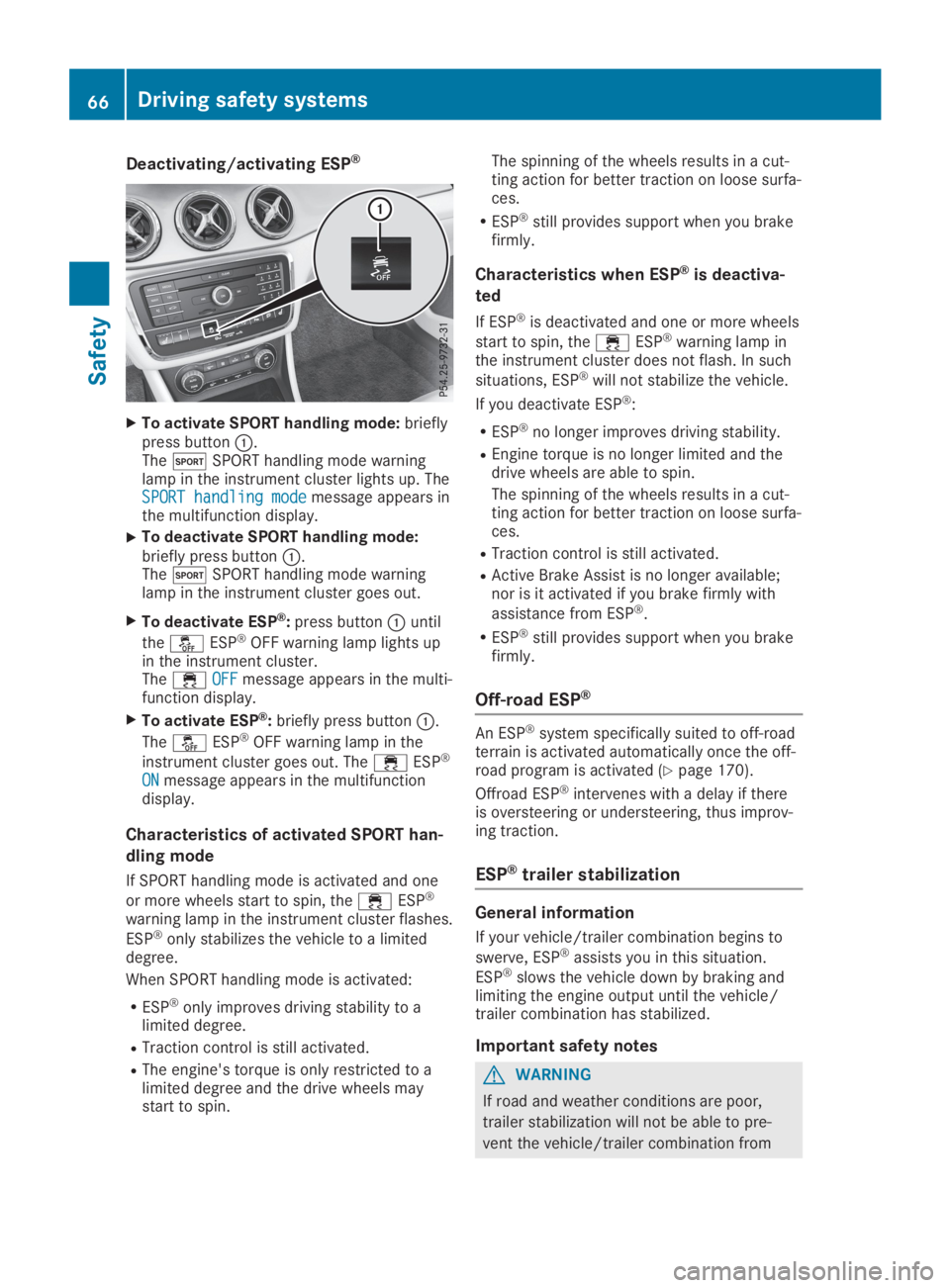
XTo activate SPORT handling mode:brieflypress buttonC.ThetSPORT handling mode warninglamp in the instrument cluster lights up. TheSPORT handling modeSPORT handling modemessage appears inthe multifunction display.
XTo deactivate SPORT handling mode:briefly press buttonC.ThetSPORT handling mode warninglamp in the instrument cluster goes out.
XTo deactivate ESP®:press buttonCuntil
the
Page 69 of 346
swerving. Trailers with a high center of grav-
ity can tip over before ESP®can detect this.
There is a risk of an accident.
Always adapt your driving style to the pre-
vailing road and weather conditions.
If your vehicle with trailer (vehicle/trailer com-bination) begins to lurch, you can only stabilizethe vehicle/trailer combination by depressingthe brake firmly.
ESP®trailer stabilization is active abovespeeds of about 65 km/h.
ESP®trailer stabilization does not work if
ESP®is deactivated or disabled because of amalfunction.
EBD (electronic brake force distribu-
tion)
General information
EBD monitors and controls the brake pressureon the rear wheels to improve driving stabilitywhile braking.
Important safety notes
iObserve the "Important safety notes" sec-tion (Ypage 60).
GWARNING
If EBD is malfunctioning, the rear wheels can
lock, e.g. under full braking. This increases
the risk of skidding and an accident.
You should therefore adapt your driving
style to the different handling characteris-
tics. Have the brake system checked at a
qualified specialist workshop.
Please observe the information on warningand indicator lamps (Ypage 233)
(Ypage 233) as well as on display messages(Ypage 206).
ADAPTIVE BRAKE
ADAPTIVE BRAKE enhances braking safety andoffers increased braking comfort. In additionto the braking function, ADAPTIVE BRAKE also
has the HOLD function (Ypage 165) and hillstart assist (Ypage 128).
STEER CONTROL
General information
STEER CONTROL helps you by transmitting anoticeable steering force to the steering wheelin the direction required for vehicle stabiliza-tion.
This steering assistance is provided in particu-lar if:
Rboth right wheels or both left wheels are ona wet or slippery road surface when youbrake
Rthe vehicle begins to skid
Important safety notes
iObserve the "Important safety notes" sec-tion (Ypage 60).
No steering assistance is provided from STEERCONTROL, if:
RESP®is malfunctioning
Rthe steering is malfunctioning
If ESP®is malfunctioning, you will be assistedfurther by the electrical power steering.
Protection against theft
Immobilizer
The immobilizer prevents your vehicle frombeing started without the correct SmartKey.
XTo activate with the SmartKey:removethe SmartKey from the ignition lock.
XTo activate with KEYLESS-GO start-func-tion or KEYLESS-GO:switch the ignition offand open the driver's door.
XTo deactivate:switch on the ignition.
When leaving the vehicle, always take theSmartKey with you and lock the vehicle. Any-one can start the engine if a valid SmartKeyhas been left inside the vehicle.
iThe immobilizer is always deactivatedwhen you start the engine.
In the event that the engine cannot be star-ted (yet the vehicle's battery is charged),
Protection against theft67
Safety
Z
Page 71 of 346
SmartKey
Important safety notes
GWARNING
If children are left unsupervised in the vehi-
cle, they could:
Roperate the vehicle's equipment
Additionally, children could set the vehicle in
motion if, for example, they:
Rrelease the parking brake
Rshift the automatic transmission out of
park position]
Rstart the engine
There is a risk of an accident and injury.
Never leave children or animals unattended
in the vehicle.
When leaving the vehicle, always take the
SmartKey with you and lock the vehicle. This
also applies for the Digital Vehicle Key if the
"Digital Vehicle Key" function is activated via
Mercedes me connect.
GWARNING
If you attach heavy or large objects to the
SmartKey, the SmartKey could be uninten-
tionally turned in the ignition lock. This
could cause the engine to be switched off.
There is a risk of an accident.
Do not attach any heavy or large objects to
the SmartKey. Remove any bulky key rings
before inserting the SmartKey into the igni-
tion lock.
!Keep the SmartKey away from strong mag-netic fields. Otherwise, the remote controlfunction could be affected.
Strong magnetic fields can occur in thevicinity of powerful electrical installations.
Do not keep the SmartKey:
Rwith electronic devices, e.g. a mobile phoneor another SmartKey
Rwith metallic objects, e.g. coins or metal foil
Rinside metallic objects, e.g. a metal case
Vehicles with KEYLESS-GO start function:do not keep the SmartKey in the cargo com-
partment. Otherwise, the SmartKey may notbe detected, e.g. when starting the engineusing the Start/Stop button.
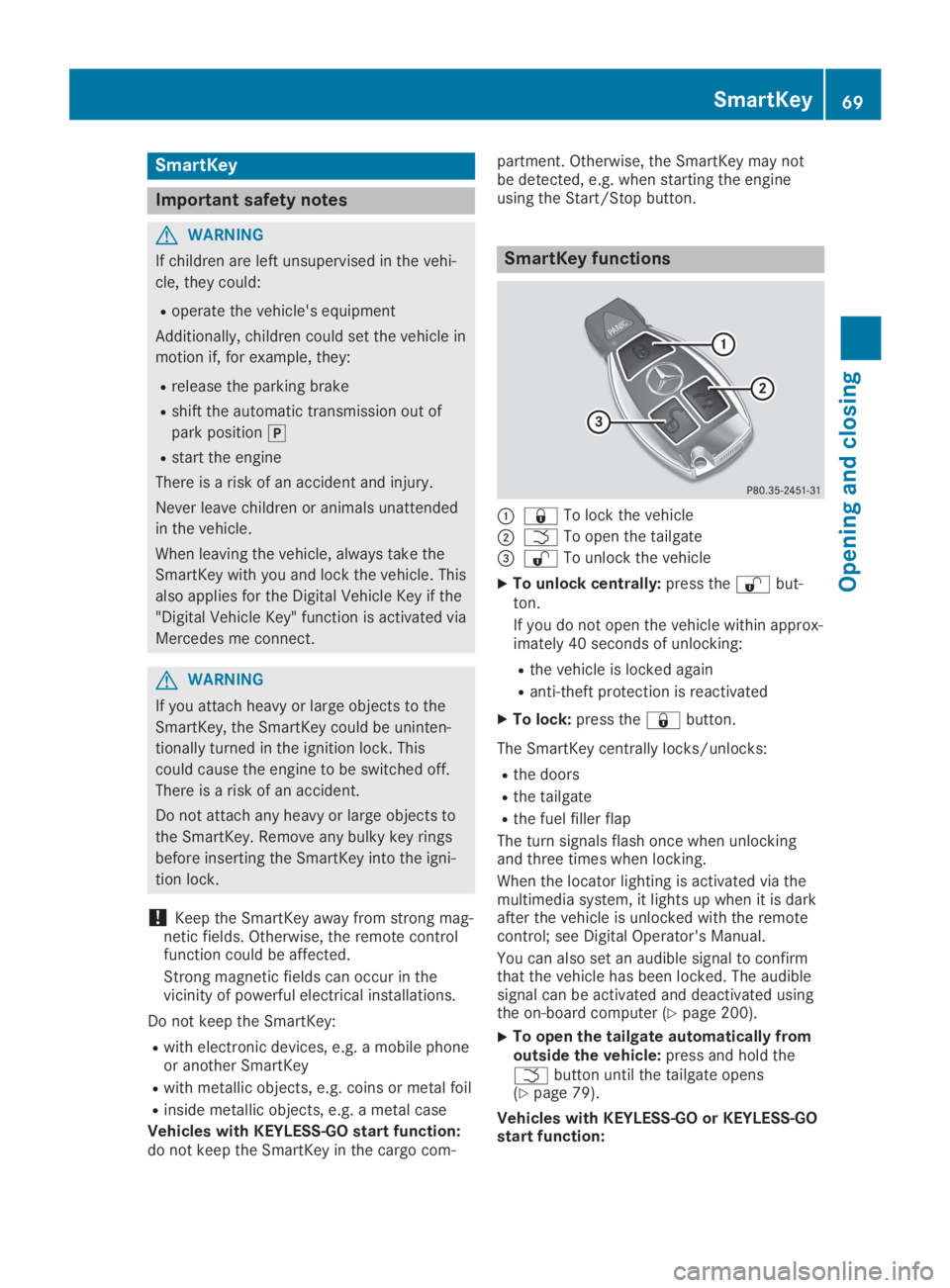
SmartKey functions
C7To lock the vehicle
DTTo open the tailgate
Page 74 of 346

XPush release catchCin the direction of thearrow and at the same time removemechanical keyDfrom the SmartKey.
For further information about:
RUnlocking the driver's door (Ypage 76)
RUnlocking the cargo compartment(Ypage 82)
RLocking the vehicle (Ypage 77)
Inserting the mechanical key
XPush mechanical keyDcompletely into theSmartKey until it engages and releasecatchCis back in its basic position.
SmartKey battery
Important safety notes
GWARNING
Batteries contain toxic and corrosive sub-
stances. If batteries are swallowed, it can
result in severe health problems. There is a
risk of fatal injury.
Keep batteries out of the reach of children.
If a battery is swallowed, seek medical
attention immediately.
The SmartKey batteries contain perchloratematerial, which may require special handlingand regard for the environment. Nationalguidelines must be observed during disposal.In California, seewww.dtsc.ca.gov/HazardousWaste/Perchlorate/index.cfm.
Mercedes-Benz recommends that you havethe battery replaced at a qualified specialistworkshop.
Checking the battery
XPress the7or6button.The battery is working properly if batterycheck lampClights up briefly.
The battery is discharged if battery checklampCdoes not light up briefly.
XChange the battery (Ypage 72).
iIf the SmartKey battery is checked withinthe signal reception range of the vehicle,pressing the7or6button:
Rlocks or
Runlocks the vehicle
iYou can get a battery at any qualified spe-cialist workshop.
Replacing the battery
You require a CR 2025 3 V cell battery.
XTake the mechanical key out of the Smart-Key (Ypage 71).
XPress mechanical keyDinto the opening inthe SmartKey in the direction of the arrowuntil battery tray coverCopens. Whendoing so, do not hold coverCshut.
XRemove battery tray coverC.
72SmartKey
Opening and closing