2019 LINCOLN MKZ air condition
[x] Cancel search: air conditionPage 311 of 595

Engine Coolant TemperatureManagement (If Equipped)
WARNING: To reduce the risk of crashand injury, be prepared that the vehiclespeed may reduce and the vehicle may notbe able to accelerate with full power until thecoolant temperature reduces.
If you tow a trailer with your vehicle, theengine may temporarily reach a highertemperature during severe operatingconditions, for example ascending a long orsteep grade in high ambient temperatures.
At this time, you may notice the coolanttemperature gauge moves toward the redzone and a message may appear in theinformation display.
You may notice a reduction in vehicle speedcaused by reduced engine power in orderto manage the engine coolant temperature. Your vehicle may enter this mode if certainhigh-temperature and high-load conditionstake place. The amount of speed reductiondepends on vehicle loading, grade andambient temperature. If this occurs, there isno need to pull off the road. You cancontinue to drive your vehicle.
The air conditioning may automatically turnon and off during severe operatingconditions to protect the engine fromoverheating. When the coolant temperaturedecreases to the normal operatingtemperature, the air conditioning turns on.
If the coolant temperature gauge moves fullyinto the red zone, or if the coolanttemperature warning or service engine soonmessages appear in your information display,do the following:
1. Pull off the road as soon as safelypossible and shift the transmission intopark (P).
2. Leave the engine running until thecoolant temperature gauge needlereturns to the normal position. If thetemperature does not drop after severalminutes, follow the remaining steps.
3. Switch the engine off and wait for it tocool. Check the coolant level.
4. If the coolant level is at or below theminimum mark, add prediluted coolantimmediately.
5. If the coolant level is normal, restart theengine and continue.
AUTOMATIC TRANSMISSION
FLUID CHECK
6F35 Transmission (If Equipped)
Note:Transmission fluid should be checkedby an authorized dealer. If required, fluidshould be added by an authorized dealer.
The automatic transmission does not havea transmission fluid dipstick.
308
MKZ (CC9) Canada/United States of America, enUSA, Edition date: 201805, First-Printing
Maintenance
Page 314 of 595
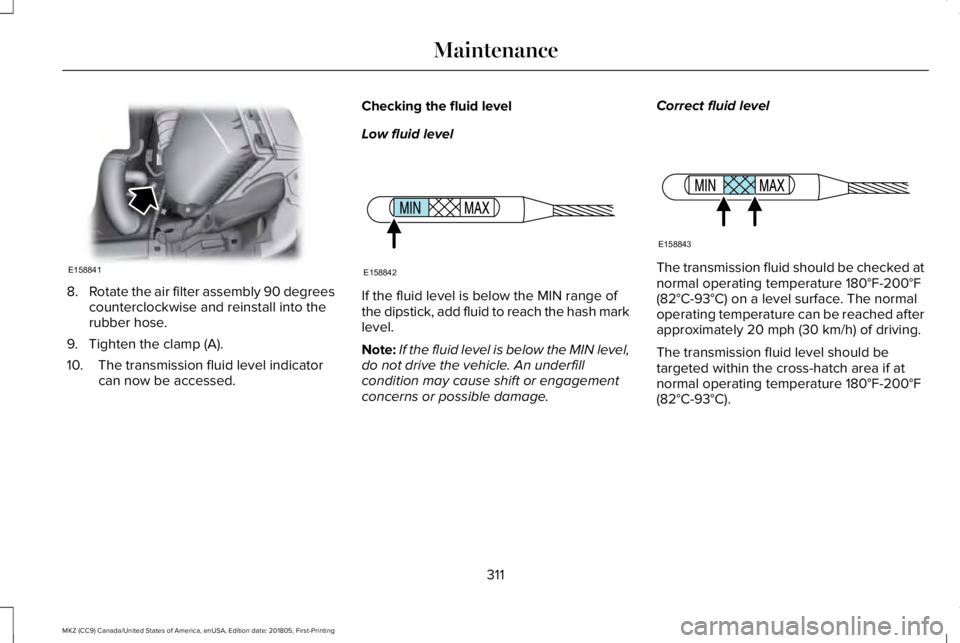
8.Rotate the air filter assembly 90 degreescounterclockwise and reinstall into therubber hose.
9. Tighten the clamp (A).
10. The transmission fluid level indicatorcan now be accessed.
Checking the fluid level
Low fluid level
If the fluid level is below the MIN range ofthe dipstick, add fluid to reach the hash marklevel.
Note:If the fluid level is below the MIN level,do not drive the vehicle. An underfillcondition may cause shift or engagementconcerns or possible damage.
Correct fluid level
The transmission fluid should be checked atnormal operating temperature 180°F-200°F(82°C-93°C) on a level surface. The normaloperating temperature can be reached afterapproximately 20 mph (30 km/h) of driving.
The transmission fluid level should betargeted within the cross-hatch area if atnormal operating temperature 180°F-200°F(82°C-93°C).
311
MKZ (CC9) Canada/United States of America, enUSA, Edition date: 201805, First-Printing
MaintenanceE158841 E158842 E158843
Page 315 of 595

High fluid level
If the fluid level is above the MAX range ofthe dipstick, remove fluid to reach thehashmark level.
Note:Fluid level above the MAX level maycause shift or engagement concerns orpossible damage. High fluid levels can becaused by an overheating condition. If yourvehicle has been operated for an extendedperiod at high speeds, in city traffic duringhot weather or pulling a trailer, the vehicleshould be switched off until normal operatingtemperatures are reached. Depending onvehicle use, cooling times could take up to30 minutes or longer.
Adjusting Automatic Transmission FluidLevels
Before adding any fluid, make sure thecorrect type is used. The type of fluid usedis normally indicated on the dipstick and alsoin the Technical Specifications section in thischapter.
Note:An overfill condition of transmissionfluid may cause shift or engagementconcerns or possible damage.
Do not use supplemental transmission fluidadditives, treatments or cleaning agents. Theuse of these materials may affecttransmission operation and result in damageto internal transmission components.Reinstall the air filter assembly. After the fluidlevel has been checked and adjusted asnecessary, do the following:
1. Shut the engine off.
2. Loosen the clamp holding the air filterassembly to the rubber hose.
3.Rotate the air filter assembly 90 degreesclockwise without disconnecting thesensor.
4.Seat the air filter assembly back into thegrommets by pushing down on the airfilter assembly.
5. Tighten the clamp.
6. Install and tighten two bolts that attachair filter assembly to the front of thevehicle.
7. Install the bolt cover (if equipped).
312
MKZ (CC9) Canada/United States of America, enUSA, Edition date: 201805, First-Printing
MaintenanceE158844 E158845 E158846
Page 329 of 595

For routine cleaning, wipe the surface witha soft, damp cloth and a mild soap and watersolution. Dry the area with a clean, soft cloth.
Note:Test any cleaner or stain remover onan inconspicuous area.
You should:
•Remove dust and loose dirt with avacuum cleaner.
•Clean and treat spills and stains as soonas possible.
Do not use the following products as thesemay damage the leather:
•Oil and petroleum or silicone-basedleather conditioners.
•Household cleaners.
•Alcohol solutions.
•Solvents or cleaners intended specificallyfor rubber, vinyl and plastics.
REPAIRING MINOR PAINT
DAMAGE
Authorized dealers have touch-up paint tomatch your vehicle’s color. Your vehicle colorcode is printed on a sticker on the front,left-hand side door jamb. Take your colorcode to your authorized dealer to make sureyou get the correct color.
Before repairing minor paint damage, use acleaner such as Motorcraft Bug and TarRemover to remove particles such as birddroppings, tree sap, insect deposits, tarspots, road salt and industrial fallout.
Always read the instructions before usingcleaning products.
CLEANING THE WHEELS
1. Regularly clean them with a wheelcleaner. We recommend that you use anapproved wheel cleaner if available.
2. Remove dirt and brake dust with asponge.
3. Remove tar and grease with a bug andtar remover. We recommend that you usean approved bug and tar remover ifavailable.
4. Thoroughly rinse the wheels with waterafter cleaning.
If you intend on parking your vehicle for anextended period after cleaning the wheelswith a wheel cleaner, drive your vehicle fora few minutes before doing so. This reducesthe risk of corrosion of the brake discs, brakepads and linings.
Do not clean the wheels when they are hot.
Note: Some car washes could damagewheel rims and covers.
Note: Using non-recommended cleaners,harsh cleaning products, chrome wheelcleaners or abrasive materials coulddamage wheel rims and covers.
326
MKZ (CC9) Canada/United States of America, enUSA, Edition date: 201805, First-Printing
Vehicle Care
Page 341 of 595

Temperature A B C
WARNING: The temperature gradefor this tire is established for a tire thatis properly inflated and not overloaded.Excessive speed, underinflation, orexcessive loading, either separately orin combination, can cause heat buildupand possible tire failure.
The temperature grades are A (thehighest), B and C, representing the tire’sresistance to the generation of heat andits ability to dissipate heat when testedunder controlled conditions on aspecified indoor laboratory test wheel.Sustained high temperature can causethe material of the tire to degenerateand reduce tire life, and excessivetemperature can lead to sudden tirefailure. The grade C corresponds to alevel of performance which all
passenger car tires must meet under theFederal Motor Vehicle Safety StandardNo. 139. Grades B and A representhigher levels of performance on thelaboratory test wheel than the minimumrequired by law.
Glossary of Tire Terminology
•Tire label: A label showing theoriginal equipment tire sizes,recommended inflation pressure andthe maximum weight the vehicle cancarry.
•Tire Identification Number: Anumber on the sidewall of each tireproviding information about the tirebrand and manufacturing plant, tiresize and date of manufacture. Alsoreferred to as DOT code.
•Inflation pressure: A measure of theamount of air in a tire.
•Standard load: A class of P-metric orMetric tires designed to carry amaximum load at set pressure. Forexample: For P-metric tires 35 psi(2.4 bar) and for Metric tires 36 psi(2.5 bar). Increasing the inflationpressure beyond this pressure willnot increase the tire’s load carryingcapability.
•Extra load: A class of P-metric orMetric tires designed to carry aheavier maximum load at 42 psi(2.9 bar). Increasing the inflationpressure beyond this pressure willnot increase the tire’s load carryingcapability.
•kPa: Kilopascal, a metric unit of airpressure.
•PSI: Pounds per square inch, astandard unit of air pressure.
•Cold tire pressure: The tire pressurewhen the vehicle has been stationaryand out of direct sunlight for an houror more and prior to the vehiclebeing driven for 1.0 mi (1.6 km).
338
MKZ (CC9) Canada/United States of America, enUSA, Edition date: 201805, First-Printing
Wheels and Tires
Page 349 of 595
7. Check the sidewalls to make surethere are no gouges, cuts or bulges.
Inspecting Your Tires and Wheel ValveStems
Periodically inspect the tire treads foruneven or excessive wear and removeobjects such as stones, nails or glassthat may be wedged in the treadgrooves. Check the tire and valve stemsfor holes, cracks, or cuts that may permitair leakage and repair or replace the tireand replace the valve stem. Inspect thetire sidewalls for cracking, cuts, bruisesand other signs of damage or excessivewear. If internal damage to the tire issuspected, have the tire demounted andinspected in case it needs to be repairedor replaced. For your safety, tires that
are damaged or show signs of excessivewear should not be used because theyare more likely to blow out or fail.
Improper or inadequate vehiclemaintenance can cause tires to wearabnormally. Inspect all your tires,including the spare, frequently, andreplace them if one or more of thefollowing conditions exist:
Tire Wear
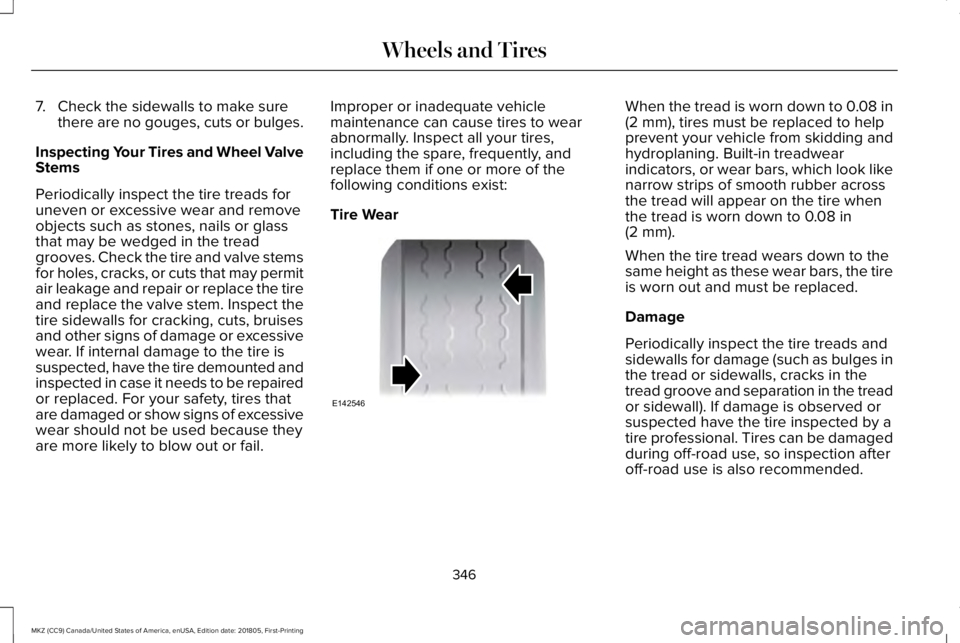
When the tread is worn down to 0.08 in(2 mm), tires must be replaced to helpprevent your vehicle from skidding andhydroplaning. Built-in treadwearindicators, or wear bars, which look likenarrow strips of smooth rubber acrossthe tread will appear on the tire whenthe tread is worn down to 0.08 in(2 mm).
When the tire tread wears down to thesame height as these wear bars, the tireis worn out and must be replaced.
Damage
Periodically inspect the tire treads andsidewalls for damage (such as bulges inthe tread or sidewalls, cracks in thetread groove and separation in the tread
or sidewall). If damage is observed orsuspected have the tire inspected by atire professional. Tires can be damagedduring off-road use, so inspection afteroff-road use is also recommended.
346
MKZ (CC9) Canada/United States of America, enUSA, Edition date: 201805, First-Printing
Wheels and TiresE142546
Page 353 of 595
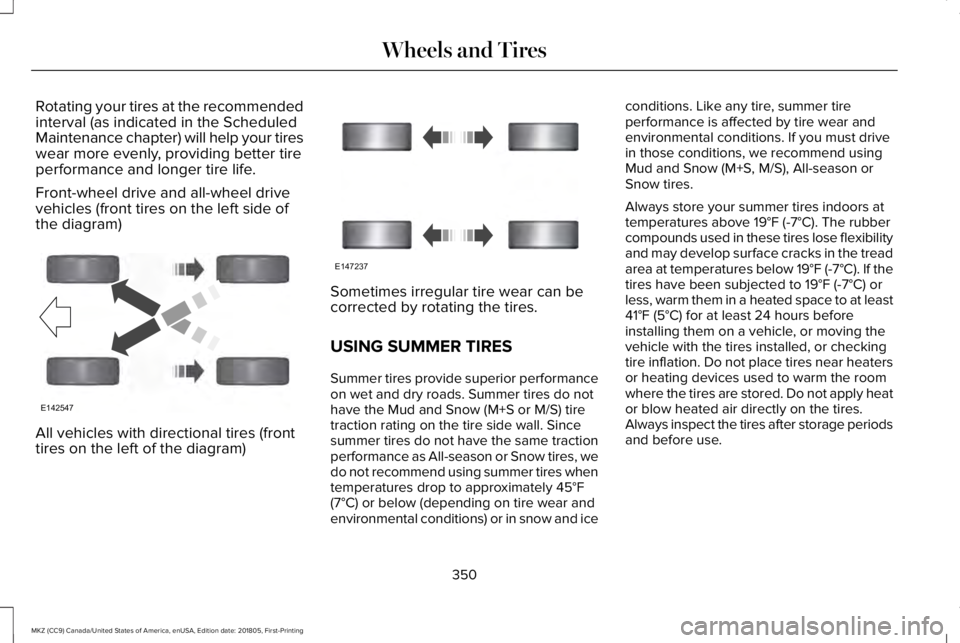
Rotating your tires at the recommendedinterval (as indicated in the ScheduledMaintenance chapter) will help your tireswear more evenly, providing better tireperformance and longer tire life.
Front-wheel drive and all-wheel drivevehicles (front tires on the left side ofthe diagram)
All vehicles with directional tires (fronttires on the left of the diagram)
Sometimes irregular tire wear can becorrected by rotating the tires.
USING SUMMER TIRES
Summer tires provide superior performanceon wet and dry roads. Summer tires do nothave the Mud and Snow (M+S or M/S) tiretraction rating on the tire side wall. Sincesummer tires do not have the same tractionperformance as All-season or Snow tires, wedo not recommend using summer tires whentemperatures drop to approximately 45°F(7°C) or below (depending on tire wear andenvironmental conditions) or in snow and ice
conditions. Like any tire, summer tireperformance is affected by tire wear andenvironmental conditions. If you must drivein those conditions, we recommend usingMud and Snow (M+S, M/S), All-season orSnow tires.
Always store your summer tires indoors attemperatures above 19°F (-7°C). The rubbercompounds used in these tires lose flexibilityand may develop surface cracks in the treadarea at temperatures below 19°F (-7°C). If thetires have been subjected to 19°F (-7°C) orless, warm them in a heated space to at least41°F (5°C) for at least 24 hours beforeinstalling them on a vehicle, or moving thevehicle with the tires installed, or checkingtire inflation. Do not place tires near heatersor heating devices used to warm the roomwhere the tires are stored. Do not apply heator blow heated air directly on the tires.Always inspect the tires after storage periodsand before use.
350
MKZ (CC9) Canada/United States of America, enUSA, Edition date: 201805, First-Printing
Wheels and TiresE142547 E147237
Page 376 of 595
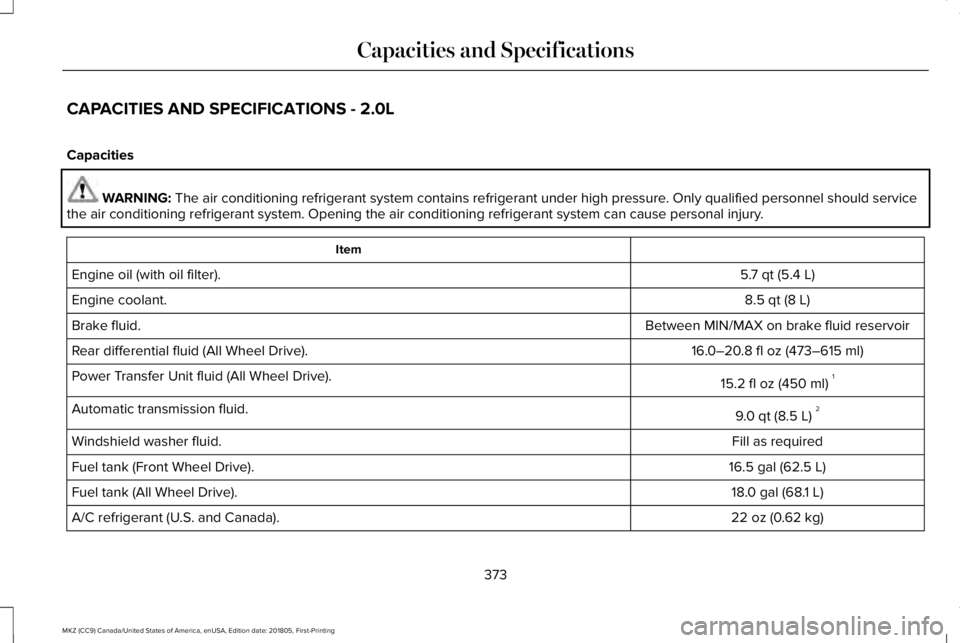
CAPACITIES AND SPECIFICATIONS - 2.0L
Capacities
WARNING: The air conditioning refrigerant system contains refrigerant under high pressure. Only qualified personnel should servicethe air conditioning refrigerant system. Opening the air conditioning refrigerant system can cause personal injury.
Item
5.7 qt (5.4 L)Engine oil (with oil filter).
8.5 qt (8 L)Engine coolant.
Between MIN/MAX on brake fluid reservoirBrake fluid.
16.0–20.8 fl oz (473–615 ml)Rear differential fluid (All Wheel Drive).
15.2 fl oz (450 ml)1Power Transfer Unit fluid (All Wheel Drive).
9.0 qt (8.5 L)2Automatic transmission fluid.
Fill as requiredWindshield washer fluid.
16.5 gal (62.5 L)Fuel tank (Front Wheel Drive).
18.0 gal (68.1 L)Fuel tank (All Wheel Drive).
22 oz (0.62 kg)A/C refrigerant (U.S. and Canada).
373
MKZ (CC9) Canada/United States of America, enUSA, Edition date: 201805, First-Printing
Capacities and Specifications