2019 LEXUS UX250H high
[x] Cancel search: highPage 423 of 476

4238-1. Specifications
8
Vehicle specifications
■Gasoline quality
In very few cases, driveability problems may
be caused by the brand of gasoline you are
using. If driveability problems persist, try
changing the brand of gasoline. If this does
not correct the problem, consult your Lexus
dealer.
■Recommendation of the use of gasoline
containing detergent additives
●Lexus recommends the use of gasoline
that contains detergent additives to avoid
the build-up of engine deposits.
●All gasoline sold in the U.S.A. contains
minimum detergent additives to clean
and/or keep clean intake systems, per
EPA’s lowest additive s concentration pro-
gram.
●Lexus strongly recommends the use of
Top Tier Detergent Gasoline. For more
information on Top Tier Detergent Gaso-
line and a list of marketers, please go to
the official websit e www.toptiergas.com.
■Recommendation of the use of low
emissions gasoline
Gasolines containing oxygenates such as
ethers and ethanol, as well as reformulated
gasolines, are available in some cities.
These fuels are typically acceptable for use,
providing they meet other fuel require-
ments. Lexus recommends these fuels, since the
formulations allow for reduced vehicle
emissions.
■Non-recommendation of the use of
blended gasoline
●Use only gasoline containing up to 15%
ethanol.
DO NOT use any flex-fuel or gasoline
that could contain more than 15% etha-
nol, including from
any pump labeled
E30 (30% ethanol ), E50 (50% eth-
anol ), E85 (85% ethanol )
(which are only some examples of fuel
containing more than 15% ethanol).
●If you use gasohol in your vehicle, be sure
that it has an octane rating no lower than
87.
●Lexus does not recommend the use of
gasoline containing methanol.
■Non-recommendation of the use of gas-
oline containing MMT
Some gasoline contains an octane enhanc-
ing additive called MMT (Methylcyclopen-
tadienyl Manganese Tricarbonyl).
Lexus does not recommend the use of gas-
oline that contains MMT. If fuel containing
MMT is used, your emission control system
may be adversely affected.
The malfunction indicator lamp on the
instrument cluster may come on. If this hap-
pens, contact your Lexus dealer for service.
■If your engine knocks
●Consult your Lexus dealer.
●You may occasionally notice light knock-
ing for a short time wh ile accelerating or
driving uphill. This is normal and there is
no need for concern.
Fuel information
You must only use unleaded gaso-
line.
Select octane rating 87 (Research
Octane Number 91) or higher. Use
of unleaded gasoline with an octane
rating lower than 87 may result in
engine knocking. Persistent knock-
ing can lead to engine damage.
At minimum, the gasoline you use
should meet the specifications of
ASTM D4814 in the U.S.A.
A
BC
Page 427 of 476

4278-1. Specifications
8
Vehicle specifications
Tire use
(P = Passenger car,
T = Temporary use)
Section width (millimeters)
Aspect ratio
(tire height to section width)
Tire construction code
(R = Radial, D = Diagonal)
Run-flat tire code
Wheel diameter (inches)
Load index (2 digits or 3 digits)
Speed symbol (alphabet with one
letter)
■Tire dimensionsSection width
Tire height
Wheel diameter Bead
Sidewall
Shoulder
Tread
Belt
Inner liner
Reinforcing rubber
Carcass
Rim lines
Bead wires
Chafer
This information has been prepared in
accordance with regulations issued by
the National Highway Traffic Safety
Administration of the U.S. Department
of Transportation.
It provides the purchasers and/or pro-
spective purchasers of Lexus vehicles
with information on uniform tire quality
grading.
Your Lexus dealer will help answer any
questions you may have as you read this
A
B
C
D
E
F
G
H
A
B
C
Tire section names
Uniform Tire Quality Grading
A
B
C
D
E
F
G
H
I
J
K
Page 428 of 476

4288-1. Specifications
information.
■DOT quality grades
All passenger vehicle tires must con-
form to Federal Safety Requirements in
addition to these grades. Quality
grades can be found where applicable
on the tire sidewall between tread
shoulder and maximum section width.
For example: Treadwear 200 Traction AA
Temperature A
■Treadwear
The treadwear grade is a comparative
rating based on the wear rate of the tire
when tested under controlled condi-
tions on a specified government test
course.
For example, a tire graded 150 would wear
one and a half (1 - 1/2) times as well on the
government course as a tire graded 100.
The relative performa nce of tires depends
upon the actual conditions of their use,
however, and may depart significantly from
the norm due to variatio ns in driving habits,
service practices and differences in road
characteristics and climate.
■Traction AA, A, B, C
The traction grades, from highest to
lowest, are AA, A, B and C, and they
represent the tire’s ability to stop on
wet pavement as measured under con-
trolled conditions on specified govern-
ment test surfaces of asphalt and
concrete.
A tire marked C may have poor traction
performance.
Warning: The traction grade assigned to
this tire is based on braking (straight
ahead) traction tests and does not include
cornering (turning) traction.
■Temperature A, B, C
The temperature grades are A (the
highest), B, and C, representing the
tire’s resistance to the generation of
heat and its ability to dissipate heat
when tested under controlled condi-
tions on a specified indoor laboratory
test wheel.
Sustained high temperature can cause the
material of the tire to degenerate and
reduce tire life, and excessive temperature
can lead to sudd en tire failure.
Grade C corresponds to a level of perfor-
mance which all passenger car tires must
meet under the Fede ral Motor Vehicle
Safety Standard No. 109.
Grades B and A represent higher levels of
performance on the laboratory test wheel
than the minimum required by law.
Warning: The temperature grades for this
tire are established for a tire that is prop-
erly inflated and not overloaded.
Excessive speed, unde rinflation, or exces-
sive loading, either separately or in combi-
nation, can cause heat buildup and
possible tire failure.
Page 430 of 476
4308-1. Specifications
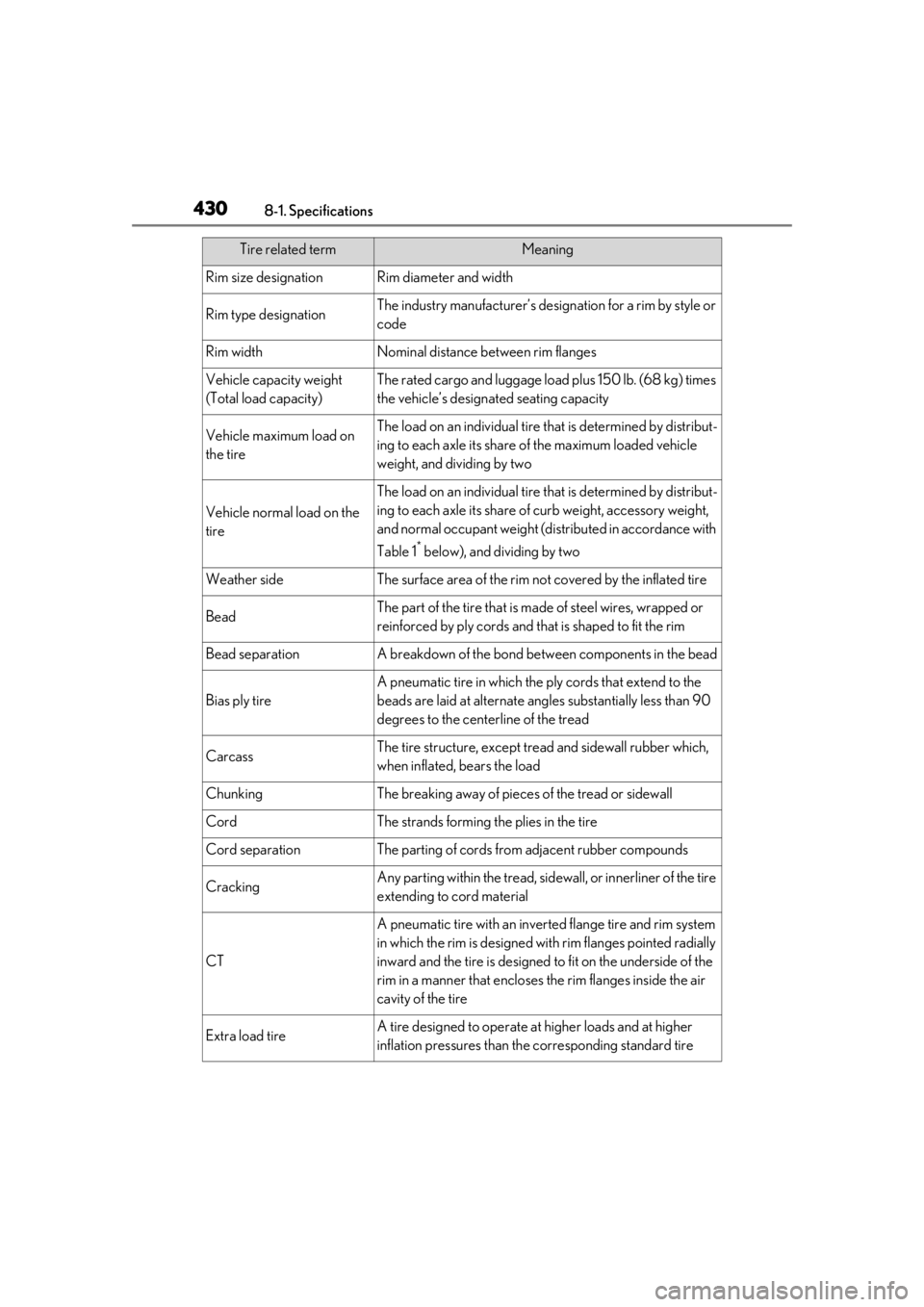
Rim size designationRim diameter and width
Rim type designationThe industry manufacturer’s designation for a rim by style or
code
Rim widthNominal distance between rim flanges
Vehicle capacity weight
(Total load capacity)The rated cargo and luggage load plus 150 lb. (68 kg) times
the vehicle’s designated seating capacity
Vehicle maximum load on
the tireThe load on an individual tire that is determined by distribut-
ing to each axle its share of the maximum loaded vehicle
weight, and dividing by two
Vehicle normal load on the
tire
The load on an individual tire that is determined by distribut-
ing to each axle its share of curb weight, accessory weight,
and normal occupant weight (distributed in accordance with
Table 1
* below), and dividing by two
Weather sideThe surface area of the rim not covered by the inflated tire
BeadThe part of the tire that is ma de of steel wires, wrapped or
reinforced by ply cords and th at is shaped to fit the rim
Bead separationA breakdown of the bond between components in the bead
Bias ply tire
A pneumatic tire in which the ply cords that extend to the
beads are laid at alternate angles substantially less than 90
degrees to the centerline of the tread
CarcassThe tire structure, except tread and sidewall rubber which,
when inflated, bears the load
ChunkingThe breaking away of pieces of the tread or sidewall
CordThe strands forming the plies in the tire
Cord separationThe parting of cords from adjacent rubber compounds
CrackingAny parting within the tread, side wall, or innerliner of the tire
extending to cord material
CT
A pneumatic tire with an inverted flange tire and rim system
in which the rim is designed wi th rim flanges pointed radially
inward and the tire is designed to fit on the underside of the
rim in a manner that encloses the rim flanges inside the air
cavity of the tire
Extra load tireA tire designed to operate at higher loads and at higher
inflation pressures than the corresponding standard tire
Tire related termMeaning
Page 431 of 476
4318-1. Specifications
8
Vehicle specifications
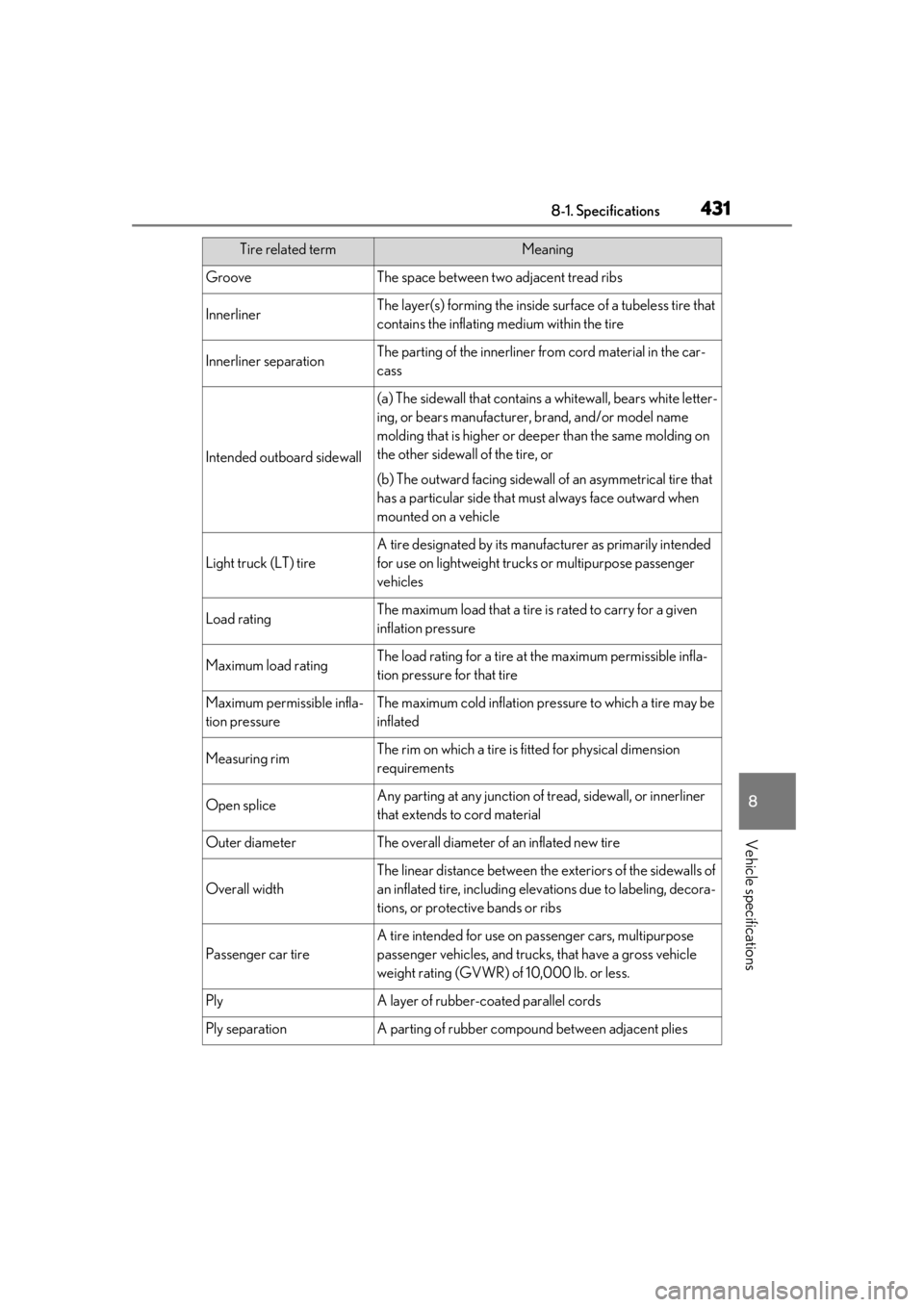
GrooveThe space between two adjacent tread ribs
InnerlinerThe layer(s) forming the inside surface of a tubeless tire that
contains the inflating medium within the tire
Innerliner separationThe parting of the innerliner fr om cord material in the car-
cass
Intended outboard sidewall
(a) The sidewall that contains a whitewall, bears white letter-
ing, or bears manufacturer, brand, and/or model name
molding that is higher or deep er than the same molding on
the other sidewall of the tire, or
(b) The outward facing sidewall of an asymmetrical tire that
has a particular side that must always face outward when
mounted on a vehicle
Light truck (LT) tire
A tire designated by its manuf acturer as primarily intended
for use on lightweight trucks or multipurpose passenger
vehicles
Load ratingThe maximum load that a tire is rated to carry for a given
inflation pressure
Maximum load ratingThe load rating for a tire at the maximum permissible infla-
tion pressure for that tire
Maximum permissible infla-
tion pressureThe maximum cold inflation pre ssure to which a tire may be
inflated
Measuring rimThe rim on which a tire is fitted for physical dimension
requirements
Open spliceAny parting at any junction of tread, sidewall, or innerliner
that extends to cord material
Outer diameterThe overall diameter of an inflated new tire
Overall width
The linear distance between the exteriors of the sidewalls of
an inflated tire, including elev ations due to labeling, decora-
tions, or protective bands or ribs
Passenger car tire
A tire intended for use on passenger cars, multipurpose
passenger vehicles, and trucks, that have a gross vehicle
weight rating (GVWR) of 10,000 lb. or less.
PlyA layer of rubber-coated parallel cords
Ply separationA parting of rubber compound between adjacent plies
Tire related termMeaning
Page 432 of 476

4328-1. Specifications
*:Table 1 Occupant loading and distribution for vehicle normal load for various desig-
nated seating capacities
Pneumatic tire
A mechanical device made of rubber, chemicals, fabric and
steel or other materials, that, when mounted on an automo-
tive wheel, provides the traction and contains the gas or fluid
that sustains the load
Radial ply tire
A pneumatic tire in which the ply cords that extend to the
beads are laid at substantiall y 90 degrees to the centerline
of the tread
Reinforced tireA tire designed to operate at higher loads and at higher
inflation pressures than the corresponding standard tire
Section width
The linear distance between the exteriors of the sidewalls of
an inflated tire, excluding elevations due to labeling, decora-
tion, or protective bands
SidewallThat portion of a tire between the tread and bead
Sidewall separationThe parting of the rubber comp ound from the cord material
in the sidewall
Snow tire
A tire that attains a traction index equal to or greater than
110, compared to the ASTM E-1136 Standard Reference
Test Tire, when using the snow traction test as described in
ASTM F-1805-00, Standard Test Method for Single Wheel
Driving Traction in a Straight Line on Snow-and Ice-Cov-
ered Surfaces, and which is ma rked with an Alpine Symbol
( ) on at least one sidewall
Test rimThe rim on which a tire is fitt ed for testing, and may be any
rim listed as appropriate for use with that tire
TreadThat portion of a tire that comes into contact with the road
Tread ribA tread section running circ umferentially around a tire
Tread separationPulling away of the tread from the tire carcass
Treadwear indicators (TWI)The projections within the principal grooves designed to
give a visual indication of the degrees of wear of the tread
Wheel-holding fixtureThe fixture used to hold the wheel and tire assembly
securely during testing
Tire related termMeaning
Page 441 of 476
4418-2. Customization
8
Vehicle specifications
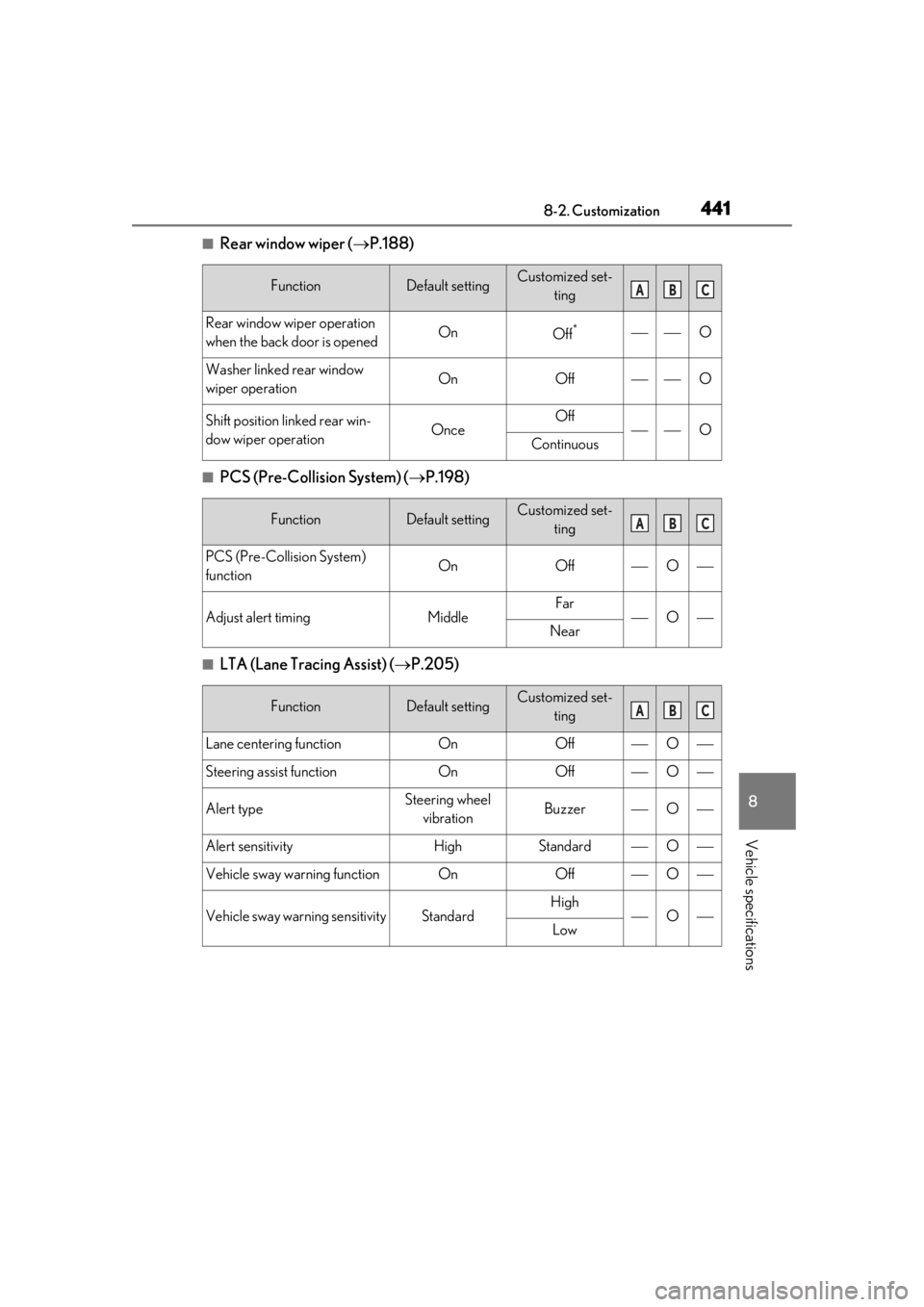
■Rear window wiper (P.188)
■PCS (Pre-Collision System) ( P.198)
■LTA (Lane Tracing Assist) ( P.205)
FunctionDefault settingCustomized set-
ting
Rear window wiper operation
when the back door is openedOnOff*O
Washer linked rear window
wiper operationOnOffO
Shift position linked rear win-
dow wiper operationOnceOffOContinuous
FunctionDefault settingCustomized set-ting
PCS (Pre-Collision System)
functionOnOffO
Adjust alert timingMiddleFarONear
FunctionDefault settingCustomized set-ting
Lane centering functionOnOffO
Steering assist functionOnOffO
Alert typeSteering wheel vibrationBuzzerO
Alert sensitivityHighStandardO
Vehicle sway warning functionOnOffO
Vehicle sway warning sensitivityStandardHighOLow
ABC
ABC
ABC
Page 444 of 476
4448-2. Customization
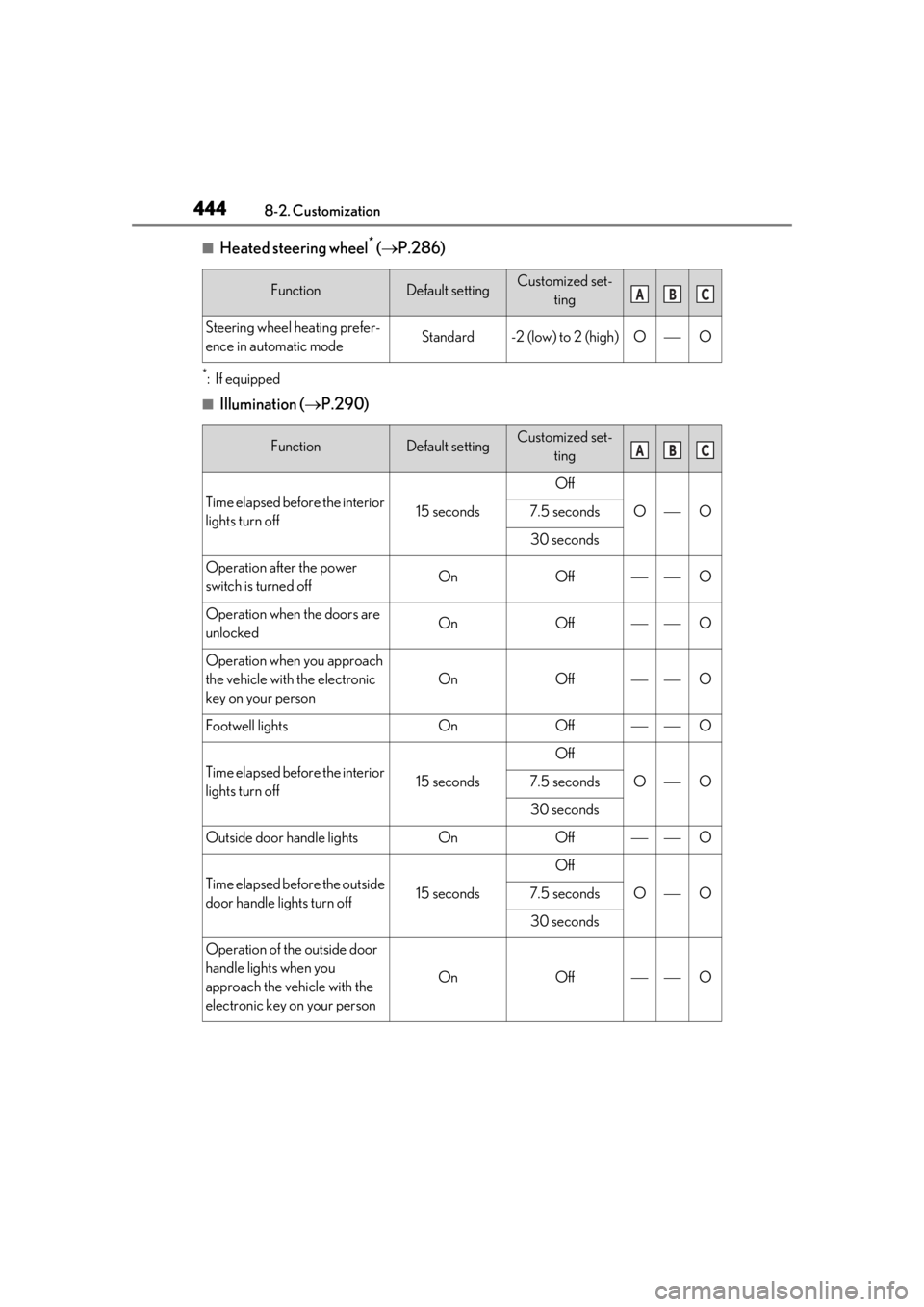
■Heated steering wheel* ( P.286)
*:If equipped
■Illumination ( P.290)
FunctionDefault settingCustomized set-
ting
Steering wheel heating prefer-
ence in automatic modeStandard-2 (low) to 2 (high)OO
FunctionDefault settingCustomized set-ting
Time elapsed before the interior
lights turn off15 seconds
Off
OO7.5 seconds
30 seconds
Operation after the power
switch is turned offOnOffO
Operation when the doors are
unlockedOnOffO
Operation when you approach
the vehicle with the electronic
key on your person
OnOffO
Footwell lightsOnOffO
Time elapsed before the interior
lights turn off15 seconds
Off
OO7.5 seconds
30 seconds
Outside door handle lightsOnOffO
Time elapsed before the outside
door handle lights turn off15 seconds
Off
OO7.5 seconds
30 seconds
Operation of the outside door
handle lights when you
approach the vehicle with the
electronic key on your person
OnOffO
ABC
ABC