2019 LEXUS UX200 brake
[x] Cancel search: brakePage 388 of 452

3887-2. Steps to take in an emergency
1Stop the engine. Shift the shift lever
to P and set the parking brake.
2
Remove the mud, snow or sand
from around the front wheels.
3
Place wood, stones or some other
material under the front wheels to
help provide traction.
4
Restart the engine.
5
Shift the shift lever to D or R and
release the parking brake. Then,
while exercising caution, depress
the accelerator pedal.
■When it is difficult to free the vehicle
Press the switch to turn off TRAC.
( P.245)
If the vehicle becomes stuck
Carry out the following proce-
dures if the tires spin or the vehicle
becomes stuck in mud, dirt or snow:
Recovering procedure
WARNING
■When attempting to free a stuck vehi-
cle
If you choose to push the vehicle back
and forth to free it, make sure the sur-
rounding area is clear to avoid striking
other vehicles, objects or people. The
vehicle may also lunge forward or lunge
back suddenly as it becomes free. Use
extreme caution.
■When shifting the shift lever
Be careful not to shif t the shift lever with
the accelerator pedal depressed.
This may lead to un expected rapid accel-
eration of the vehicle that may cause an
accident resulting in death or serious
injury.
NOTICE
■To avoid damage to the transmission
and other components
●Avoid spinning the tires and depress-
ing the accelerator pedal more than
necessary.
●If the vehicle remains stuck even after
these procedures are performed, the
vehicle may require towing to be freed.
Page 394 of 452
3948-1. Specifications
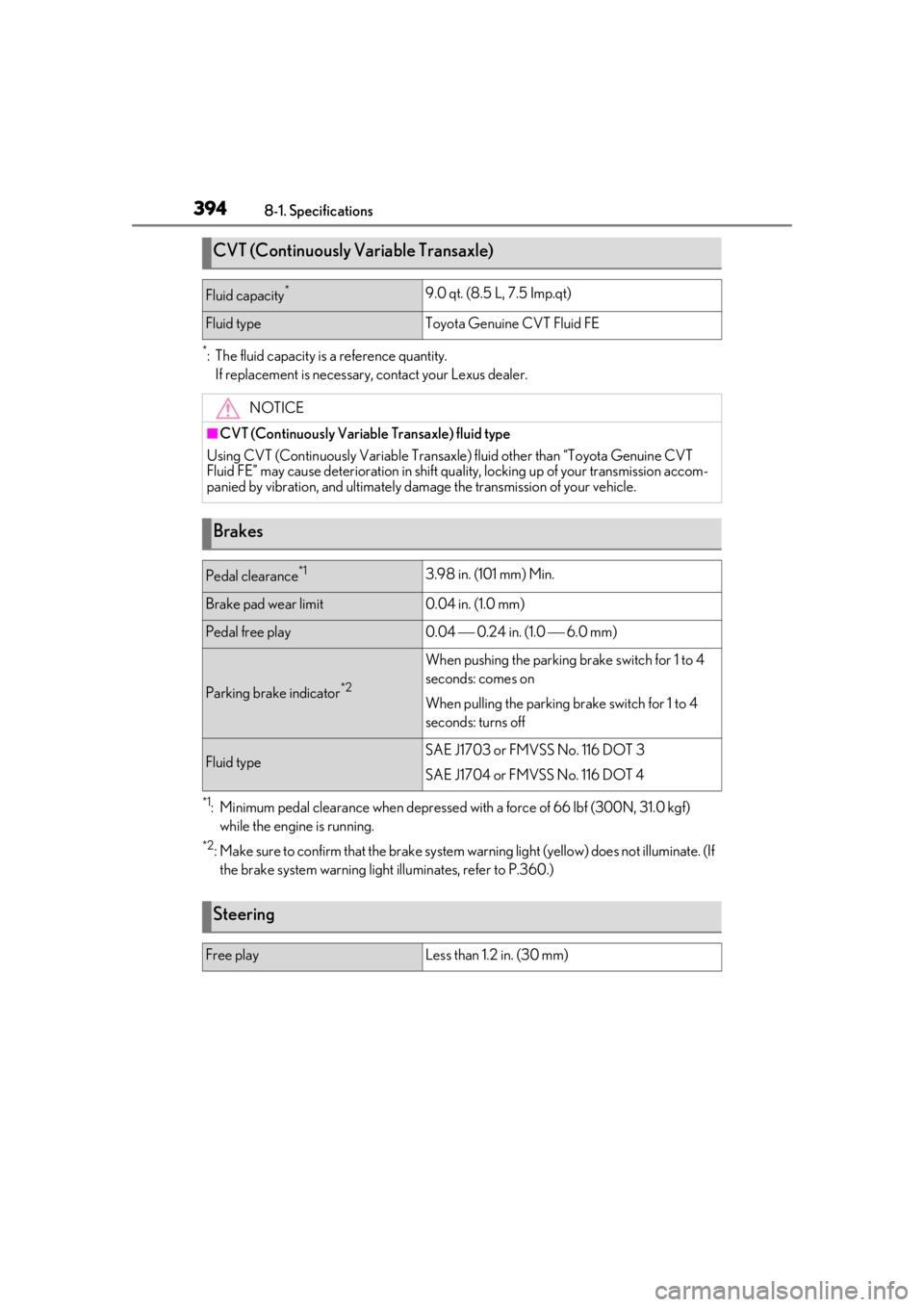
*: The fluid capacity is a reference quantity.If replacement is necessary, contact your Lexus dealer.
*1: Minimum pedal clearance when depressed with a force of 66 lbf (300N, 31.0 kgf) while the engine is running.
*2: Make sure to confirm that the brake system wa rning light (yellow) does not illuminate. (If
the brake system warning light illuminates, refer to P.360.)
CVT (Continuously Variable Transaxle)
Fluid capacity*9.0 qt. (8.5 L, 7.5 Imp.qt)
Fluid typeToyota Genuine CVT Fluid FE
NOTICE
■CVT (Continuously Variable Transaxle) fluid type
Using CVT (Continuously Variable Transaxl e) fluid other than “Toyota Genuine CVT
Fluid FE” may cause deterioration in shift qua lity, locking up of your transmission accom-
panied by vibration, and ultimately damage the transmission of your vehicle.
Brakes
Pedal clearance*13.98 in. (101 mm) Min.
Brake pad wear limit0.04 in. (1.0 mm)
Pedal free play0.04 0.24 in. (1.0 6.0 mm)
Parking brake indicator*2
When pushing the parking brake switch for 1 to 4
seconds: comes on
When pulling the parking brake switch for 1 to 4
seconds: turns off
Fluid typeSAE J1703 or FMVSS No. 116 DOT 3
SAE J1704 or FMVSS No. 116 DOT 4
Steering
Free playLess than 1.2 in. (30 mm)
Page 403 of 452
4038-1. Specifications
8
Vehicle specifications
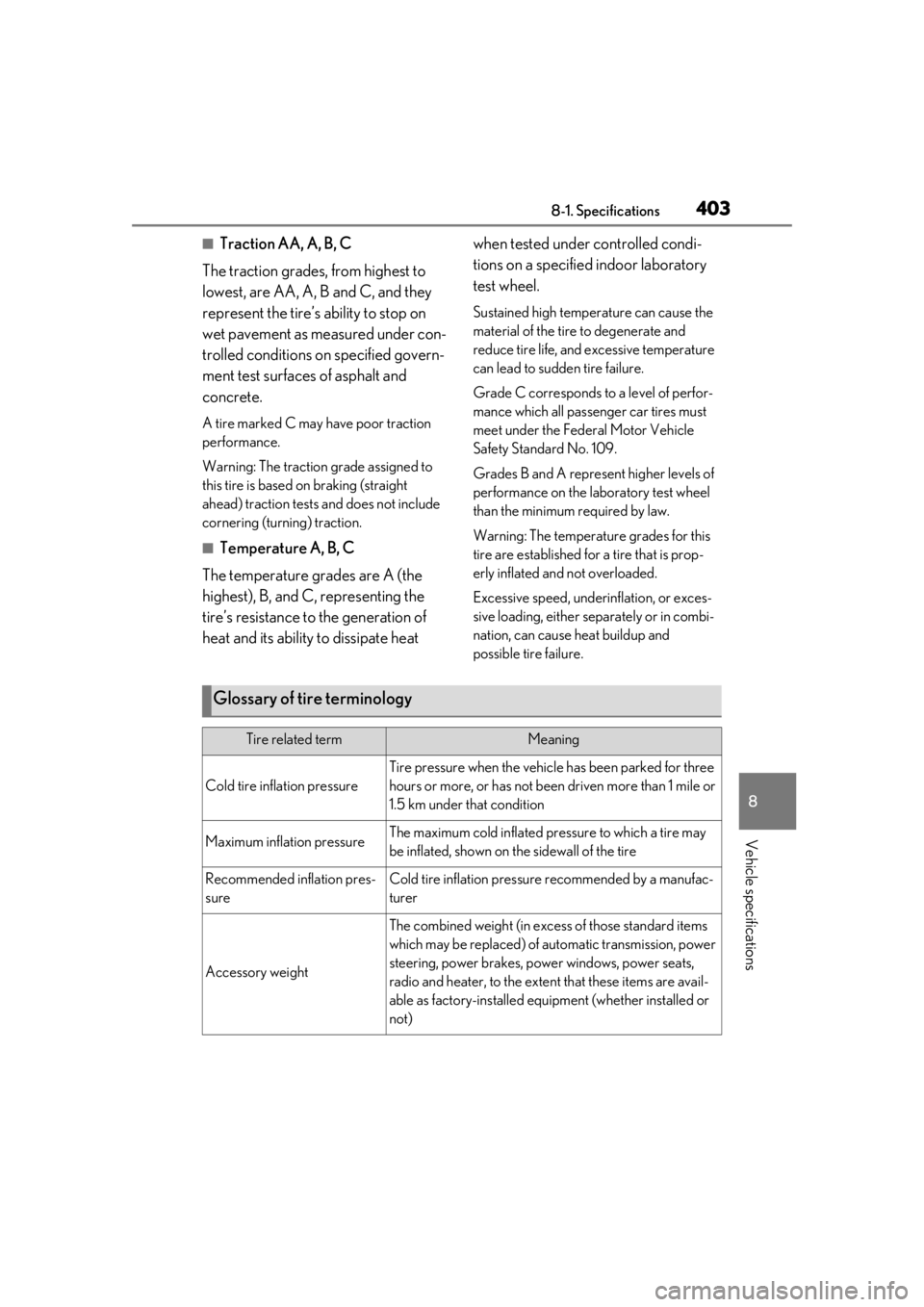
■Traction AA, A, B, C
The traction grades, from highest to
lowest, are AA, A, B and C, and they
represent the tire’s ability to stop on
wet pavement as measured under con-
trolled conditions on specified govern-
ment test surfaces of asphalt and
concrete.
A tire marked C may have poor traction
performance.
Warning: The traction grade assigned to
this tire is based on braking (straight
ahead) traction tests and does not include
cornering (turning) traction.
■Temperature A, B, C
The temperature grades are A (the
highest), B, and C, representing the
tire’s resistance to the generation of
heat and its ability to dissipate heat when tested under controlled condi-
tions on a specified indoor laboratory
test wheel.
Sustained high temperature can cause the
material of the tire to degenerate and
reduce tire life, and excessive temperature
can lead to sudd
en tire failure.
Grade C corresponds to a level of perfor-
mance which all passenger car tires must
meet under the Fede ral Motor Vehicle
Safety Standard No. 109.
Grades B and A represent higher levels of
performance on the laboratory test wheel
than the minimum required by law.
Warning: The temperature grades for this
tire are established for a tire that is prop-
erly inflated and not overloaded.
Excessive speed, unde rinflation, or exces-
sive loading, either separately or in combi-
nation, can cause heat buildup and
possible tire failure.
Glossary of tire terminology
Tire related termMeaning
Cold tire inflation pressure
Tire pressure when the vehicle has been parked for three
hours or more, or has not been driven more than 1 mile or
1.5 km under that condition
Maximum inflation pressureThe maximum cold inflated pressure to which a tire may
be inflated, shown on the sidewall of the tire
Recommended inflation pres-
sureCold tire inflation pressure recommended by a manufac-
turer
Accessory weight
The combined weight (in excess of those standard items
which may be replaced) of automatic transmission, power
steering, power brakes, powe r windows, power seats,
radio and heater, to the extent that these items are avail-
able as factory-installed equi pment (whether installed or
not)
Page 404 of 452

4048-1. Specifications
Curb weight
The weight of a motor vehicle with standard equipment,
including the maximum capacity of fuel, oil and coolant,
and if so equipped, air conditioning and additional weight
optional engine
Maximum loaded vehicle
weight
The sum of:
(a) Curb weight
(b) Accessory weight
(c) Vehicle capacity weight
(d) Production options weight
Normal occupant weight150 lb. (68 kg) times the number of occupants specified in
the second column of Table 1
* that follows
Occupant distributionDistribution of occupants in a vehicle as specified in the
third column of Table 1
* below
Production options weight
The combined weight of in stalled regular production
options weighing over 5 lb. (2.3 kg) in excess of the stan-
dard items which they replace, not previously considered
in curb weight or accessory weight, including heavy duty
brakes, ride levelers, roof rack, heavy duty battery, and
special trim
RimA metal support for a tire or a tire and tube assembly upon
which the tire beads are seated
Rim diameter
(Wheel diameter)Nominal diameter of the bead seat
Rim size designationRim diameter and width
Rim type designationThe industry manufacturer’s designation for a rim by style
or code
Rim widthNominal distance between rim flanges
Vehicle capacity weight
(Total load capacity)The rated cargo and luggage load plus 150 lb. (68 kg)
times the vehicle’s desi gnated seating capacity
Vehicle maximum load on the
tireThe load on an individual tire that is determined by distrib-
uting to each axle its share of the maximum loaded vehicle
weight, and dividing by two
Vehicle normal load on the tire
The load on an individual tire that is determined by distrib-
uting to each axle its shar e of curb weight, accessory
weight, and normal occupant we ight (distributed in accor-
dance with Table 1
* below), and dividing by two
Tire related termMeaning
Page 408 of 452
4088-2. Customization
8-2.Customization
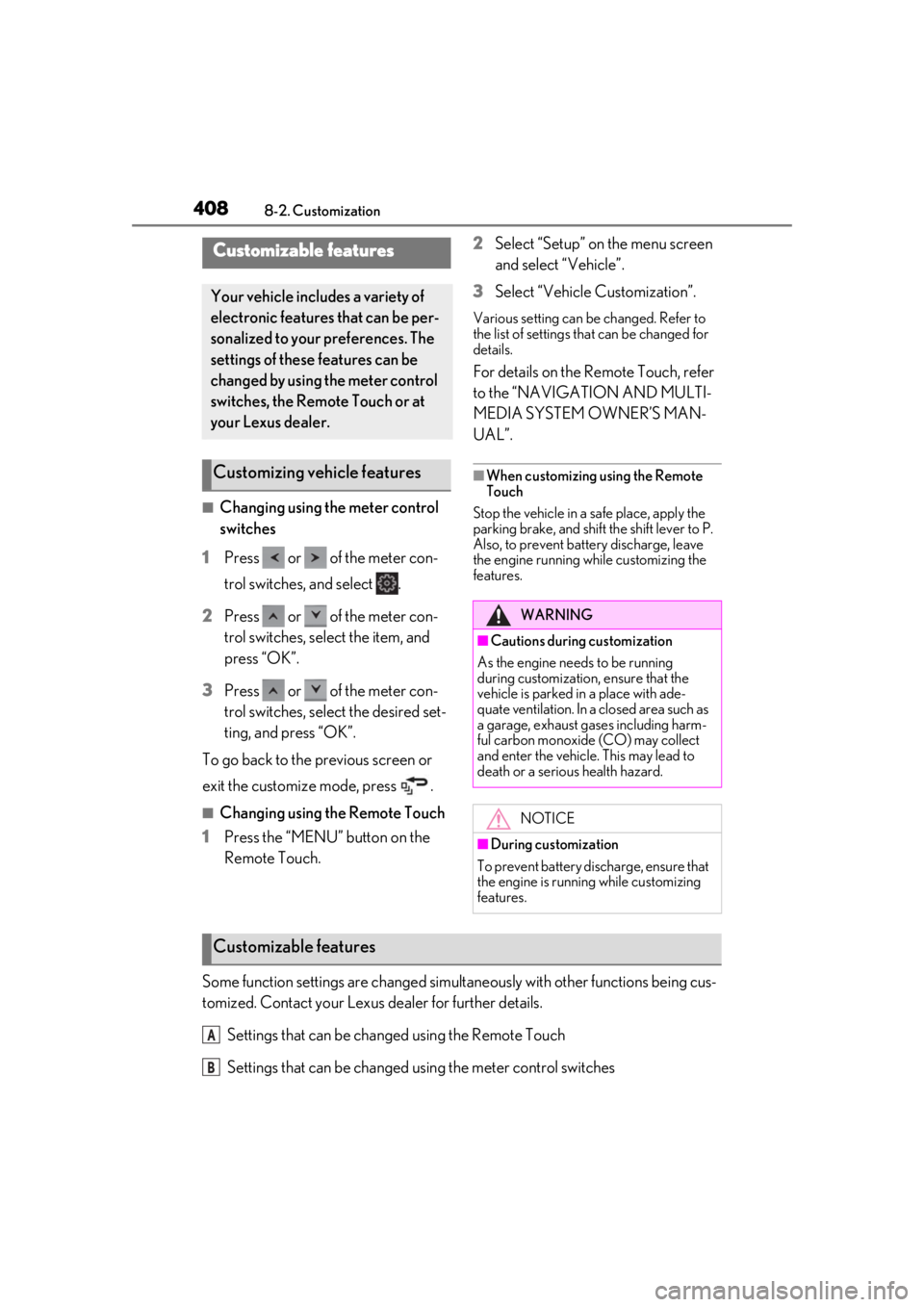
■Changing using the meter control
switches
1
Press or of the meter con-
trol switches, and select .
2
Press or of the meter con-
trol switches, select the item, and
press “OK”.
3
Press or of the meter con-
trol switches, select the desired set-
ting, and press “OK”.
To go back to the previous screen or
exit the customize mode, press .
■Changing using the Remote Touch
1
Press the “MENU” button on the
Remote Touch. 2
Select “Setup” on the menu screen
and select “Vehicle”.
3
Select “Vehicle Customization”.
Various setting can be changed. Refer to
the list of settings th at can be changed for
details.
For details on the Remote Touch, refer
to the “NAVIGATION AND MULTI-
MEDIA SYSTEM OWNER’S MAN-
UAL”.
■When customizing using the Remote
Touch
Stop the vehicle in a safe place, apply the
parking brake, and shift the shift lever to P.
Also, to prevent battery discharge, leave
the engine running while customizing the
features.
Some function settings are changed simultaneously with other functions being cus-
tomized. Contact your Lexus dealer for further details.
Settings that can be changed using the Remote Touch
Settings that can be changed using the meter control switches
Customizable features
Your vehicle includes a variety of
electronic features that can be per-
sonalized to your preferences. The
settings of these features can be
changed by using the meter control
switches, the Remote Touch or at
your Lexus dealer.
Customizing vehicle features
WARNING
■Cautions during customization
As the engine needs to be running
during customization, ensure that the
vehicle is parked in a place with ade-
quate ventilation. In a closed area such as
a garage, exhaust gases including harm-
ful carbon monoxide (CO) may collect
and enter the vehicle. This may lead to
death or a serious health hazard.
NOTICE
■During customization
To prevent battery discharge, ensure that
the engine is running while customizing
features.
Customizable features
A
B
Page 416 of 452
4168-2. Customization
*:If equipped
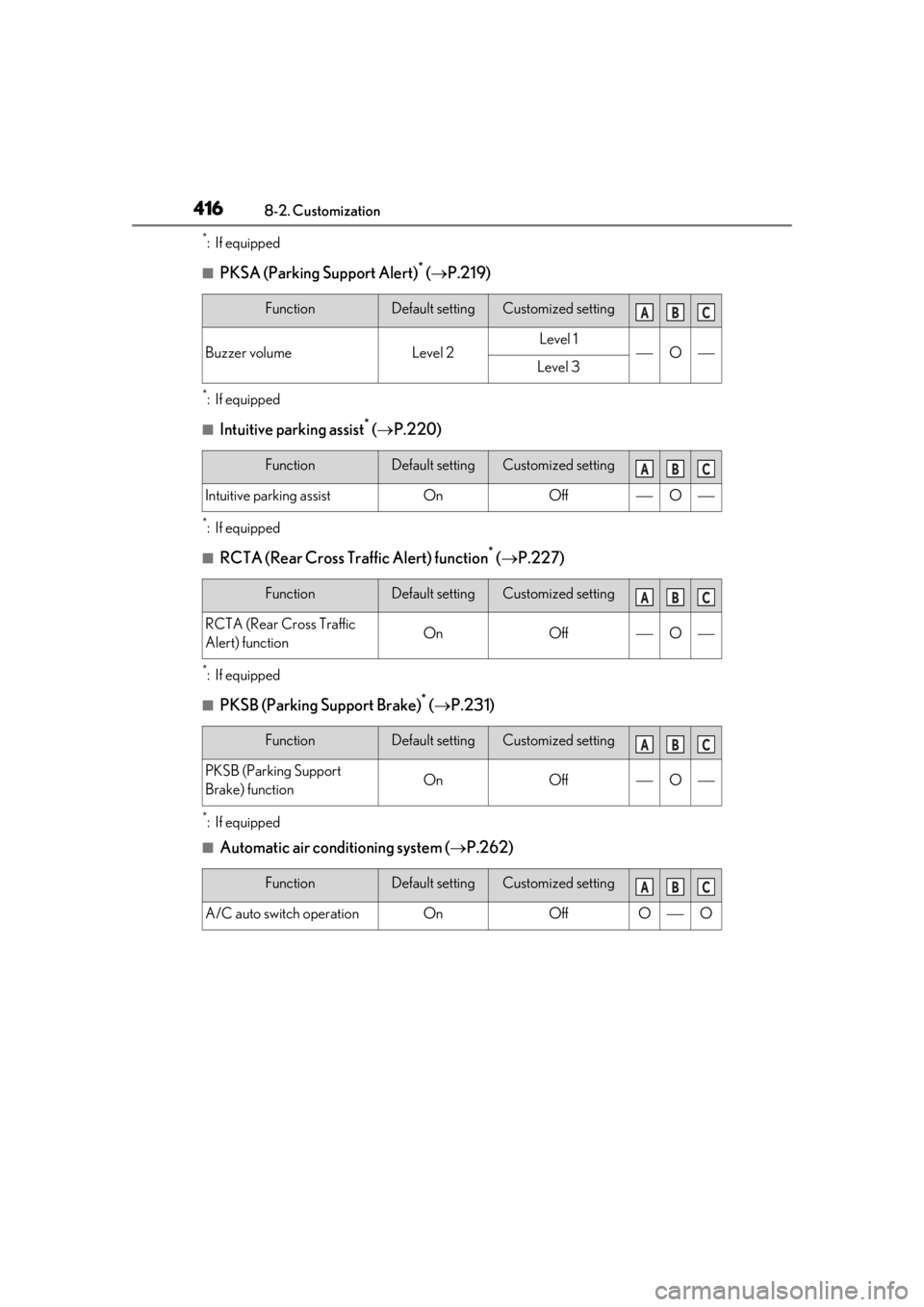
■PKSA (Parking Support Alert)* ( P.219)
*:If equipped
■Intuitive parking assist* ( P.220)
*:If equipped
■RCTA (Rear Cross Traffic Alert) function* ( P.227)
*:If equipped
■PKSB (Parking Support Brake)* ( P.231)
*:If equipped
■Automatic air conditioning system ( P.262)
FunctionDefault settingCustomized setting
Buzzer volumeLevel 2Level 1OLevel 3
FunctionDefault settingCustomized setting
Intuitive parking assistOnOffO
FunctionDefault settingCustomized setting
RCTA (Rear Cross Traffic
Alert) functionOnOffO
FunctionDefault settingCustomized setting
PKSB (Parking Support
Brake) functionOnOffO
FunctionDefault settingCustomized setting
A/C auto switch operationOnOffOO
ABC
ABC
ABC
ABC
ABC
Page 419 of 452
4198-3. Initialization
8
Vehicle specifications
8-3.Initialization
*:If equipped
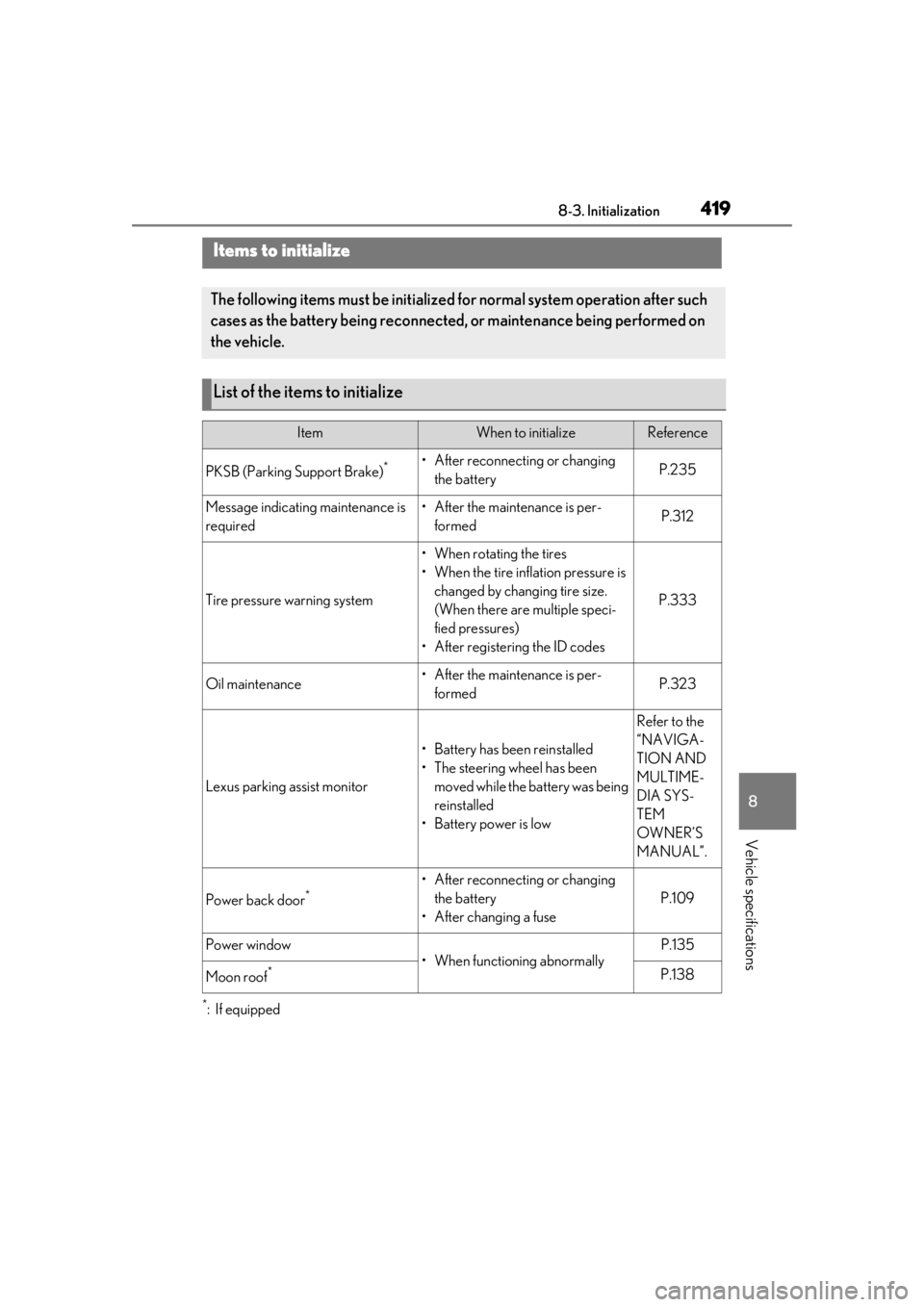
Items to initialize
The following items must be initialized for normal system operation after such
cases as the battery being reconnected, or maintenance being performed on
the vehicle.
List of the items to initialize
ItemWhen to initializeReference
PKSB (Parking Support Brake)*• After reconnecting or changing the batteryP.235
Message indicating maintenance is
required• After the maintenance is per-formedP.312
Tire pressure warning system
• When rotating the tires
• When the tire inflation pressure is changed by changing tire size.
(When there are multiple speci-
fied pressures)
• After registering the ID codes
P.333
Oil maintenance• After the maintenance is per- formedP.323
Lexus parking assist monitor
•Battery has been reinstalled
• The steering wheel has been moved while the battery was being
reinstalled
• Battery power is low
Refer to the
“NAVIGA-
TION AND
MULTIME-
DIA SYS-
TEM
OWNER’S
MANUAL”.
Power back door*• After reconnecting or changing the battery
• After changing a fuse
P.109
Power window
• When functioning abnormally
P.135
Moon roof*P.138
Page 434 of 452

434What to do if... (Troubleshooting)
1-1.What to do if... (Troubleshooting)What to do if... (Troubleshooting)
If you lose your mechanical keys,
new genuine mechanical keys can
be made by your Lexus dealer.
( P.379)
If you lose your electronic keys, the
risk of vehicle theft increases signifi-
cantly. Contact your Lexus dealer
immediately. ( P.379)
Is the electronic key battery weak or
depleted? ( P.341)
Is the engine switch in ON?
When locking the doors, turn the engine
switch off. ( P.152)
Is the electronic key left inside the
vehicle?
When locking the doors, make sure that
you have the electronic key on your per-
son.
The function may not operate prop-
erly due to the condition of the radio
wave. ( P.115)
Is the child-protector lock set?
The rear door cannot be opened
from inside the vehicle when the
lock is set. Open the rear door from
outside and then unlock the child-
protector lock. ( P.101)
Did you press the engine switch
while firmly depressing the brake
pedal? ( P.152)
Is the shift lever in P? ( P.155)
Is the electronic key anywhere
detectable inside the vehicle?
( P.114)
Is the steering wheel unlocked?
( P.152)
Is the electronic key battery weak or
depleted?
In this case, the engine can be
started in a temporary way.
( P.381)
Is the battery discharged?
( P.382)
Is the engine switch in ON?
If you have a problem, check the
following before contacting your
Lexus dealer.
The doors cannot be locked,
unlocked, opened or closed
You lose your keys
The doors cannot be locked or
unlocked
The rear door cannot be opened
If you think something is wrong
The engine does not start
The shift lever cannot be shifted
from P even if you depress the
brake pedal