2019 LEXUS GS300H flat tire
[x] Cancel search: flat tirePage 272 of 600

2724-5. Using the driving support systems
GS450h_300h_OM_OM30F92E_(EE)
WARNING
■Pre-crash braking*3
●When the pre-crash braking function is operating, a large amount of braking force will be applied.
●If the vehicle is stopped by the operation of the pre-crash braking function, the pre-crash braking function operation will be canceled after approximately 2 seconds.Depress the brake pedal as necessary.
●The pre-crash braking function may not operate if certain operations are performedby the driver. If the accelerator pedal is being depressed strongly or the steeringwheel is being turned, the system may determine that the driver is taking evasive
action and possibly prevent the pre-crash braking function from operating.
●In some situations, while the pre-crash braking function is operating, operation of thefunction may be canceled if the accelerator pedal is depressed strongly or the steer-
ing wheel is turned and the system determines that the driver is taking evasive action.
●If the brake pedal is being depressed, the system may determine that the driver is tak-ing evasive action and possibly delay the operation timing of the pre-crash braking
function.
*3: Depending on the region in which the vehicle was sold, the pre-crash braking func-
tion may not be available.
■When to disable the pre-crash safety system
In the following situations, disable the system, as it may not operate properly, possibly
leading to an accident resulting in death or serious injury:
●When the vehicle is being towed
●When your vehicle is towing another vehicle
●When transporting the vehicle via truck, boat, train or similar means of transportation
●When the vehicle is raised on a lift with the hybrid system on and the tires are allowed to rotate freely
●When inspecting the vehicle using a drum tester such as a chassis dynamometer orspeedometer tester, or when using an on vehicle wheel balancer
●When a strong impact is applied to the front bumper or front grille, due to an accident
or other reasons
●If the vehicle cannot be driven in a stable manner, such as when the vehicle has beenin an accident or is malfunctioning
●When the vehicle is driven in a sporty manner or off-road
●When the tires are not properly inflated
●When the tires are very worn
●When tires of a size other than specified are installed
●When tire chains are installed
●When a compact spare tire or an emergency tire puncture repair kit is used
●If equipment (snow plow, etc.) that may obstruct the radar sensor or camera sensor istemporarily installed to the vehicle
Page 280 of 600

2804-5. Using the driving support systems
GS450h_300h_OM_OM30F92E_(EE)
• After the hybrid system has started the vehicle has not been driven for a certain amount of time• While making a left/right turn and for a few seconds after making a left/right turn
• While driving on a curve and for a few seconds after driving on a curve • If your vehicle is skidding
• If the wheels are misaligned • If a wiper blade is blocking the camera sensor
• The vehicle is wobbling. • The vehicle is being driven at extremely high speeds.• When driving on a hill
• If the radar sensor or camera sensor is misaligned
●In some situations such as the following, sufficient braking force may not be obtained,
preventing the system from performing properly:
• If the braking functions cannot operate to their full extent, such as when the brake parts are extremely cold, extremely hot, or wet
• If the vehicle is not properly maintained (brakes or tires are excessively worn, improper tire inflation pressure, etc.)• When the vehicle is being driven on a gravel road or other slippery surface
●Some pedestrians such as the following may not be detected by the radar sensor and
camera sensor, preventing the system from operating properly*4:
• Pedestrians shorter than approximately 1 m (3 .2 ft.) or taller than approximately 2 m
(6.5 ft.) • Pedestrians wearing oversized clothing (a rain coat, long skirt, etc.), making their sil- houette obscure
• Pedestrians who are carrying large baggage, holding an umbrella, etc., hiding part of their body• Pedestrians who are bending forward or squatting
• Pedestrians who are pushing a stroller , wheelchair, bicycle or other vehicle • Groups of pedestrians which are close together• Pedestrians who are wearing white and look extremely bright
• Pedestrians in the dark, such as at night or while in a tunnel • Pedestrians whose clothing appears to be nearly the same color or brightness astheir surroundings
• Pedestrians near walls, fences, guardrails, or large objects • Pedestrians who are on a metal object (manhole cover, steel plate, etc.) on the road• Pedestrians who are walking fast
• Pedestrians who are changing speed abruptly • Pedestrians running out from be hind a vehicle or a large object • Pedestrians who are extremely close to the side of the vehicle (outside rear view
mirror, etc.)
• If the front of the vehicle is raised or low- ered
Page 285 of 600

2854-5. Using the driving support systems
4
Driving
GS450h_300h_OM_OM30F92E_(EE)
WARNING
■Before using LKA system
Do not rely solely upon the LKA system. Th e LKA system does not automatically drive the vehicle or reduce the amount of attention that must be paid to the area in front of
the vehicle. The driver must always assume full responsibility for driving safely by pay- ing careful attention to the surrounding conditions and operating the steering wheel tocorrect the path of the vehicle. Also, the driver must take adequate breaks when
fatigued, such as from driving for a long period of time. Failure to perform appropriate driving operat ions and pay careful attention may lead to an accident, resulting in death or serious injury.
■To avoid operating LKA system by mistake
When not using the LKA system, use the LKA switch to turn the system off.
■Situations unsuitable for LKA system
Do not use the LKA system in the following situations. The system may not operate properly and le ad to an accident, resulting in death or serious injury.
●A spare tire, tire chains, etc. are equipped.
●When the tires have been excessively worn, or when the tire inflation pressure is low.
●Tires which differ by structure, manufacturer, brand or tread pattern are used.
●Objects or patterns that could be mistaken for white (yellow) lines are present on the side of the road (guardrails, cu rbs, reflective poles, etc.).
●Vehicle is driven on a snow-covered road.
●White (yellow) lines are difficult to see due to rain, snow, fog, dust, etc.
●Asphalt repair marks, white (yellow) line marks, etc. are present due to road repair.
●Vehicle is driven in a temporary lane or restricted lane due to construction work.
●Vehicle is driven on a road surface which is slippery due to rainy weather, fallen snow, freezing, etc.
●Vehicle is driven in traffic lanes other than on highways and freeways.
●Vehicle is driven in a construction zone.
●Vehicle is towing a trailer or another vehicle. (vehicles with towing package)
■Preventing LKA system malfunctions and operations performed by mistake
●Do not modify the headlights or place stickers, etc. on the surface of the lights.
●Do not modify the suspension etc. If the suspension etc. needs to be replaced, con- tact any authorized Lexus retailer or Le xus authorized repairer, or any reliable
repairer.
●Do not install or place anything on the hood or grille. Also, do not install a grille guard (bull bars, kangaroo bar, etc.).
●If your windshield needs repairs, contac t any authorized Lexus retailer or Lexus authorized repairer, or any reliable repairer.
Page 330 of 600

3304-5. Using the driving support systems
GS450h_300h_OM_OM30F92E_(EE)
WARNING
■When the VSC is activated
The slip indicator light flashes. Always drive carefully. Reckless driving may cause an accident. Exercise particular care when the indicator light flashes.
■When the TRC/VSC systems are turned off
Be especially careful and drive at a speed appropriate to the road conditions. As these are the systems to help ensure vehicle stability and driving force, do not turn the TRC/
VSC systems off unless necessary.
■Replacing tires
Make sure that all tires are of the specified size, brand, tread pattern and total load
capacity. In addition, make sure that the tires are inflated to the recommended tire infla- tion pressure level.
The ABS, TRC and VSC systems will not function correctly if different tires are installed
on the vehicle. Contact any authorized Lexus retailer or Lexus authorized repairer, or any reliable repairer for further information when replacing tires or wheels.
■Handling of tires and the suspension
Using tires with any kind of problem or modi fying the suspension will affect the driving assist systems, and may cause a system to malfunction.
Page 332 of 600

3324-6. Driving tips
GS450h_300h_OM_OM30F92E_(EE)
◆Delays
Repeated acceleration and deceleration, as well as long waits at traffic lights,
will lead to bad fuel economy. Check traffic reports before leaving and avoid
delays as much as possible. When driving in a traffic jam, gently release the
brake pedal to allow the vehicle to move forward slightly while avoiding over-
use of the accelerator pedal. Doing so can help control excessive gasoline
consumption.
◆Highway driving
Control and maintain the vehicle at a constant speed. Before stopping at a toll
booth or similar, allow plenty of time to release the accelerator and gently
apply the brakes. A greater amount of electrical energy can be regenerated
when slowing down.
◆Air conditioning
Use the air conditioning only when necessary. Doing so can help reduce
excessive gasoline consumption.
In summer: When the ambient temperature is high, use the recirculated air
mode. Doing so will help to reduce the burden on the air conditioning system
and reduce fuel consumption as well.
In winter: Because the gasoline engine will not automatically cut out until it
and the interior of the vehicle are warm, it will consume fuel. Also, fuel con-
sumption can be improved by avoiding overuse of the heater.
◆Checking tire inflation pressure
Make sure to check the tire inflation pressure frequently. Improper tire infla-
tion pressure can cause poor fuel economy.
Also, as snow tires can cause large amounts of friction, their use on dry roads
can lead to poor fuel economy. Use ti res that are appropriate for the season.
Page 389 of 600

389
6Maintenance and care
GS450h_300h_OM_OM30F92E_(EE)
6-1. Maintenance and care
Cleaning and protecting
the vehicle exterior ................390
Cleaning and protecting
the vehicle interior.................. 394
6-2. Maintenance
Maintenance
requirements ............................ 397
6-3. Do-it-yourself maintenance
Do-it-yourself service
precautions................................ 399
Hood ................................................ 401
Positioning a floor jack ............ 402
Engine compartment ...............403
12-volt battery ...............................412
Tires ...................................................416
Tire inflation pressure .............. 429
Wheels ............................................ 431
Air conditioning filter ............... 433
Electronic key battery.............. 435
Checking and replacing
fuses.............................................. 437
Light bulbs..................................... 442
Page 398 of 600

3986-2. Maintenance
GS450h_300h_OM_OM30F92E_(EE)
■Does your vehicle need repairs?
Be on the alert for changes in performance and sounds, and visual tip-offs that indicate service is needed. Some important clues are:
●Engine missing, stumbling or pinging
●Appreciable loss of power
●Strange engine noises
●A fluid leak under the vehicle (However, water dripping from the air conditioning sys-tem after use is normal.)
●Change in exhaust sound (This may indicate a dangerous carbon monoxide leak. Drive
with the windows open and have the exhaust system checked immediately.)
●Flat-looking tires, excessive tire sque al when cornering, uneven tire wear
●Vehicle pulls to one side when driven straight on a level road
●Strange noises related to suspension movement
●Loss of brake effectiveness, spongy feeling brake pedal, pedal almost touches the floor, vehicle pulls to one side when braking
●Engine coolant temperature continually higher than normal ( P. 105)
If you notice any of these clues, take your vehicle to any authorized Lexus retailer or Lexus authorized repairer, or any reliable repairer as soon as possible. Your vehicle may
need adjustment or repair.
WARNING
■If your vehicle is not properly maintained
Improper maintenance could result in serious damage to the vehicle and possible death or serious injury.
■Handling of the 12-volt battery
12-volt battery posts, terminals and related accessories contain lead and lead com- pounds which are known to cause brain damage. Wash your hands after handling.
( P. 412)
Page 399 of 600
399
6
6-3. Do-it-yourself maintenance
Maintenance and care
GS450h_300h_OM_OM30F92E_(EE)
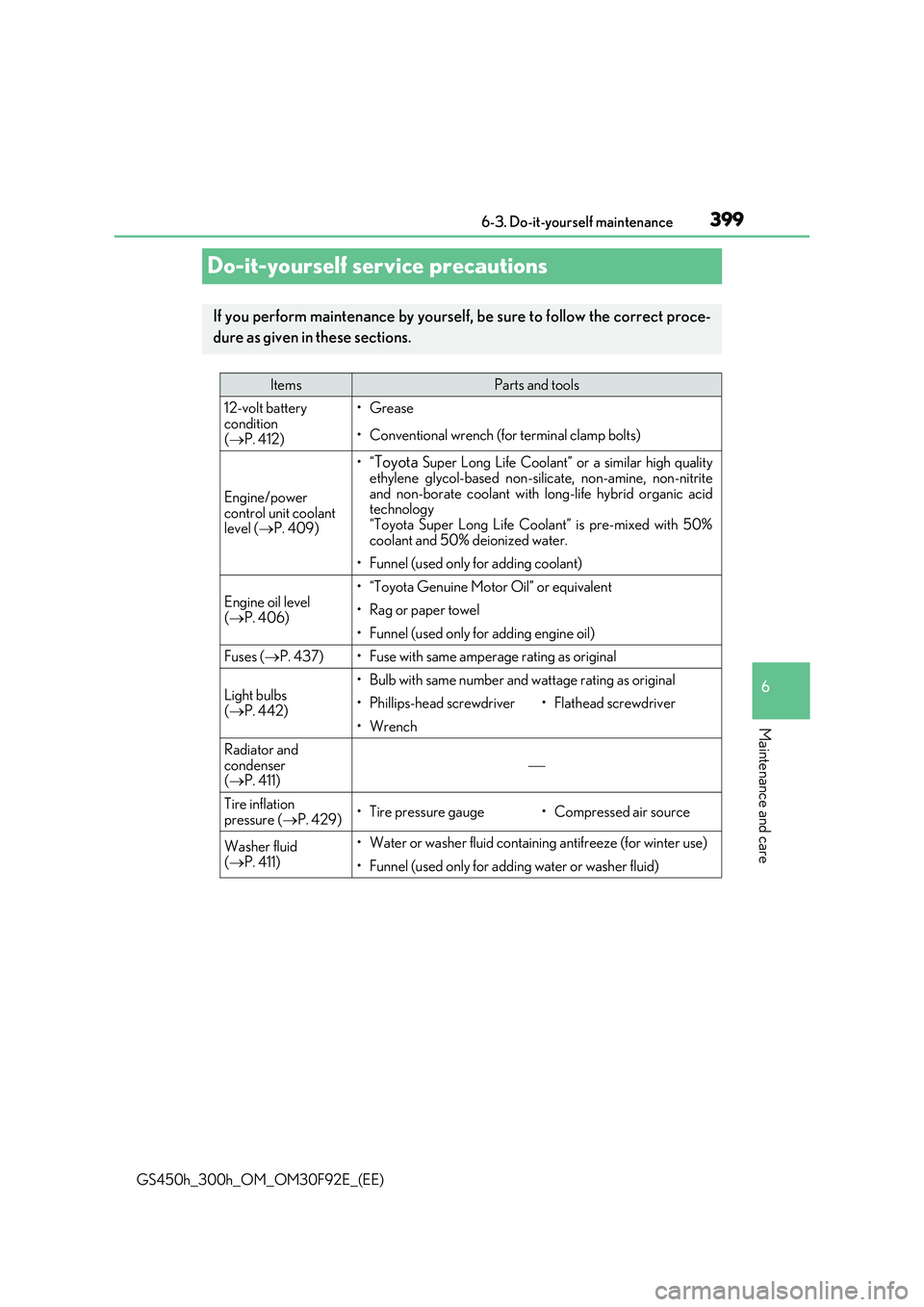
Do-it-yourself service precautions
If you perform maintenance by yourself, be sure to follow the correct proce-
dure as given in these sections.
ItemsParts and tools
12-volt battery
condition ( P. 412)
•Grease
• Conventional wrench (for terminal clamp bolts)
Engine/power
control unit coolant level ( P. 409)
•“Toyota Super Long Life Coolant” or a similar high quality ethylene glycol-based non-silicate, non-amine, non-nitrite
and non-borate coolant with long-life hybrid organic acid technology“Toyota Super Long Life Coolant” is pre-mixed with 50%
coolant and 50% deionized water.
• Funnel (used only for adding coolant)
Engine oil level ( P. 406)
• “Toyota Genuine Motor Oil” or equivalent
•Rag or paper towel
• Funnel (used only for adding engine oil)
Fuses (P. 437)• Fuse with same amperage rating as original
Light bulbs ( P. 442)
• Bulb with same number and wattage rating as original
• Phillips-head screwdriver• Flathead screwdriver
•Wrench
Radiator and condenser ( P. 411)
Tire inflation
pressure ( P. 429)• Tire pressure gauge• Compressed air source
Washer fluid
( P. 411)
• Water or washer fluid containing antifreeze (for winter use)
• Funnel (used only for adding water or washer fluid)