2019 KIA SOUL steering wheel
[x] Cancel search: steering wheelPage 438 of 564
What to do in an emergency
30
7
Emergency towing precautions
Turn the ignition switch to ACC so
the steering wheel isn’t locked.
Place the transaxle shift lever in N (Neutral).
Release the parking brake.
Press the brake pedal with more force than usual since you will have
reduced brake performance.
More steering effort will be required because the power steer-
ing system will be disabled.
If you are driving down a long hill, the brakes may overheat and brake
performance will be reduced. Stop
often and let the brakes cool off.
If the car is being towed with all four wheels on the ground, it can
be towed only from the front. Be
sure that the transaxle is in neutral.
Be sure the steering is unlocked by
placing the ignition switch in the
ACC position. A driver must be in
the towed vehicle to operate the
steering and brakes.
✽ ✽ NOTICE
Before towing, check the automatic
transaxle for fluid leaks under your
vehicle. If the automatic transaxle
fluid is leaking, a flatbed equipment
or towing dolly must be used.
CAUTION- Automatic
transaxle
To avoid serious damage to theautomatic transaxle, limit thevehicle speed to 15 km/h (10mph) and drive less than 1.5 km(1 mile) when towing.
Page 446 of 564
Maintenance
88
While operating your vehicle:
Note any changes in the sound ofthe exhaust or any smell of
exhaust fumes in the vehicle.
Check for vibrations in the steering wheel. Notice any increased steer-
ing effort or looseness in the steer-
ing wheel, or change in its straight-
ahead position.
Notice if your vehicle constantly turns slightly or "pulls" to one side
when traveling on smooth, level
roads.
When stopping, listen and check for unusual sounds, pulling to one
side, increased brake pedal travel
or “hard-to-push” brake pedal.
If any slipping or changes in the operation of your transaxle occurs,
check the transaxle fluid level.
Check the automatic transaxle P (Park) function.
Check the parking brake.
Check for fluid leaks under your vehicle (water dripping from the air
conditioning system during or after
use is normal).
At least monthly:
Check the coolant level in theengine coolant reservoir.
Check the operation of all exterior lights, including the stoplights, turn
signals and hazard warning flash-
ers.
Check the inflation pressures of all tires including the spare.
At least twice a year
(i.e., every Spring and Fall):
Check the radiator, heater and air conditioning hoses for leaks or
damage.
Check the windshield washer spray and wiper operation. Clean
the wiper blades with clean cloth
dampened with washer fluid.
Check the headlight alignment.
Check the muffler, exhaust pipes, shields and clamps.
Check the lap/shoulder belts for wear and function.
Check for worn tires and loose wheel lug nuts.
Page 463 of 564
825
Maintenance
Brake/clutch (if equipped) fluid
Check the brake fluid level in the
brake fluid reservoir. The level should
be between “MIN” and “MAX” marks
on the side of the reservoir. Use only
hydraulic brake fluid conforming to
DOT 3 or DOT 4 specification.
Parking brake
Inspect the parking brake system
including the parking brake lever (or
pedal) and cables.
Brake discs, pads, calipers
and rotors
Check the pads for excessive wear,
discs for run out and wear, and
calipers for fluid leakage.
Exhaust pipe and muffler
Visually inspect the exhaust pipes,
muffler and hangers for cracks, dete-
rioration, or damage. Start the
engine and listen carefully for any
exhaust gas leakage. Tighten con-
nections or replace parts as neces-
sary.
Suspension mounting bolts
Check the suspension connections
for looseness or damage. Retighten
to the specified torque.
Steering gear box, linkage &
boots/lower arm ball joint
With the vehicle stopped and engine
off, check for excessive free-play in
the steering wheel.
Check the linkage for bends or dam-
age. Check the dust boots and ball
joints for deterioration, cracks, or
damage. Replace any damaged
parts.
Page 538 of 564
Maintenance
100
8
Taking care of leather seats
Vacuum the seat periodically to
remove dust and sand on the seat.
It will prevent abrasion or damage of
the leather and maintain its quality.
Wipe the natural leather seat cover often with dry or soft cloth.
Sufficient use of a leather protec- tive may prevent abrasion of the
cover and helps maintain the color.
Be sure to read the instructions
and consult a specialist when
using leather coating or protective
agents.
Leather with bright colors(beige, cream beige) is easily contaminat-
ed and clear in appearance. Clean
the seats frequently.
Avoid wiping with wet cloth. It may cause the surface to crack.
Cleaning the leather seats
Remove all contaminations instant-ly. Refer to instructions below for
removal of each contaminant.
Cosmetic products(sunscreen, foundation, etc.)
- Apply cleansing cream on a clothand wipe the contaminated point.
Wipe off the cream with a wet
cloth and remove water with a dry
cloth.
Beverages(coffee, soft drink, etc.) - Apply a small amount of neutraldetergent and wipe until contami-
nations do not smear.
Oil - Remove oil immediately withabsorbable cloth and wipe with
stain remover for natural leather
only.
Chewing gum - Harden the gum with ice andremove gradually.CAUTION- Electrical
components
Never allow water or other liq-uids to come in contact withelectrical/electronic compo-nents inside the vehicle as thismay damage them.
CAUTION- Leather
When cleaning leather products(steering wheel, seats etc.), useneutral detergents or low alco-hol content solutions. If you usehigh alcohol content solutionsor acid/alkaline detergents, thecolor of the leather may fade orthe surface may get stripped off.
Page 563 of 564
I9
Index
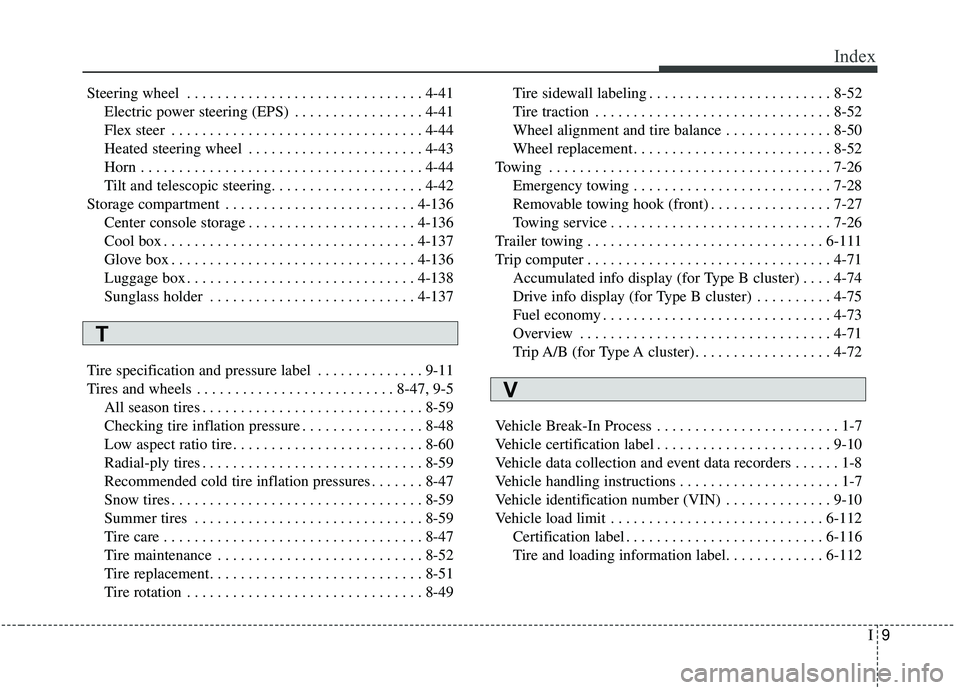
Steering wheel . . . . . . . . . . . . . . . . . . . . . . . . . . . . . . . 4-41Electric power steering (EPS) . . . . . . . . . . . . . . . . . 4-41
Flex steer . . . . . . . . . . . . . . . . . . . . . . . . . . . . . . . . . 4-44
Heated steering wheel . . . . . . . . . . . . . . . . . . . . . . . 4-43
Horn . . . . . . . . . . . . . . . . . . . . . . . . . . . . . . . . . . . . \
. 4-44
Tilt and telescopic steering. . . . . . . . . . . . . . . . . . . . 4-42
Storage compartment . . . . . . . . . . . . . . . . . . . . . . . . . 4-136 Center console storage . . . . . . . . . . . . . . . . . . . . . . 4-136
Cool box . . . . . . . . . . . . . . . . . . . . . . . . . . . . . . . . . 4-137
Glove box . . . . . . . . . . . . . . . . . . . . . . . . . . . . . . . . 4-136
Luggage box . . . . . . . . . . . . . . . . . . . . . . . . . . . . . . 4-138
Sunglass holder . . . . . . . . . . . . . . . . . . . . . . . . . . . 4-137
Tire specification and pressure label . . . . . . . . . . . . . . 9-11
Tires and wheels . . . . . . . . . . . . . . . . . . . . . . . . . . 8-47, 9-5 All season tires . . . . . . . . . . . . . . . . . . . . . . . . . . . . . 8-59
Checking tire inflation pressure . . . . . . . . . . . . . . . . 8-48
Low aspect ratio tire. . . . . . . . . . . . . . . . . . . . . . . . . 8-60
Radial-ply tires . . . . . . . . . . . . . . . . . . . . . . . . . . . . . 8-59
Recommended cold tire inflation pressures . . . . . . . 8-47
Snow tires . . . . . . . . . . . . . . . . . . . . . . . . . . . . . . . . . 8-59
Summer tires . . . . . . . . . . . . . . . . . . . . . . . . . . . . . . 8-59
Tire care . . . . . . . . . . . . . . . . . . . . . . . . . . . . . . . . . . 8-47\
Tire maintenance . . . . . . . . . . . . . . . . . . . . . . . . . . . 8-52
Tire replacement . . . . . . . . . . . . . . . . . . . . . . . . . . . . 8-51
Tire rotation . . . . . . . . . . . . . . . . . . . . . . . . . . . . . . . 8-49 Tire sidewall labeling . . . . . . . . . . . . . . . . . . . . . . . . 8-52
Tire traction . . . . . . . . . . . . . . . . . . . . . . . . . . . . . . . 8-52
Wheel alignment and tire balance . . . . . . . . . . . . . . 8-50
Wheel replacement . . . . . . . . . . . . . . . . . . . . . . . . . . 8-52
Towing . . . . . . . . . . . . . . . . . . . . . . . . . . . . . . . . . . . . \
. 7-26 Emergency towing . . . . . . . . . . . . . . . . . . . . . . . . . . 7-28
Removable towing hook (front) . . . . . . . . . . . . . . . . 7-27
Towing service . . . . . . . . . . . . . . . . . . . . . . . . . . . . . 7-26
Trailer towing . . . . . . . . . . . . . . . . . . . . . . . . . . . . . . . 6-111
Trip computer . . . . . . . . . . . . . . . . . . . . . . . . . . . . . . . . 4-71 Accumulated info display (for Type B cluster) . . . . 4-74
Drive info display (for Type B cluster) . . . . . . . . . . 4-75
Fuel economy . . . . . . . . . . . . . . . . . . . . . . . . . . . . . . 4-73
Overview . . . . . . . . . . . . . . . . . . . . . . . . . . . . . . . . . 4-71
Trip A/B (for Type A cluster) . . . . . . . . . . . . . . . . . . 4-72
Vehicle Break-In Process . . . . . . . . . . . . . . . . . . . . . . . . 1-7
Vehicle certification label . . . . . . . . . . . . . . . . . . . . . . . 9-10
Vehicle data collection and event data recorders . . . . . . 1-8
Vehicle handling instructions . . . . . . . . . . . . . . . . . . . . . 1-7
Vehicle identification number (VIN) . . . . . . . . . . . . . . 9-10
Vehicle load limit . . . . . . . . . . . . . . . . . . . . . . . . . . . . 6-112 Certification label . . . . . . . . . . . . . . . . . . . . . . . . . . 6-116
Tire and loading information label. . . . . . . . . . . . . 6-112
T
V