2019 KIA SOUL power steering
[x] Cancel search: power steeringPage 337 of 564
647
Driving your vehicle
Vehicle stability management
(VSM)
This system provides further
enhancements to vehicle stability
and steering responses when a vehi-
cle is driving on a slippery road or a
vehicle detects changes in coeffi-
cient of friction between right wheels
and left wheels when braking.
VSM operation
When the VSM is in operation, ESC
indicator light ( ) blinks.
When the vehicle stability manage-
ment is operating properly, you can
feel a slight pulsation in the vehicle
and/or abnormal steering responses
(EPS). This is only the effect of brake
and EPS control and indicates noth-
ing unusual.The VSM does not operate when:
Driving on bank road such as gra-
dient or incline
Driving in reverse
ESC OFF indicator light ( ) remains on the instrument cluster
EPS indicator light remains on the instrument cluster
VSM operation off
If you press the ESC OFF button to
turn off the ESC, the VSM will also
cancel and the ESC OFF indicator
light ( ) illuminates.
To turn on the VSM, press the button
again. The ESC OFF indicator light
goes out.
Malfunction indicator
The VSM can be deactivated even if
you don’t cancel the VSM operation
by pressing the ESC OFF button. It
indicates that a malfunction has
been detected somewhere in the
Electric Power Steering system or
VSM system. If the ESC indicator
light ( ) or EPS warning light
remains on, take your vehicle to an
authorized Kia dealer and have the
system checked.
✽ ✽ NOTICE
• The VSM is designed to function
above approximately 13 mph (22
km/h) on curves.
• The VSM is designed to function above approximately 6 mph (10
km/h) when a vehicle is braking on
a split-mu road. The split-mu road
is made of surfaces which have dif-
ferent friction forces.
Page 344 of 564
Driving your vehicle
54
6
Brake operation
In an urgent situation, the braking
system enters into the ready status
for prompt reaction against the dri-
ver’s depressing the brake pedal.
The AEB provides additional brak- ing power for optimum braking per-
formance, when the driver
depresses the brake pedal.
The braking control is automatical- ly deactivated, when the driver
sharply depresses the accelerator
pedal, or when the driver abruptly
operates the steering wheel.
The braking control is automatical- ly canceled, when risk factors dis-
appear.
The driver should always exercise
caution when operating the vehicle,
even though there is no warning
message or warning alarm.
✽ ✽ NOTICE
The AEB operates in accordance
with the risk levels, such as the dis-
tance from the vehicle/passer-by in
front, the speed of the vehicle/pass-
er-by in front, and the driver's vehi-
cle operation.
✽ ✽NOTICE
The AEB system logic operates with-
in certain parameters, such as the
distance from the vehicle or pedes-
trian ahead, the speed of the vehicle
ahead, and the driver's vehicle
speed. Certain conditions such as
inclement weather and road condi-
tions may affect the operation of the
AEB system.WARNING
The AEB cannot avoid all colli-
sions. The AEB might not com-
pletely stop the vehicle before
collision, due to ambient weath-
er and road conditions. The
driver has the responsibility to
drive safely and control the
vehicle.
WARNING
The AEB braking control is a
supplemental system and can-
not completely stop the vehicle
nor avoid all collisions. It is the
responsibility of the driver to
safely drive and control the
vehicle.
WARNING
Never deliberately drive danger-
ously to activate the system as
such conduct increases the risk
of an accident.
Page 377 of 564
687
Driving your vehicle
When Active ECO is activated:
The acceleration may slightly bereduced even though you depress
the accelerator fully.
The air conditioner performance may be limited
The shift pattern of the automatic transaxle may change.
The engine noise may get louder.
The above situations are normal
conditions when the active eco sys-
tem is activated to improve fuel effi-
ciency. Limitation of Active ECO operation:
If the following conditions occur while
Active ECO is operating, the system
operation is limited even though there
is no change in the ECO indicator.
When the coolant temperature is
low:
The system will be limited until
engine performance becomes nor-
mal.
When driving up a hill: The system will be limited to gain
power when driving uphill because
the engine torque is restricted.
When using manual mode: The system will be limited accord-
ing to the shift location.
When the accelerator pedal is deeply depressed for a few seconds:
The system will be limited, judging
that the driver wants to speed up.SPORT mode
SPORT mode focuses on dynamic
driving by automatically controlling
the steering wheel, engine and
transaxle system.
When the DRIVE MODE button ispressed and the SPORT mode is
selected, the SPORT indicator
(yellow) will illuminate.
Whenever the hybrid system is restarted, the Drive Mode will revert
back to ECO mode. If SPORT mode
is desired, re-select SPORT mode
from the DRIVE MODE button
If the system is activated: - After speeding, it maintains thegear and RPM for some time
even though the accelerator
pedal is not depressed.
- Up-shifting is delayed.
✽ ✽
NOTICE
In Sport drive mode, the fuel effi-
ciency may decrease.
Page 392 of 564

Driving your vehicle
102
6
Remember, your vehicle does not
require extended warm-up. After
the engine has started, allow the
engine to run for 10 to 20 seconds
prior to placing the vehicle in gear.
In very cold weather, however, give
your engine a slightly longer warm-
up period.
Don't "lug" or "over-rev" the engine. Lugging is driving too slowly in a
very high gear resulting in engine
bucking. If this happens, shift to a
lower gear. Over-revving is racing
the engine beyond its safe limit.
This can be avoided by shifting at
the recommended speed. Use your air conditioning sparingly.
The air conditioning system is
operated by engine power so your
fuel economy is reduced when you
use it.
Open windows at high speeds can reduce fuel economy.
Fuel economy is less in crosswinds and headwinds. To help offset
some of this loss, slow down when
driving in these conditions.
Keeping a vehicle in good operating
condition is important both for econ-
omy and safety. Therefore, have an
authorized Kia dealer perform
scheduled inspections and mainte-
nance.
WARNING
- Engine off during motion
Never turn the engine off to
coast down hills or anytime the
vehicle is in motion. The power
steering and power brakes will
not function properly without
the engine running. In addition,
turning off the ignition while
driving could engage the steer-
ing wheel lock resulting in loss
of vehicle steering. Keep the
engine on and downshift to an
appropriate gear for engine
braking effect.
Page 436 of 564
What to do in an emergency
28
7
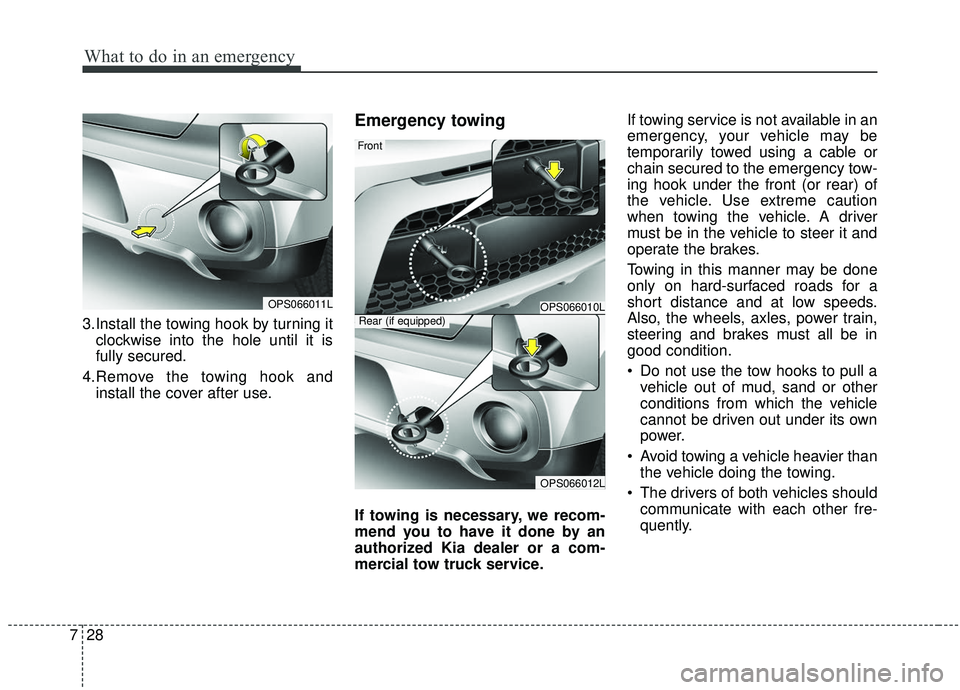
3.Install the towing hook by turning it
clockwise into the hole until it is
fully secured.
4.Remove the towing hook and install the cover after use.
Emergency towing
If towing is necessary, we recom-
mend you to have it done by an
authorized Kia dealer or a com-
mercial tow truck service. If towing service is not available in an
emergency, your vehicle may be
temporarily towed using a cable or
chain secured to the emergency tow-
ing hook under the front (or rear) of
the vehicle. Use extreme caution
when towing the vehicle. A driver
must be in the vehicle to steer it and
operate the brakes.
Towing in this manner may be done
only on hard-surfaced roads for a
short distance and at low speeds.
Also, the wheels, axles, power train,
steering and brakes must all be in
good condition.
Do not use the tow hooks to pull a
vehicle out of mud, sand or other
conditions from which the vehicle
cannot be driven out under its own
power.
Avoid towing a vehicle heavier than the vehicle doing the towing.
The drivers of both vehicles should communicate with each other fre-
quently.
OPS066011LOPS066010L
OPS066012L
Front
Rear (if equipped)
Page 438 of 564
What to do in an emergency
30
7
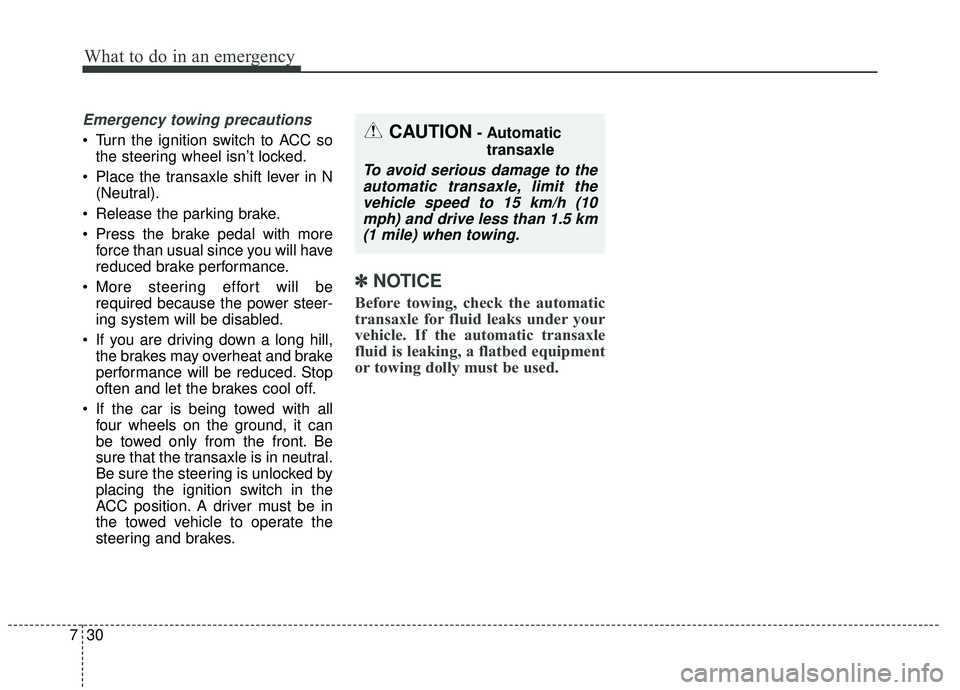
Emergency towing precautions
Turn the ignition switch to ACC so
the steering wheel isn’t locked.
Place the transaxle shift lever in N (Neutral).
Release the parking brake.
Press the brake pedal with more force than usual since you will have
reduced brake performance.
More steering effort will be required because the power steer-
ing system will be disabled.
If you are driving down a long hill, the brakes may overheat and brake
performance will be reduced. Stop
often and let the brakes cool off.
If the car is being towed with all four wheels on the ground, it can
be towed only from the front. Be
sure that the transaxle is in neutral.
Be sure the steering is unlocked by
placing the ignition switch in the
ACC position. A driver must be in
the towed vehicle to operate the
steering and brakes.
✽ ✽ NOTICE
Before towing, check the automatic
transaxle for fluid leaks under your
vehicle. If the automatic transaxle
fluid is leaking, a flatbed equipment
or towing dolly must be used.
CAUTION- Automatic
transaxle
To avoid serious damage to theautomatic transaxle, limit thevehicle speed to 15 km/h (10mph) and drive less than 1.5 km(1 mile) when towing.
Page 506 of 564

Maintenance
68
8
Inner fuse panel
Description Fuse rating Protected component
POWER OUTLET 20A P_OUTLET
ACC 10AO_S_MIRR_SW, AMP, AUDIO/UVO/AVN 4.0_HEAD UNIT, BCM, MOOD_LAMP_UNIT, SMK_UNIT,
LDC_AMP(400W), LDC_AMP(200W), ISG, USB_CHARGER, ICM_BOX(POWER_OUTLET_RLY_COIL),
E_CALL_UNIT
HEAD LAMP 25A C/LIGHT, REAR_P_OUTLET
DRL 10A BCM(DAY_RUNNNIG_LIGHT_LAMP_POWER)
MODULE 6 7.5ASUNROOF_MOTOR, LUGGAGE_PORTABLE_LAMP(CHARGE_POWER), SEAT_EXTN_DRV(HEAT-
ED), REAR_SEAT(IGN2)
WIPER FRT 2 25A FRONT_WIPER_MOTOR(POWER), FRONT_WIPER_RLY(LOW)
WIPER RR 15AREAR_WIPER_MOTOR, MULTI_FUNCTION_SW(WIPER), REAR_WIPER_RLY,
REAR_WIPER_RLY_COIL,
AMP 30A AMP, LDC_AMP(400W)
MODULE 5 7.5A BCM, SMK_UNIT
WIPER FRT 1 10A MULTI_FUNCTION_SW(WIPER), BCM(WASHER_MOTOR_POWER),
HEATED STEERING 15A STEERING_HEATED A/CON 1 7.5A AIR_CONTROL_UNIT(MANUAL, AUTO), IONIZER, PTC_RLY_COIL, BLOWER_RLY_COIL
HEATED MIRROR 10A OUTSIDE_MIRROR(HEATED), ECU(ELEC. LOAD DEFROST),
AIR_CONTROL_UNIT_MANUAL/AUTO(HEATED_SIGNAL)
Page 563 of 564
I9
Index
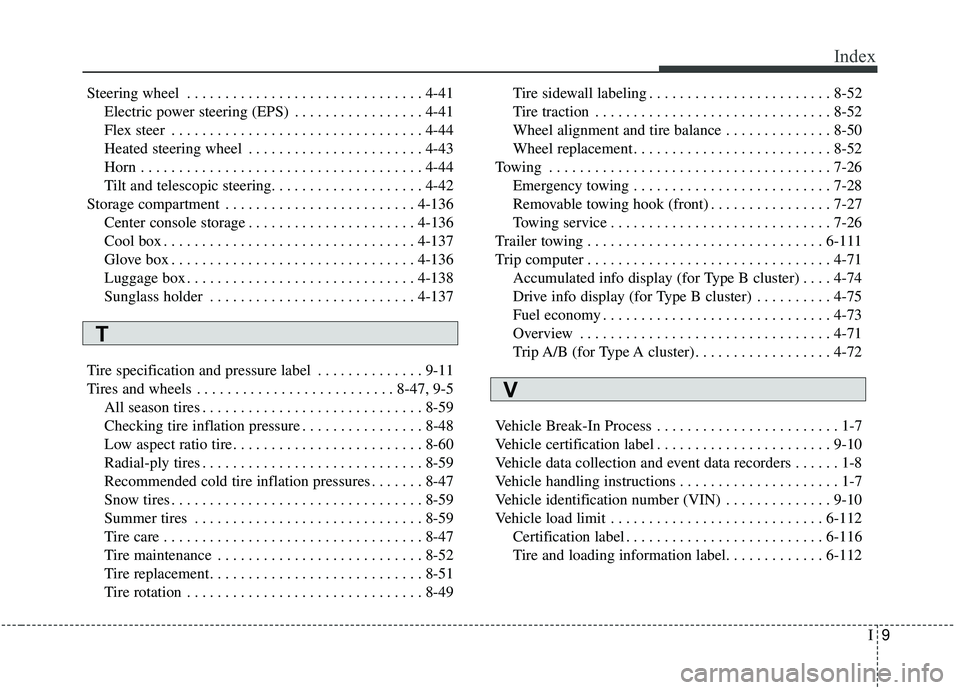
Steering wheel . . . . . . . . . . . . . . . . . . . . . . . . . . . . . . . 4-41Electric power steering (EPS) . . . . . . . . . . . . . . . . . 4-41
Flex steer . . . . . . . . . . . . . . . . . . . . . . . . . . . . . . . . . 4-44
Heated steering wheel . . . . . . . . . . . . . . . . . . . . . . . 4-43
Horn . . . . . . . . . . . . . . . . . . . . . . . . . . . . . . . . . . . . \
. 4-44
Tilt and telescopic steering. . . . . . . . . . . . . . . . . . . . 4-42
Storage compartment . . . . . . . . . . . . . . . . . . . . . . . . . 4-136 Center console storage . . . . . . . . . . . . . . . . . . . . . . 4-136
Cool box . . . . . . . . . . . . . . . . . . . . . . . . . . . . . . . . . 4-137
Glove box . . . . . . . . . . . . . . . . . . . . . . . . . . . . . . . . 4-136
Luggage box . . . . . . . . . . . . . . . . . . . . . . . . . . . . . . 4-138
Sunglass holder . . . . . . . . . . . . . . . . . . . . . . . . . . . 4-137
Tire specification and pressure label . . . . . . . . . . . . . . 9-11
Tires and wheels . . . . . . . . . . . . . . . . . . . . . . . . . . 8-47, 9-5 All season tires . . . . . . . . . . . . . . . . . . . . . . . . . . . . . 8-59
Checking tire inflation pressure . . . . . . . . . . . . . . . . 8-48
Low aspect ratio tire. . . . . . . . . . . . . . . . . . . . . . . . . 8-60
Radial-ply tires . . . . . . . . . . . . . . . . . . . . . . . . . . . . . 8-59
Recommended cold tire inflation pressures . . . . . . . 8-47
Snow tires . . . . . . . . . . . . . . . . . . . . . . . . . . . . . . . . . 8-59
Summer tires . . . . . . . . . . . . . . . . . . . . . . . . . . . . . . 8-59
Tire care . . . . . . . . . . . . . . . . . . . . . . . . . . . . . . . . . . 8-47\
Tire maintenance . . . . . . . . . . . . . . . . . . . . . . . . . . . 8-52
Tire replacement . . . . . . . . . . . . . . . . . . . . . . . . . . . . 8-51
Tire rotation . . . . . . . . . . . . . . . . . . . . . . . . . . . . . . . 8-49 Tire sidewall labeling . . . . . . . . . . . . . . . . . . . . . . . . 8-52
Tire traction . . . . . . . . . . . . . . . . . . . . . . . . . . . . . . . 8-52
Wheel alignment and tire balance . . . . . . . . . . . . . . 8-50
Wheel replacement . . . . . . . . . . . . . . . . . . . . . . . . . . 8-52
Towing . . . . . . . . . . . . . . . . . . . . . . . . . . . . . . . . . . . . \
. 7-26 Emergency towing . . . . . . . . . . . . . . . . . . . . . . . . . . 7-28
Removable towing hook (front) . . . . . . . . . . . . . . . . 7-27
Towing service . . . . . . . . . . . . . . . . . . . . . . . . . . . . . 7-26
Trailer towing . . . . . . . . . . . . . . . . . . . . . . . . . . . . . . . 6-111
Trip computer . . . . . . . . . . . . . . . . . . . . . . . . . . . . . . . . 4-71 Accumulated info display (for Type B cluster) . . . . 4-74
Drive info display (for Type B cluster) . . . . . . . . . . 4-75
Fuel economy . . . . . . . . . . . . . . . . . . . . . . . . . . . . . . 4-73
Overview . . . . . . . . . . . . . . . . . . . . . . . . . . . . . . . . . 4-71
Trip A/B (for Type A cluster) . . . . . . . . . . . . . . . . . . 4-72
Vehicle Break-In Process . . . . . . . . . . . . . . . . . . . . . . . . 1-7
Vehicle certification label . . . . . . . . . . . . . . . . . . . . . . . 9-10
Vehicle data collection and event data recorders . . . . . . 1-8
Vehicle handling instructions . . . . . . . . . . . . . . . . . . . . . 1-7
Vehicle identification number (VIN) . . . . . . . . . . . . . . 9-10
Vehicle load limit . . . . . . . . . . . . . . . . . . . . . . . . . . . . 6-112 Certification label . . . . . . . . . . . . . . . . . . . . . . . . . . 6-116
Tire and loading information label. . . . . . . . . . . . . 6-112
T
V