2019 KIA SORENTO all
[x] Cancel search: allPage 409 of 573
Driving your vehicle
132
5
If you do decide to pull a trailer
Here are some important points if
you decide to pull a trailer:
Consider using a sway control. You
can ask a hitch dealer about sway
control.
Do not do any towing with your vehicle during its first 2,000 km
(1,200 miles) in order to allow the
engine to properly break in. Failure
to heed this caution may result in
serious engine or transmission
damage.
When towing a trailer, be sure to consult an authorized Kia dealer
for further information on additional
requirements such as a towing kit,
etc.
Always drive your vehicle at a mod- erate speed (less than 100 km/h
(60 mph)).
On a long uphill grade, do not exceed 70 km/h (45 mph) or the
posted towing speed limit,
whichever is lower.
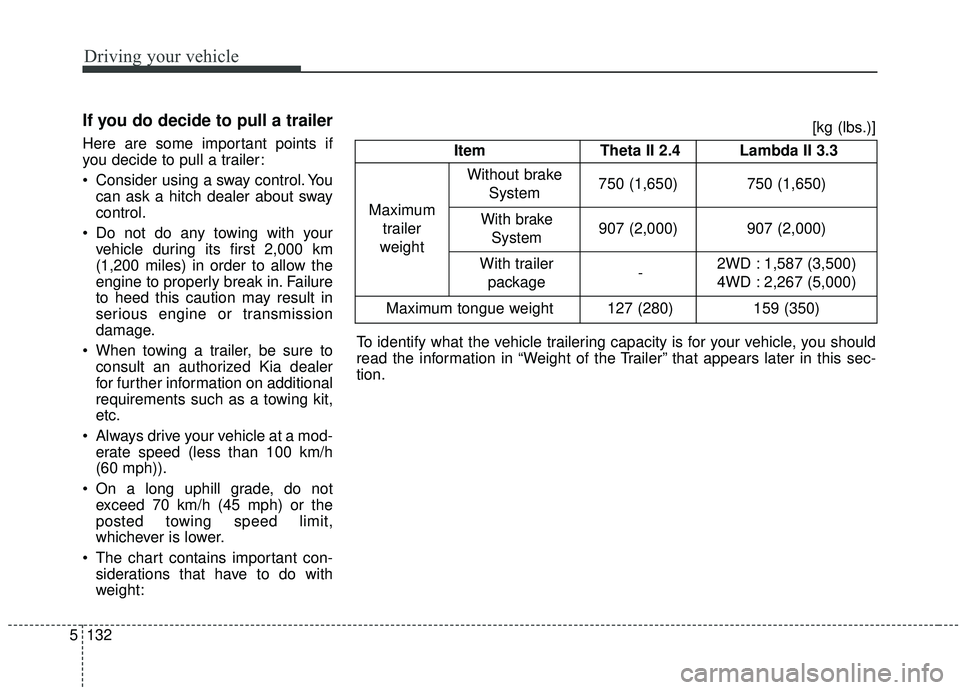
The chart contains important con- siderations that have to do with
weight: Item Theta II 2.4 Lambda II 3.3
Maximum trailer
weight Without brake
System 750 (1,650) 750 (1,650)
With brake
System907 (2,000) 907 (2,000)
With trailer package -2WD : 1,587 (3,500)
4WD : 2,267 (5,000)
Maximum tongue weight 127 (280) 159 (350)
To identify what the vehicle trailering capacity is for your vehicle, you should
read the information in “Weight of the Trailer” that appears later in this sec-
tion. [kg (lbs.)]
Page 410 of 573
5133
Driving your vehicle
Weight of the trailer
What is the maximum safe weight of
a trailer? It should never weigh more
than the maximum trailer weight with
trailer brakes. But even that can be
too heavy.
It depends on how you plan to use
your trailer. For example, speed, alti-
tude, road grades, outside tempera-
ture and how often your vehicle is
used to pull a trailer are all important.
The ideal trailer weight can also
depend on any special equipment
that you have on your vehicle.
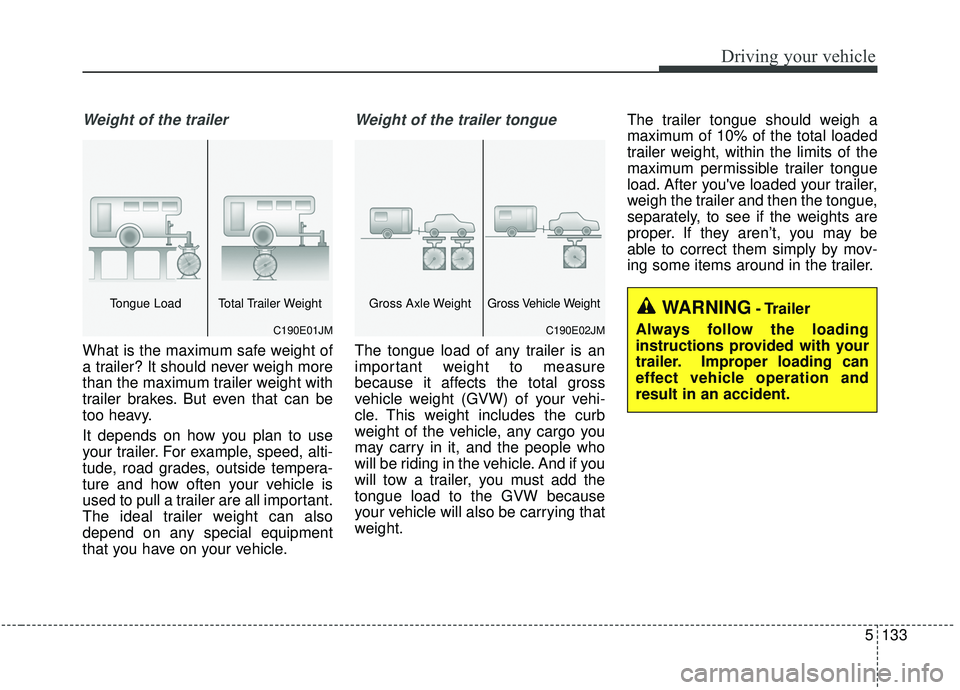
Weight of the trailer tongue
The tongue load of any trailer is an
important weight to measure
because it affects the total gross
vehicle weight (GVW) of your vehi-
cle. This weight includes the curb
weight of the vehicle, any cargo you
may carry in it, and the people who
will be riding in the vehicle. And if you
will tow a trailer, you must add the
tongue load to the GVW because
your vehicle will also be carrying that
weight.The trailer tongue should weigh a
maximum of 10% of the total loaded
trailer weight, within the limits of the
maximum permissible trailer tongue
load. After you've loaded your trailer,
weigh the trailer and then the tongue,
separately, to see if the weights are
proper. If they aren’t, you may be
able to correct them simply by mov-
ing some items around in the trailer.
C190E01JM
Tongue Load Total Trailer Weight
C190E02JM
Gross Axle WeightGross Vehicle WeightWARNING- Trailer
Always follow the loading
instructions provided with your
trailer. Improper loading can
effect vehicle operation and
result in an accident.
Page 412 of 573
5135
Driving your vehicle
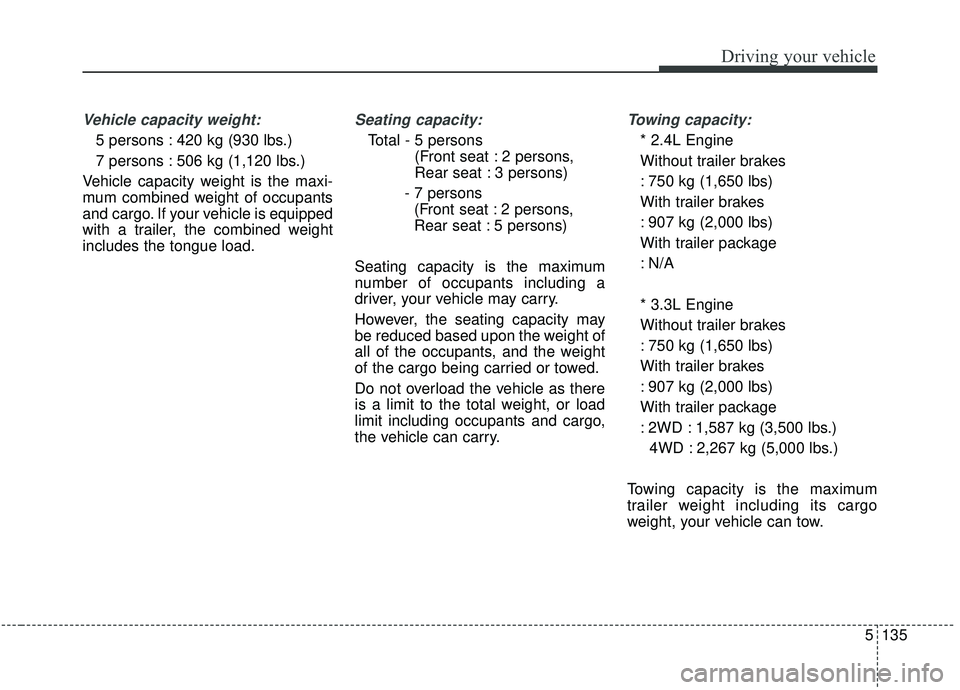
Vehicle capacity weight:
5 persons : 420 kg (930 lbs.)
7 persons : 506 kg (1,120 lbs.)
Vehicle capacity weight is the maxi-
mum combined weight of occupants
and cargo. If your vehicle is equipped
with a trailer, the combined weight
includes the tongue load.
Seating capacity:
Total - 5 persons (Front seat : 2 persons,
Rear seat : 3 persons)
- 7 persons (Front seat : 2 persons,
Rear seat : 5 persons)
Seating capacity is the maximum
number of occupants including a
driver, your vehicle may carry.
However, the seating capacity may
be reduced based upon the weight of
all of the occupants, and the weight
of the cargo being carried or towed.
Do not overload the vehicle as there
is a limit to the total weight, or load
limit including occupants and cargo,
the vehicle can carry.
Towing capacity:
* 2.4L Engine
Without trailer brakes
: 750 kg (1,650 lbs)
With trailer brakes
: 907 kg (2,000 lbs)
With trailer package
: N/A
* 3.3L Engine
Without trailer brakes
: 750 kg (1,650 lbs)
With trailer brakes
: 907 kg (2,000 lbs)
With trailer package
: 2WD : 1,587 kg (3,500 lbs.) 4WD : 2,267 kg (5,000 lbs.)
Towing capacity is the maximum
trailer weight including its cargo
weight, your vehicle can tow.
Page 415 of 573
Driving your vehicle
138
5
Certification label
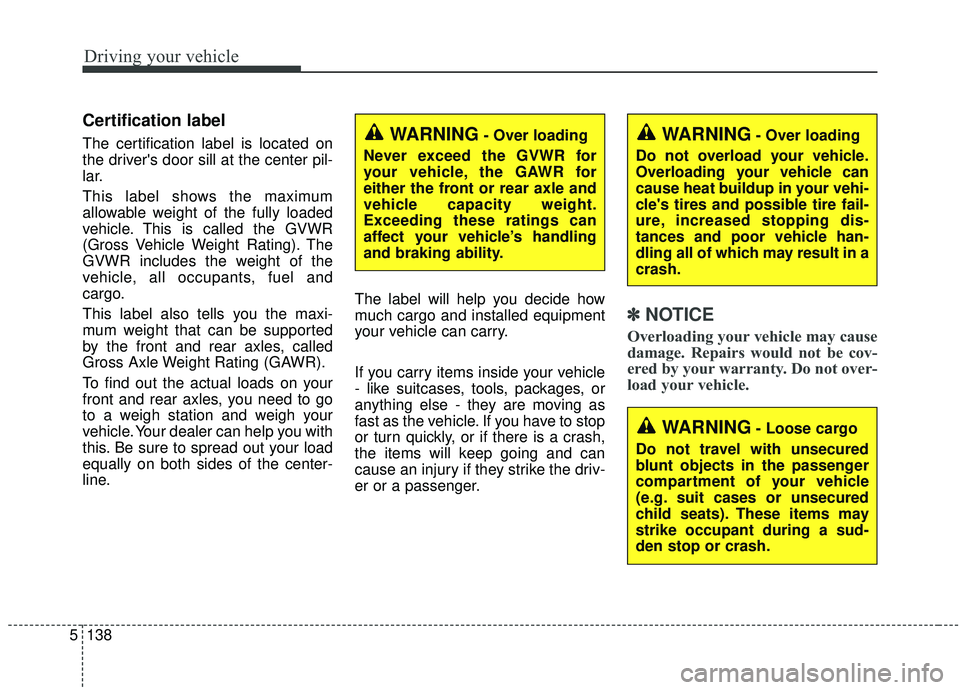
The certification label is located on
the driver's door sill at the center pil-
lar.
This label shows the maximum
allowable weight of the fully loaded
vehicle. This is called the GVWR
(Gross Vehicle Weight Rating). The
GVWR includes the weight of the
vehicle, all occupants, fuel and
cargo.
This label also tells you the maxi-
mum weight that can be supported
by the front and rear axles, called
Gross Axle Weight Rating (GAWR).
To find out the actual loads on your
front and rear axles, you need to go
to a weigh station and weigh your
vehicle. Your dealer can help you with
this. Be sure to spread out your load
equally on both sides of the center-
line. The label will help you decide how
much cargo and installed equipment
your vehicle can carry.
If you carry items inside your vehicle
- like suitcases, tools, packages, or
anything else - they are moving as
fast as the vehicle. If you have to stop
or turn quickly, or if there is a crash,
the items will keep going and can
cause an injury if they strike the driv-
er or a passenger.
✽ ✽
NOTICE
Overloading your vehicle may cause
damage. Repairs would not be cov-
ered by your warranty. Do not over-
load your vehicle.
WARNING- Over loading
Never exceed the GVWR for
your vehicle, the GAWR for
either the front or rear axle and
vehicle capacity weight.
Exceeding these ratings can
affect your vehicle’s handling
and braking ability.WARNING- Over loading
Do not overload your vehicle.
Overloading your vehicle can
cause heat buildup in your vehi-
cle's tires and possible tire fail-
ure, increased stopping dis-
tances and poor vehicle han-
dling all of which may result in a
crash.
WARNING- Loose cargo
Do not travel with unsecured
blunt objects in the passenger
compartment of your vehicle
(e.g. suit cases or unsecured
child seats). These items may
strike occupant during a sud-
den stop or crash.
Page 416 of 573
5139
Driving your vehicle
This section will guide you in the
proper loading of your vehicle and/or
trailer, to keep your loaded vehicle
weight within its design rating capa-
bility, with or without a trailer.
Properly loading your vehicle will
provide maximum return of the vehi-
cle design performance. Before load-
ing your vehicle, familiarize yourself
with the following terms for determin-
ing your vehicle's weight ratings, with
or without a trailer, from the vehicle's
specifications and the certification
label:
Base curb weight
This is the weight of the vehicle
including a full tank of fuel and all
standard equipment. It does not
include passengers, cargo, or option-
al equipment.
Vehicle curb weight
This is the weight of your new vehicle
when you picked it up from your deal-
er plus any aftermarket equipment.
Cargo weight
This figure includes all weight added
to the Base Curb Weight, including
cargo and optional equipment.
GAW (Gross axle weight)
This is the total weight placed on
each axle (front and rear) - including
vehicle curb weight and all payload.
GAWR
(Gross axle weight rating)
This is the maximum allowable
weight that can be carried by a single
axle (front or rear). These numbers
are shown on the certification label.
The total load on each axle must
never exceed its GAWR.
GVW (Gross vehicle weight)
This is the Base Curb Weight plus
actual Cargo Weight plus passen-
gers.
GVWR
(Gross vehicle weight rating)
This is the maximum allowable
weight of the fully loaded vehicle
(including all options, equipment,
passengers and cargo). The GVWR
is shown on the certification label
located on the driver’s door sill.
VEHICLE WEIGHT GLOSSARY
Page 417 of 573
What to do in an emergency
Road warning . . . . . . . . . . . . . . . . . . . . . . . . . . . . . . 6-2
• Hazard warning flashers . . . . . . . . . . . . . . . . . . . . . . . 6-2
In case of an emergency while driving . . . . . . . . . . 6-3
• If the engine stalls at a crossroad or crossing. . . . . . . 6-3
• If you have a flat tire while driving . . . . . . . . . . . . . . . 6-3
• If the engine stalls while driving . . . . . . . . . . . . . . . . . 6-3
If the engine will not start . . . . . . . . . . . . . . . . . . . . 6-4
• If engine doesn't turn over or turns over slowly . . . . 6-4
• If engine turns over normally but does not start . . . . 6-4
Emergency starting . . . . . . . . . . . . . . . . . . . . . . . . . 6-5
• Jump starting . . . . . . . . . . . . . . . . . . . . . . . . . . . . . . . . . 6-5
• Push-starting . . . . . . . . . . . . . . . . . . . . . . . . . . . . . . . . . 6-7
If the engine overheats . . . . . . . . . . . . . . . . . . . . . . . 6-8
Tire Pressure Monitoring System (TPMS) . . . . . . 6-9
• Check tire pressure . . . . . . . . . . . . . . . . . . . . . . . . . . . . 6-9
• Low tire pressure telltale . . . . . . . . . . . . . . . . . . . . . . 6-11
• Low tire pressure position telltale . . . . . . . . . . . . . . . 6-11
• Changing a tire with TPMS . . . . . . . . . . . . . . . . . . . . 6-13
If you have a flat tire . . . . . . . . . . . . . . . . . . . . . . . 6-16
• Jack and tools . . . . . . . . . . . . . . . . . . . . . . . . . . . . . . . 6-16
• Removing and storing the spare tire . . . . . . . . . . . . . 6-17
• Changing tires . . . . . . . . . . . . . . . . . . . . . . . . . . . . . . . 6-19
Towing . . . . . . . . . . . . . . . . . . . . . . . . . . . . . . . . . . 6-26\
• Towing service . . . . . . . . . . . . . . . . . . . . . . . . . . . . . . . 6-26
6
Page 418 of 573
What to do in an emergency
26
ROAD WARNING
Hazard warning flashers
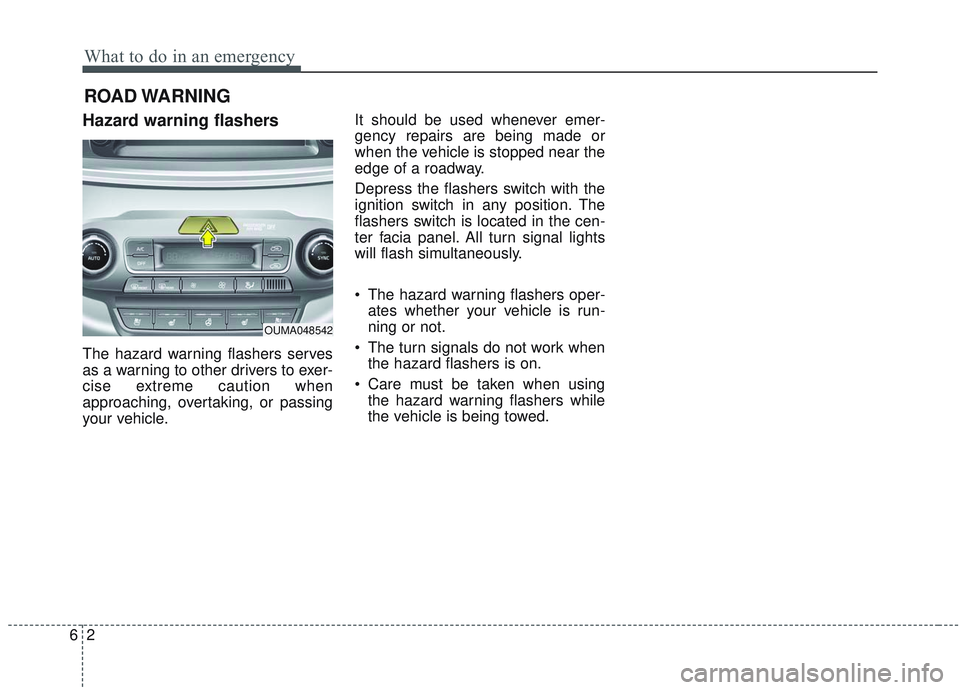
The hazard warning flashers serves
as a warning to other drivers to exer-
cise extreme caution when
approaching, overtaking, or passing
your vehicle.It should be used whenever emer-
gency repairs are being made or
when the vehicle is stopped near the
edge of a roadway.
Depress the flashers switch with the
ignition switch in any position. The
flashers switch is located in the cen-
ter facia panel. All turn signal lights
will flash simultaneously.
• The hazard warning flashers oper-
ates whether your vehicle is run-
ning or not.
The turn signals do not work when the hazard flashers is on.
Care must be taken when using the hazard warning flashers while
the vehicle is being towed.
OUMA048542
Page 419 of 573
63
What to do in an emergency
If the engine stalls at a cross-
road or crossing
If the engine stalls at a crossroad or
crossing, set the shift lever in the N
(Neutral) position and then push the
vehicle to a safe place.
If you have a flat tire while
driving
If a tire goes flat while you are driv-
ing:
1. Take your foot off the acceleratorpedal and let the vehicle slow
down while driving straight ahead.
Do not apply the brakes immedi-
ately or attempt to pull off the road
as this may cause a loss of con-
trol. When the vehicle has slowed
to such a speed that it is safe to do
so, brake carefully and pull off the
road. Drive off the road as far as
possible and park on a firm level
ground. If you are on a divided
highway, do not park in the median
area between the two traffic lanes. 2. When the vehicle is stopped, turn
on your emergency hazard flash-
ers, set the parking brake and put
the transmission in P (Park).
3. Have all passengers get out of the vehicle. Be sure they all get out on
the side of the vehicle that is away
from traffic.
4. When changing a flat tire, follow the instruction provided later in
this section.
If the engine stalls while driv-
ing
1. Reduce your speed gradually,keeping a straight line. Move cau-
tiously off the road to a safe place.
2. Turn on your emergency flashers.
3. Try to start the engine again. If your vehicle will not start, contact
an authorized Kia dealer or seek
other qualified assistance.
✽ ✽NOTICE
If there was a check engine light and
loss of power or stall and if safe to do
so, wait at least 10 seconds to restart
the vehicle after it stalls. This may
reset the car so it will no longer run
at low power condition.
IN CASE OF AN EMERGENCY WHILE DRIVING