Maintenance
48
7
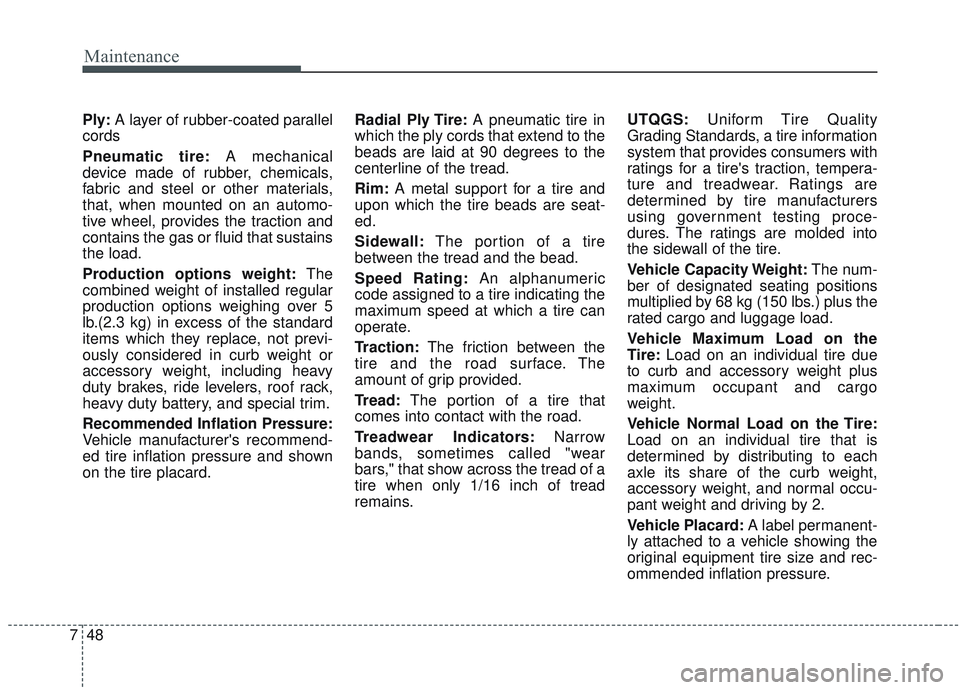
Ply: A layer of rubber-coated parallel
cords
Pneumatic tire: A mechanical
device made of rubber, chemicals,
fabric and steel or other materials,
that, when mounted on an automo-
tive wheel, provides the traction and
contains the gas or fluid that sustains
the load.
Production options weight: The
combined weight of installed regular
production options weighing over 5
lb.(2.3 kg) in excess of the standard
items which they replace, not previ-
ously considered in curb weight or
accessory weight, including heavy
duty brakes, ride levelers, roof rack,
heavy duty battery, and special trim.
Recommended Inflation Pressure:
Vehicle manufacturer's recommend-
ed tire inflation pressure and shown
on the tire placard. Radial Ply Tire:
A pneumatic tire in
which the ply cords that extend to the
beads are laid at 90 degrees to the
centerline of the tread.
Rim: A metal support for a tire and
upon which the tire beads are seat-
ed.
Sidewall: The portion of a tire
between the tread and the bead.
Speed Rating: An alphanumeric
code assigned to a tire indicating the
maximum speed at which a tire can
operate.
Traction: The friction between the
tire and the road surface. The
amount of grip provided.
Tread: The portion of a tire that
comes into contact with the road.
Treadwear Indicators: Narrow
bands, sometimes called "wear
bars," that show across the tread of a
tire when only 1/16 inch of tread
remains. UTQGS:
Uniform Tire Quality
Grading Standards, a tire information
system that provides consumers with
ratings for a tire's traction, tempera-
ture and treadwear. Ratings are
determined by tire manufacturers
using government testing proce-
dures. The ratings are molded into
the sidewall of the tire.
Vehicle Capacity Weight: The num-
ber of designated seating positions
multiplied by 68 kg (150 lbs.) plus the
rated cargo and luggage load.
Vehicle Maximum Load on the
Tire: Load on an individual tire due
to curb and accessory weight plus
maximum occupant and cargo
weight.
Vehicle Normal Load on the Tire:
Load on an individual tire that is
determined by distributing to each
axle its share of the curb weight,
accessory weight, and normal occu-
pant weight and driving by 2.
Vehicle Placard: A label permanent-
ly attached to a vehicle showing the
original equipment tire size and rec-
ommended inflation pressure.
88
Specifications & Consumer information
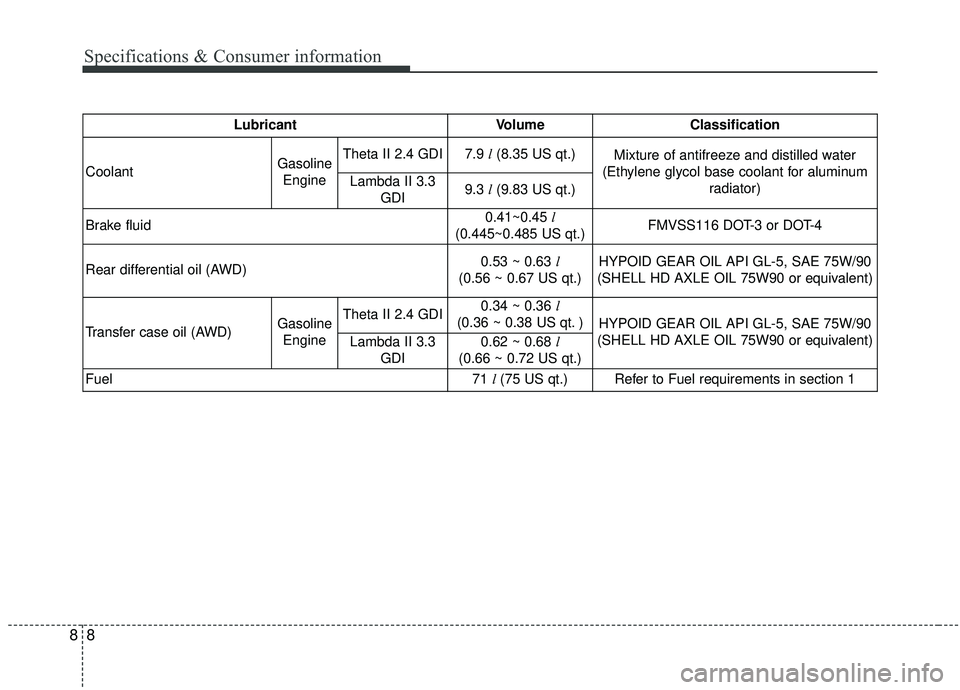
Lubricant VolumeClassification
CoolantGasolineEngine Theta II 2.4 GDI7.9 l(8.35 US qt.)Mixture of antifreeze and distilled water
(Ethylene glycol base coolant for aluminum radiator)
Lambda II 3.3GDI9.3 l(9.83 US qt.)
Brake fluid0.41~0.45 l
(0.445~0.485 US qt.)FMVSS116 DOT-3 or DOT-4
Rear differential oil (AWD)0.53 ~ 0.63 l
(0.56 ~ 0.67 US qt.)HYPOID GEAR OIL API GL-5, SAE 75W/90
(SHELL HD AXLE OIL 75W90 or equivalent)
Transfer case oil (AWD)Gasoline Engine Theta II 2.4 GDI0.34 ~ 0.36 l
(0.36 ~ 0.38 US qt. )
HYPOID GEAR OIL API GL-5, SAE 75W/90
(SHELL HD AXLE OIL 75W90 or equivalent)
Lambda II 3.3 GDI0.62 ~ 0.68 l
(0.66 ~ 0.72 US qt.)
Fuel71 l(75 US qt.)Refer to Fuel requirements in section 1