Page 68 of 503
351
Safety features of your vehicle
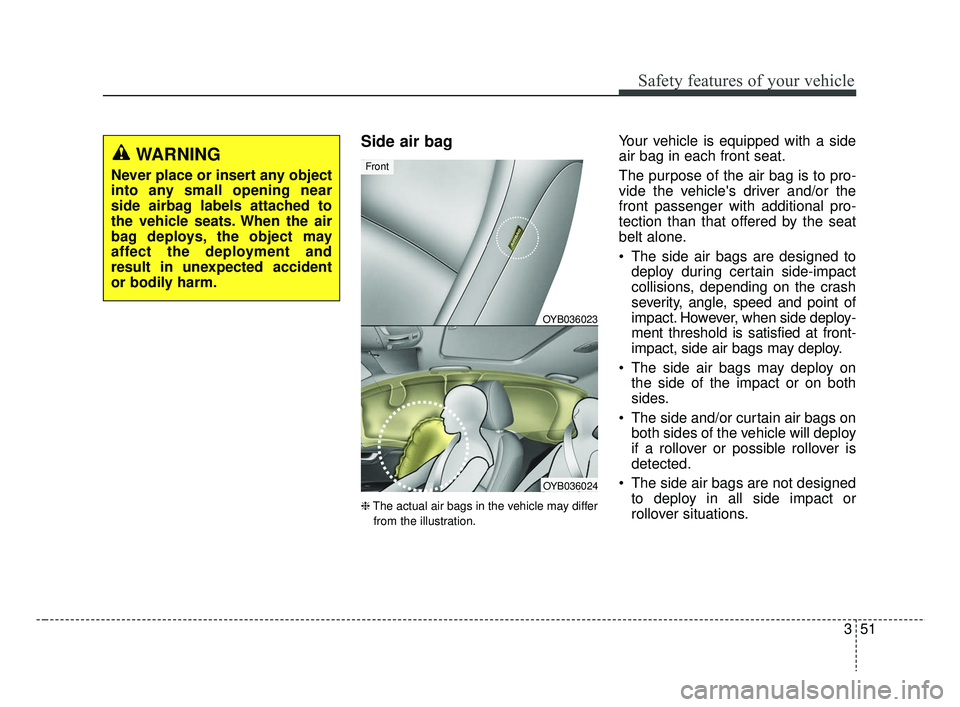
Side air bag
❈The actual air bags in the vehicle may differ
from the illustration.
Your vehicle is equipped with a side
air bag in each front seat.
The purpose of the air bag is to pro-
vide the vehicle's driver and/or the
front passenger with additional pro-
tection than that offered by the seat
belt alone.
The side air bags are designed to deploy during certain side-impact
collisions, depending on the crash
severity, angle, speed and point of
impact. However, when side deploy-
ment threshold is satisfied at front-
impact, side air bags may deploy.
The side air bags may deploy on the side of the impact or on both
sides.
The side and/or curtain air bags on both sides of the vehicle will deploy
if a rollover or possible rollover is
detected.
The side air bags are not designed to deploy in all side impact or
rollover situations.
WARNING
Never place or insert any object
into any small opening near
side airbag labels attached to
the vehicle seats. When the air
bag deploys, the object may
affect the deployment and
result in unexpected accident
or bodily harm.
OYB036023
OYB036024
Front
SC CAN (ENG) 3.QXP 7/18/2018 5:57 PM Page 51
Page 70 of 503

353
Safety features of your vehicle
Curtain air bag
❈The actual air bags in the vehicle may differ
from the illustration.
Curtain air bags are located along
both sides of the roof rails above the
front and rear doors.
They are designed to help protect
occupants in certain side impacts
and to help prevent them from eject-
ing out of the vehicle as a result of a
rollover, especially when the seat-
belts are also in use.
The curtain air bags are designed to deploy during certain side impact
collisions, depending on the crash
severity, angle, speed and point of
impact. However, when side deploy-
ment threshold is satisfied at front-
impact, side air bags may deploy.
The curtain air bags may deploy on the side of the impact or on both
sides.
Also, the curtain air bags on both sides of the vehicle will deploy in
certain rollover situations.
The curtain air bags are not designed to deploy in all side
impact or rollover situations.
WARNING - No attaching
objects
Do not place any objects over the air bag or between the air
bag and yourself. Also, do not
attach any objects around the
area the air bag inflates such
as the door, side door glass,
front and rear pillar.
Do not place any objects between the door and the
seat. They may become dan-
gerous projectiles if the side
air bag inflates.
Do not install any accessories on the side or near the side air
bags.
Do not hang heavy items on the coat hooks for safety rea-
sons.
Never place or insert any object into any small opening
near side airbag labels
attached to the vehicle seats.
When the air bag deploys, the
object may affect the deploy-
ment and result in unexpected
accident or bodily harm.
OYB036026
OYB036025
SC CAN (ENG) 3.QXP 7/18/2018 5:57 PM Page 53
Page 72 of 503
355
Safety features of your vehicle
Why didn’t my air bag go off in
a collision? (Inflation and non-
inflation conditions of the air
bag)
There are many types of accidents in
which the air bag would not be
expected to provide additional pro-
tection.
These include rear impacts, second
or third collisions in multiple impact
accidents, as well as low speed
impacts.
Air bag collision sensors
(1) SRS control module/Rollover sensor
(2) Front impact sensor (3) Side impact sensor
(4) Pressure side impact sensor
OSC037013N/OYB036032/OSC037024N/OYB036033/OYB036034
SC CAN (ENG) 3.QXP 7/18/2018 5:57 PM Page 55
Page 73 of 503

Safety features of your vehicle
56
3
Problems may arise if the sensor
installation angles are changed due
to the deformation of the front
bumper, body or B pillar where side
collision sensors are installed. Have
the vehicle checked and repaired by
an authorized Kia dealer.
Installing aftermarket bumper guards
or replacing a bumper with non-gen-
uine parts may adversely affect your
vehicle’s collision and air bag deploy-
ment performance.Air bag inflation conditions
Front air bags
Front air bags are designed to inflate
in a frontal collision depending on
the severity of impact of the front col-
lision.
1JBA3513
WARNING - Air bag
sensors
Do not hit or allow any objects to impact the locations where
air bag or sensors are installed.
This may cause unexpected
air bag deployment, which
could result in serious per-
sonal injury or death.
If the installation location or angle of the sensors is altered
in any way, the air bags may
deploy when they should not
or they may not deploy when
they should.
Therefore, do not try to perform
maintenance on or around the
air bag sensors. Have the vehi-
cle checked and repaired by an
authorized Kia dealer.
SC CAN (ENG) 3.QXP 7/18/2018 5:57 PM Page 56
Page 74 of 503

357
Safety features of your vehicle
❈The actual air bags in the vehicle may differ
from the illustration.
Side air bags
Side air bags (side and/or curtain air
bags) are designed to inflate when an
impact is detected by side collision
sensors depending on the severity of
impact resulting from a side impact
collision. Also, the side and/or curtain air bags
are designed to inflate when a rollover
is detected by a rollover sensor.
Although the front air bags (driver’s
and front passenger’s air bags) are
designed to inflate in frontal colli-
sions, they also may inflate in other
types of collisions if the front impact
sensors detect a sufficient frontal
force in another type of impact. Side
and curtain air bags are designed to
inflate in certain side impact colli-
sions. They may inflate in other types
of collisions where a side force is
detected by the sensors. Side air bag
and/or curtain air bags may also
inflate where rollover sensors indi-
cate the possibility of a rollover
occurring (even if none actually
occurs) or in other situations, includ-
ing when the vehicle is tilted while
being towed.
Even where side and/or curtain air
bags would not provide impact pro-
tection in a rollover, however, they
will deploy to prevent ejection of
occupants, especially those who are
restrained with seat belts.
If the vehicle chassis is impacted by
bumps or objects on unimproved
roads or sidewalks, air bags may
deploy. Drive carefully on unim-
proved roads or on surfaces not
designed for vehicle traffic to prevent
unintended air bag deployment.
1JBA3516
OYDDSA2040
SC CAN (ENG) 3.QXP 7/25/2018 12:12 PM Page 57
Page 75 of 503
Safety features of your vehicle
58
3
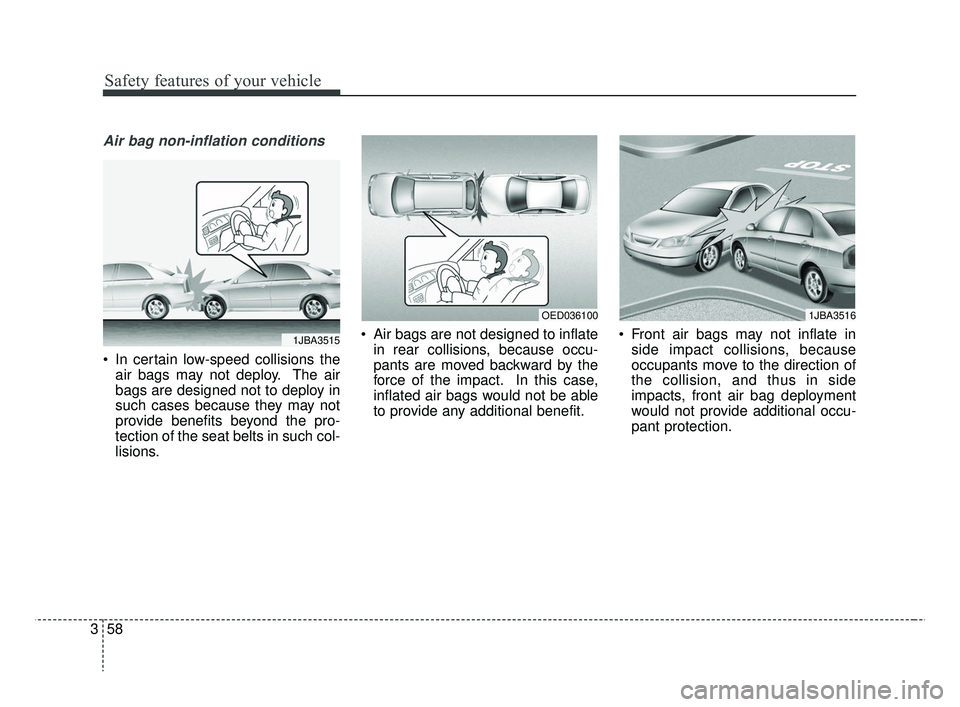
Air bag non-inflation conditions
In certain low-speed collisions the
air bags may not deploy. The air
bags are designed not to deploy in
such cases because they may not
provide benefits beyond the pro-
tection of the seat belts in such col-
lisions. Air bags are not designed to inflate
in rear collisions, because occu-
pants are moved backward by the
force of the impact. In this case,
inflated air bags would not be able
to provide any additional benefit. Front air bags may not inflate in
side impact collisions, because
occupants move to the direction of
the collision, and thus in side
impacts, front air bag deployment
would not provide additional occu-
pant protection.
1JBA3516OED036100
1JBA3515
SC CAN (ENG) 3.QXP 7/18/2018 5:57 PM Page 58
Page 76 of 503
359
Safety features of your vehicle
In a slant or angled collision, theforce of impact may direct the
occupants in a direction where the
air bags would not be able to pro-
vide any additional benefit, and
thus the sensors may not deploy
any air bags. Just before impact, drivers often
brake heavily. Such heavy braking
lowers the front portion of the vehi-
cle causing it to “ride” under a vehi-
cle with a higher ground clearance.
Air bags may not inflate in this
“under-ride” situation because
deceleration forces that are detect-
ed by sensors may be significantly
replaced by such “under-ride” colli-
sions. Front air bags may not inflate in
rollover accidents because front air
bag deployment would not provide
additional occupant protection.
However, side and curtain air bags
may inflate when the vehicle is
rolled over.
1JBA35221JBA35211JBA3517
SC CAN (ENG) 3.QXP 7/18/2018 5:57 PM Page 59
Page 149 of 503
471
Features of your vehicle
Edit settings after shifting to P/Edit set-
tings after engaging parking brake
This warning message appears if
you try to adjust the User Settings
while driving.
- Automatic Transmission
For your safety, change the User
Settings after parking the vehicle,
applying the parking brake and mov-
ing the shift lever to P (Park).
- Manual Transmission
For your safety, change the User
Settings after engaging the parking
brake and moving the shift lever to N
(Neutral).Driver Assistance (if equipped)
Forward Collision-Avoidance
Assist (FCA) (if equipped) :To
activate or deactivate the Forward
Collision-Avoidance Assist (FCA)
system.
❈ For more details, refer to “Forward
Collision-avoidance Assist (FCA)”
in chapter 6.
Forward Collision Warning
(FCW) (if equipped) : Choose the
sensitivity of the Forward Collision
Warning (FCW).
❈ For more details, refer to “Forward
Collision-avoidance Assist (FCA)”
in chapter 6. Door
Automatically Lock
- Enable on Speed : All doors will be
automatically locked when the
vehicle speed exceeds 9.3mph
(15km/h).
- Enable on Shift : All doors will be automatically locked if the
Automatic Transmission shift lever
is shifted from the P (Park) position
to the R (Reverse), N (Neutral), or
D (Drive) position.
SC CAN (ENG) 4.QXP 7/18/2018 5:49 PM Page 71