Page 84 of 611
317
Safety features of your vehicle
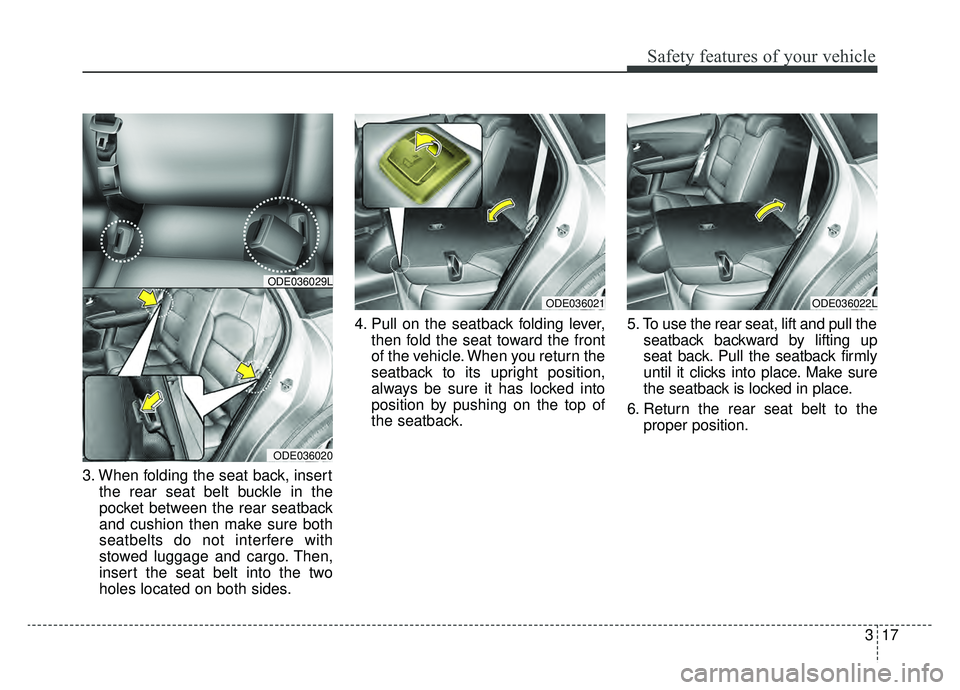
3. When folding the seat back, insertthe rear seat belt buckle in the
pocket between the rear seatback
and cushion then make sure both
seatbelts do not interfere with
stowed luggage and cargo. Then,
insert the seat belt into the two
holes located on both sides. 4. Pull on the seatback folding lever,
then fold the seat toward the front
of the vehicle. When you return the
seatback to its upright position,
always be sure it has locked into
position by pushing on the top of
the seatback. 5. To use the rear seat, lift and pull the
seatback backward by lifting up
seat back. Pull the seatback firmly
until it clicks into place. Make sure
the seatback is locked in place.
6. Return the rear seat belt to the proper position.
ODE036020
ODE036029L
ODE036022LODE036021
Page 89 of 611
Safety features of your vehicle
22
3
Front seat belt warning
Driving
conditionsConditionsWarning pattern
Seat beltVehicle speedLightSound
While
parked
(Ignition
switch ON)Buckled
0 mph (0 km/h)Illuminates
(for 6 seconds)
No sound
Unbuckled
- Sounds (for 6 seconds, driver`s seat)
- No sound (for passenger’s seat)
While
drivenUnbuckled6 mph (9 km/h) or more butless than 12mph (20 km/h)Continuously IlluminatesNo sound
When the seatbelt is unbuckled after useLess than 12 mph (20km/h)Continuously IlluminatesNo sound
12 mph (20 km/hr) or moreBlinks continuouslyAlarm sounds for 100 seconds
ODE036083N
■ Type B■Type A
ODE036084L
Page 93 of 611
Safety features of your vehicle
26
3
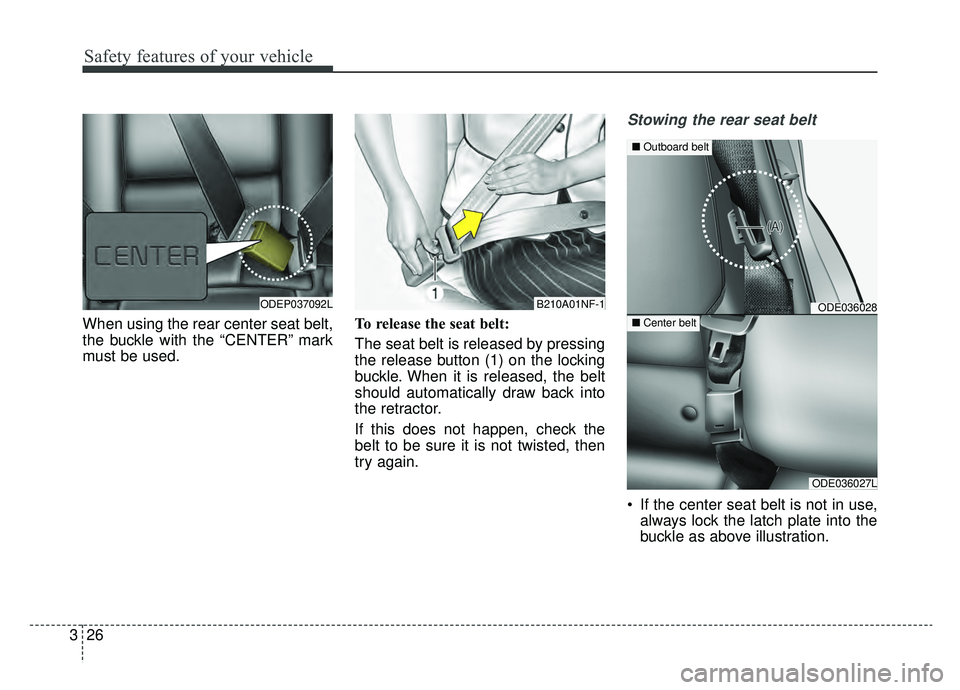
When using the rear center seat belt,
the buckle with the “CENTER” mark
must be used. To release the seat belt:
The seat belt is released by pressing
the release button (1) on the locking
buckle. When it is released, the belt
should automatically draw back into
the retractor.
If this does not happen, check the
belt to be sure it is not twisted, then
try again.
Stowing the rear seat belt
If the center seat belt is not in use,
always lock the latch plate into the
buckle as above illustration.
B210A01NF-1ODE036028
■ Outboard belt
ODE036027L
■Center belt
ODEP037092L
Page 102 of 611
335
Safety features of your vehicle
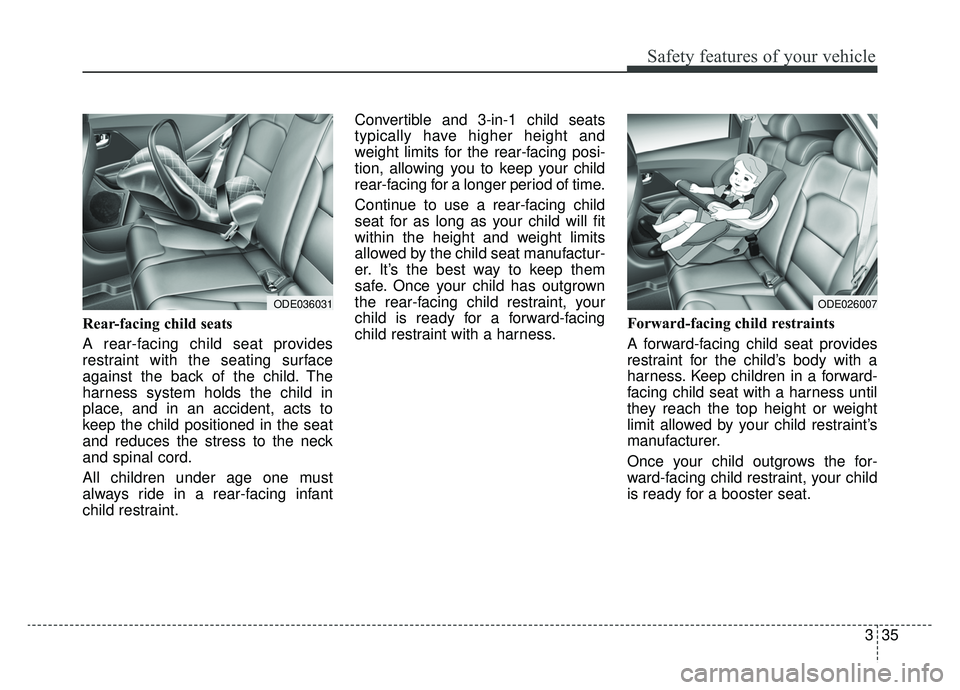
Rear-facing child seats
A rear-facing child seat provides
restraint with the seating surface
against the back of the child. The
harness system holds the child in
place, and in an accident, acts to
keep the child positioned in the seat
and reduces the stress to the neck
and spinal cord.
All children under age one must
always ride in a rear-facing infant
child restraint.Convertible and 3-in-1 child seats
typically have higher height and
weight limits for the rear-facing posi-
tion, allowing you to keep your child
rear-facing for a longer period of time.
Continue to use a rear-facing child
seat for as long as your child will fit
within the height and weight limits
allowed by the child seat manufactur-
er. It’s the best way to keep them
safe. Once your child has outgrown
the rear-facing child restraint, your
child is ready for a forward-facing
child restraint with a harness.
Forward-facing child restraints
A forward-facing child seat provides
restraint for the child’s body with a
harness. Keep children in a forward-
facing child seat with a harness until
they reach the top height or weight
limit allowed by your child restraint’s
manufacturer.
Once your child outgrows the for-
ward-facing child restraint, your child
is ready for a booster seat.
ODE036031 ODE026007
Page 104 of 611
337
Safety features of your vehicle
Lower Anchors and Tether forChildren (LATCH) System
The LATCH system holds a child
restraint during driving and in an
accident. This system is designed to
make installation of the child restraint
easier and reduce the possibility of
improperly installing your child
restraint. The LATCH system uses
anchors in the vehicle and attach-
ments on the child restraint. The
LATCH system eliminates the need
to use seat belts to secure the child
restraint to the rear seats.
Lower anchors are metal bars built
into the vehicle. There are two lower
anchors for each LATCH seating
position that will accommodate a
child restraint with lower attach-
ments.
To use the LATCH system in your
vehicle, you must have a child
restraint with LATCH attachments.
The child seat manufacturer will pro-
vide you with instructions on how to
use the child seat with its attach-
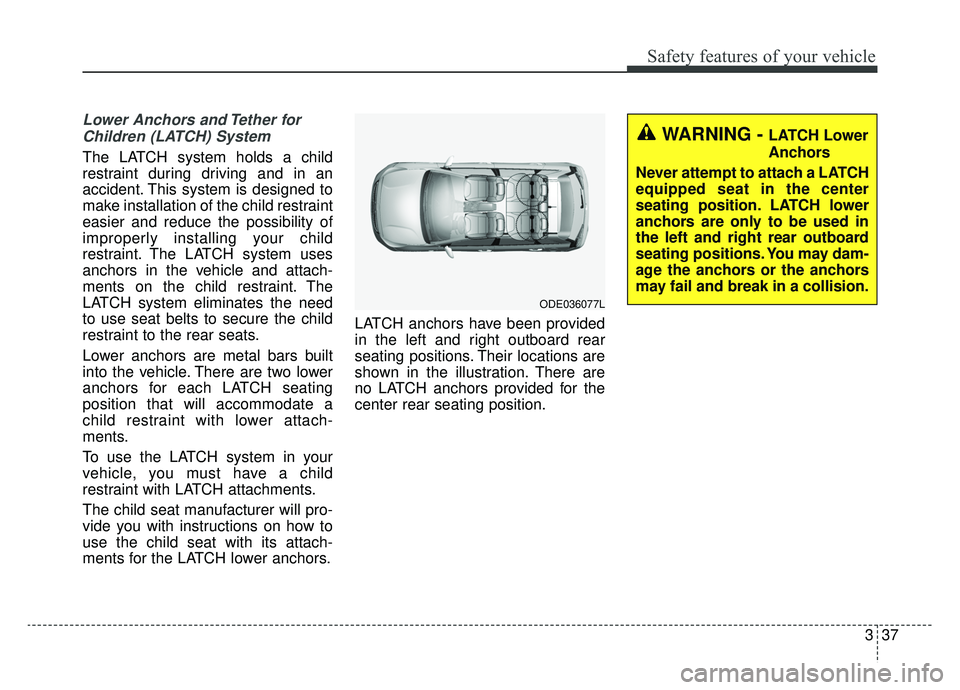
ments for the LATCH lower anchors. LATCH anchors have been provided
in the left and right outboard rear
seating positions. Their locations are
shown in the illustration. There are
no LATCH anchors provided for the
center rear seating position.
ODE036077L
WARNING - LATCH Lower
Anchors
Never attempt to attach a LATCH
equipped seat in the center
seating position. LATCH lower
anchors are only to be used in
the left and right rear outboard
seating positions. You may dam-
age the anchors or the anchors
may fail and break in a collision.
Page 105 of 611
Safety features of your vehicle
38
3
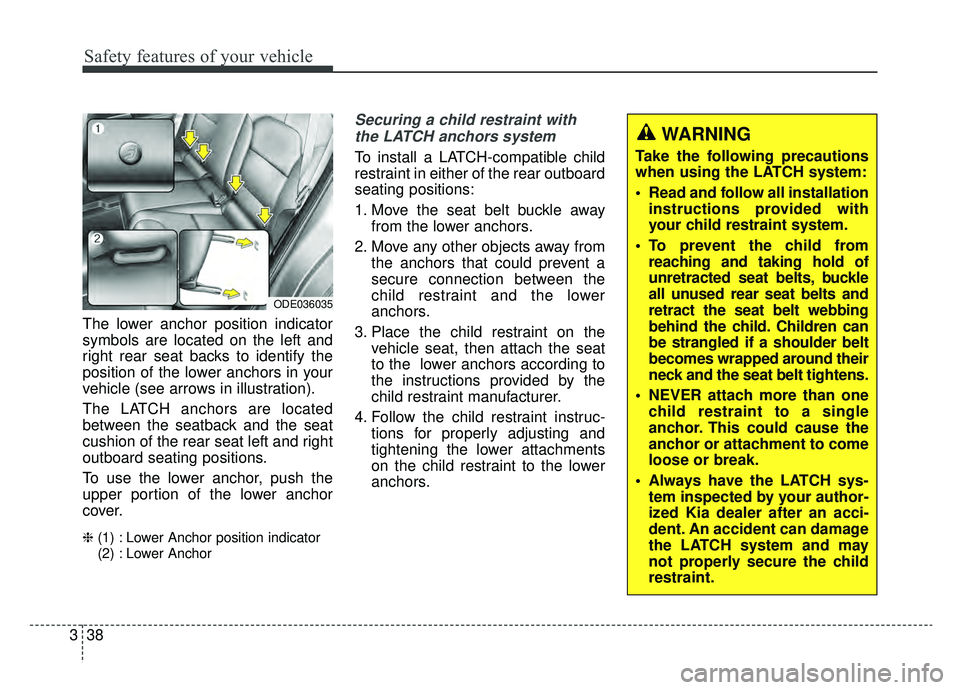
The lower anchor position indicator
symbols are located on the left and
right rear seat backs to identify the
position of the lower anchors in your
vehicle (see arrows in illustration).
The LATCH anchors are located
between the seatback and the seat
cushion of the rear seat left and right
outboard seating positions.
To use the lower anchor, push the
upper portion of the lower anchor
cover.
❈ (1) : Lower Anchor position indicator
(2) : Lower Anchor
Securing a child restraint with
the LATCH anchors system
To install a LATCH-compatible child
restraint in either of the rear outboard
seating positions:
1. Move the seat belt buckle away from the lower anchors.
2. Move any other objects away from the anchors that could prevent a
secure connection between the
child restraint and the lower
anchors.
3. Place the child restraint on the vehicle seat, then attach the seat
to the lower anchors according to
the instructions provided by the
child restraint manufacturer.
4. Follow the child restraint instruc- tions for properly adjusting and
tightening the lower attachments
on the child restraint to the lower
anchors.
ODE036035
WARNING
Take the following precautions
when using the LATCH system:
Read and follow all installationinstructions provided with
your child restraint system.
To prevent the child from reaching and taking hold of
unretracted seat belts, buckle
all unused rear seat belts and
retract the seat belt webbing
behind the child. Children can
be strangled if a shoulder belt
becomes wrapped around their
neck and the seat belt tightens.
NEVER attach more than one child restraint to a single
anchor. This could cause the
anchor or attachment to come
loose or break.
Always have the LATCH sys- tem inspected by your author-
ized Kia dealer after an acci-
dent. An accident can damage
the LATCH system and may
not properly secure the child
restraint.
Page 106 of 611
339
Safety features of your vehicle
✽ ✽NOTICE
The recommended maximum
weight for the LATCH system is 65
lbs. (30 kg). When selecting a proper
child restraint, consider that the
maximum total weight of the child
plus the child restraint should be
less than 65 lbs (30 kg).
As a guide, the MAX child restraint
weight should be determined by the
following calculation:
Child Restraint Weight =
65 - (child's total weight in lbs.)
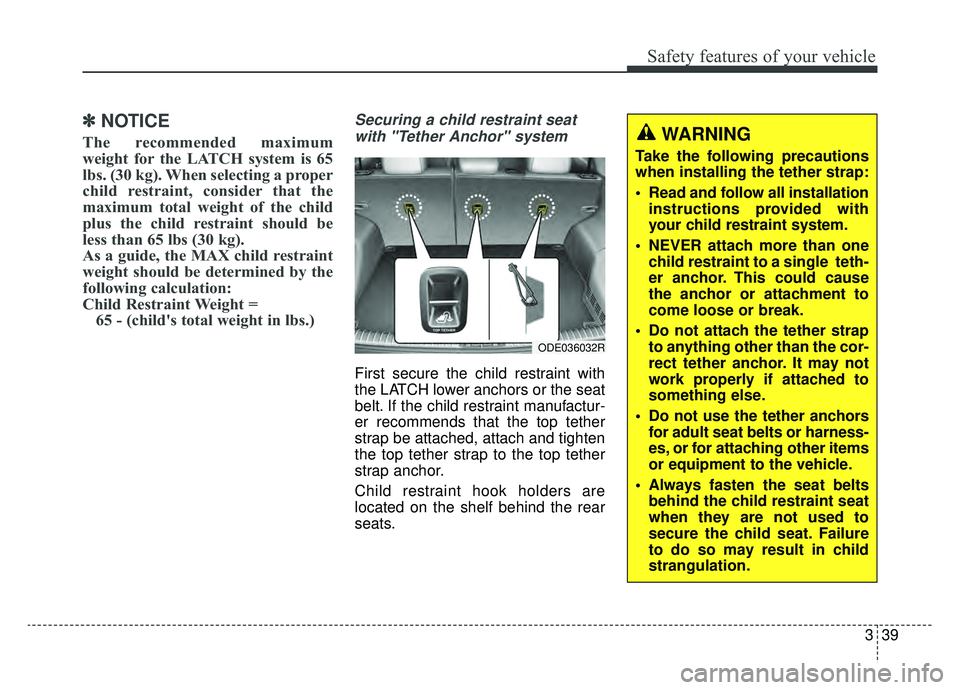
Securing a child restraint seat
with "Tether Anchor" system
First secure the child restraint with
the LATCH lower anchors or the seat
belt. If the child restraint manufactur-
er recommends that the top tether
strap be attached, attach and tighten
the top tether strap to the top tether
strap anchor.
Child restraint hook holders are
located on the shelf behind the rear
seats.
ODE036032R
WARNING
Take the following precautions
when installing the tether strap:
Read and follow all installation instructions provided with
your child restraint system.
NEVER attach more than one child restraint to a single teth-
er anchor. This could cause
the anchor or attachment to
come loose or break.
Do not attach the tether strap to anything other than the cor-
rect tether anchor. It may not
work properly if attached to
something else.
Do not use the tether anchors for adult seat belts or harness-
es, or for attaching other items
or equipment to the vehicle.
Always fasten the seat belts behind the child restraint seat
when they are not used to
secure the child seat. Failure
to do so may result in child
strangulation.
Page 107 of 611
Safety features of your vehicle
40
3
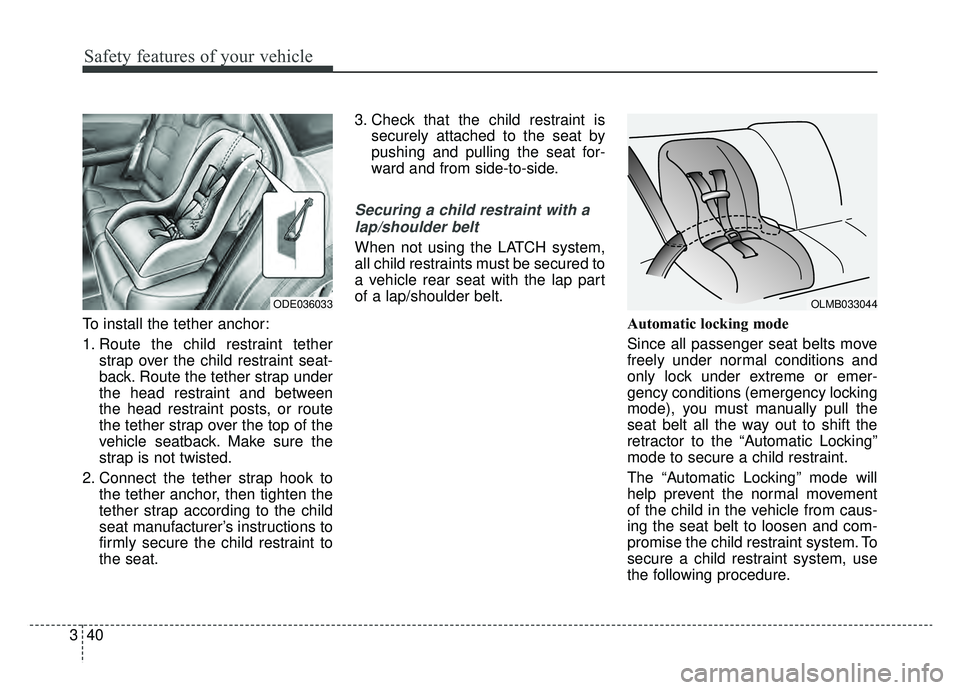
To install the tether anchor:
1. Route the child restraint tether
strap over the child restraint seat-
back. Route the tether strap under
the head restraint and between
the head restraint posts, or route
the tether strap over the top of the
vehicle seatback. Make sure the
strap is not twisted.
2. Connect the tether strap hook to the tether anchor, then tighten the
tether strap according to the child
seat manufacturer’s instructions to
firmly secure the child restraint to
the seat. 3. Check that the child restraint is
securely attached to the seat by
pushing and pulling the seat for-
ward and from side-to-side.
Securing a child restraint with a
lap/shoulder belt
When not using the LATCH system,
all child restraints must be secured to
a vehicle rear seat with the lap part
of a lap/shoulder belt.
Automatic locking mode
Since all passenger seat belts move
freely under normal conditions and
only lock under extreme or emer-
gency conditions (emergency locking
mode), you must manually pull the
seat belt all the way out to shift the
retractor to the “Automatic Locking”
mode to secure a child restraint.
The “Automatic Locking” mode will
help prevent the normal movement
of the child in the vehicle from caus-
ing the seat belt to loosen and com-
promise the child restraint system. To
secure a child restraint system, use
the following procedure.
ODE036033 OLMB033044