2019 KIA FORTE fuel system
[x] Cancel search: fuel systemPage 272 of 550
Driving your vehicle
26
5
In sports mode, moving the shift
lever backwards or forwards will
allow you to make gearshifts rapidly.
In contrast to a manual transmission,
the sports mode allows gearshifts
with the accelerator pedal
depressed.
Up (+) : Push the lever forward
once to shift up one gear.
Down (-) : Pull the lever backwards
once to shift down one gear.✽ ✽
NOTICE
• In sports mode, the driver must
execute upshifts in accordance
with road conditions, being care-
ful to keep the engine speed below
the red zone.
• In sports mode, only the 8 forward gears can be selected. To reverse
or park the vehicle, move the shift
lever to the R (Reverse) or P
(Park) position as required.
• In sports mode, downshifts are made automatically when the
vehicle slows down. When the
vehicle stops, 1st gear is automati-
cally selected.
• In sports mode, when the engine rpm approaches the red zone, shift
points are varied to upshift auto-
matically.
• To maintain the required levels of vehicle performance and safety,
the system may not execute cer-
tain gearshifts when the shift lever
is operated. (Continued)(Continued)
• When driving on a slippery road,
push the shift lever forward into
the +(up) position. This causes the
transmission to shift into the 2nd
gear which is better for smooth
driving on a slippery road. Push
the shift lever to the -(down) side
to shift back to the 1st gear.
• When SPORT mode is activated: - The engine rpm will tend toremain raised over a certain
length of time even after releas-
ing the accelerator
- Upshifts are delayed when accel- erating
• In SPORT mode, the fuel efficien- cy may decrease.
BDm CAN (ENG) 5.QXP 7/4/2018 10:13 AM Page 26
Page 347 of 550

5101
Driving your vehicle
SPORT mode
SPORT mode focuses on
dynamic driving by auto-
matically adjusting the
steering wheel, engine
and transmission system.
button is pressed and
the SPORT mode is
selected, the SPORT
indicator (red) will illumi-
nate.
is activated, and the
engine start/stop button
is turned off and on it will
change to NORMAL
mode. To turn on the
SPORT mode press
DRIVE MODE button
again.
ed:
- While holding vehicle speed, it maintains the
gear and RPM for some
time even though the
accelerator pedal is not
depressed.
- Up-shifting is delayed.
✽ ✽
NOTICE
In Sport drive mode, the fuel effi-
ciency may decrease.
SPORT
BDm CAN (ENG) 5.QXP 7/4/2018 10:17 AM Page 101
Page 373 of 550
5127
Driving your vehicle
Remember, your vehicle does notrequire extended warm-up. After
the engine has started, allow the
engine to run for 10 to 20 seconds
prior to placing the vehicle in gear.
In very cold weather, however, give
your engine a slightly longer warm-
up period.
Don't "lug" or "over-rev" the engine. Lugging is driving too slowly in a
very high gear resulting in engine
bucking. If this happens, shift to a
lower gear. Over-revving is racing
the engine beyond its safe limit.
This can be avoided by shifting at
the recommended speed. Use your air conditioning sparingly.
The air conditioning system is
operated by engine power so your
fuel economy is reduced when you
use it.
Open windows at high speeds can reduce fuel economy.
Fuel economy is less in crosswinds and headwinds. To help offset
some of this loss, slow down when
driving in these conditions.
Keeping a vehicle in good operating
condition is important both for econ-
omy and safety. Therefore, have an
authorized Kia dealer perform
scheduled inspections and mainte-
nance.
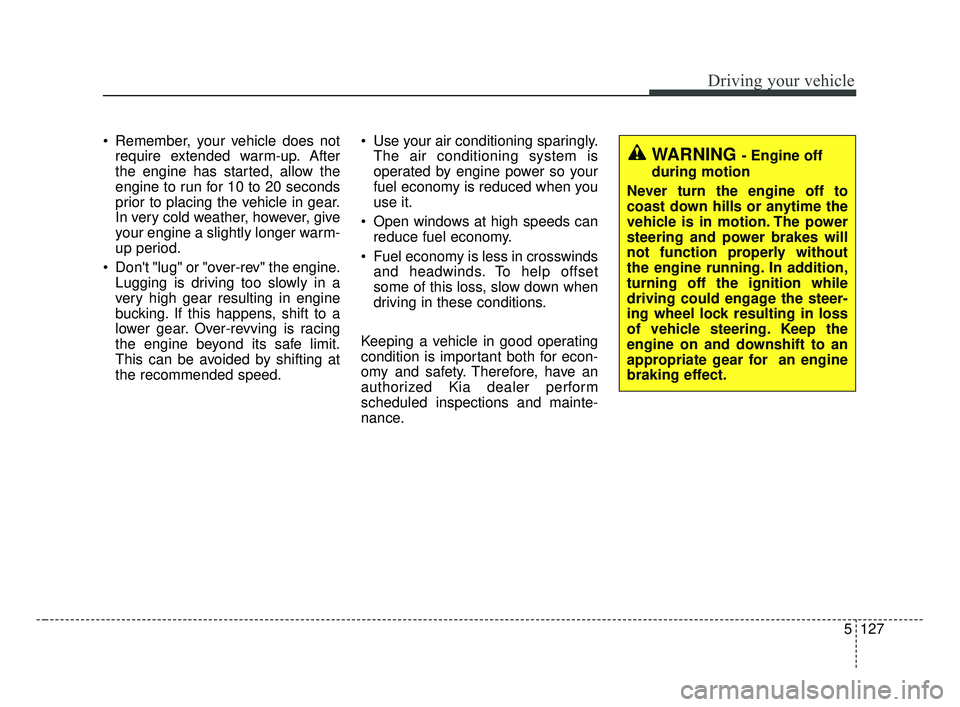
WARNING - Engine off
during motion
Never turn the engine off to
coast down hills or anytime the
vehicle is in motion. The power
steering and power brakes will
not function properly without
the engine running. In addition,
turning off the ignition while
driving could engage the steer-
ing wheel lock resulting in loss
of vehicle steering. Keep the
engine on and downshift to an
appropriate gear for an engine
braking effect.
BDm CAN (ENG) 5.QXP 7/4/2018 10:18 AM Page 127
Page 395 of 550
69
What to do in an emergency
Each tire, including the spare (if pro-
vided), should be checked monthly
when cold and inflated to the inflation
pressure recommended by the vehi-
cle manufacturer on the vehicle plac-
ard or tire inflation pressure label. (If
your vehicle has tires of a different
size than the size indicated on the
vehicle placard or tire inflation pres-
sure label, you should determine the
proper tire inflation pressure for
those tires.)
As an added safety feature, your
vehicle has been equipped with a tire
pressure monitoring system (TPMS)
that illuminates a low tire pressure
telltale when one or more of your
tires is significantly under-inflated.
Accordingly, when the low tire pres-
sure telltale illuminates, you should
stop and check your tires as soon as
possible, and inflate them to the
proper pressure. Driving on a signifi-
cantly under-inflated tire causes the
tire to overheat and can lead to tire
failure. Under-inflation also reduces
fuel efficiency and tire tread life, and
may affect the vehicle’s handling and
stopping ability.Please note that the TPMS is not a
substitute for proper tire maintenance,
and it is the driver’s responsibility to
maintain correct tire pressure, even if
under-inflation has not reached the
level to trigger illumination of the
TPMS low tire pressure telltale.
Your vehicle has also been equipped
with a TPMS malfunction indicator to
indicate when the system is not
operating properly. The TPMS mal-
function indicator is combined with
the low tire pressure telltale. When
the system detects a malfunction,
the telltale will flash for approximate-
ly one minute and then remain con-
tinuously illuminated. This sequence
will continue upon subsequent vehi-
cle start-ups as long as the malfunc-
tion exists. When the malfunction
indicator is illuminated, the system
may not be able to detect or signal
low tire pressure as intended. TPMS
malfunctions may occur for a variety
of reasons, including the installation
of replacement or alternate tires or
wheels on the vehicle that prevent
the TPMS from functioning properly.
Always check the TPMS malfunction
telltale after replacing one or more
tires or wheels on your vehicle to
ensure that the replacement or alter-
nate tires and wheels allow the TPMS
to continue to function properly.
BDm CAN (ENG) 6.qxp 7/4/2018 10:20 AM Page 9
Page 424 of 550

Maintenance
Engine compartment . . . . . . . . . . . . . . . . . . . . . . . . 7-4
Maintenance services . . . . . . . . . . . . . . . . . . . . . . . . 7-5
• Owner’s responsibility . . . . . . . . . . . . . . . . . . . . . . . . . 7-5
• Owner maintenance precautions . . . . . . . . . . . . . . . . . 7-6
Owner maintenance . . . . . . . . . . . . . . . . . . . . . . . . . 7-8
• Owner maintenance schedule . . . . . . . . . . . . . . . . . . . 7-8
Scheduled maintenance service. . . . . . . . . . . . . . . 7-10
Explanation of scheduled maintenance items . . . 7-16
• Engine oil and filter. . . . . . . . . . . . . . . . . . . . . . . . . . . 7-16
• Drive belts . . . . . . . . . . . . . . . . . . . . . . . . . . . . . . . . . . 7-16\
• Fuel filter (for gasoline) . . . . . . . . . . . . . . . . . . . . . . . 7-16
• Fuel lines, fuel hoses and connections . . . . . . . . . . . . 7-16
• Vapor hose and fuel filler cap . . . . . . . . . . . . . . . . . . 7-16
• Vacuum crankcase ventilation hoses . . . . . . . . . . . . . 7-17
• Air cleaner filter . . . . . . . . . . . . . . . . . . . . . . . . . . . . . 7-17
• Spark plugs . . . . . . . . . . . . . . . . . . . . . . . . . . . . . . . . . 7-17
• Cooling system . . . . . . . . . . . . . . . . . . . . . . . . . . . . . . . 7-17
• Coolant . . . . . . . . . . . . . . . . . . . . . . . . . . . . . . . . . . . . \
. 7-17
• Intelligent Variable Transmission (IVT) fluid . . . . . 7-17
• Manual transaxle fluid . . . . . . . . . . . . . . . . . . . . . . . . 7-18
• Brake hoses and lines . . . . . . . . . . . . . . . . . . . . . . . . . 7-18
• Brake fluid . . . . . . . . . . . . . . . . . . . . . . . . . . . . . . . . . . 7-19\
• Parking brake . . . . . . . . . . . . . . . . . . . . . . . . . . . . . . . 7-19
• Brake discs, pads, calipers and rotors. . . . . . . . . . . . 7-19
• Exhaust pipe and muffler . . . . . . . . . . . . . . . . . . . . . . 7-19
• Suspension mounting bolts . . . . . . . . . . . . . . . . . . . . . 7-19• Steering gear box, linkage &
boots/lower arm ball joint . . . . . . . . . . . . . . . . . . . . 7-20
• Drive shafts and boots. . . . . . . . . . . . . . . . . . . . . . . . . 7-20
• Air conditioning refrigerant . . . . . . . . . . . . . . . . . . . . 7-20
Checking fluid levels . . . . . . . . . . . . . . . . . . . . . . . 7-20
Engine oil. . . . . . . . . . . . . . . . . . . . . . . . . . . . . . . . . 7-21
• Checking the engine oil level . . . . . . . . . . . . . . . . . . . 7-21
• Changing the engine oil and filter . . . . . . . . . . . . . . . 7-22
Engine coolant . . . . . . . . . . . . . . . . . . . . . . . . . . . . 7-23
• Checking the coolant level . . . . . . . . . . . . . . . . . . . . . 7-23
• Changing the coolant . . . . . . . . . . . . . . . . . . . . . . . . . 7-25
Brake/clutch fluid . . . . . . . . . . . . . . . . . . . . . . . . . . 7-26
• Checking the brake/clutch fluid level . . . . . . . . . . . . 7-26
Washer fluid . . . . . . . . . . . . . . . . . . . . . . . . . . . . . . 7-27
• Checking the washer fluid level . . . . . . . . . . . . . . . . . 7-27
Parking brake . . . . . . . . . . . . . . . . . . . . . . . . . . . . . 7-28
• Checking the parking brake. . . . . . . . . . . . . . . . . . . . 7-28
Air cleaner. . . . . . . . . . . . . . . . . . . . . . . . . . . . . . . . 7-29
• Filter replacement . . . . . . . . . . . . . . . . . . . . . . . . . . . . 7-29
Climate control air filter . . . . . . . . . . . . . . . . . . . . 7-31
• Filter inspection . . . . . . . . . . . . . . . . . . . . . . . . . . . . . . 7-31
Wiper blades . . . . . . . . . . . . . . . . . . . . . . . . . . . . . . 7-33
• Blade inspection . . . . . . . . . . . . . . . . . . . . . . . . . . . . . . 7-33
• Blade replacement . . . . . . . . . . . . . . . . . . . . . . . . . . . . 7-33
7
BDm CAN (ENG) 7.qxp 7/4/2018 10:23 AM Page 1
Page 426 of 550
• Side marker (LED type) bulb replacement(Rear combination lamp Type B) . . . . . . . . . . . . . . 7-83
• Rear turn signal lamp bulb replacement . . . . . . . . . 7-84
• Back up lamp bulb replacement . . . . . . . . . . . . . . . . 7-84
• High mounted stop lamp (LED type) bulb replacement . . . . . . . . . . . . . . . . . . . . . . . . . . . . . . . . 7-84
• High mounted stop lamp (bulb type) bulb replacement . . . . . . . . . . . . . . . . . . . . . . . . . . . . . . . . 7-85
• License plate lamp bulb replacement . . . . . . . . . . . . 7-85
• Map lamp (Bulb type) bulb replacement . . . . . . . . . 7-86
• Map lamp (LED type) bulb replacement . . . . . . . . . 7-87
• Room lamp (Bulb type) bulb replacement . . . . . . . . 7-87
• Room lamp (LED type) bulb replacement . . . . . . . . 7-88
• Vanity mirror lamp bulb replacement . . . . . . . . . . . 7-88
• Glove box lamp replacement . . . . . . . . . . . . . . . . . . . 7-89
• Trunk room lamp replacement . . . . . . . . . . . . . . . . . 7-89
Appearance care . . . . . . . . . . . . . . . . . . . . . . . . . . . 7-91
• Exterior care . . . . . . . . . . . . . . . . . . . . . . . . . . . . . . . . 7-91
• Interior care . . . . . . . . . . . . . . . . . . . . . . . . . . . . . . . . . 7-96
Emission control system . . . . . . . . . . . . . . . . . . . . 7-99
• Crankcase emission control system . . . . . . . . . . . . . . 7-99
• Evaporative emission control (including ORVR: Onboard Refueling Vapor Recovery) system . . . . . 7-99
• Exhaust emission control system . . . . . . . . . . . . . . . 7-100
7
BDm CAN (ENG) 7.qxp 7/4/2018 10:23 AM Page 3
Page 431 of 550

Maintenance
87
OWNER MAINTENANCE
The following lists are vehicle checks
and inspections that should be per-
formed by the owner or an author-
ized Kia dealer at the frequencies
indicated to help ensure safe,
dependable operation of your vehi-
cle.
Any adverse conditions should be
brought to the attention of your deal-
er as soon as possible.
These Owner Maintenance Checks
are generally not covered by war-
ranties and you may be charged for
labor, parts and lubricants used.Owner maintenance schedule
When you stop for fuel:
Check the engine oil level.
Check the coolant level in coolantreservoir.
Check the windshield washer fluid level.
Look for low or under-inflated tires.
While operating your vehicle:
Note any changes in the sound of the exhaust or any smell of
exhaust fumes in the vehicle.
Check for vibrations in the steering wheel. Notice any increased steer-
ing effort or looseness in the steer-
ing wheel, or change in its straight-
ahead position.
Notice if your vehicle constantly turns slightly or “pulls” to one side
when traveling on smooth, level
road.
When stopping, listen and check for unusual sounds, pulling to one
side, increased brake pedal travel
or “hard-to-push” brake pedal.
If any slipping or changes in the operation of your transmission
occurs, check the transmission
fluid level.
Check manual transaxle operation, including clutch operation.
Check the parking brake.
Check for fluid leaks under your vehicle (water dripping from the air
conditioning system during or after
use is normal).
WARNING- Hot coolant
Be careful when checking your
engine coolant level when the
engine is hot. Scalding hot
coolant and steam may blow
out under pressure.
BDm CAN (ENG) 7.qxp 7/4/2018 10:23 AM Page 8
Page 436 of 550

713
Maintenance
Number of months or driving distance, whichever comes first
Months1224364860728496108120132144156168180
Miles×1,0007.51522.530 37.5 45 52.5 60 67.5 75 82.5 90 97.5 105 112.5
Km×1,00012 24 36 48 60 72 84 96 108 120 132 144 156 168 180
Cooling system---I-I-I-I-I-I-
Intelligent Variable Transmission(IVT)
fluidNo check, No service required
Manual transmission fluid *3---I---I---I---
Vapor hose and fuel filler cap-I-I-I-I-I-I-I-
Fuel tank air filter *4-I-I-I-I-I-I-I-
Fuel lines, hoses and
connections of each part---I---I---I---
Parking brake (Hand type)-I-I-I-I-I-I-I-
Brake fluid-I-I-I-I-I-I-I-
Cooling system hoses and connectionsInspect every 12,000 km (7,500 miles) or 6 months
Clutch (if equipped) and brake pedal
free playInspect every 12,000 km (7,500 miles) or 6 months
All latch, hinges and locksInspect every 24,000 km (15,000 miles) or 12 months
MAINTENANCEINTERVALS
MAINTENANCE
ITEM
Normal Maintenance Schedule - Non Turbo Models (CONT.)
I : Inspect and if necessary, adjust, correct, clean or replace.
R : Replace or change.
*
3: Manual transmission fluid should be changed anytime it has been submerged in water.
*4: Fuel tank air filter is considered to be maintenance free but periodic inspection is recommended as the level of maintenance will be dependent upon the quality fuel used in the vehicle.
BDm CAN (ENG) 7.qxp 7/4/2018 10:23 AM Page 13