Page 189 of 540
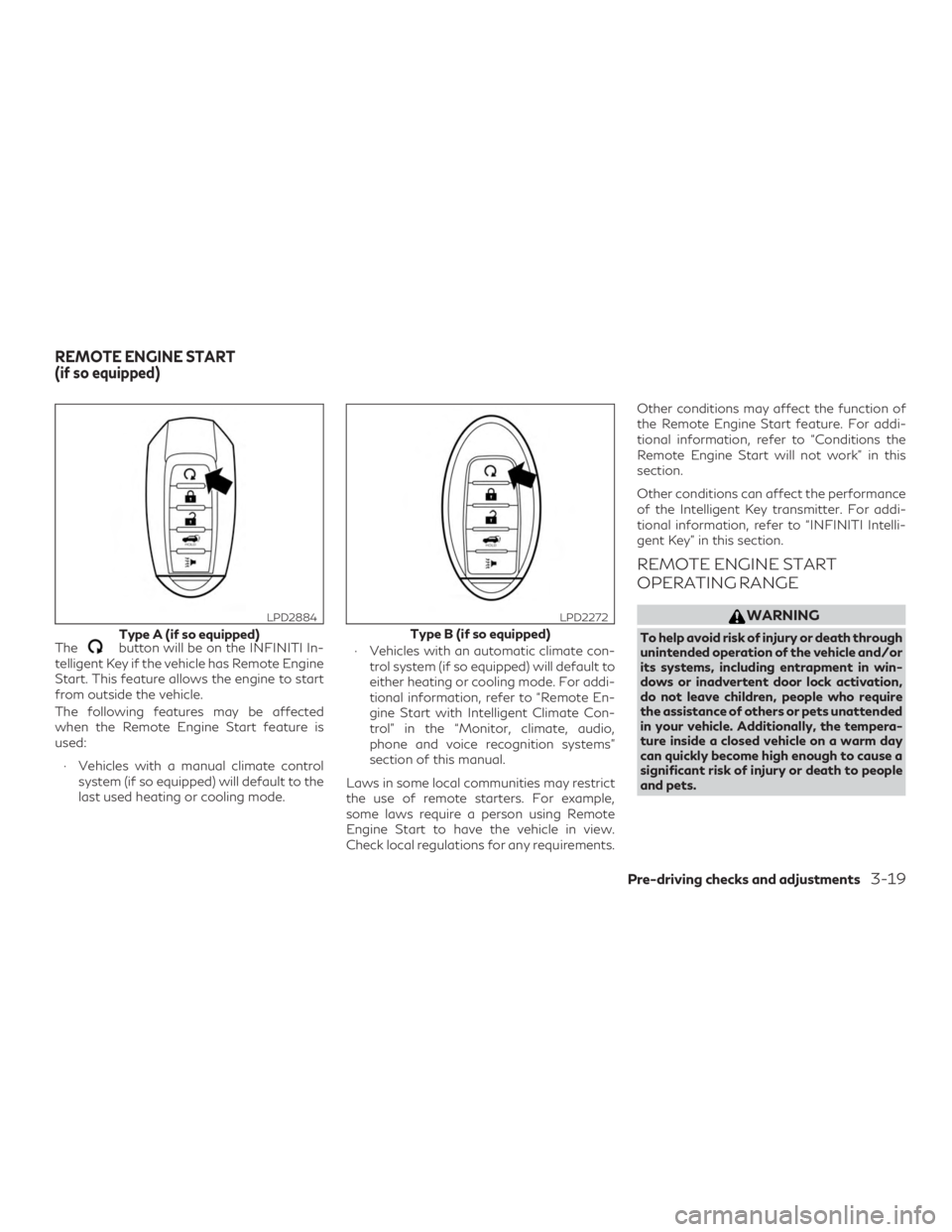
Thebutton will be on the INFINITI In-
telligent Key if the vehicle has Remote Engine
Start. This feature allows the engine to start
from outside the vehicle.
The following features may be affected
when the Remote Engine Start feature is
used:
∙ Vehicles with a manual climate control system (if so equipped) will default to the
last used heating or cooling mode. ∙ Vehicles with an automatic climate con-
trol system (if so equipped) will default to
either heating or cooling mode. For addi-
tional information, refer to “Remote En-
gine Start with Intelligent Climate Con-
trol” in the “Monitor, climate, audio,
phone and voice recognition systems”
section of this manual.
Laws in some local communities may restrict
the use of remote starters. For example,
some laws require a person using Remote
Engine Start to have the vehicle in view.
Check local regulations for any requirements. Other conditions may affect the function of
the Remote Engine Start feature. For addi-
tional information, refer to “Conditions the
Remote Engine Start will not work” in this
section.
Other conditions can affect the performance
of the Intelligent Key transmitter. For addi-
tional information, refer to “INFINITI Intelli-
gent Key” in this section.
REMOTE ENGINE START
OPERATING RANGE
WARNING
To help avoid risk of injury or death through
unintended operation of the vehicle and/or
its systems, including entrapment in win-
dows or inadvertent door lock activation,
do not leave children, people who require
the assistance of others or pets unattended
in your vehicle. Additionally, the tempera-
ture inside a closed vehicle on a warm day
can quickly become high enough to cause a
significant risk of injury or death to people
and pets.Type A (if so equipped)
LPD2884
Type B (if so equipped)
LPD2272
REMOTE ENGINE START
(if so equipped)
Pre-driving checks and adjustments3-19
Page 283 of 540

∙ Make sure the area around the vehicle isclear.
∙ Check fluid levels such as engine oil, cool- ant, brake fluid, and windshield-washer
fluid as frequently as possible, or at least
whenever you refuel.
∙ Check that all windows and lights are clean.
∙ Visually inspect tires for their appearance and condition. Also check tires for proper
inflation.
∙ Check that all doors are closed.
∙ Position seat and adjust head restraints/headrests.
∙ Adjust inside and outside mirrors.
∙ Fasten seat belts and ask all passengers to do likewise.
∙ Check the operation of warning lights when the ignition switch is placed in the
ON position. For additional information,
refer to “Warning lights, indicator lights
and audible reminders” in the “Instru-
ments and controls” section of this
manual. 1. Apply the parking brake.
2. Move the shift lever to P (Park) or
N (Neutral). P (Park) is recommended.
The starter is designed not to operate if
the shift lever is in any of the driving
positions.
3. Push the ignition switch to the ON posi- tion. Depress the brake pedal and push
the ignition switch to start the engine.
To start the engine immediately, push
and release the ignition switch while de-
pressing the brake pedal with the ignition
switch in any position.
∙ If the engine is very hard to start in extremely cold weather or when re-
starting, depress the accelerator pedal
a little (approximately 1/3 to the floor)
and while holding, crank the engine.
Release the accelerator pedal when
the engine starts.
∙ If the engine is very hard to start be- cause it is flooded, depress the accel-
erator pedal all the way to the floor
and hold it. Push the ignition switch to
the ON position to start cranking the
engine. After 5 or 6 seconds, stop
cranking by pushing the ignition switch
to the LOCK position. After cranking the engine, release the accelerator
pedal. Crank the engine with your foot
off the accelerator pedal by depress-
ing the brake pedal and pushing the
ignition switch to start the engine. If
the engine starts, but fails to run, re-
peat the above procedure.
CAUTION
Do not operate the starter for more than
15 seconds at a time. If the engine does not
start, push the ignition switch to the OFF
position and wait 10 seconds before crank-
ing again, otherwise the starter could be
damaged.
4. Warm-up:
Allow the engine to idle for at least
30 seconds after starting. Do not race
the engine while warming it up. Drive at a
moderate speed for a short distance
first, especially in cold weather. In cold
weather, keep the engine running for a
minimum of2-3minutes before shut-
ting it off. Starting and stopping the en-
gine over a short period of time may
make the vehicle more difficult to start.
5. To stop the engine, place the shift lever in the P (Park) position and push the
ignition switch to the OFF position.
BEFORE STARTING THE ENGINE STARTING THE ENGINE
Starting and driving5-17
Page 424 of 540

WARNING
Always follow the instructions below. Fail-
ure to do so could result in damage to the
charging system and cause personal injury.1. If the booster battery is in another ve- hicle, position the two vehicles to bring
their batteries near each other.
Do not allow the two vehicles to touch.
2. Apply the parking brake. Move the shift lever to P (Park). Switch off all unneces-
sary electrical systems (lights, heater, air
conditioner, etc.). 3. Connect the jumper cables in the se-
quence illustrated (�A,�B,�C,�D).
CAUTION
∙ Always connect positive (�) to positive(�) and negative (�) to body ground (for
example, strut mounting bolt, engine lift
bracket, etc.) — not to the battery.
∙ Make sure the jumper cables do not touch moving parts in the engine compartment
and that the cable clamps do not contact
any other metal.
4. Start the engine of the booster vehicle and let it run for a few minutes. 5. Keep the engine speed of the booster
vehicle at about 2,000 rpm and start the
engine of the vehicle being jump started.
CAUTION
Do not keep the starter motor engaged for
more than 10 seconds. If the engine does
not start right away, place the ignition
switch in the OFF position and wait 3 to
4 seconds before trying again.
6. After starting the engine, carefully dis- connect the negative cable and then the
positive cable.
LCE2223
6-12In case of emergency