Page 457 of 685
5-133
Driving your vehicle
5
To decrease Cruise Controlspeed
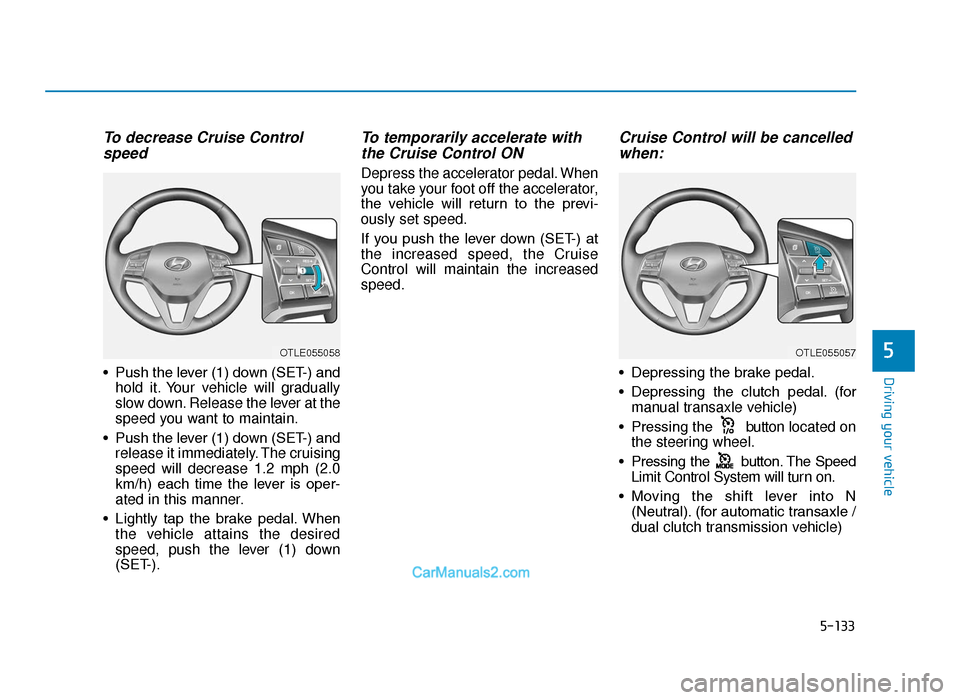
• Push the lever (1) down (SET-) and
hold it. Your vehicle will gradually
slow down. Release the lever at the
speed you want to maintain.
• Push the lever (1) down (SET-) and release it immediately. The cruising
speed will decrease 1.2 mph (2.0
km/h) each time the lever is oper-
ated in this manner.
• Lightly tap the brake pedal. When the vehicle attains the desired
speed, push the lever (1) down
(SET-).
To temporarily accelerate withthe Cruise Control ON
Depress the accelerator pedal. When
you take your foot off the accelerator,
the vehicle will return to the previ-
ously set speed.
If you push the lever down (SET-) at
the increased speed, the Cruise
Control will maintain the increased
speed.
Cruise Control will be cancelledwhen:
• Depressing the brake pedal.
• Depressing the clutch pedal. (for
manual transaxle vehicle)
• Pressing the b uttonlocated on
the steering wheel.
• Pressing the button. The Speed Limit Control System will turn on.
• Moving the shift lever into N (Neutral). (for automatic transaxle /
dual clutch transmission vehicle)
OTLE055057OTLE055058
TLe UK 5.qxp 5/10/2018 12:29 PM Page 133
Page 464 of 685
5-140
Driving your vehicle
• Pressing the CANCEL / O button located on the steering wheel.
• Pressing the CRUISE / button. Both the CRUISE indicator and the
SET indicator will turn OFF.
• Moving the shift lever into N (Neutral). (for automatic transaxle /
dual clutch transmission vehicle)
• Decreasing the vehicle speed lower than the speed by 12 mph
(20 km/h).
• Decreasing the vehicle speed to less than approximately 20 mph
(30 km/h).
• The ESC (Electronic Stability Control) is operating.
• Downshifting to the 2nd gear in Sports Mode.
Information
Each of the above actions will cancel
Cruise Control operation (The set
speed on the instrument cluster will go
off), but only pressing the CRUISE
button will turn the system off. If you
wish to resume Cruise Control opera-
tion, push the lever up (RES+) located
on your steering wheel. You will
return to your previously preset
speed, unless the system was turned
off using the CRUISE button.
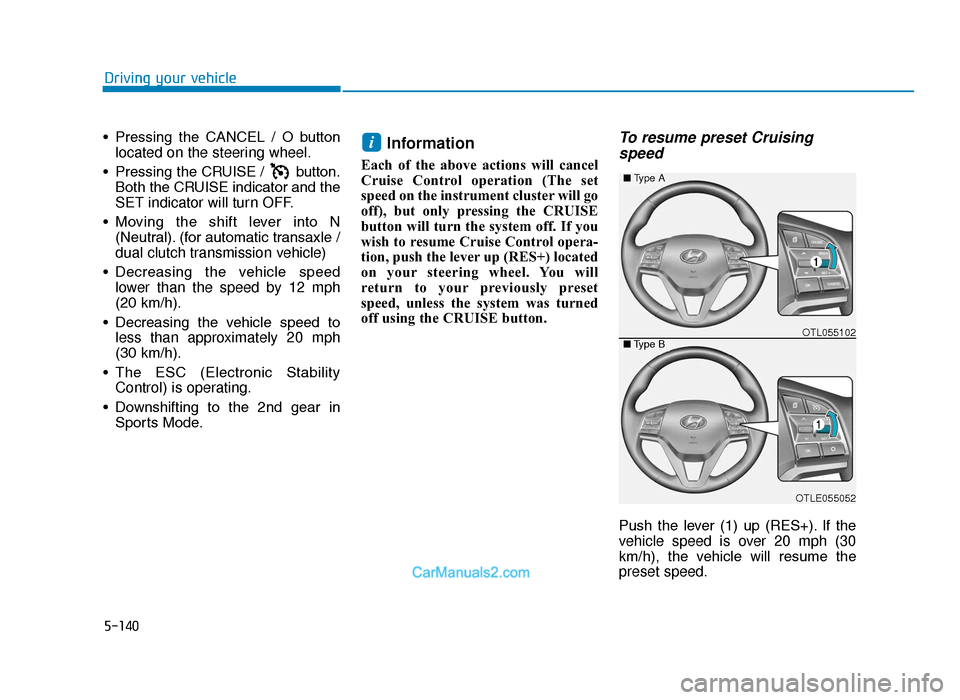
To resume preset Cruisingspeed
Push the lever (1) up (RES+). If the
vehicle speed is over 20 mph (30
km/h), the vehicle will resume the
preset speed.
i
OTLE055052
■ Type A
■Type BOTL055102
TLe UK 5.qxp 5/10/2018 12:30 PM Page 140
Page 496 of 685
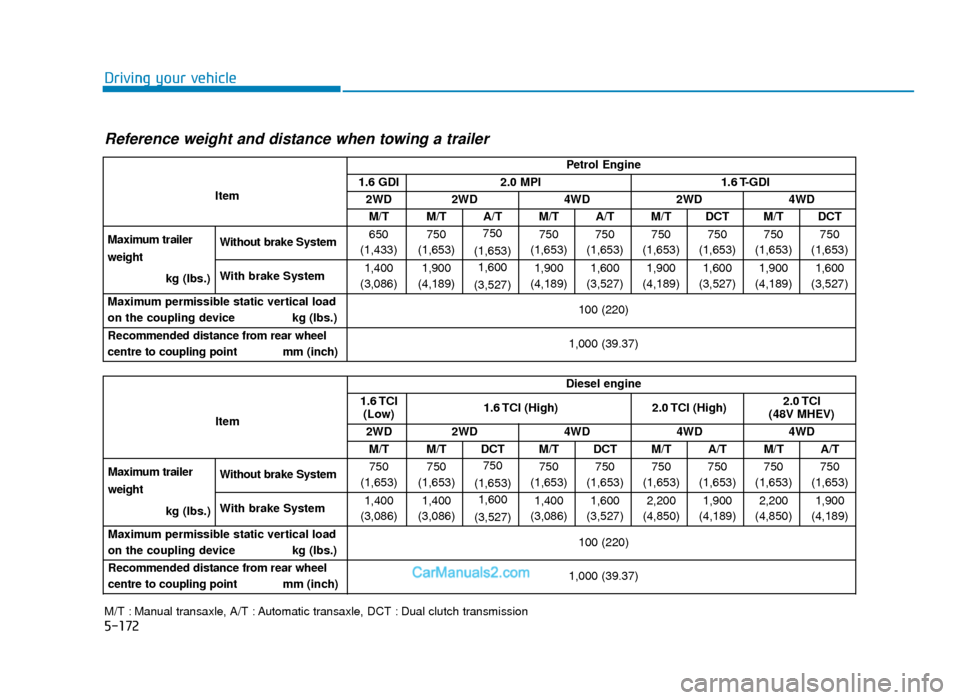
5-172
Driving your vehicle
M/T : Manual transaxle, A/T : Automatic transaxle, DCT : Dual clutch transmissionItem
Petrol Engine
1.6 GDI2.0 MPI1.6 T-GDI
2WD2WD4WD2WD4WD
M/T M/T A/T M/T A/T
M/TDCTM/TDCT
Maximum trailer
weight kg (Ibs.)
Without brake System 650
(1,433) 750
(1,653) 750
(1,653) 750
(1,653) 750
(1,653)750
(1,653)750
(1,653)750
(1,653)750
(1,653)
With brake System 1,400
(3,086) 1,900
(4,189) 1,600
(3,527) 1,900
(4,189) 1,600
(3,527)
1,900
(4,189)1,600
(3,527)1,900
(4,189)1,600
(3,527)
Maximum permissible static vertical load
on the coupling device kg (Ibs.) 100 (220)
Recommended distance from rear wheel
centre to coupling point mm (inch) 1,000 (39.37)
Item Diesel engine
1.6 TCI
(Low)1.6 TCI (High)2.0 TCI (High)2.0 TCI
(48V MHEV)
2WD2WD4WD4WD4WD
M/T M/T DCT M/T DCT
M/TA/TM/TA/T
Maximum trailer
weight kg (Ibs.)
Without brake System 750
(1,653) 750
(1,653) 750
(1,653) 750
(1,653) 750
(1,653)750
(1,653)750
(1,653)750
(1,653)750
(1,653)
With brake System 1,400
(3,086) 1,400
(3,086) 1,600
(3,527) 1,400
(3,086) 1,600
(3,527)
2,200
(4,850)1,900
(4,189)2,200
(4,850)1,900
(4,189)
Maximum permissible static vertical load
on the coupling device kg (Ibs.) 100 (220)
Recommended distance from rear wheel
centre to coupling point mm (inch) 1,000 (39.37)
Reference weight and distance when towing a trailer
TLe UK 5.qxp 6/12/2018 2:45 PM Page 172
Page 501 of 685
5-177
Driving your vehicle
5
Parking on hills
Generally, if you have a trailer
attached to your vehicle, you should
not park your vehicle on a hill.
However, if you ever have to park
your trailer on a hill, here's how to do
it:
1. Pull the vehicle into the parkingspace.
Turn the steering wheel in the direction of the kerb (left if headed
down hill, right if headed up hill).
2. Shift the vehicle to P (Park, for automatic transaxle/dual clutch
transmission vehicle) or neutral
(for manual transaxle vehicle).
3. Set the parking brake and shut off the vehicle.
4. Place wheel chocks under the trailer wheels on the down hill side
of the wheels.
5. Start the vehicle, hold the brakes, shift to neutral, release the park-
ing brake and slowly release the
brakes until the trailer chocks
absorb the load. 6. Reapply the brakes and parking
brakes.
7. Move the shift lever to P (Park, for automatic transaxle/dual clutch
transmission vehicle) or 1st gear
when the vehicle is parked on a
uphill grade and in R (Reverse) on
a downhill (for manual transaxle
vehicle).
8. Shut off the vehicle and release the vehicle brakes but leave the
parking brake set.
Ready to leave after parking ona hill
1. With the shift lever to P (Park, for
automatic transaxle/dual clutch
transmission vehicle) or neutral (for
manual transaxle vehicle), apply
your brakes and hold the brake
pedal down whilst you:
• Start your engine;
• Shift into gear; and
• Release the parking brake.
2. Slowly remove your foot from the brake pedal.
3. Drive slowly until the trailer is clear of the chocks.
4. Stop and have someone pick up and store the chocks.
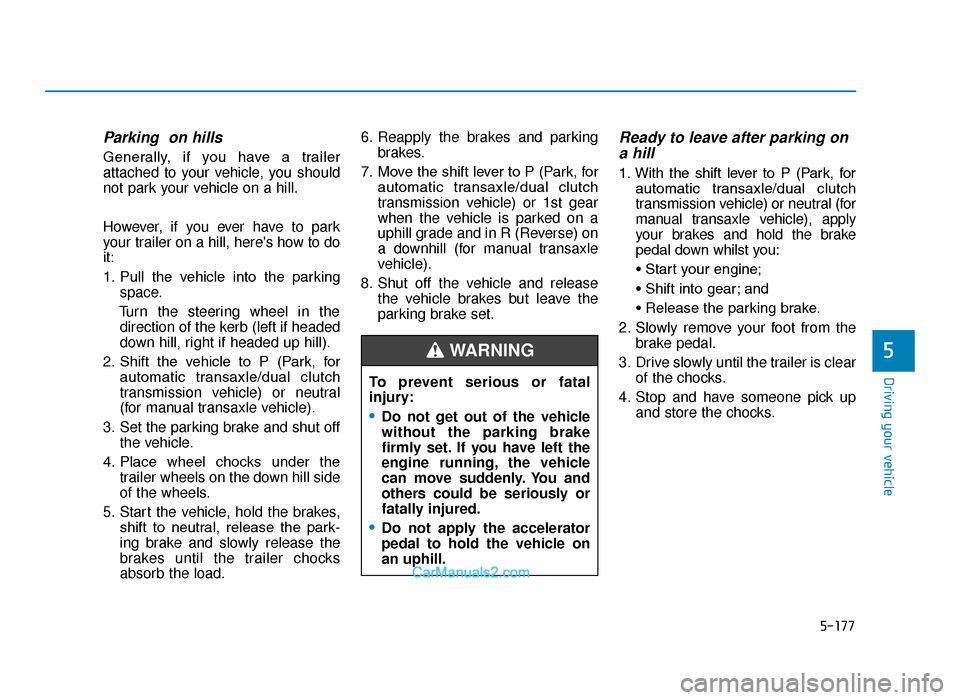
To prevent serious or fatal
injury:
•Do not get out of the vehicle
without the parking brake
firmly set. If you have left the
engine running, the vehicle
can move suddenly. You and
others could be seriously or
fatally injured.
•Do not apply the accelerator
pedal to hold the vehicle on
an uphill.
WARNING
TLe UK 5.qxp 5/10/2018 12:33 PM Page 177
Page 506 of 685
6-3
What to do in an emergency
If the engine stalls at a cross-
road or crossing
If the engine stalls at a crossroad or
crossing, if safe to do so, move the
shift lever to the N (Neutral) position
and then push the vehicle to a safe
location.
If you have a flat tyre whilst
driving
If a tyre goes flat whilst you are driv-
ing:
• Take your foot off the acceleratorpedal and let the vehicle slow
down whilst driving straight ahead.
Do not apply the brakes immedi-
ately or attempt to pull off the road
as this may cause loss of vehicle
control resulting in an accident.
When the vehicle has slowed to
such a speed that it is safe to do
so, brake carefully and pull off the
road. Drive off the road as far as
possible and park on firm, level
ground. If you are on a divided
highway, do not park in the median
area between the two traffic lanes. • When the vehicle is stopped, press
the hazard warning flasher button,
move the shift lever into P (Park,
for automatic transaxle/dual clutch
transmission vehicle) or neutral (for
manual transaxle vehicle), apply the
parking brake, and place the ignition
switch in the LOCK/OFF position.
• Have all passengers get out of the vehicle. Be sure they all get out on
the side of the vehicle that is away
from traffic.
• When changing a flat tyre, follow the instructions provided later in
this chapter.
6
TLe UK 6.qxp 5/10/2018 1:20 PM Page 3
Page 509 of 685
6-6
What to do in an emergency
To prevent damage to your vehi-
cle:
• Only use a 12-volt power supply (battery or jumper system) to
jump start your vehicle.
• Do not attempt to jump start your vehicle by push-starting.
Information
An inappropriately disposedbattery can be harmful to the
environment and human
health. Dispose the battery
according to your local law(s)
or regulations.
Jump starting procedure
1. Position the vehicles close enough that the jumper cables will reach,
but do not allow the vehicles to
touch.
2. Avoid fans or any moving parts in the engine compartment at all
times, even when the vehicles are
turned off.
3. Turn off all electrical devices such as radios, lights, air conditioning,
etc. Put the vehicles in P (Park, for
automatic transaxle/dual clutch
transmission vehicle) or neutral
(for manual transaxle vehicle), and
set the parking brakes. Turn both
vehicles OFF.iNOTICE
Pb
TLe UK 6.qxp 5/10/2018 1:20 PM Page 6
Page 511 of 685
6-8
What to do in an emergency
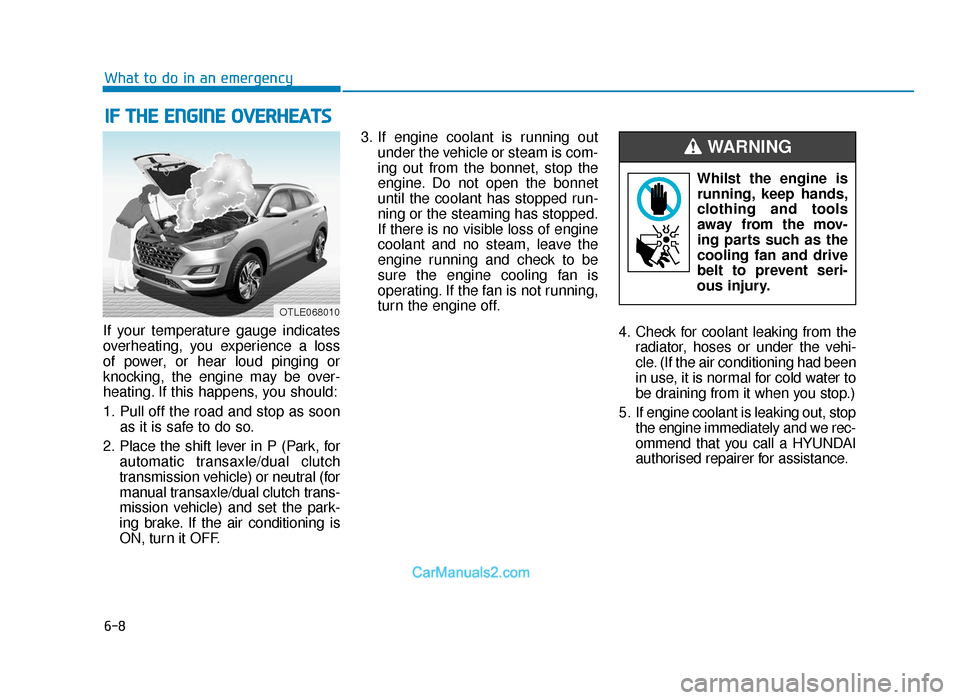
If your temperature gauge indicates
overheating, you experience a loss
of power, or hear loud pinging or
knocking, the engine may be over-
heating. If this happens, you should:
1. Pull off the road and stop as soon as it is safe to do so.
2. Place the shift lever in P (Park, for automatic transaxle/dual clutch
transmission vehicle) or neutral (for
manual transaxle/dual clutch trans-
mission vehicle) and set the park-
ing brake. If the air conditioning is
ON, turn it OFF. 3. If engine coolant is running out
under the vehicle or steam is com-
ing out from the bonnet, stop the
engine. Do not open the bonnet
until the coolant has stopped run-
ning or the steaming has stopped.
If there is no visible loss of engine
coolant and no steam, leave the
engine running and check to be
sure the engine cooling fan is
operating. If the fan is not running,
turn the engine off.
4. Check for coolant leaking from theradiator, hoses or under the vehi-
cle. (If the air conditioning had been
in use, it is normal for cold water to
be draining from it when you stop.)
5. If engine coolant is leaking out, stop the engine immediately and we rec-
ommend that you call a HYUNDAI
authorised repairer for assistance.
IF THE ENGINE OVERHEATS
Whilst the engine isrunning, keep hands,
clothing and tools
away from the mov-
ing parts such as the
cooling fan and drive
belt to prevent seri-
ous injury.
WARNING
OTLE068010
TLe UK 6.qxp 5/10/2018 1:20 PM Page 8
Page 522 of 685
6-19
What to do in an emergency
6
Follow these steps to change your
vehicle’s tyre:
1. Park on a level, firm surface.
2. Move the shift lever into P (Park,for automatic transaxle/dual clutch
transmission vehicle) or neutral
(for manual transaxle vehicle),
apply the parking brake, and place
the ignition switch in the
LOCK/OFF position.
3. Press the hazard warning flasher button.
4. Remove the wheel lug nut wrench, jack, jack handle, and spare tyre
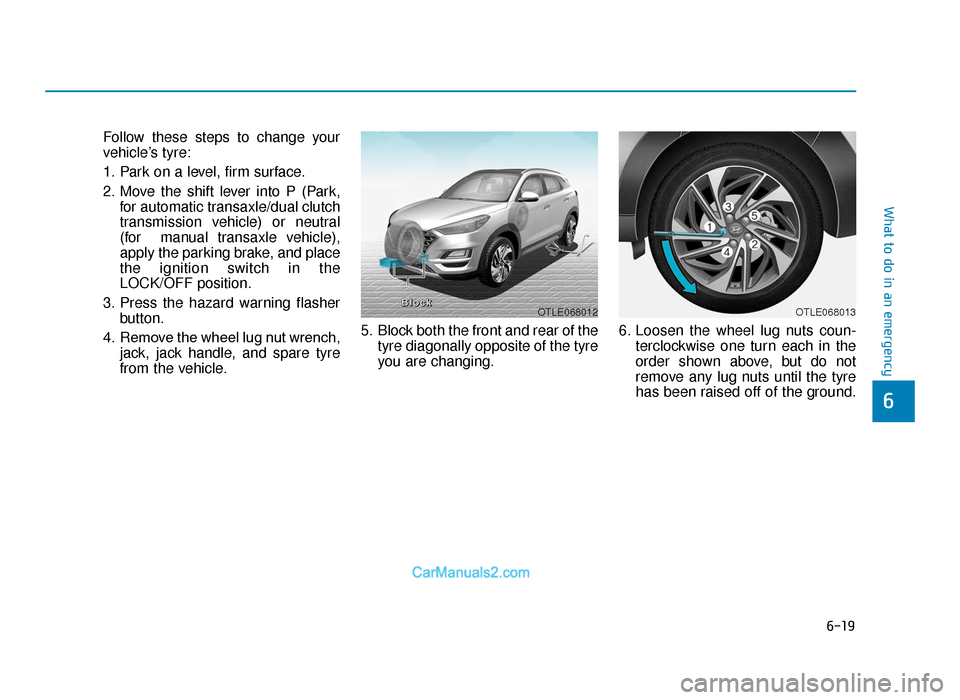
from the vehicle. 5. Block both the front and rear of the
tyre diagonally opposite of the tyre
you are changing. 6. Loosen the wheel lug nuts coun-
terclockwise one turn each in the
order shown above, but do not
remove any lug nuts until the tyre
has been raised off of the ground.
OTLE068012
BBlloocckkOTLE068013
TLe UK 6.qxp 5/10/2018 1:20 PM Page 19