2019 Hyundai Tucson air filter
[x] Cancel search: air filterPage 578 of 685
7-29
7
Maintenance
CLIMATE CONTROL AIR FILTER
Filter inspection
If the vehicle is operated in the
severely air-polluted cities or on
dusty rough roads for a long period,
it should be inspected more fre-
quently and replaced earlier. When
you, the owner, replace the climate
control air filter, replace it performing
the following procedure, and be care-
ful to avoid damaging other compo-
nents.
Replace the filter according to the
Maintenance Schedule.
Install a new climate control air filter
in the correct direction with the
arrow symbol(
↓) facing downwards.
Otherwise, the climate control effects
may decrease, possibly with a noise.
Filter replacement
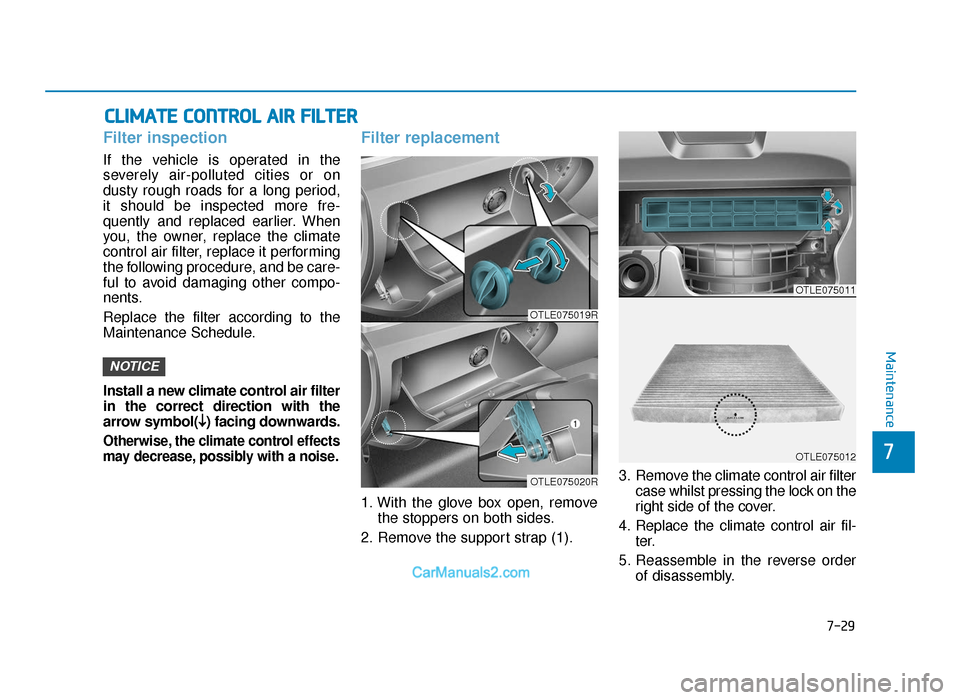
1. With the glove box open, removethe stoppers on both sides.
2. Remove the support strap (1). 3. Remove the climate control air filter
case whilst pressing the lock on the
right side of the cover.
4. Replace the climate control air fil- ter.
5. Reassemble in the reverse order of disassembly.
NOTICE
OTLE075019R
OTLE075020R
OTLE075011
OTLE075012
TLe UK 7.qxp 5/10/2018 1:34 PM Page 29
Page 641 of 685
7-92
Maintenance
EMISSION CONTROL SYSTEM
The emission control system of your
vehicle is covered by a written limited
warranty. Please see the warranty
information contained in the Warranty
Booklet in your vehicle.
Your vehicle is equipped with an emis-
sion control system to meet all emis-
sion regulations.
There are three emission control
systems which are as follows.
(1) Crankcase emission control sys-tem
(2) Evaporative emission control sys- tem
(3) Exhaust emission control system
In order to assure the proper function
of the emission control systems, it is
recommended that you have your car
inspected and maintained by a
HYUNDAI authorised repairer in
accordance with the maintenance
schedule in this manual.1. Crankcase emission control system
The positive crankcase ventilation
system is employed to prevent air
pollution caused by blow-by gases
being emitted from the crankcase.
This system supplies fresh filtered air
to the crankcase through the air
intake hose. Inside the crankcase,
the fresh air mixes with blow-by
gases, which then pass through the
PCV valve into the induction system.
2. Evaporative emission controlsystem
The Evaporative Emission Control
System is designed to prevent fuel
vapours from escaping into the
atmosphere.
For the Inspection and Maintenance
Test (With Electronic Stability Control
(ESC) system)
•To prevent the vehicle from
misfiring during dynamome-
ter testing, turn the Electronic
Stability Control (ESC) sys-
tem off by pressing the ESC
switch.
•After dynamometer testing is
completed, turn the ESC sys-
tem back on by pressing the
ESC switch again.
CAUTION
TLe UK 7.qxp 5/10/2018 1:40 PM Page 92
Page 645 of 685
7-96
Maintenance
Diesel particulate filter (DPF) (if equipped)
The Diesel Particulate Filter (DPF)
system removes the soot in the
exhaust gas. Unlike a disposable air
filter, the DPF system automatically
burns (oxidizes) and removes the
accumulated soot according to the
driving condition. In order words, the
active burning by engine control sys-
tem and high exhaust gas tempera-
ture caused by normal/high diving
condition burns and removes the
accumulated soot.
However, if the vehicle continues to
be driven at repeated short distance
or driven at low speed for a long
time, the accumulated soot may not
be automatically removed because
of low exhaust gas temperature.
More than a certain amount of soot
deposited, the malfunction indicator
light ( ) illuminates.
When the malfunction indicator light
illuminates, it may turn-off after driv-
ing the vehicle at more than 60km/h
(37 mph) or at more than second
gear with 1500~2500 engine rpm for
a certain time (for about 25 minutes). If the malfunction indicator light
( ) continues to be blinked or the
warning massage “Check exhaust
system” illuminates in spite of the
procedure, visit a professional work-
shop and check the DPF system.
HYUNDAI
recommends to visit a
HYUNDAI authorised repairer/serv-
ice partner.
If you continue to drive with the mal-
function indicator light blinking for a
long time, the DPF system can be
damaged and fuel consumption can
be worsen and the engine durability
can be worsen by oil dilution.Diesel Fuel
(if equipped with DPF)
We recommend you to use only
the regulated diesel fuels, when
your vehicle is equipped with
the DPF system.
When you use other diesel
fuels, which is high in sulfurs
(above 50 ppm) or contains
unspecified additives, it may
damage the DPF system and
cause the white smoke emis-
sion.
CAUTION
TLe UK 7.qxp 6/12/2018 2:51 PM Page 96
Page 646 of 685
Gasoline (Petrol) ParticulateFilter (GPF) (if equipped)
The Gasoline (Petrol) Particulate
Filter (GPF) system removes the soot
in the exhaust gas.
The GPF system automatically burns
(or oxidises) the accumulated soot in
accordance with driving situations,
unlike a disposable air filter.
In other words, the accumulated soot
is automatically purged out by the
engine control system and by the high
exhaust-gas temperature at normal/
high driving speeds.
However, when the vehicle is continu-
ally driven at repeated short distances
or driven at low speed for a long time,
the accumulated soot may not be
automatically removed because of low
exhaust gas temperature. In this case,
the accumulated soot is out of the
detection range, the soot oxidization
process does not occur, and the
Gasoline (Petrol) Par ticulate Filter
(GPF) Lamp ( ) Illuminates. The Gasoline (P
etrol) Particulate
Filter (GPF) Lamp stops illuminating,
when the driving speed exceeds
80 km/h (50 mph) with engine rpm
1,500 ~ 4,000 and the gear in the 3rd
position or above for approximately
30 minutes.
When the GPF Lamp continuously
blinks or the warning message “Check
exhaust system” illuminates in the
above cases, we recommend that you
have the GPF system checked by a
HYUNDAI authorised repairer.
When the vehicle is continuously driv-
en with the GPF Lamp flashing for an
extended period of time, it may dam-
age the GPF system and lower the
fuel economy.
7-97
7
Maintenance
Gasoline (Petrol) Fuel
(if equipped with GPF)
We recommend you to use only
the regulated petrol fuels, when
your vehicle is equipped with
the GPF system.
When you use other petrol fuels
which contain unspecified addi-
tives, they may damage the GPF
system and cause exhaust
emission problems.
CAUTION
TLe UK 7.qxp 6/12/2018 2:51 PM Page 97
Page 676 of 685
 I-3
Battery.................................................................\
..........7-33Battery capacity label ................................................7-35
Battery recharging..............")
I-3
Battery.................................................................\
..........7-33Battery capacity label ................................................7-35
Battery recharging......................................................7-35
For best battery service ..............................................7-33
Reset items .................................................................7-36
Before driving .................................................................5-5 Before entering the vehicle ..........................................5-5
Before starting .............................................................5-5
Blind-spot collision warning (BCW) system .............5-100
Bluetooth...............................................................\
........4-32
Bluetooth
®Wireless Technology hands-free..................4-5
Bonnet ........................................................................\
...3-42
Brake/clutch fluid .........................................................7-24
Braking system .............................................................5-43 Anti-lock Brake System (ABS) .................................5-56
Auto hold ...................................................................5-52
Disc brakes wear indicator ........................................5-44
Downhill Brake Control (DBC) ................................5-64
Electronic Parking Brake (EPB) ................................5-46
Electronic Stability Control (ESC) ............................5-58
Emergency Stop Signal (ESS) ...................................5-66
Good braking practices ..............................................5-67
Hill-Start Assist Control (HAC) ................................5-63
Parking brake (hand type) .........................................5-44
Power brakes..............................................................5-43
Vehicle Stability Management (VSM) ......................5-62
Bulb wattage ...................................................................8-3 Cargo security screen .................................................3-180
Centre console storage................................................3-168
Changing tyres ..............................................................6-18
Checking the engine oil level (Diesel Engine).............7-17
Checking the engine oil level (Petrol Engine) .............7-15
Child Restraint System (CRS)......................................2-38
Installing a Child Restraint System (CRS) ................2-41
Our Recommendation: Children always in the rear ..2-38
Selecting a Child Restraint System (CRS) ................2-39
Cigarette lighter ..........................................................3-177
Clearing the vehicle-restarting restriction ..................7-101
Climate control additional features ............................3-167 Automatic ventilation ..............................................3-167
Sunroof inside air recirculation ...............................3-167
To cancel or set the Automatic Ventilation..............3-167
Climate control air filter ...............................................7-29
Clock ........................................................................\
...3-177
Clothes hanger ............................................................3-178
Cool box .....................................................................3-1\
69
Crankcase emission control system..............................7-92
Cruise control .............................................................5-135
Cruise control (with speed limit control) ...................5-130
Cup holder ..................................................................3-171
I
Index
BC
TLe UK Index.qxp 6/12/2018 3:27 PM Page 3