2019 Hyundai Nexo filter
[x] Cancel search: filterPage 440 of 560
7-16
Maintenance
S
ST
T A
A C
CK
K
C
C O
O O
OL
LI
IN
N G
G
C
C O
O O
OL
LA
A N
N T
T
The high-pressure cooling system
has a reservoir filled with year-round
antifreeze coolant. The reservoir is
filled at the factory.
Check the antifreeze protection and
coolant level at least once a year, at
the beginning of the winter season
and before traveling to a colder cli-
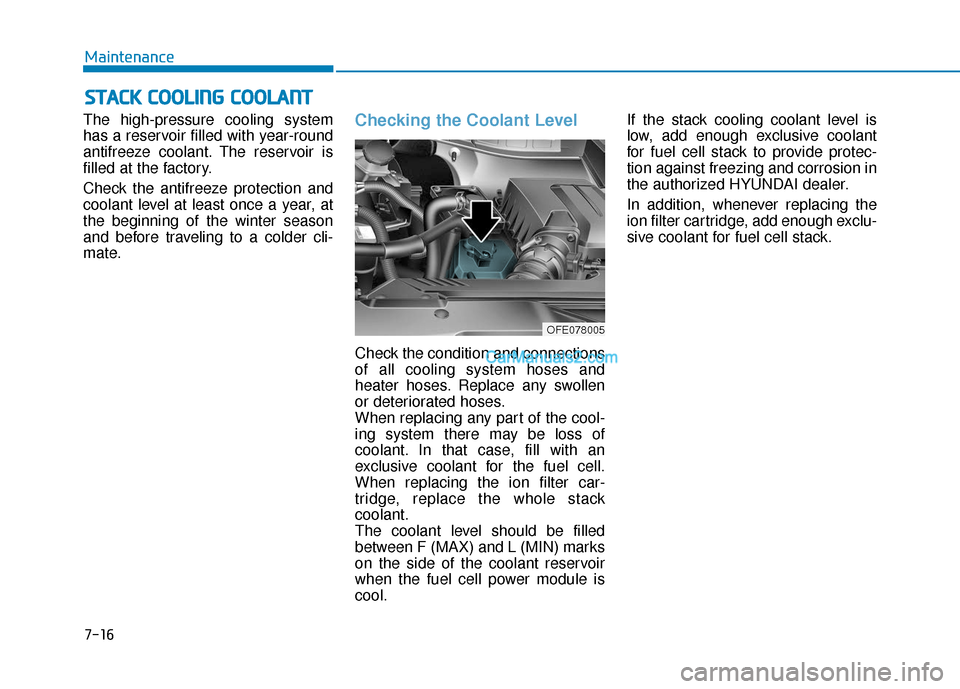
mate.Checking the Coolant Level
Check the condition and connections
of all cooling system hoses and
heater hoses. Replace any swollen
or deteriorated hoses.
When replacing any part of the cool-
ing system there may be loss of
coolant. In that case, fill with an
exclusive coolant for the fuel cell.
When replacing the ion filter car-
tridge, replace the whole stack
coolant.
The coolant level should be filled
between F (MAX) and L (MIN) marks
on the side of the coolant reservoir
when the fuel cell power module is
cool. If the stack cooling coolant level is
low, add enough exclusive coolant
for fuel cell stack to provide protec-
tion against freezing and corrosion in
the authorized HYUNDAI dealer.
In addition, whenever replacing the
ion filter cartridge, add enough exclu-
sive coolant for fuel cell stack.
OFE078005
Page 444 of 560
7-20
Maintenance
W
WA
AS
SH
H E
ER
R
F
F L
LU
U I
ID
D
Checking the Washer Fluid
Level
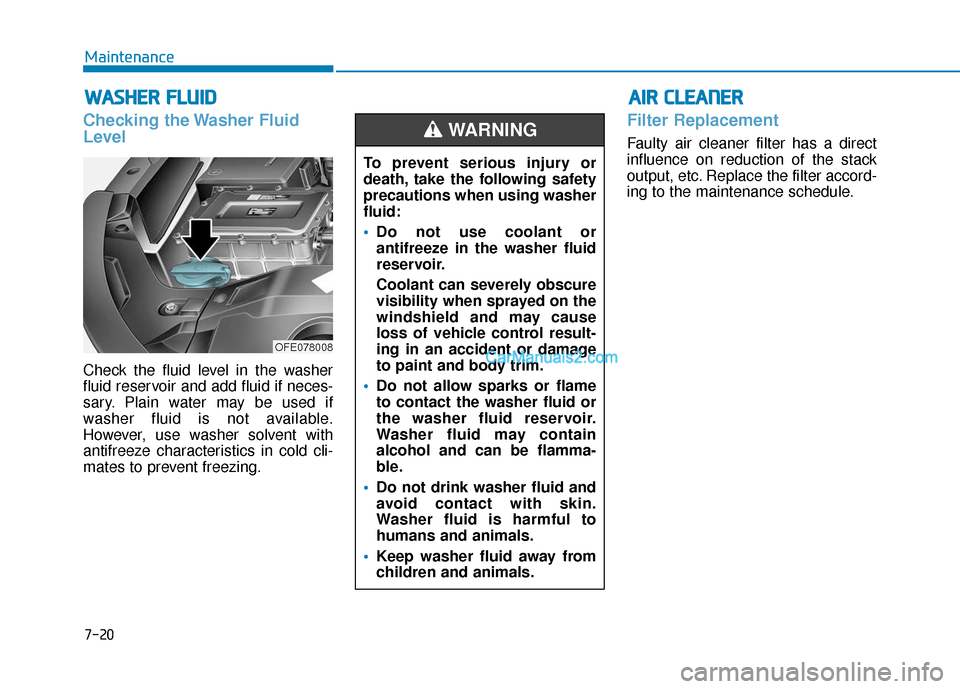
Check the fluid level in the washer
fluid reservoir and add fluid if neces-
sary. Plain water may be used if
washer fluid is not available.
However, use washer solvent with
antifreeze characteristics in cold cli-
mates to prevent freezing.
Filter Replacement
Faulty air cleaner filter has a direct
influence on reduction of the stack
output, etc. Replace the filter accord-
ing to the maintenance schedule.
OFE078008
To prevent serious injury or
death, take the following safety
precautions when using washer
fluid:
Do not use coolant or
antifreeze in the washer fluid
reservoir.
Coolant can severely obscure
visibility when sprayed on the
windshield and may cause
loss of vehicle control result-
ing in an accident or damage
to paint and body trim.
Do not allow sparks or flame
to contact the washer fluid or
the washer fluid reservoir.
Washer fluid may contain
alcohol and can be flamma-
ble.
Do not drink washer fluid and
avoid contact with skin.
Washer fluid is harmful to
humans and animals.
Keep washer fluid away from
children and animals.
WARNING
A AI
IR
R
C
C L
LE
E A
A N
N E
ER
R
Page 445 of 560
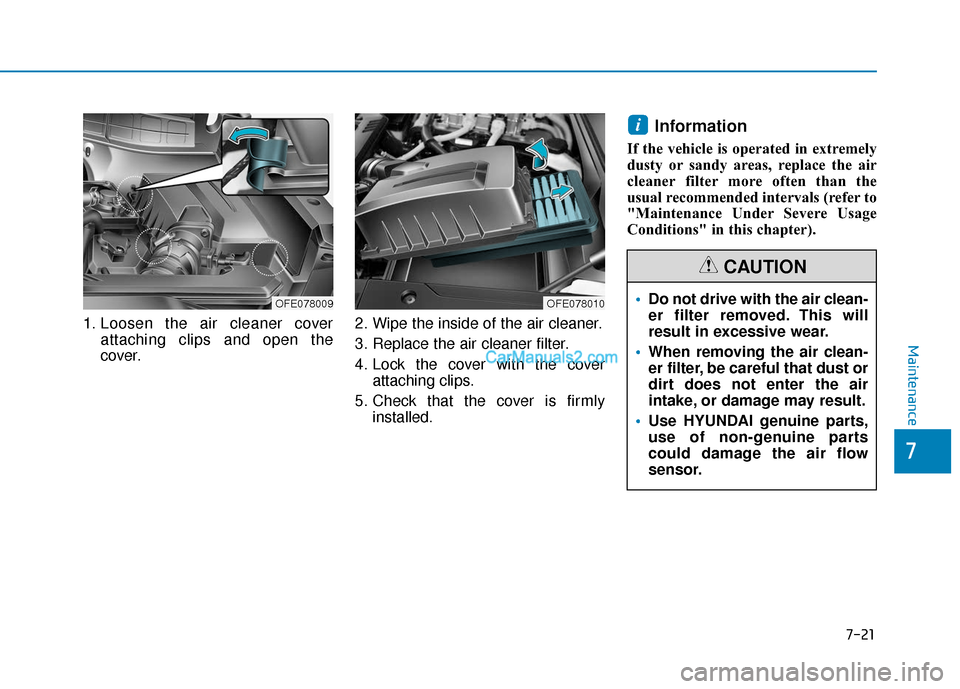
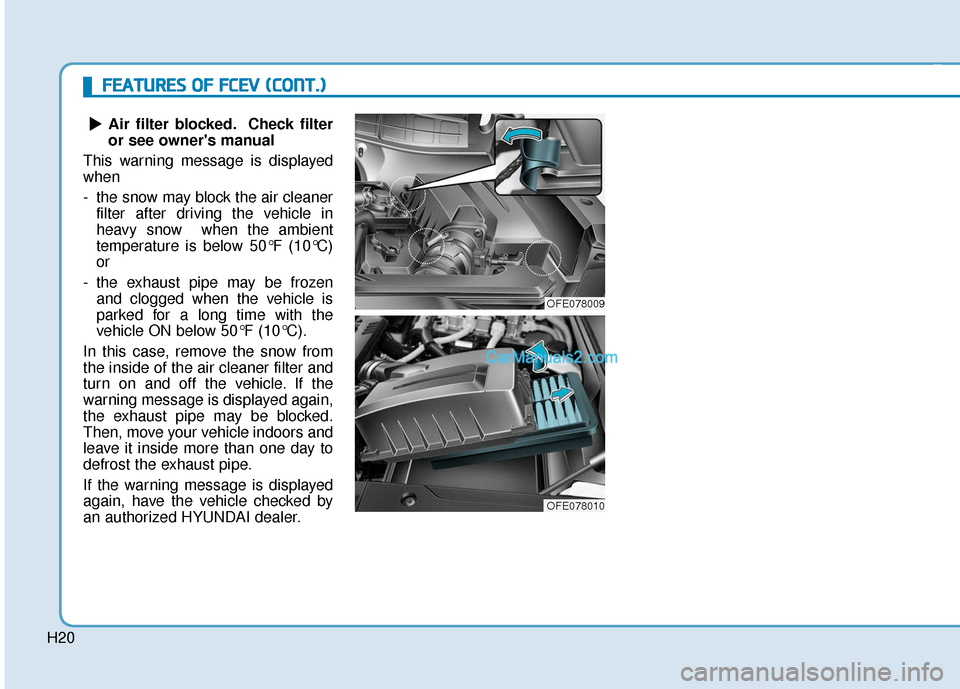
1. Loosen the air cleaner coverattaching clips and open the
cover. 2. Wipe the inside of the air cleaner.
3. Replace the air cleaner filter.
4. Lock the cover with the cover
attaching clips.
5. Check that the cover is firmly installed.
Information
If the vehicle is operated in extremely
dusty or sandy areas, replace the air
cleaner filter more often than the
usual recommended intervals (refer to
"Maintenance Under Severe Usage
Conditions" in this chapter).
i
7-21
7
Maintenance
OFE078010OFE078009Do not drive with the air clean-
er filter removed. This will
result in excessive wear.
When removing the air clean-
er filter, be careful that dust or
dirt does not enter the air
intake, or damage may result.
Use HYUNDAI genuine parts,
use of non-genuine parts
could damage the air flow
sensor.
CAUTION
Page 446 of 560
7-22
Maintenance
C
CL
LI
IM
M A
AT
TE
E
C
C O
O N
NT
TR
R O
O L
L
A
A I
IR
R
F
F I
IL
L T
T E
ER
R
Filter Inspection
The climate control air filter should
be replaced according to the
Maintenance Schedule. If the vehicle
is operated in severely air-polluted
cities or on dusty rough roads for a
long period, it should be inspected
more frequently and replaced earlier.
When you replace the climate control
air filter, replace it performing the fol-
lowing procedure, and be careful to
avoid damaging other components.
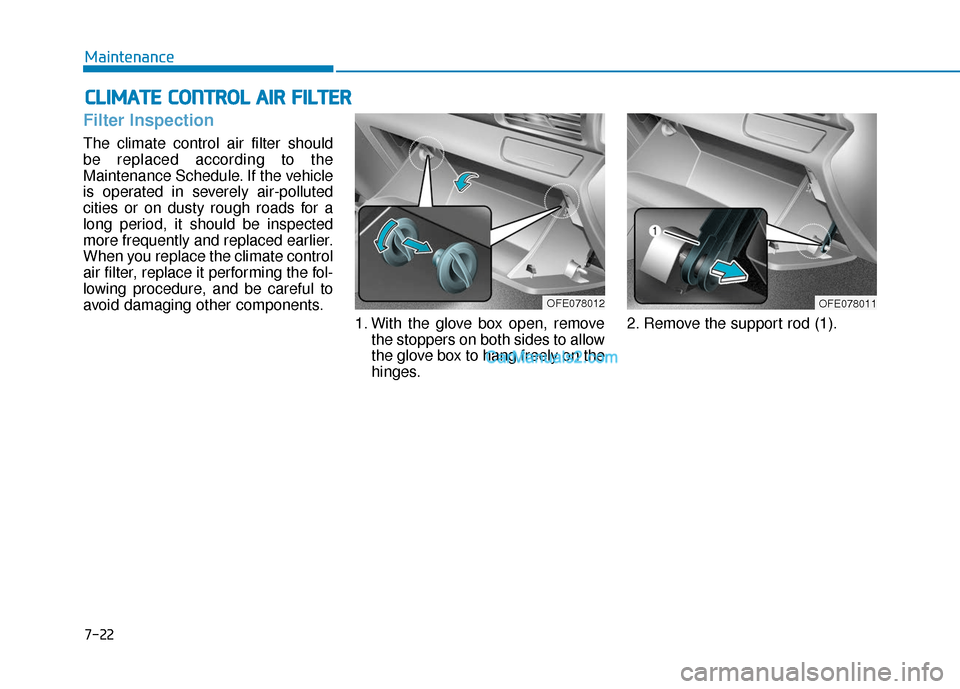
1. With the glove box open, removethe stoppers on both sides to allow
the glove box to hang freely on the
hinges. 2. Remove the support rod (1).
OFE078011OFE078012
Page 520 of 560
H16
F
FE
E A
A T
TU
U R
RE
ES
S
O
O F
F
F
F C
C E
E V
V
(
( C
C O
O N
NT
T.
.)
)
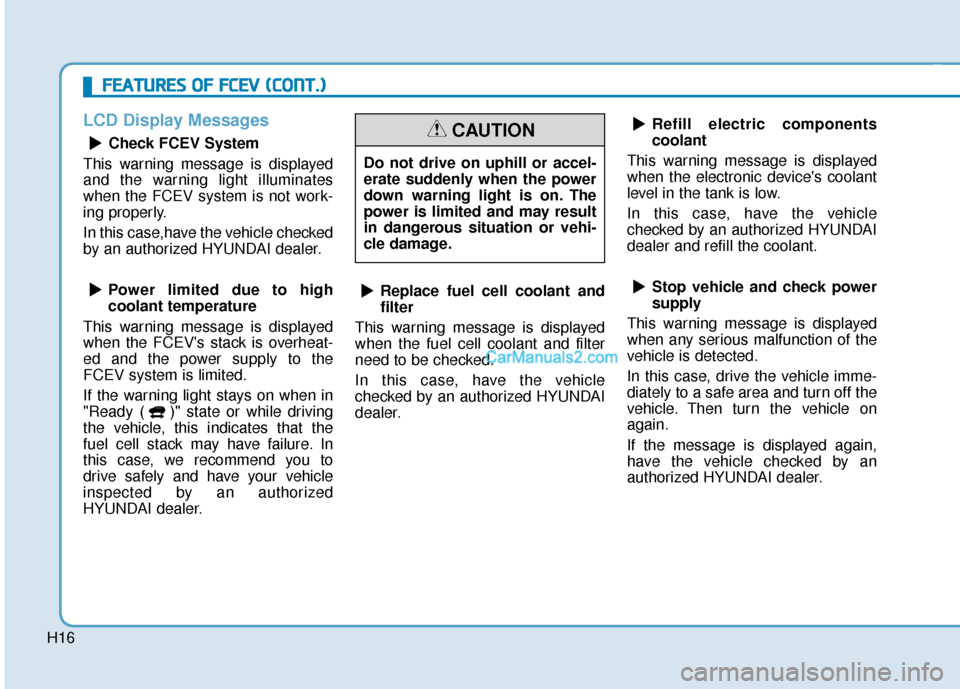
LCD Display Messages
Check FCEV System
This warning message is displayed
and the warning light illuminates
when the FCEV system is not work-
ing properly.
In this case,have the vehicle checked
by an authorized HYUNDAI dealer.
Power limited due to high
coolant temperature
This warning message is displayed
when the FCEV's stack is overheat-
ed and the power supply to the
FCEV system is limited.
If the warning light stays on when in
"Ready ( )" state or while driving
the vehicle, this indicates that the
fuel cell stack may have failure. In
this case, we recommend you to
drive safely and have your vehicle
inspected by an authorized
HYUNDAI dealer. Replace fuel cell coolant and
filter
This warning message is displayed
when the fuel cell coolant and filter
need to be checked.
In this case, have the vehicle
checked by an authorized HYUNDAI
dealer. Refill electric components
coolant
This warning message is displayed
when the electronic device's coolant
level in the tank is low.
In this case, have the vehicle
checked by an authorized HYUNDAI
dealer and refill the coolant.
Stop vehicle and check power
supply
This warning message is displayed
when any serious malfunction of the
vehicle is detected.
In this case, drive the vehicle imme-
diately to a safe area and turn off the
vehicle. Then turn the vehicle on
again.
If the message is displayed again,
have the vehicle checked by an
authorized HYUNDAI dealer.
▲ ▲
▲
▲
▲
▲▲
▲
▲
▲
Do not drive on uphill or accel-
erate suddenly when the power
down warning light is on. The
power is limited and may result
in dangerous situation or vehi-
cle damage.
CAUTION
Page 524 of 560
H20Air filter blocked. Check filter
or see owner's manual
This warning message is displayed
when
- the snow may block the air cleaner filter after driving the vehicle in
heavy snow when the ambient
temperature is below 50°F (10°C)
or
- the exhaust pipe may be frozen and clogged when the vehicle is
parked for a long time with the
vehicle ON below 50°F (10°C).
In this case, remove the snow from
the inside of the air cleaner filter and
turn on and off the vehicle. If the
warning message is displayed again,
the exhaust pipe may be blocked.
Then, move your vehicle indoors and
leave it inside more than one day to
defrost the exhaust pipe.
If the warning message is displayed
again, have the vehicle checked by
an authorized HYUNDAI dealer.
▲ ▲
OFE078009
OFE078010
F
F E
E A
A T
TU
U R
RE
ES
S
O
O F
F
F
F C
C E
E V
V
(
( C
C O
O N
NT
T.
.)
)
Page 539 of 560
H35
CategoryQuestionsAnswers
Vehicle
Management (12 items)
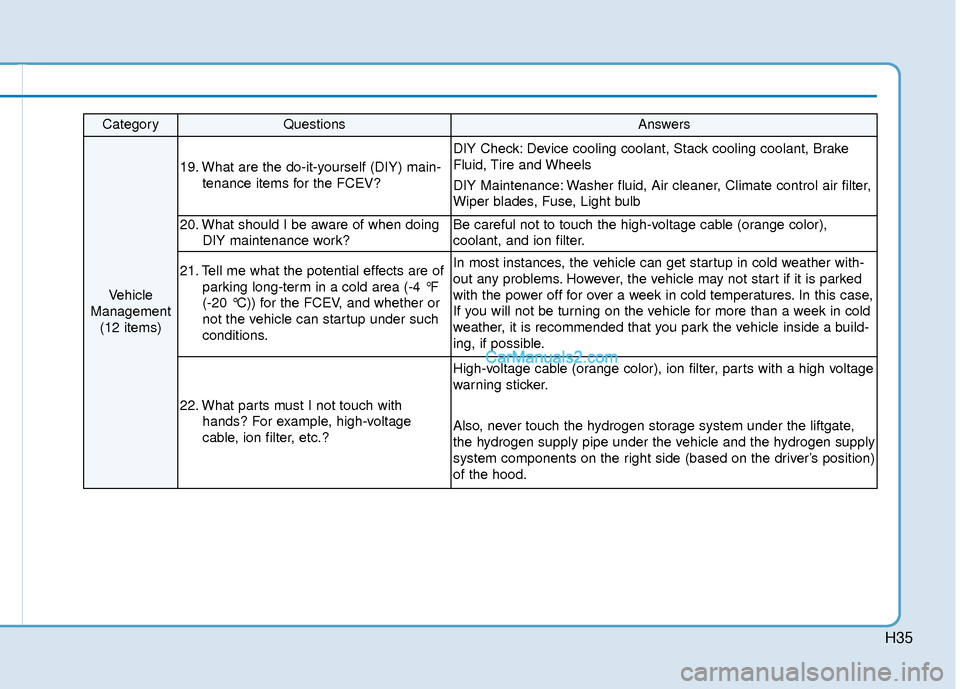
19. What are the do-it-yourself (DIY) main- tenance items for the FCEV?
DIY Check: Device cooling coolant, Stack cooling coolant, Brake
Fluid, Tire and Wheels
DIY Maintenance: Washer fluid, Air cleaner, Climate control air filter,
Wiper blades, Fuse, Light bulb
20. What should I be aware of when doingDIY maintenance work?Be careful not to touch the high-voltage cable (orange color),
coolant, and ion filter.
21. Tell me what the potential effects are ofparking long-term in a cold area (-4 °F
(-20 °C)) for the FCEV, and whether or
not the vehicle can startup under such
conditions.In most instances, the vehicle can get startup in cold weather with-
out any problems. However, the vehicle may not start if it is parked
with the power off for over a week in cold temperatures. In this case,
If you will not be turning on the vehicle for more than a week in cold
weather, it is recommended that you park the vehicle inside a build-
ing, if possible.
22. What parts must I not touch withhands? For example, high-voltage
cable, ion filter, etc.?
High-voltage cable (orange color), ion filter, parts with a high voltage
warning sticker.
Also, never touch the hydrogen storage system under the liftgate,
the hydrogen supply pipe under the vehicle and the hydrogen supply
system components on the right side (based on the driver’s position)
of the hood.
Page 551 of 560

I-2
12V battery......................................................................7-\
27Battery recharging ......................................................7-28
Reset Features ............................................................7-28
AC Inverter ...................................................................3-166\
Accessing Your Vehicle ....................................................3-3 Smart Key.....................................................................3-3\
Immobilizer System .....................................................3-9
Active Hood Lift System ................................................2-70 System activation .......................................................2-70
System limitation........................................................2-71
System malfunction ....................................................2-72
Air Bag - Advanced Supplemental Restraint System.....2-47 Where Are the Air Bags? ...........................................2-49
How Does the Air Bag System Operate? ...................2-52
What to Expect After an Air Bag Inflates ..................2-57
Occupant Classification System (OCS) .....................2-58
Why Didn't My Air Bag Go Off in a Collision?........2-60
SRS Care ....................................................................2-60\
Additional Safety Precautions ....................................2-60
Air Bag Warning Labels.............................................2-60
Why Didn't My Air Bag Go Off in a Collision?........2-63
SRS Care ....................................................................2-68\
Additional Safety Precautions ....................................2-69
Air Bag Warning Labels.............................................2-69 Air Bag Warning Labels .................................................2-69
Air cleaner.......................................................................7\
-20
Filter Replacement .....................................................7-20
Air Conditioning System ..................................................8-5
Anti-lock Brake System (ABS) ......................................5-29
Appearance care..............................................................7-62 Exterior Care ..............................................................7-62
Interior Care ...............................................................7-67
Auto Hold .......................................................................5\
-25
Automatic Climate Control System..............................3-146 Automatic Temperature Control Mode ....................3-147
Manual Temperature Control Mode .........................3-147
System Operation .....................................................3-154
System Maintenance ................................................3-155
Before Driving ..................................................................5-4 Before Entering the Vehicle .........................................5-4
Before Starting .............................................................5-4
Blind-Spot Collision Warning/ Blind-Spot Collision-avoidance Assist ........................5-53
System Description ....................................................5-53
System Setting and Activation ...................................5-54
Warning and System Control .....................................5-57
Detecting Sensor (Front View Camera and Rear Corner Radar) .................................................5-59
Limitations of the System ..........................................5-62
Index
A
B