2019 HONDA CLARITY FUEL CELL ESP
[x] Cancel search: ESPPage 5 of 551
A Few Words About Safety
Your safety, and the safety of others, is very important. And
operating this vehicle safely is an important responsibility.
To help you make informed decisions about safety, we have
provided operating procedures and other information on labels and
in this manual. This information alerts you to potential hazards that
could hurt you or others.
Of course, it is not practical or possible to warn you about all the
hazards associated with operating or maintaining your vehicle. You
must use your own good judgment. You will find this impo
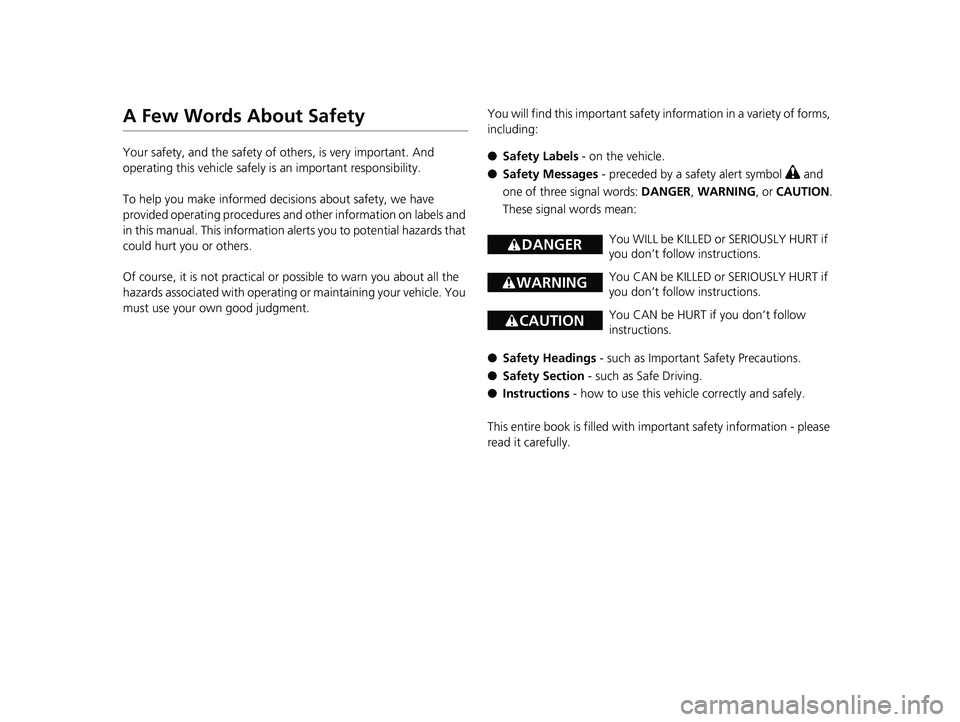
rtant safety information in a variety of forms,
including:
● Safety Labels - on the vehicle.
● Safety Messages - preceded by a safety alert symbol
3 and
one of three signal words: DANGER, WARNING , or CAUTION .
These signal words mean:
● Safety Headings - such as Important Safety Precautions.
● Safety Section - such as Safe Driving.
● Instructions - how to use this vehi cle correctly and safely.
This entire book is filled with important safety information - please
read it carefully.
3 DANGERYou WILL be KILLED or SERIOUSLY HURT if
you don’t follow instructions.
3 WARNINGYou CAN be KILLED or SERIOUSLY HURT if
you don’t follow instructions.
3CAUTIONYou CAN be HURT if you don’t follow
instructions.
19 CLARITY FCV CSS-31TRT6200.book 3 ページ 2019年1月17日 木曜日 午前11時54分
Page 7 of 551
Contents
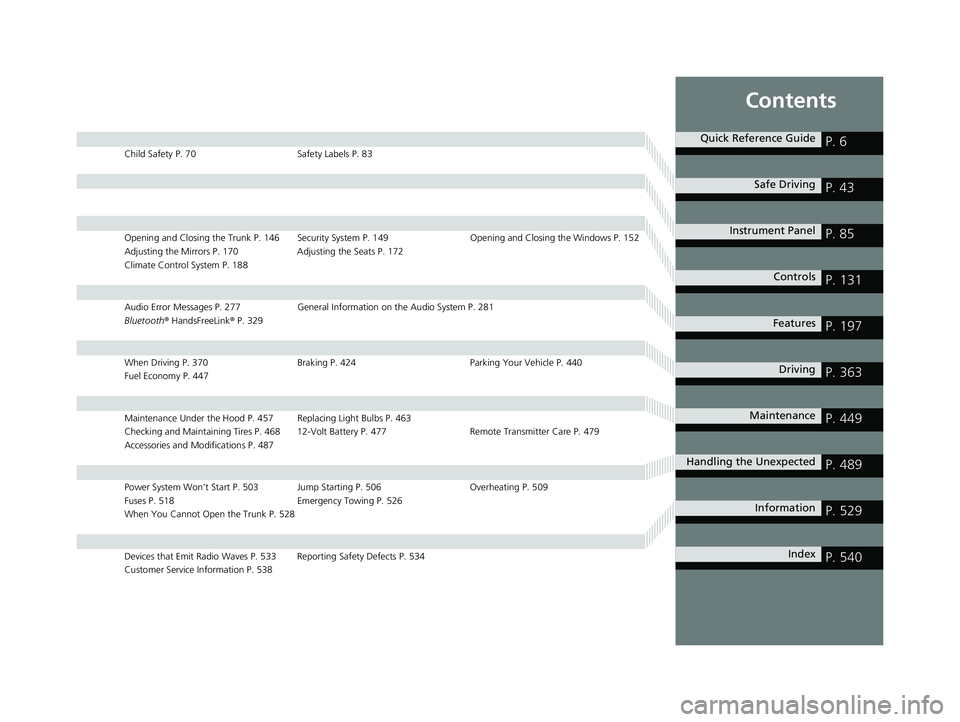
Child Safety P. 70Safety Labels P. 83
Opening and Closing the Trunk P. 146 Security System P. 149 Opening and Closing the Windows P. 152
Adjusting the Mirrors P. 170 Adjusting the Seats P. 172
Climate Control System P. 188
Audio Error Messages P. 277 General Information on the Audio System P. 281
Bluetooth ® HandsFreeLink ® P. 329
When Driving P. 370 Braking P. 424Parking Your Vehicle P. 440
Fuel Economy P. 447
Maintenance Under the Hood P. 457 Replacing Light Bulbs P. 463
Checking and Maintaining Tires P. 468 12-Volt Battery P. 477 Remote Transmitter Care P. 479
Accessories and Modifications P. 487
Power System Won’t Start P. 503 Jump Starting P. 506 Overheating P. 509
Fuses P. 518 Emergency Towing P. 526
When You Cannot Open the Trunk P. 528
Devices that Emit Radio Waves P. 533 Reporting Safety Defects P. 534
Customer Service Information P. 538
Quick Reference GuideP. 6
Safe DrivingP. 43
Instrument PanelP. 85
ControlsP. 131
FeaturesP. 197
DrivingP. 363
MaintenanceP. 449
Handling the UnexpectedP. 489
InformationP. 529
IndexP. 540
19 CLARITY FCV CSS-31TRT6200.book 5 ページ 2019年1月17日 木曜日 午前11時54分
Page 13 of 551
11
Quick Reference Guide
Characteristics of Fuel Cell Vehicles
A fuel cell vehicle (FCV) converts hydrogen gas into electricity which is used to power an electric motor. The FC (fuel cell) system comprises
of hydrogen tanks and an FC stack, as well as other components, and requires a constant supply of hydrogen fuel, and proper cooling and
ventilation to generate electricity.
The FC stack is the main power unit which comprises of a series of fuel cells joined together or “stacked” on one another. With in each fuel
cell, hydrogen reacts with oxygen to create an electric current whic h is used to not only power the motor but also charge a High Voltage
battery. This High Voltage battery provides supplementary power to assist the FC power system when the vehicle is subjected to heavy
acceleration.
Unlike vehicles that use internal combustion engines, FC vehicles emit no harmful emissions such as CO
2 and NOx, and are thus considered
environmentally responsible. The only substance discharged from the tailpipe is water, in the form of both liquid and vapor.
FC Stack
Fuel cell power output may decline faster than usual under the following circumstances:
● The vehicle is frequently used in sub-zero temperatures over extended periods of time.
● The vehicle is repeatedly left in stand by state for extended periods of time.
● The FC system is subjected to frequent starting and stopping.
● Salt water has permeated the air cleaner element.
u Replace the air cleaner element and clean the surrounding area.
● The vehicle is driven extensively in areas whose air contains high levels of:
Dust
Sulfur (common to hot spring and volcanoes)
Organic solvents, e.g., paints and thinners
Amine-related substa nces, e.g., ammonia
Chlorinated substances, e.g., salt and snow-melting agents
u Once the vehicle is driven in a normal environment again, fuel cell power output will return over time.
In the following circumstances, power output may be temporarily limited:
● You are repeatedly accelerating and decelerating aggressively.
● You are ascending a slope or driving at high altitudes above 6,562 feet (2,000 meters).
2 Driver Information Interface Wa rning and Information Messages (P104)
19 CLARITY FCV CSS-31TRT6200.book 11 ページ 2019年1月17日 木曜日 午前11時 54分
Page 20 of 551
18
Quick Reference Guide
Hydrogen Gas Leak
If a hydrogen gas leak is suspected, follow the recommended actions listed in the
instructions of this owner’s manual. 2 If Hydrogen Gas is Leaking (P511)
WARNING
Since hydrogen gas is highly flammable, a
hydrogen gas leak is extremely dangerous
as the leaked gas, which is dispersed into
the atmosphere, can ignite, resulting in a
fire in which you or someone else can be
serious injured or killed. Keep flammable
materials and liquids away from the vehicle
at all times, especially if a hydrogen gas
leak is detected.
In the case of a hydrogen gas leak, a buzzer
will sound and the hydrogen gas leak
indicator will come on. If you are driving
the vehicle, stop in a safe, well-ventilated
place. Then turn the power mode to OFF
and contact an authorized Honda Clarity
Fuel Cell dealer at once. You should also
display signs warning of the danger and be
aware of and keep away anything that
could ignite the gas.
The system is designed so that in the event
that the vehicle catches fire, the gas inside
the tanks will be released through the tank
valves, thereby ensuring that pressure (due
to heat from the fire) within the tanks does
not build up.
This gas is released toward the rear of the
vehicle in a downward direction. Do not
attempt to extinguish the fire from behind
the vehicle as the exiting gas may ignite
into a flame.
19 CLARITY FCV CSS-31TRT6200.book 18 ページ 2019年1月17日 木曜日 午前11時 54分
Page 29 of 551
27
Quick Reference Guide
Controls (P 131)
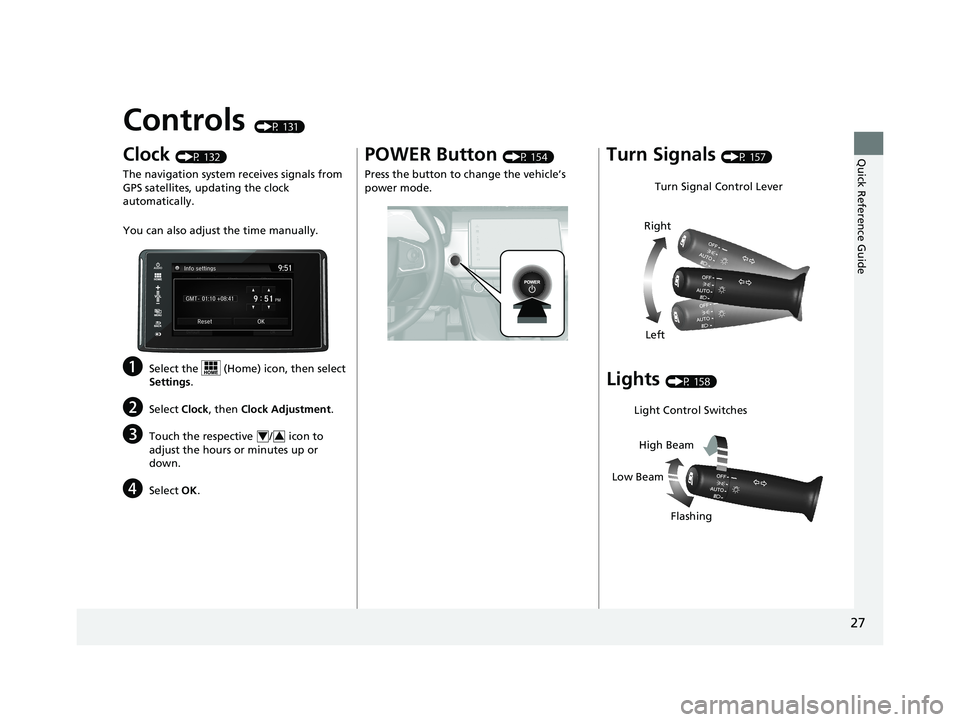
Clock (P 132)
The navigation system receives signals from
GPS satellites, updating the clock
automatically.
You can also adjust the time manually.
aSelect the (Home) icon, then select
Settings.
bSelect Clock, then Clock Adjustment .
cTouch the respective / icon to
adjust the hours or minutes up or
down.
dSelect OK.
43
POWER Button (P 154)
Press the button to ch ange the vehicle’s
power mode.Turn Signals (P 157)
Lights (P 158)
Turn Signal Control Lever
Right
Left
Light Control Switches
Low Beam High Beam
Flashing
19 CLARITY FCV CSS-31TRT6200.book 27 ページ 2019年1月17日 木曜日 午前11時 54分
Page 46 of 551
44
Safe Driving
For Safe Driving
The following pages explain your vehicle’s safety features and how to use them
properly. The safety precautions below are ones that we consider to be among the
most important.
Important Safety Precautions
■Always wear your seat belt
A seat belt is your best protection in all types of collisions. Airbags are designed to
supplement seat belts, not replace them. So even though your vehicle is equipped
with airbags, make sure you and your passengers always wear your seat belts, and
wear them properly.
■Restrain all children
Children ages 12 and under should ride prop erly restrained in a back seat, not the
front seat. Infants and small children should be restrained in a child seat. Larger
children should use a booster seat and a lap/shoulder seat belt until they can use the
belt properly without a booster seat.
■Be aware of airbag hazards
While airbags can save lives, they can cause serious or fatal injuries to occupants
who sit too close to them, or are not prop erly restrained. Infants, young children,
and short adults are at the greatest risk. Be sure to follow all instructions and
warnings in this manual.
■Don’t drink and drive
Alcohol and driving don’t mix. Even one dr ink can reduce your ability to respond to
changing conditions, and your reaction time gets worse with every additional drink.
So don’t drink and drive, and don’t let your friends drink and drive, either.
1Important Safety Precautions
Some states and territorie s prohibit the use of cell
phones other than hands-free devices by the driver
while driving.
19 CLARITY FCV CSS-31TRT6200.book 44 ページ 2019年1月17日 木曜日 午前11時 54分
Page 60 of 551
58
uuAirbags uTypes of Airbags
Safe Driving
Types of Airbags
Your vehicle is equipped with four types of airbags:
• Front airbags: Airbags in front of the driver ’s and front passenger’s seats.
• Driver’s knee airbag: Airbag under the steering column.
• Side airbags: Airbags in the driver’s and front passenger’s seat-backs.
• Side curtain airbags: Airbags above the side windows.
Each is discussed in the following pages.
Front Airbags (SRS)
The front SRS airbags inflate in a moderate-to -severe frontal collision to help protect
the head and chest of the driver and/or front passenger.
SRS (Supplemental Restraint System) indicates that the airbags are designed to
supplement seat belts, not replace them. Seat belts are the occupant’s primary
restraint system.
The front airbags are housed in the center of the steering wheel for the driver, and
in the dashboard for the front pass enger. Both airbags are marked SRS AIRBAG.
■Housing Locations
1Types of Airbags
The airbags can inflate whenever the power mode is
in ON.
After an airbag inflates in a crash, you may see a
small amount of smoke. This is from the combustion
process of the infl ator material and is not harmful.
People with respiratory pr oblems may experience
some temporary discomfort. If this occurs, get out of
the vehicle as soon as it is safe to do so.
1 Front Airbags (SRS)
During a frontal crash severe enough to cause one or
both front airbags to deploy, the airbags can inflate
at different rates, dependi ng on the severity of the
crash, whether or not the se at belts are latched, and/
or other factors. Frontal airbags are designed to
supplement the seat belts to help reduce the
likelihood of head and chest injuries in frontal
crashes.
19 CLARITY FCV CSS-31TRT6200.book 58 ページ 2019年1月17日 木曜日 午前11時 54分
Page 63 of 551
61
uuAirbags uFront Airbags (SRS)
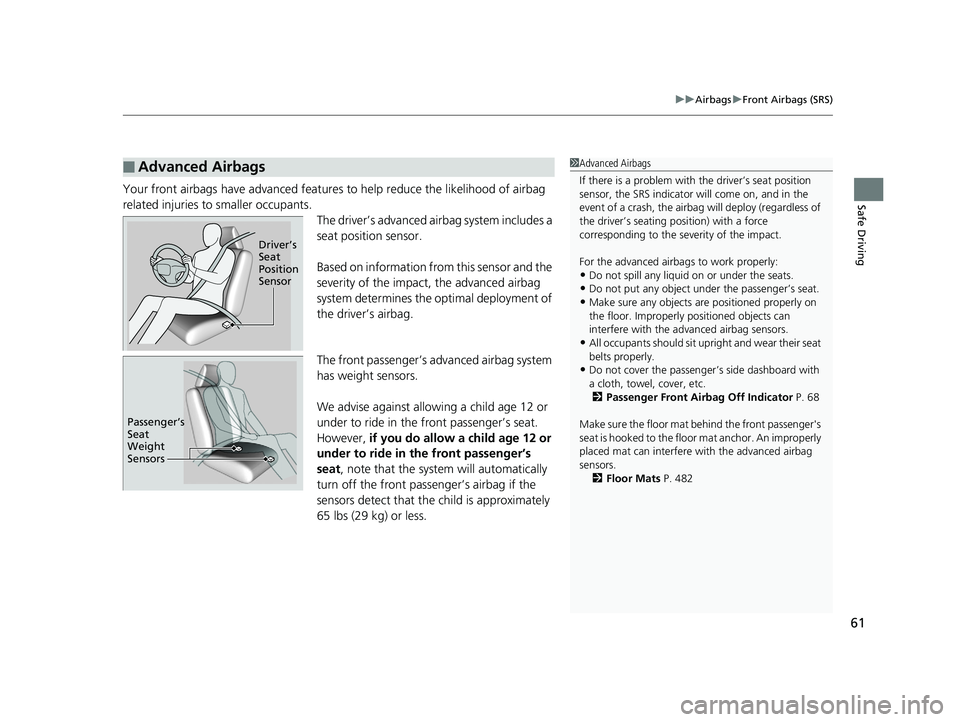
Safe DrivingYour front airbags have advanced features to help reduce the likelihood of airbag
related injuries to smaller occupants.
The driver’s advanced airbag system includes a
seat position sensor.
Based on information from this sensor and the
severity of the impact, the advanced airbag
system determines the optimal deployment of
the driver’s airbag.
The front passenger’s ad vanced airbag system
has weight sensors.
We advise against allowi ng a child age 12 or
under to ride in the front passenger’s seat.
However, if you do allow a child age 12 or
under to ride in the front passenger’s
seat , note that the system will automatically
turn off the front passenger’s airbag if the
sensors detect that the child is approximately
65 lbs (29 kg) or less.
■Advanced Airbags1 Advanced Airbags
If there is a problem with the driver’s seat position
sensor, the SRS indicator wi ll come on, and in the
event of a crash, the airbag will deploy (regardless of
the driver’s seating position) with a force
corresponding to the se verity of the impact.
For the advanced airbags to work properly:
•Do not spill any liquid on or under the seats.
•Do not put any object under the passenger’s seat.
•Make sure any objects are positioned properly on
the floor. Improperly pos itioned objects can
interfere with the advanced airbag sensors.
•All occupants should sit upri ght and wear their seat
belts properly.
•Do not cover the passenger ’s side dashboard with
a cloth, towel, cover, etc. 2 Passenger Front Airbag Off Indicator P. 68
Make sure the floor mat behind the front passenger's
seat is hooked to the floor mat anchor. An improperly
placed mat can interfere with the advanced airbag
sensors.
2 Floor Mats P. 482
Driver’s
Seat
Position
Sensor
Passenger’s
Seat
Weight
Sensors
19 CLARITY FCV CSS-31TRT6200.book 61 ページ 2019年1月17日 木曜日 午前11時 54分