2019 HONDA CLARITY FUEL CELL tire pressure
[x] Cancel search: tire pressurePage 452 of 551
450
Maintenance
Before Performing Maintenance
Inspection and Maintenance
For your safety, perform all listed inspections and maintenance to keep your vehicle
in good condition. If you become aware of any abnormality (noise, smell, insufficient
brake fluid, oil residue on the ground, etc .), have your vehicle inspected by an
authorized Honda Clar ity Fuel Cell dealer. (Note, however, that service at an
authorized Honda Clarity Fuel Cell dealer is not mandatory to keep your warranties
in effect.)
■Daily inspections
Perform inspections before long distance trips, when washing the vehicle, or when
refueling.
■Periodic inspections
• Check the brake fluid level monthly.
2 Brake Fluid P. 461
•Check the tire pressure monthly. Examin e the tread for wear and foreign objects.
2Checking and Maintaining Tires P. 468
•Check the operation of the exterior lights monthly.
2 Replacing Light Bulbs P. 463
•Check the condition of the wiper bl ades at least every six months.
2Checking and Maintaining Wiper Blades P. 465
■Types of Inspection and Maintenance
1Inspection and Maintenance
Maintenance, replacement, or repair of
emissions control devices and systems may be
done by any automotive repair establishment or
individuals using parts that are “certified” to
EPA standards.
According to state and fede ral regulations, failure to
perform maintenance on the maintenance main
items marked with # will not void your emissions
warranties. However, all ma intenance services should
be performed in accordan ce with the intervals
indicated by the driver information interface.
2 Maintenance Service Items P. 455
If you want to perform complex maintenance tasks
that require more skills a nd tools, you can purchase a
subscription to the Service Express website at
www.techinfo.honda.com .
2 Authorized Manuals P. 537
If you want to perform ma intenance yourself, make
sure that you have the necessary tools and skills first.
After performing ma intenance, update the records in
the separate maintenance booklet.
19 CLARITY FCV CSS-31TRT6200.book 450 ページ 2019年1月17日 木曜日 午前11 時54分
Page 470 of 551
468
Maintenance
Checking and Maintaining Tires
Checking Tires
To safely operate your vehicle, your tires must be of the proper type and size, in
good condition with adequate tread, and properly inflated.
■Inflation guidelines
Properly inflated tires provide the best combination of handlin g, tread life, and comfort.
Refer to the driver’s doorjamb label or spec ifications page for the specified pressure.
Underinflated tires wear unevenly, adversely affect handling and fuel economy, and
are more likely to fail from overheating.
Overinflated tires make your vehicle ride harshly, are more prone to road hazards,
and wear unevenly.
Every day before you drive, look at each of the tires. If one looks lower than the
others, check the pressure with a tire gauge.
At least once a month or before long trips, use a gauge to measure the pressure in
all tires. Even tires in good condition ca n lose 1–2 psi (10–20 kPa, 0.1–0.2 kgf/cm
2)
per month.
■Inspection guidelines
Every time you check inflation, also examine the tires and valve stems.
Look for:
• Bumps or bulges on the side or in the tread . Replace the tire if you find any cuts,
splits, or cracks in the si de of the tire. Replace it if you see fabric or cord.
• Remove any foreign objects and inspect for air leaks.
• Uneven tread wear. Have an authorized Honda Clarity Fuel Cell dealer check the
wheel alignment.
• Excessive tread wear.
2 Wear Indicators P. 473
•Cracks or other damage around valve stem.
1Checking Tires
Measure the air pressure when tires are cold. This
means the vehicle has been parked for at least three
hours, or driven less than 1 mile (1.6 km). If
necessary, add or releas e air until the specified
pressure is reached.
If checked when hot, tire pressure can be as much as
4–6 psi (30–40 kPa, 0.3–0.4 kgf/cm
2) higher than if
checked when cold.
Whenever tire pressure is adjusted, you must
calibrate the TPMS. 2 TPMS Calibration P. 415
Have an authorized Honda Clarity Fuel Cell dealer
check the tires if you feel a consistent vibration while
driving. New tire s and any that have been removed
and reinstalled should be properly balanced.
3WARNING
Using tires that are excessively worn or
improperly inflated can cause a crash in
which you can be seriously hurt or killed.
Follow all instruction s in this owner’s
manual regarding ti re inflation and
maintenance.
19 CLARITY FCV CSS-31TRT6200.book 468 ページ 2019年1月17日 木曜日 午前11 時54分
Page 471 of 551
469
uuChecking and Maintaining Tires uTire and Loading Information Label
Continued
Maintenance
Tire and Loading Information Label
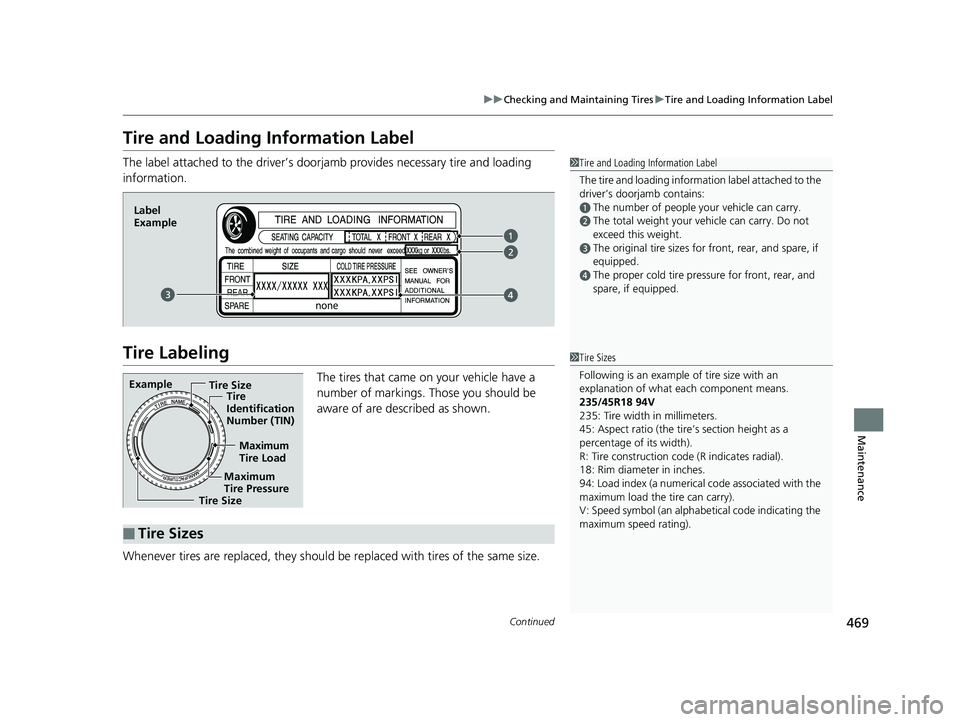
The label attached to the dr iver’s doorjamb provides necessary tire and loading
information.
Tire Labeling
The tires that came on your vehicle have a
number of markings. Those you should be
aware of are described as shown.
Whenever tires are replaced, they should be replaced with tires of the same size.
1Tire and Loading Information Label
The tire and loading informat ion label attached to the
driver’s doorjamb contains:
aThe number of people your vehicle can carry.bThe total weight your vehicle can carry. Do not
exceed this weight.
cThe original tire sizes for front, rear, and spare, if
equipped.
dThe proper cold tire pre ssure for front, rear, and
spare, if equipped.
Label
Example
Example Tire Size
Tire
Identification
Number (TIN)
Maximum
Tire Load
Maximum
Tire Pressure
Tire Size
■Tire Sizes
1 Tire Sizes
Following is an example of tire size with an
explanation of what each component means.
235/45R18 94V
235: Tire width in millimeters.
45: Aspect ratio (the tire’s section height as a
percentage of its width).
R: Tire construction code (R indicates radial).
18: Rim diameter in inches.
94: Load index (a numerical code associated with the
maximum load the tire can carry).
V: Speed symbol (an alphab etical code indicating the
maximum speed rating).
19 CLARITY FCV CSS-31TRT6200.book 469 ページ 2019年1月17日 木曜日 午前11 時54分
Page 472 of 551
uuChecking and Maintaining Tires uTire Labeling
470
Maintenance
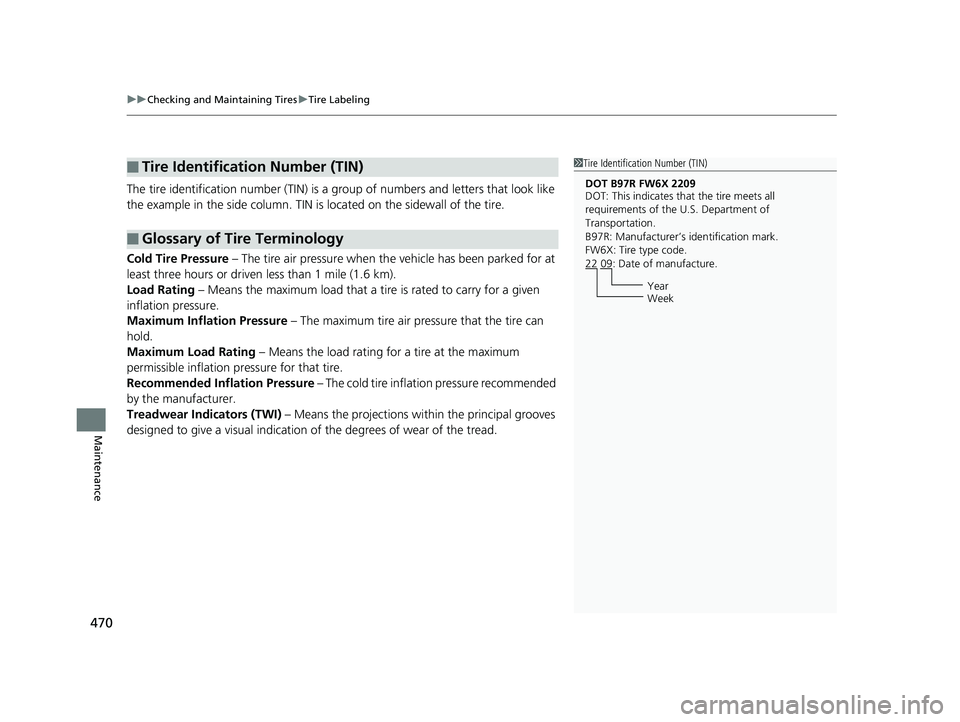
The tire identification number (TIN) is a group of numbers and letters that look like
the example in the side co lumn. TIN is located on the sidewall of the tire.
Cold Tire Pressure – The tire air pressure when the vehicle has been parked for at
least three hours or driven less than 1 mile (1.6 km).
Load Rating – Means the maximum load that a ti re is rated to carry for a given
inflation pressure.
Maximum Inflation Pressure – The maximum tire air pressure that the tire can
hold.
Maximum Load Rating – Means the load rating for a tire at the maximum
permissible inflation pr essure for that tire.
Recommended Inflation Pressure – The cold tire inflation pressure recommended
by the manufacturer.
Treadwear Indicators (TWI) – Means the projections within the principal grooves
designed to give a visual indication of the degrees of wear of the tread.
■Tire Identification Number (TIN)
■Glossary of Tire Terminology
1 Tire Identification Number (TIN)
DOT B97R FW6X 2209
DOT: This indicates that the tire meets all
requirements of the U.S. Department of
Transportation.
B97R: Manufacturer’s identification mark.
FW6X: Tire type code.
22 09: Date of manufacture.
Year
Week
19 CLARITY FCV CSS-31TRT6200.book 470 ページ 2019年1月17日 木曜日 午前11 時54分
Page 475 of 551
473
uuChecking and Maintaining Tires uWear Indicators
Maintenance
Wear Indicators
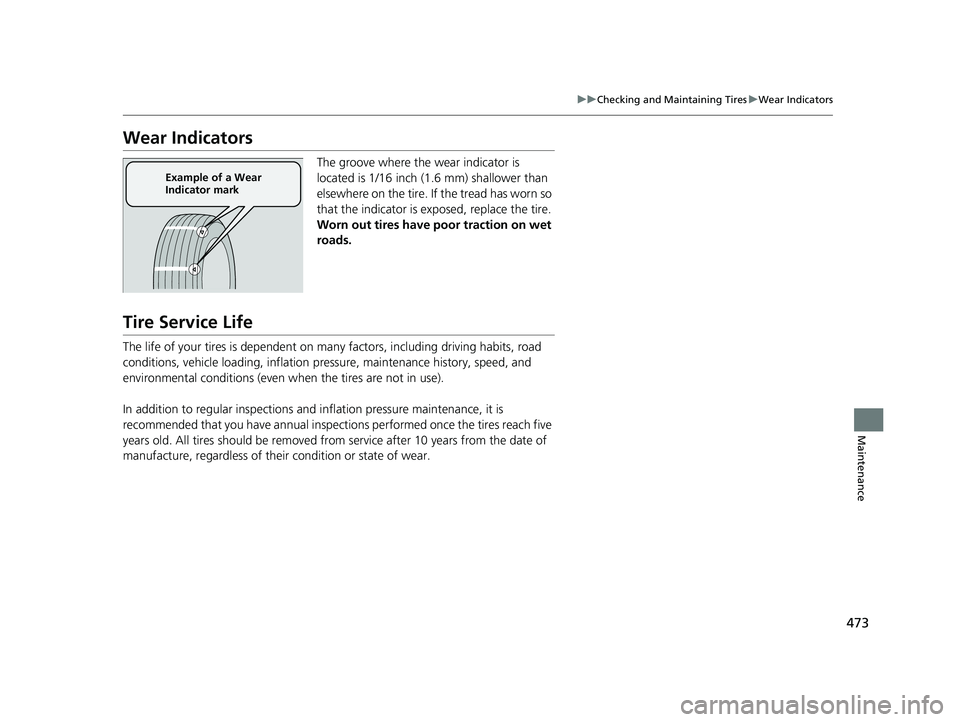
The groove where the wear indicator is
located is 1/16 inch (1.6 mm) shallower than
elsewhere on the tire. If the tread has worn so
that the indicator is ex posed, replace the tire.
Worn out tires have po or traction on wet
roads.
Tire Service Life
The life of your tires is dependent on many factors, including driving habits, road
conditions, vehicle loading, inflation pressure, maintenance history, speed, and
environmental conditions (even wh en the tires are not in use).
In addition to regular inspections and inflation pressure maintenance, it is
recommended that you have annual inspections performed once the tires reach five
years old. All tires should be removed fro m service after 10 years from the date of
manufacture, regardless of their condition or state of wear.
Example of a Wear
Indicator mark
19 CLARITY FCV CSS-31TRT6200.book 473 ページ 2019年1月17日 木曜日 午前11 時54分
Page 476 of 551
474
uuChecking and Maintaining Tires uTire and Wheel Replacement
Maintenance
Tire and Wheel Replacement
Replace your tires with radials of the sa me size, load range, speed rating, and
maximum cold tire pressure ra ting (as shown on the tire’s sidewall). Using tires of a
different size or construction can cause ce rtain vehicle systems such as the ABS and
Vehicle Stability Assist ® (VSA®) system to work incorrectly.
It is best to replace all four tires at the same time. If that isn’t possible, replace the
front or rear tires in pairs.
Make sure that the wheel’s specifications match thos e of the original wheels.1Tire and Wheel Replacement
3WARNING
Installing improper tires on your vehicle can
affect handling and stability. This can cause
a crash in which you can be seriously hurt or
killed.
Always use the size and type of tires
recommended in this owner’s manual.
19 CLARITY FCV CSS-31TRT6200.book 474 ページ 2019年1月17日 木曜日 午前11 時54分
Page 491 of 551
489
Handling the Unexpected
This chapter explains how to handle unexpected troubles.
If a Tire Goes FlatTemporarily Repairi ng a Flat Tire....... 490
Handling of the Jack ......................... 502
Power System Won’t Start Checking the Procedure ................... 503
If the Smart Entry Remote Battery is Weak .......................................... 504
Emergency Power System Off........... 505
Jump Starting .................................... 506
Overheating How to Handle Overheating ............. 509
If Hydrogen Gas is Leaking .............. 511Indicator, Coming On/Blinking
If the 12-Volt Battery Charging System Indicator Comes On ....................... 513
If the Brake System Indicator (Red) Comes On or Blinks ....................................... 514
If the Electric Power Steering (EPS) System Indicator Comes On ........................... 514If the Brake System Indicator (Red) Comes On or Blinks at the Same Time
When the Brake System Indicator
(Amber) Comes On ...................... 515
If the Low Tire Pressure/TPMS Indicator
Comes On or Blinks ....................... 516
If the Transmission System Indicator Blinks along with the Warning Message .... 517
Fuses Fuse Locations ................................. 518
Inspecting and Changing Fuses ........ 525
Emergency Towing ........................... 526
When You Cannot Unlock the Hydrogen Fuel Lid .............................................. 527
When You Cannot Open the Trunk .. 528
19 CLARITY FCV CSS-31TRT6200.book 489 ページ 2019年1月17日 木曜日 午前11 時54分
Page 493 of 551
Continued491
uuIf a Tire Goes Flat uTemporarily Repairing a Flat Tire
Handling the Unexpected
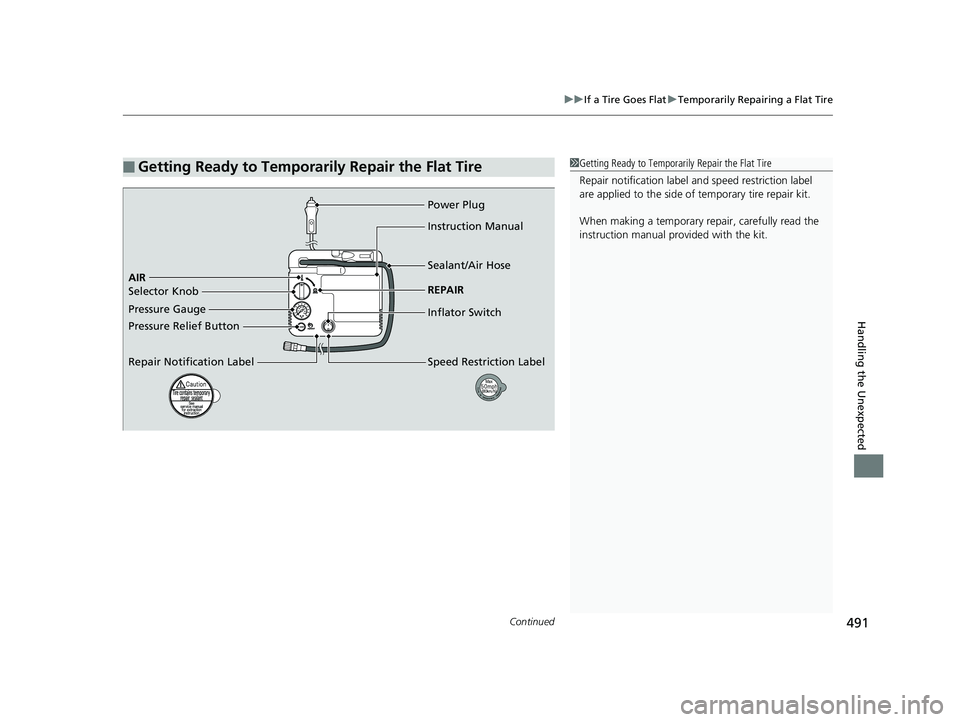
■Getting Ready to Temporarily Repair the Flat Tire1Getting Ready to Temporarily Repair the Flat Tire
Repair notificati on label and speed restriction label
are applied to the side of temporary tire repair kit.
When making a temporary repair, carefully read the
instruction manual provided with the kit.
Pressure Gauge AIR Power Plug
Pressure Relief Button
Repair Notification LabelInstruction Manual
Sealant/Air Hose
REPAIR
Inflator Switch
Speed Restriction Label
Selector Knob
19 CLARITY FCV CSS-31TRT6200.book 491 ページ 2019年1月17日 木曜日 午前11
時54分