2019 HONDA CIVIC SEDAN heating
[x] Cancel search: heatingPage 549 of 679
547
Maintenance
This chapter discusses basic maintenance.
Before Performing MaintenanceInspection and Maintenance ............ 548
Safety When Performing Maintenance .... 549Parts and Fluids Used in Maintenance Service ........................................... 550
Maintenance Minder
TM..................... 551
Maintenance Under the Hood
Maintenance Items Un der the Hood .... 557Opening the Hood ........................... 559
Recommended Engine Oil ................ 560
Oil Check ......................................... 561
Adding Engine Oil ............................ 563
Changing the Engine Oil and Oil Filter..... 564
Engine Coolant ................................ 567
Transmission Fluid ............................ 569
Brake/Clutch
* Fluid .......................... 570
Refilling Window Washer Fluid......... 571
Replacing Light Bulbs ....................... 572
Checking and Maintaining Wiper Blades.... 581Checking and Maintaining Tires
Checking Tires ................................. 584
Tire and Loading Information Label .. 585
Tire Labeling .................................... 585
DOT Tire Quality Grading (U.S. Vehicles).. 587Wear Indicators................................ 589
Tire Service Life ................................ 589 Tire and Wheel Replacement ........... 590
Tire Rotation .................................... 591
Winter Tires ..................................... 592
Battery ............................................... 594
Remote Transmitter Care Replacing the Button Battery ........... 596
Heating System
*/Climate Control
System* Maintenance .................... 598
Cleaning Interior Care .................................... 599
Exterior Care.................................... 601
Accessories and Modifications Accessories ...................................... 604
Modifications................................... 605
* Not available on all models
19 CIVIC 4D HCM_HMIN_J (KA KL KC)-31TBA6301.book 547 ページ 2018年10月26日 金曜日 午前7時42分
Page 586 of 679
584
Maintenance
Checking and Maintaining Tires
Checking Tires
To safely operate your vehicle, your tires must be of the proper type and size, in
good condition with adequate tread, and properly inflated.
■Inflation guidelines
Properly inflated tires provide the best combination of handling, tread life, and
comfort. Refer to the driver’s doorjamb labe l or specifications page for the specified
pressure.
Underinflated tires wear unevenly, adversely affect handling and fuel economy, and
are more likely to fail from overheating.
Overinflated tires make your vehicle ride harshly, are more prone to road hazards,
and wear unevenly.
Every day before you drive, look at each of the tires. If one looks lower than the
others, check the pressure with a tire gauge.
At least once a month or before long trips, use a gauge to measure the pressure in
all tires, including the spare
*. Even tires in good condition can lose 1-2 psi (10-20
kPa, 0.1-0.2 kgf/cm2) per month.
■Inspection guidelines
Every time you check inflation, also examine the tires and valve stems. Look for:
• Bumps or bulges on the side or in the tread . Replace the tire if you find any cuts,
splits, or cracks in the si de of the tire. Replace it if you see fabric or cord.
• Remove any foreign objects and inspect for air leaks.
• Uneven tread wear. Have a deal er check the wheel alignment.
• Excessive tread wear.
2 Wear Indicators P. 589
•Cracks or other damage around valve stem.
1Checking Tires
Measure the air pressure when tires are cold. This
means the vehicle has been parked for at least three
hours, or driven less than 1 mile (1.6 km). If
necessary, add or releas e air until the specified
pressure is reached.
If checked when hot, tire pressure can be as much as
4–6 psi (30–40 kPa, 0.3–0.4 kgf/cm
2) higher than if
checked when cold.
Whenever tire pressure is adjusted, you must
calibrate the TPMS. 2 TPMS Calibration P. 463
Have a dealer check the tires if you feel a consistent
vibration while driving. Ne w tires and any that have
been removed and reinst alled should be properly
balanced.
Check the spare tire pressu re once a month or before
long trips.
3WARNING
Using tires that are excessively worn or
improperly inflated can cause a crash in
which you can be seriously hurt or killed.
Follow all instruction s in this owner’s
manual regarding ti re inflation and
maintenance.
U.S. models
Models with a spare tire
* Not available on all models
19 CIVIC 4D HCM_HMIN_J (KA KL KC)-31TBA6301.book 584 ページ 2018年10月26日 金曜日 午前7時42分
Page 600 of 679
598
Maintenance
Heating System*/Climate Control System* Maintenance
Air Conditioning*
To ensure proper and safe operation, the Society of Automotive Engineers (SAE
J2845) recommends that the refrigerant sy stem only be serviced by trained and
certified technicians.
Never repair or replace the air conditioning evaporator (cooling coil) with one
removed from a used or salvaged vehicle.
New replacement mobile air conditioning evaporators must be certified (and
labeled) as meeting SAE Standard J2842.
Dust and Pollen Filter
The heating system*/climate control system* is equipped with a dust and pollen filter
that collects pollen, dust, and other de bris in the air. The Maintenance MinderTM
messages will let you know when to replace the filter.
We recommend that you replace the dust and pollen filter sooner when using your
vehicle in areas with high concentrations of dust.
1Air Conditioning*
NOTICE
Vented refrigerant is harmful to the environment.
To avoid refrigerant from venting, never replace the
evaporator with one re moved from a used or
salvaged vehicle.
Refrigerant in your vehicle’s air conditioning system is
flammable and can be igni ted during servicing if
proper procedures are not followed.
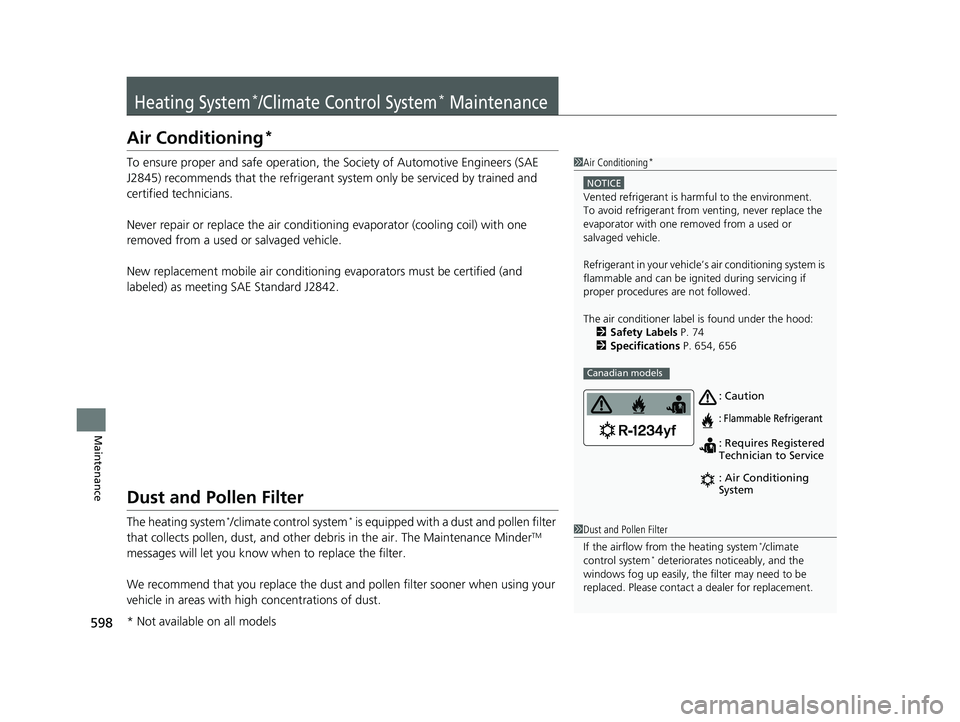
The air conditioner labe l is found under the hood:
2 Safety Labels P. 74
2 Specifications P. 654, 656
Canadian models
: Caution
: Flammable Refrigerant
: Requires Registered
Technician to Service
: Air Conditioning
System
1Dust and Pollen Filter
If the airflow from the heating system
*/climate
control system* deteriorates noticeably, and the
windows fog up easily, the filter may need to be
replaced. Please contact a dealer for replacement.
* Not available on all models
19 CIVIC 4D HCM_HMIN_J (KA KL KC)-31TBA6301.book 598 ページ 2018年10月26日 金曜日 午前7時42分
Page 609 of 679
607
Handling the Unexpected
This chapter explains how to handle unexpected troubles.
ToolsTypes of Tools .................................. 608
If a Tire Goes Flat
Changing a Flat Tire
*....................... 609
Temporarily Repair ing a Flat Tire*..... 616
Engine Does Not Start
Checking the Engine ........................ 628
If the Smart Entry Remote Battery is Weak .. 629Emergency Engine Stop ................... 630
Jump Starting .................................... 631
Shift Lever Does Not Move .............. 634
Overheating
How to Handle Overheating ............. 635 Indicator, Coming On/Blinking
If the Low Oil Pressure Indicator Comes On....637
If the Charging System Indicator Comes
On ................................................. 637
If the Malfunction Indicator Lamp Comes On or Blinks ................................... 638
If the Brake System Indicator (Red) Comes On or Blinks ................................... 639
If the Brake System Indicator (Red) Comes On or Blinks at the Same Time When the
Brake System Indicator (Amber) Comes
On ................................................. 640 If the Electric Power Steering (EPS) System
Indicator Comes On ....................... 641
If the Low Tire Pressure/TPMS Indicator Comes On or Blinks ....................... 642
Fuses Fuse Locations ................................. 643
Inspecting and Changing Fuses ........ 647
Emergency Towing ........................... 648
When You Cannot Unlock the Fuel Fill Door ................................................. 649
When You Cannot Open the Trunk.....650
Refueling ........................................... 651
* Not available on all models
19 CIVIC 4D HCM_HMIN_J (KA KL KC)-31TBA6301.book 607 ページ 2018年10月26日 金曜日 午前7時42分
Page 637 of 679
635Continued
Handling the Unexpected
Overheating
How to Handle Overheating
Overheating symptoms are as follows:
•The temperature gauge pointer is at th e mark or the engine suddenly loses
power.
• Steam or spray comes out of the engine compartment.
■First thing to do
1. Immediately park the vehicle in a safe place.
2. Turn off all accessories and turn on the hazard warning lights.
u No steam or spray present: Keep the engine running and open the hood.
u Steam or spray is present: Turn off the engine and wait until it subsides.
Then open the hood.
1 How to Handle Overheating
NOTICE
Continuing to drive with the temperature gauge
pointer at the mark may damage the engine.
3WARNING
Steam and spray from an overheated
engine can seriously scald you.
Do not open the hood if steam is coming
out.
H
H
19 CIVIC 4D HCM_HMIN_J (KA KL KC)-31TBA6301.book 635 ページ 2018年10月26日 金曜日 午前7時42分
Page 638 of 679
uuOverheating uHow to Handle Overheating
636
Handling the Unexpected
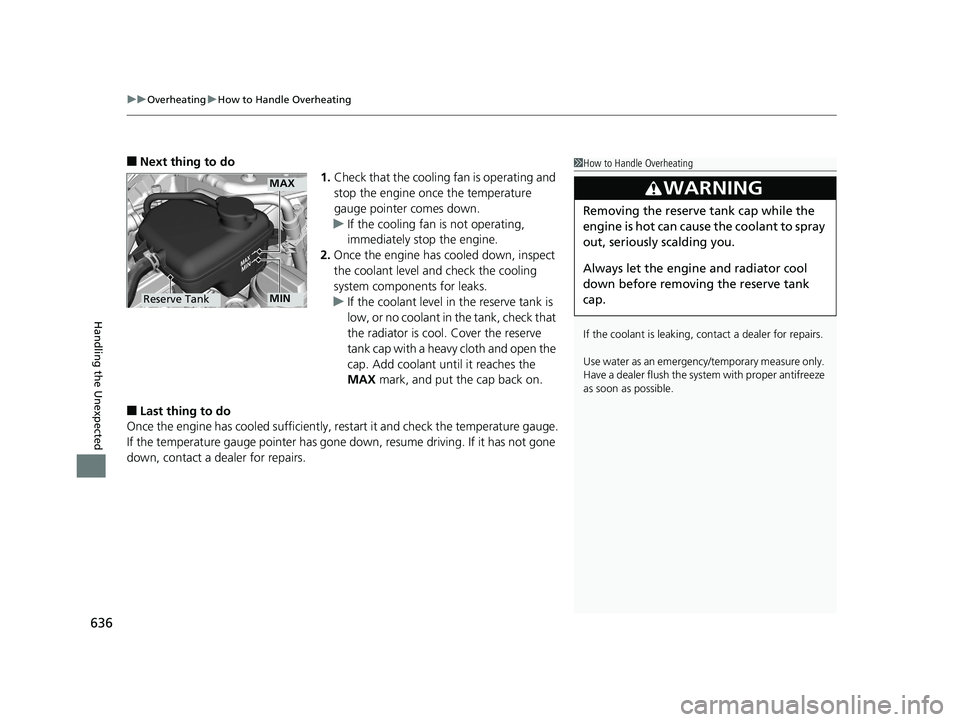
■Next thing to do
1.Check that the cooling fan is operating and
stop the engine once the temperature
gauge pointer comes down.
u If the cooling fan is not operating,
immediately stop the engine.
2. Once the engine has cooled down, inspect
the coolant level an d check the cooling
system components for leaks.
u If the coolant level in the reserve tank is
low, or no coolant in the tank, check that
the radiator is cool. Cover the reserve
tank cap with a heavy cloth and open the
cap. Add coolant until it reaches the
MAX mark, and put the cap back on.
■Last thing to do
Once the engine has cooled sufficiently, restart it and check the temperature gauge.
If the temperature gauge pointer has gone do wn, resume driving. If it has not gone
down, contact a dealer for repairs.
1 How to Handle Overheating
If the coolant is leaking, contact a dealer for repairs.
Use water as an emergency/temporary measure only.
Have a dealer flush the system with proper antifreeze
as soon as possible.
3WARNING
Removing the reserve tank cap while the
engine is hot can cause the coolant to spray
out, seriously scalding you.
Always let the engine and radiator cool
down before removing the reserve tank
cap.
MAX
Reserve TankMIN
19 CIVIC 4D HCM_HMIN_J (KA KL KC)-31TBA6301.book 636 ページ 2018年10月26日 金曜日 午前7時42分
Page 639 of 679
637
Handling the Unexpected
Indicator, Coming On/Blinking
If the Low Oil Pressure Indicator Comes On
■Reasons for the indicator to come on
Comes on when the engine oil pressure is low.
■What to do as soon as the indicator comes on
1. Immediately park the vehicle on level ground in a safe place.
2. If necessary, turn the hazard warning lights on.
■What to do after parking the vehicle
1. Stop the engine and let it sit for approximately three minutes.
2. Open the hood and check the oil level.
u Add oil as necessary.
2 Oil Check P. 561
3.Start the engine and check th e low oil pressure indicator.
u The indicator goes off: Start driving again.
u The indicator does not go off within 10 seconds: Immediately stop
the engine and contact a dealer for repairs.
If the Charging System Indicator Comes On
■Reasons for the indicator to come on
Comes on when the battery is not being charged.
■What to do when th e indicator comes on
Turn off the heating system*/climate control system*, rear defogger, and
other electrical systems, and immedi ately contact a dealer for repairs.
1If the Low Oil Pressure Indicator Comes On
NOTICE
Running the engine with low oil pressure can cause
serious mechanical damage almost immediately.
1If the Charging System Indicator Comes On
If you need to stop temporarily, do not turn off the
engine. Restarting the engi ne may rapidly discharge
the battery.
* Not available on all models
19 CIVIC 4D HCM_HMIN_J (KA KL KC)-31TBA6301.book 637 ページ 2018年10月26日 金曜日 午前7時42分
Page 641 of 679
639
uuIndicator, Comi ng On/BlinkinguIf the Brake System Indicator (Red) Comes On or Blinks
Handling the Unexpected
If the Brake System Indicator (Red) Comes On or
Blinks
■Reasons for the indicator to come on
• The brake fluid is low.
• There is a malfunction in the brake system.
■What to do when the indica tor comes on while driving
Depress the brake pedal lightly to check pedal pressure.
• If normal, check the brake fluid level the next time you stop.
• If abnormal, take immediate acti on. If necessary, downshift the
transmission to slow the vehicle using engine braking.
■Reason for the indicator to blink
• There is a problem with the electric parking brake system.
■What to do when the indicator blinks
Avoid using the parking brake and have your vehicle checked by a dealer
immediately.
1 If the Brake System Indicator (Red) Comes On or Blinks
Have your vehicle re paired immediately.
It is dangerous to drive with low brake fluid. If there
is no resistance from the brake pedal, stop
immediately in a safe plac e. If necessary downshift
the gears.
If the brake system indicator and ABS indicator come
on simultaneously, the elec tronic brake distribution
system is not working. Th is can result in vehicle
instability under sudden braking.
Have your vehicle inspecte d by a dealer immediately.
If the brake system indicator (red) blinks at the same
time when the brake system indicator (amber) comes
on, the parking br ake may not work.
Avoid using the parking brak e and have your vehicle
checked by a dealer immediately. 2 If the Brake System Indicator (Red) Comes
On or Blinks at the Same Time When the
Brake System Indicator (Amber) Comes On
P. 640
If you repeatedly operate th e electric parking brake in
a short period of time, the brake stops operating to
prevent heating of the system and the indicator
blinks.
It returns to its original state in approximately one
minute.
U.S.
Canada
(Red)
19 CIVIC 4D HCM_HMIN_J (KA KL KC)-31TBA6301.book 639 ページ 2018年10月26日 金曜日 午前7時42分