2019 FORD RANGER ECT
[x] Cancel search: ECTPage 21 of 512

INSTRUMENT PANEL
Air vents.
A
Multi-function display. See General Information (page 90).
B
Windshield wipers.
See Wipers and Washers (page 69).
C
Audio control. See Audio Control (page 66). Voice control. See Voice Control
(page
67).
D
Instrument cluster.
See Instrument Cluster (page 83).
E
Cruise control switches. See
Cruise Control (page 67).
F
Direction indicators.
See Direction Indicators (page 75).
G
Lighting control.
See Lighting Control (page 71).
H
Hood release lever.
See Opening and Closing the Hood (page 256).
I
Ignition switch.
See Ignition Switch (page 133).
J
Steering wheel adjustment lever.
See Adjusting the Steering Wheel (page
66).
K
18
Ranger (TFG) Canada/United States of America, enUSA, Edition date: 201809, Fourth-Printing At a GlanceE266455
Page 23 of 512

GENERAL INFORMATION
See the following sections for directions
on how to properly use safety restraints
for children.
WARNING: Always make sure your
child is secured properly in a device that
is appropriate for their height, age and
weight. Child safety restraints must be
bought separately from your vehicle.
Failure to follow these instructions and
guidelines may result in an increased risk
of serious injury or death to your child. WARNING: All children are shaped
differently. The National Highway Traffic
Safety Administration and other safety
organizations, base their
recommendations for child restraints on
probable child height, age and weight
thresholds, or on the minimum
requirements of the law. We recommend
that you check with a NHTSA Certified
Child Passenger Safety Technician (CPST) to make sure that you properly
install the child restraint in your vehicle
and that you consult your pediatrician to
make sure you have a child restraint
appropriate for your child. To locate a
child restraint fitting station and CPST,
contact NHTSA toll free at
1-888-327-4236 or go to
www.nhtsa.dot.gov. In Canada, contact
Transport Canada toll free at
1-800-333-0371 or go to www.tc.gc.ca
to find a Child Car Seat Clinic in your
area. Failure to properly restrain children
in child restraints made especially for
their height, age and weight, may result
in an increased risk of serious injury or
death to your child.
WARNING: On hot days, the
temperature inside the vehicle can rise
very quickly. Exposure of people or
animals to these high temperatures for
even a short time can cause death or
serious heat related injuries, including
brain damage. Small children are
particularly at risk.
20
Ranger (TFG) Canada/United States of America, enUSA, Edition date: 201809, Fourth-Printing Child Safety
Page 25 of 512
INSTALLING CHILD
RESTRAINTS
Child Restraints
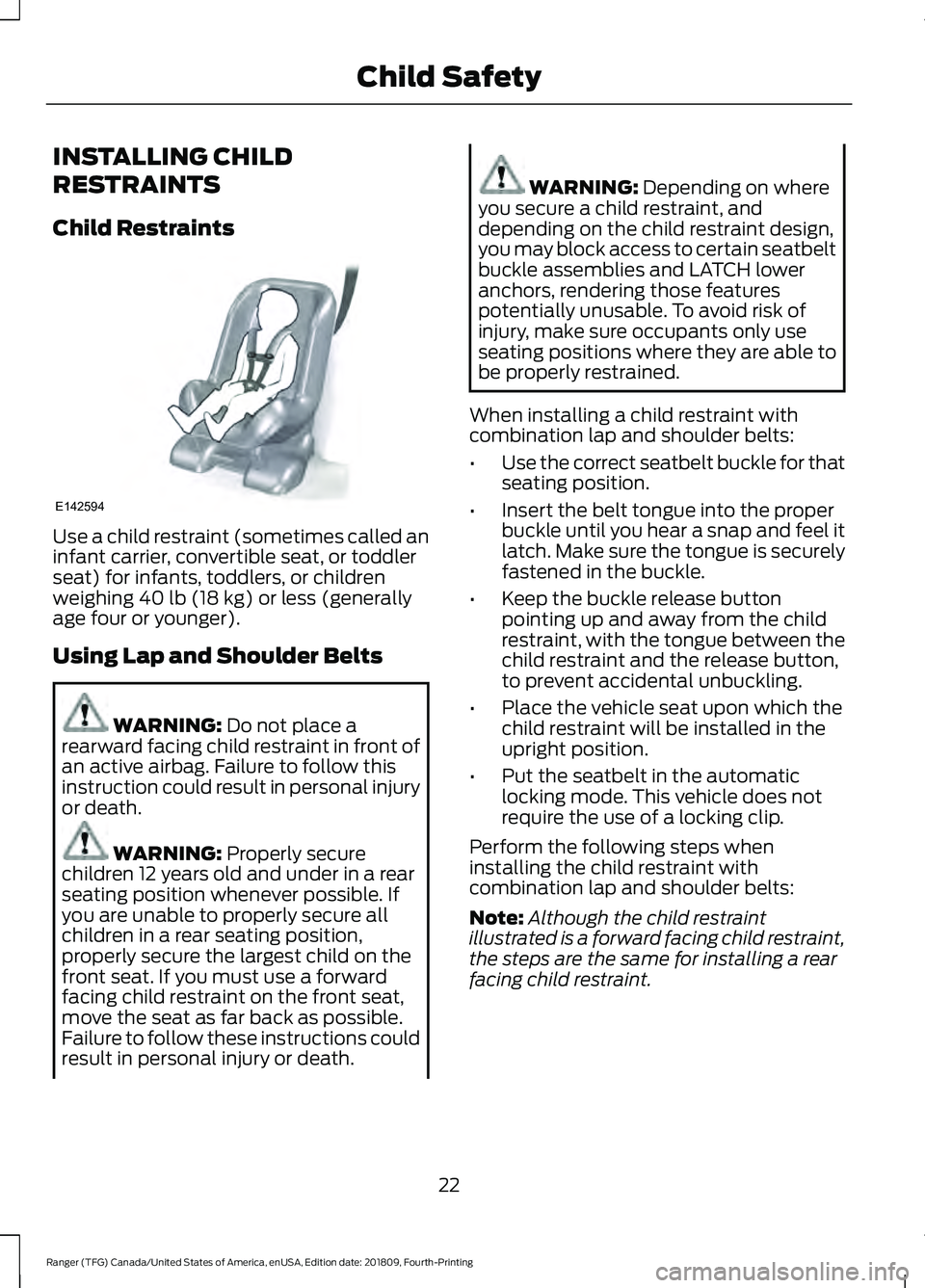
Use a child restraint (sometimes called an
infant carrier, convertible seat, or toddler
seat) for infants, toddlers, or children
weighing 40 lb (18 kg) or less (generally
age four or younger).
Using Lap and Shoulder Belts WARNING:
Do not place a
rearward facing child restraint in front of
an active airbag. Failure to follow this
instruction could result in personal injury
or death. WARNING:
Properly secure
children 12 years old and under in a rear
seating position whenever possible. If
you are unable to properly secure all
children in a rear seating position,
properly secure the largest child on the
front seat. If you must use a forward
facing child restraint on the front seat,
move the seat as far back as possible.
Failure to follow these instructions could
result in personal injury or death. WARNING:
Depending on where
you secure a child restraint, and
depending on the child restraint design,
you may block access to certain seatbelt
buckle assemblies and LATCH lower
anchors, rendering those features
potentially unusable. To avoid risk of
injury, make sure occupants only use
seating positions where they are able to
be properly restrained.
When installing a child restraint with
combination lap and shoulder belts:
• Use the correct seatbelt buckle for that
seating position.
• Insert the belt tongue into the proper
buckle until you hear a snap and feel it
latch. Make sure the tongue is securely
fastened in the buckle.
• Keep the buckle release button
pointing up and away from the child
restraint, with the tongue between the
child restraint and the release button,
to prevent accidental unbuckling.
• Place the vehicle seat upon which the
child restraint will be installed in the
upright position.
• Put the seatbelt in the automatic
locking mode. This vehicle does not
require the use of a locking clip.
Perform the following steps when
installing the child restraint with
combination lap and shoulder belts:
Note: Although the child restraint
illustrated is a forward facing child restraint,
the steps are the same for installing a rear
facing child restraint.
22
Ranger (TFG) Canada/United States of America, enUSA, Edition date: 201809, Fourth-Printing Child SafetyE142594
Page 26 of 512
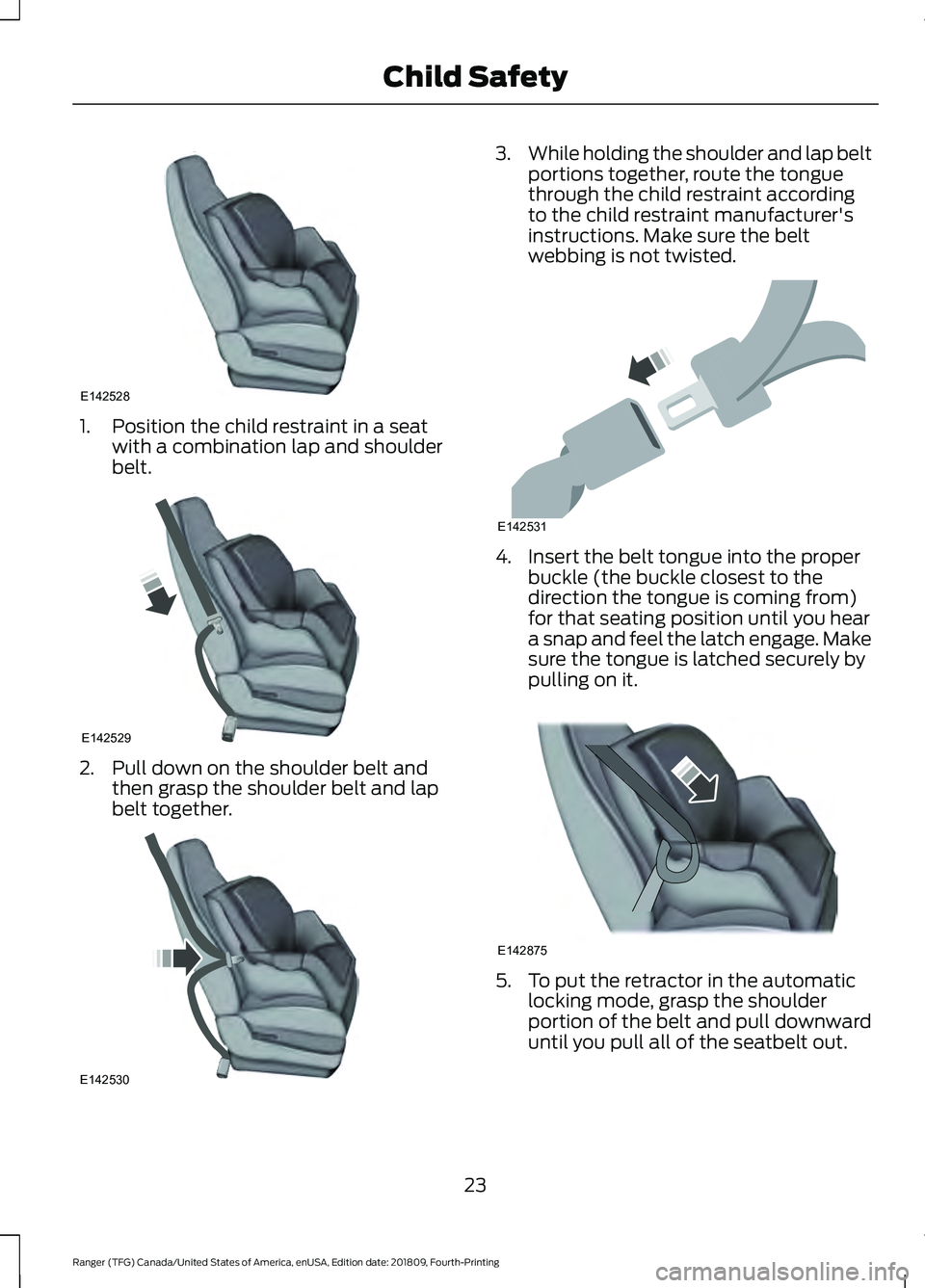
1. Position the child restraint in a seat
with a combination lap and shoulder
belt. 2. Pull down on the shoulder belt and
then grasp the shoulder belt and lap
belt together. 3.
While holding the shoulder and lap belt
portions together, route the tongue
through the child restraint according
to the child restraint manufacturer's
instructions. Make sure the belt
webbing is not twisted. 4. Insert the belt tongue into the proper
buckle (the buckle closest to the
direction the tongue is coming from)
for that seating position until you hear
a snap and feel the latch engage. Make
sure the tongue is latched securely by
pulling on it. 5. To put the retractor in the automatic
locking mode, grasp the shoulder
portion of the belt and pull downward
until you pull all of the seatbelt out.
23
Ranger (TFG) Canada/United States of America, enUSA, Edition date: 201809, Fourth-Printing Child SafetyE142528 E142529 E142530 E142531 E142875
Page 28 of 512
WARNING: Depending on where
you secure a child restraint, and
depending on the child restraint design,
you may block access to certain seatbelt
buckle assemblies and LATCH lower
anchors, rendering those features
potentially unusable. To avoid risk of
injury, make sure occupants only use
seating positions where they are able to
be properly restrained.
The LATCH system is composed of three
vehicle anchor points: two lower anchors
where the vehicle seat backrest and seat
cushion meet (called the seat bight) and
one top tether anchor behind that seating
position.
LATCH compatible child restraints have
two rigid or webbing mounted
attachments that connect to the two lower
anchors at the LATCH equipped seating
positions in your vehicle. This type of
attachment method eliminates the need
to use seatbelts to attach the child
restraint. However, you can still use the
seatbelt to attach the child restraint if the
lower anchors are not used.
For forward-facing child restraints, you
must also attach the top tether strap to
the proper top tether anchor if a top tether
strap has been provided with your child
restraint.
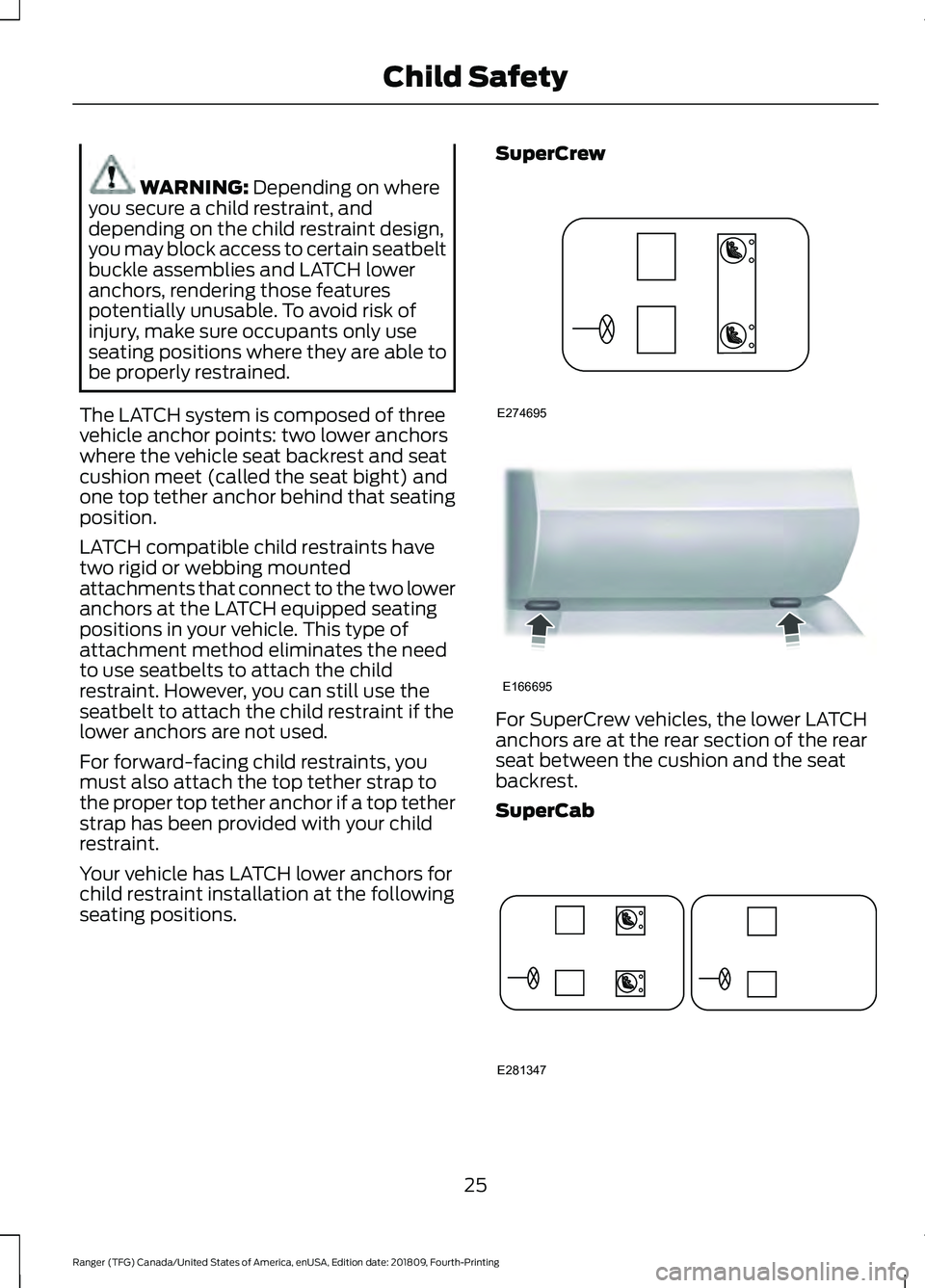
Your vehicle has LATCH lower anchors for
child restraint installation at the following
seating positions. SuperCrew
For SuperCrew vehicles, the lower LATCH
anchors are at the rear section of the rear
seat between the cushion and the seat
backrest.
SuperCab
25
Ranger (TFG) Canada/United States of America, enUSA, Edition date: 201809, Fourth-Printing Child SafetyE274695 E166695 E281347
Page 30 of 512
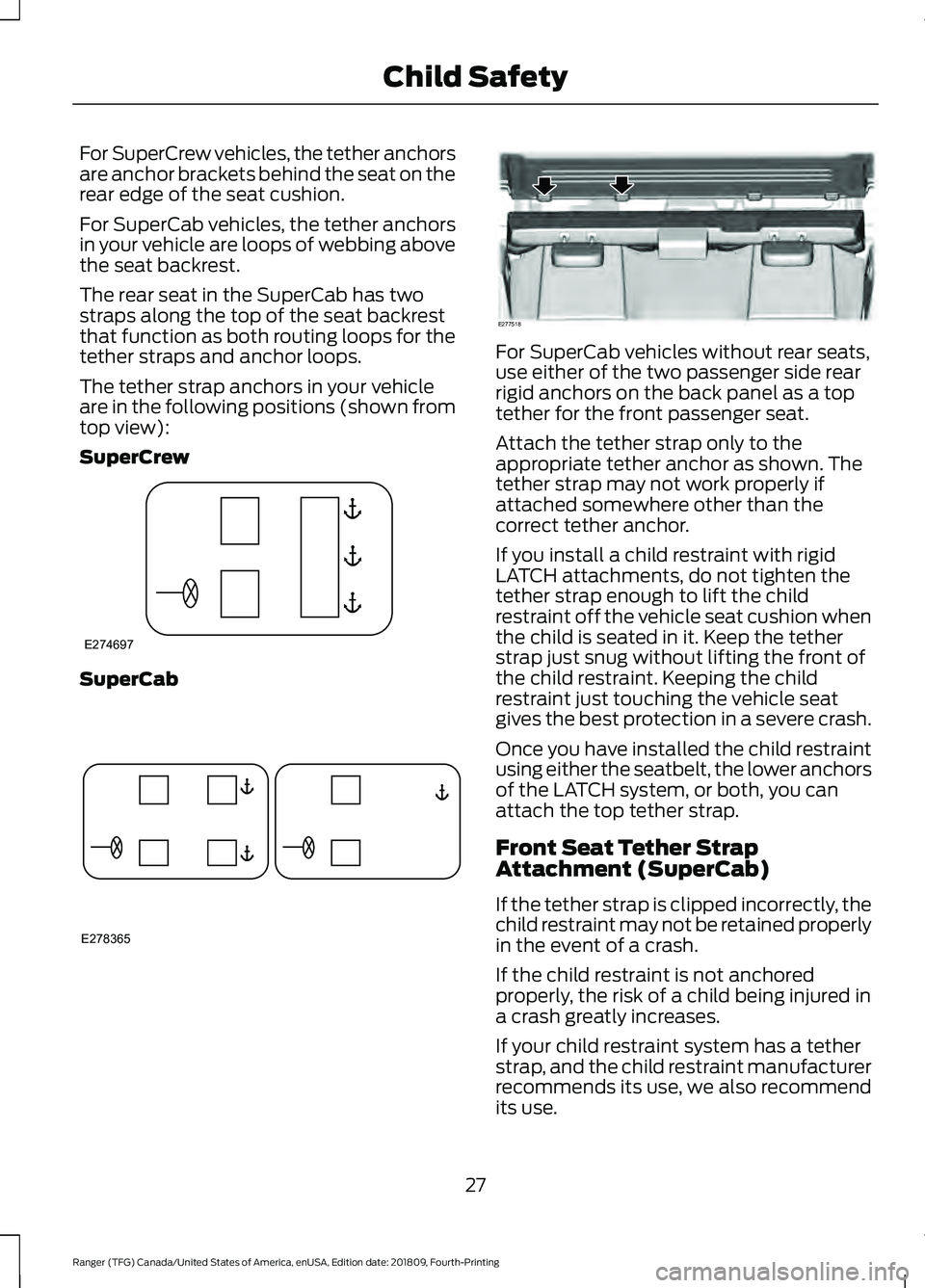
For SuperCrew vehicles, the tether anchors
are anchor brackets behind the seat on the
rear edge of the seat cushion.
For SuperCab vehicles, the tether anchors
in your vehicle are loops of webbing above
the seat backrest.
The rear seat in the SuperCab has two
straps along the top of the seat backrest
that function as both routing loops for the
tether straps and anchor loops.
The tether strap anchors in your vehicle
are in the following positions (shown from
top view):
SuperCrew
SuperCab For SuperCab vehicles without rear seats,
use either of the two passenger side rear
rigid anchors on the back panel as a top
tether for the front passenger seat.
Attach the tether strap only to the
appropriate tether anchor as shown. The
tether strap may not work properly if
attached somewhere other than the
correct tether anchor.
If you install a child restraint with rigid
LATCH attachments, do not tighten the
tether strap enough to lift the child
restraint off the vehicle seat cushion when
the child is seated in it. Keep the tether
strap just snug without lifting the front of
the child restraint. Keeping the child
restraint just touching the vehicle seat
gives the best protection in a severe crash.
Once you have installed the child restraint
using either the seatbelt, the lower anchors
of the LATCH system, or both, you can
attach the top tether strap.
Front Seat Tether Strap
Attachment (SuperCab)
If the tether strap is clipped incorrectly, the
child restraint may not be retained properly
in the event of a crash.
If the child restraint is not anchored
properly, the risk of a child being injured in
a crash greatly increases.
If your child restraint system has a tether
strap, and the child restraint manufacturer
recommends its use, we also recommend
its use.
27
Ranger (TFG) Canada/United States of America, enUSA, Edition date: 201809, Fourth-Printing Child SafetyE274697 E278365 E277518
Page 31 of 512
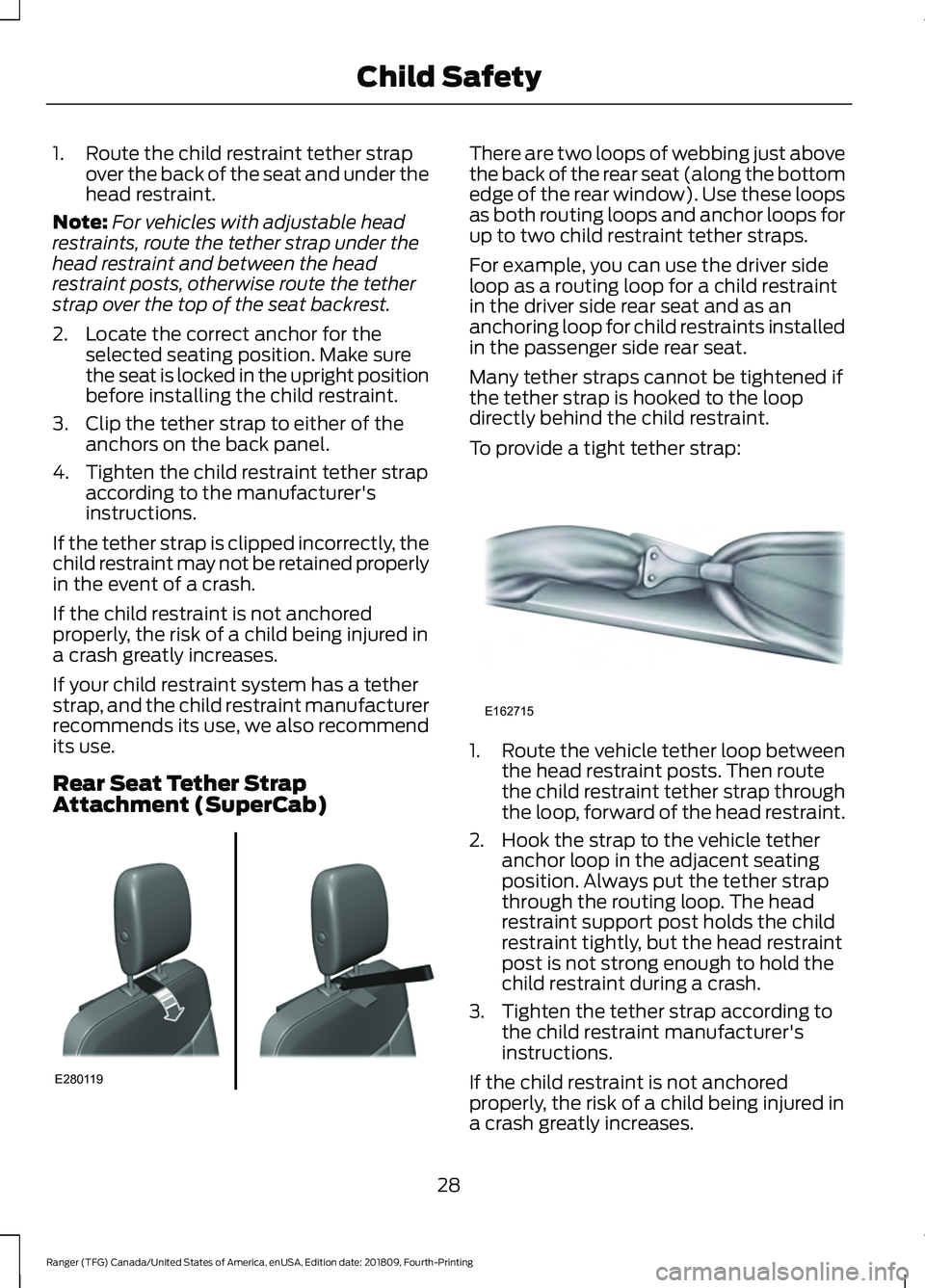
1. Route the child restraint tether strap
over the back of the seat and under the
head restraint.
Note: For vehicles with adjustable head
restraints, route the tether strap under the
head restraint and between the head
restraint posts, otherwise route the tether
strap over the top of the seat backrest.
2. Locate the correct anchor for the selected seating position. Make sure
the seat is locked in the upright position
before installing the child restraint.
3. Clip the tether strap to either of the anchors on the back panel.
4. Tighten the child restraint tether strap according to the manufacturer's
instructions.
If the tether strap is clipped incorrectly, the
child restraint may not be retained properly
in the event of a crash.
If the child restraint is not anchored
properly, the risk of a child being injured in
a crash greatly increases.
If your child restraint system has a tether
strap, and the child restraint manufacturer
recommends its use, we also recommend
its use.
Rear Seat Tether Strap
Attachment (SuperCab) There are two loops of webbing just above
the back of the rear seat (along the bottom
edge of the rear window). Use these loops
as both routing loops and anchor loops for
up to two child restraint tether straps.
For example, you can use the driver side
loop as a routing loop for a child restraint
in the driver side rear seat and as an
anchoring loop for child restraints installed
in the passenger side rear seat.
Many tether straps cannot be tightened if
the tether strap is hooked to the loop
directly behind the child restraint.
To provide a tight tether strap:
1.
Route the vehicle tether loop between
the head restraint posts. Then route
the child restraint tether strap through
the loop, forward of the head restraint.
2. Hook the strap to the vehicle tether anchor loop in the adjacent seating
position. Always put the tether strap
through the routing loop. The head
restraint support post holds the child
restraint tightly, but the head restraint
post is not strong enough to hold the
child restraint during a crash.
3. Tighten the tether strap according to the child restraint manufacturer's
instructions.
If the child restraint is not anchored
properly, the risk of a child being injured in
a crash greatly increases.
28
Ranger (TFG) Canada/United States of America, enUSA, Edition date: 201809, Fourth-Printing Child SafetyE280119 E162715
Page 32 of 512
If your child restraint system has a tether
strap, and the child restraint manufacturer
recommends its use, we also recommend
its use.
BOOSTER SEATS
WARNING: Do not put the
shoulder section of the seatbelt or allow
the child to put the shoulder section of
the seatbelt under their arm or behind
their back. Failure to follow this
instruction could reduce the
effectiveness of the seatbelt and
increase the risk of injury or death in a
crash.
Use a belt-positioning booster seat for
children who have outgrown or no longer
properly fit in a child safety restraint
(generally children who are less than
57 in
(1.45 m) tall, are greater than age 4 and
less than age 12, and between 40 lb (18 kg)
and
80 lb (36 kg) and upward to 100 lb
(45 kg) if recommended by your child
restraint manufacturer). Many state and
provincial laws require that children use
approved booster seats until they reach
age eight, a height of
57 in (1.45 m) tall, or
80 lb (36 kg).
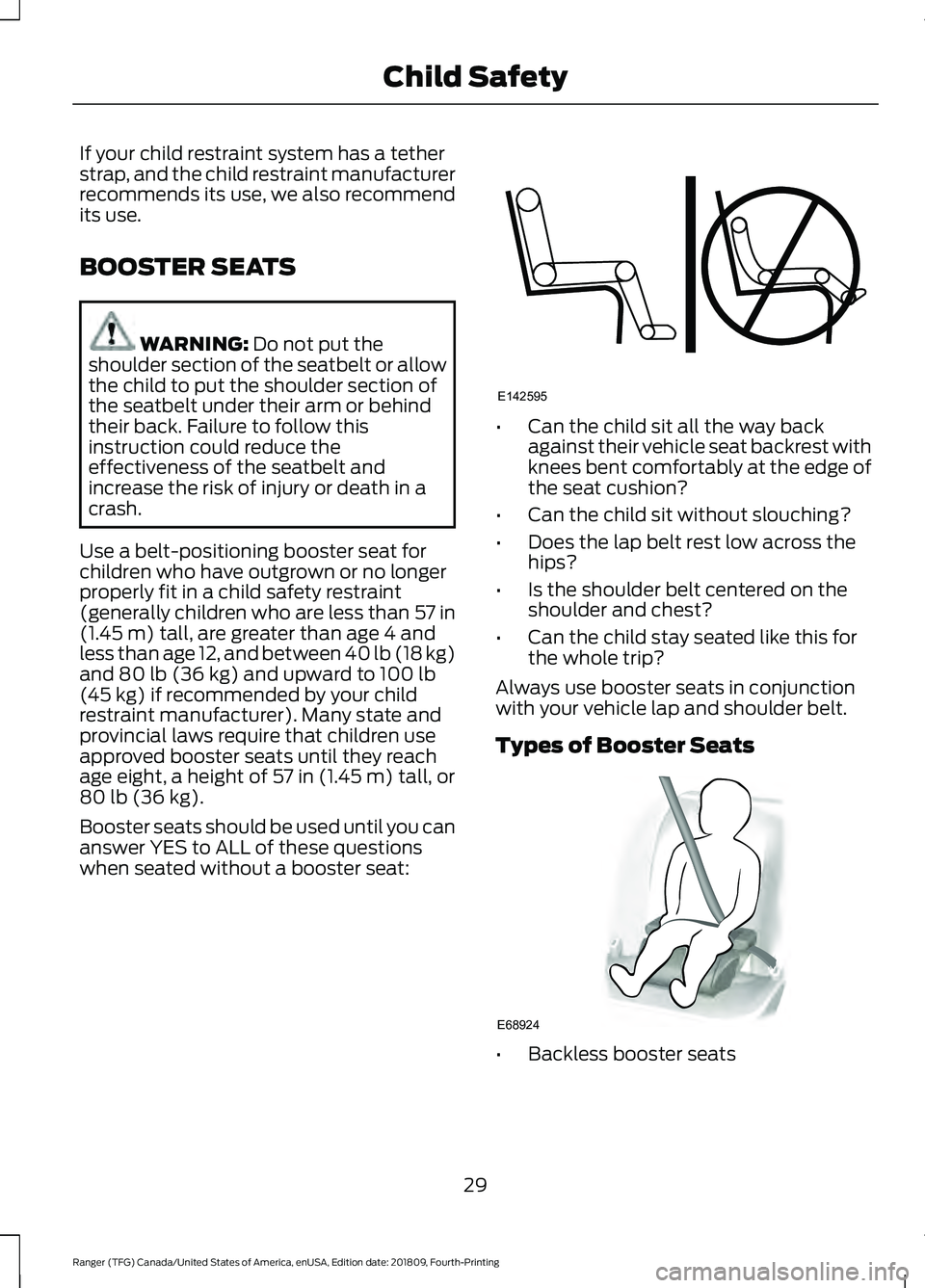
Booster seats should be used until you can
answer YES to ALL of these questions
when seated without a booster seat: •
Can the child sit all the way back
against their vehicle seat backrest with
knees bent comfortably at the edge of
the seat cushion?
• Can the child sit without slouching?
• Does the lap belt rest low across the
hips?
• Is the shoulder belt centered on the
shoulder and chest?
• Can the child stay seated like this for
the whole trip?
Always use booster seats in conjunction
with your vehicle lap and shoulder belt.
Types of Booster Seats •
Backless booster seats
29
Ranger (TFG) Canada/United States of America, enUSA, Edition date: 201809, Fourth-Printing Child SafetyE142595 E68924