2019 FORD F650/750 fuel type
[x] Cancel search: fuel typePage 14 of 387
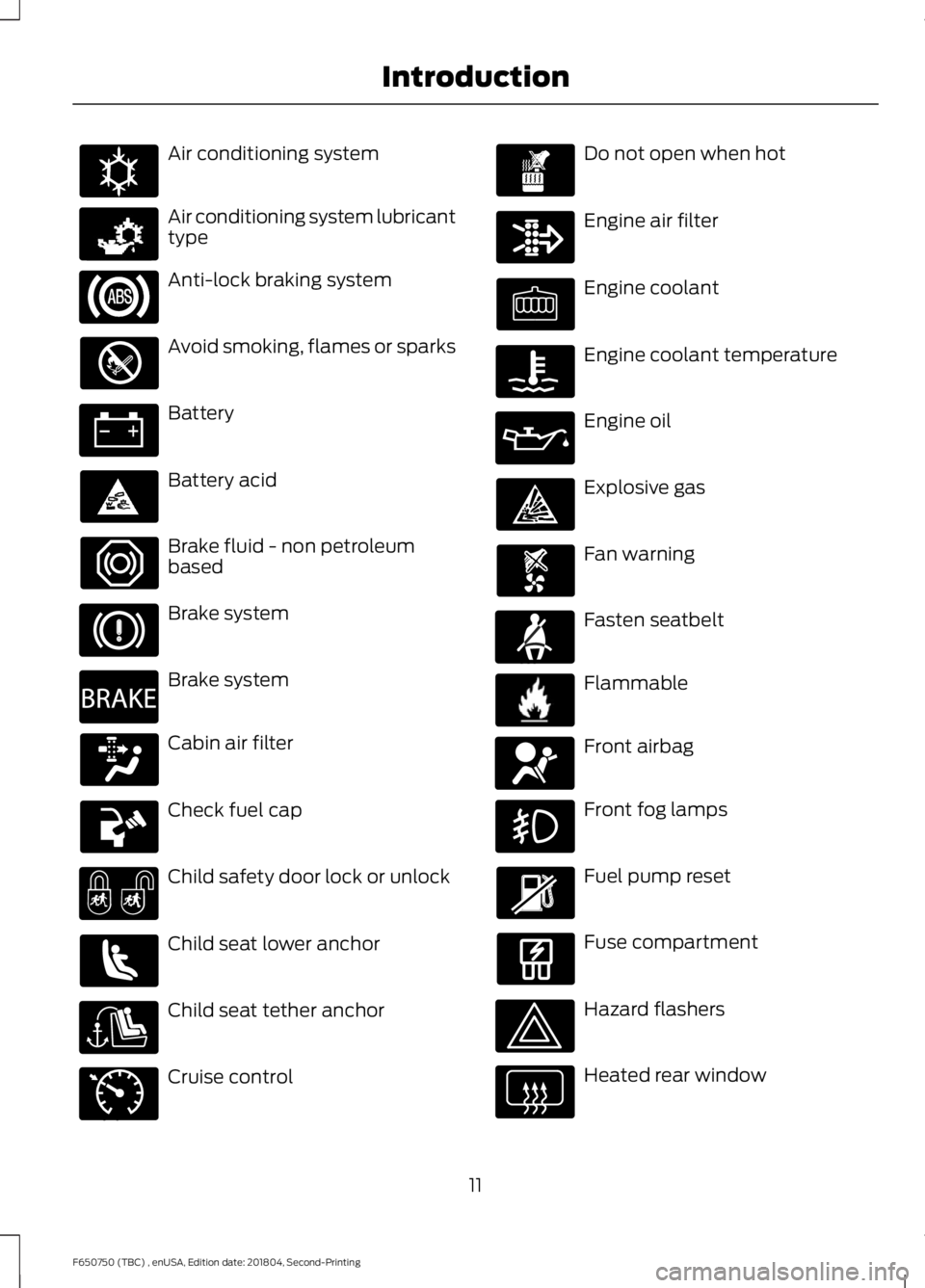
Air conditioning system
Air conditioning system lubricant
type
Anti-lock braking system
Avoid smoking, flames or sparks
Battery
Battery acid
Brake fluid - non petroleum
based
Brake system
Brake system
Cabin air filter
Check fuel cap
Child safety door lock or unlock
Child seat lower anchor
Child seat tether anchor
Cruise control Do not open when hot
Engine air filter
Engine coolant
Engine coolant temperature
Engine oil
Explosive gas
Fan warning
Fasten seatbelt
Flammable
Front airbag
Front fog lamps
Fuel pump reset
Fuse compartment
Hazard flashers
Heated rear window
11
F650750 (TBC) , enUSA, Edition date: 201804, Second-Printing IntroductionE162384 E231157 E270480 E71340 E71880 E231160 E67017
Page 96 of 387
personal injury or sickness may result.
If you splash fuel on your skin, promptly
wash your skin thoroughly with soap
and water. Consult a physician
immediately if you experience an
adverse reaction.
Low Fuel Pressure (If Equipped)
Diesel engine vehicles have a low fuel
pressure detection system.
The following are possible causes for a low
fuel pressure warning message to appear
in the information display:
• Cold start or during cold operation
below
32°F (0°C). If the low fuel
pressure message appears during a
cold start or up to 10 minutes after the
initial cold start, monitor the
information display. If the low fuel
pressure message disappears and does
not re-appear after the engine has fully
warmed up, waxed or gelled fuel is
what most likely caused the message.
Do not use alcohol based additives to
correct fuel gelling. This may result in
damage to the fuel injectors and
systems. Use an anti-gel additive. See
Capacities and Specifications (page
261
).
Note: The vehicle Warranty may be void if
you use additives that do not meet or
exceed Ford specifications. If the low fuel
pressure message persistently appears after
re-fueling and then disappears when the
engine has fully warmed up, consider using
different fuel sources. •
Low fuel operation: If the low fuel
pressure message appears when your
vehicle is warm and during low fuel
tank level operation (near empty),
refuel your vehicle. If the message
reappears after fueling, see below. If
the message does not come back, the
low fuel pressure condition was due to
low fuel levels in the fuel tank.
• Normal operation: If the low fuel
pressure message appears during
normal operation when the engine is
fully warm, and fuel level is not low,
you must change the fuel filters
regardless of the maintenance
schedule interval.
• If replacement of the fuel filter does
not remedy the low fuel pressure
message during normal operation as
defined above, take the vehicle to an
authorized dealer.
FUEL QUALITY - DIESEL
Fuel Requirements - Choosing The
Right Fuel: Vehicles Operated
Where Ultra Low Sulfur Diesel Fuel
Is Required (United
States/Canada/Puerto Rico/U.S.
Virgin Islands And Other Locales)
You should use Ultra-Low Sulfur Diesel
fuel (also known as ULSD) designated as
number 1-D or 2-D with a maximum of
15-ppm sulfur in your diesel vehicle. You
may operate your vehicle on diesel fuels
containing up to 20% biodiesel, also
known as B20. These fuels should meet
the ASTM D975 diesel or the ASTM D7467
B6-B20 biodiesel industry specifications.
Outside of North America, use fuels
meeting EN590 or equivalent local market
standard.
Note: The vehicle Warranty does not cover
damage caused by using an improper type
of fuel or fuel additive.
93
F650750 (TBC) , enUSA, Edition date: 201804, Second-Printing Fuel and Refueling
Page 103 of 387
If the fuel cap warning lamp remains on,
at the next opportunity, safely pull off of
the road, remove the fuel filler cap, align
the cap properly and reinstall it. The check
fuel cap warning lamp or warning message
may not reset immediately. It may take
several driving cycles for the indicators to
turn off. A driving cycle consists of an
engine start-up (after four or more hours
with the engine off) followed by normal
city and highway driving.
FUEL CONSUMPTION
Real world fuel consumption is governed
by many factors, for example driving style,
high speed driving, stop-start driving, air
conditioning usage, the accessories fitted,
payload and towing.
•
The usable capacity of the fuel tank is
the amount of fuel that can be added
into the tank after the gauge indicates
empty.
• The advertised capacity is the total fuel
tank size. See Capacities and
Specifications (page 255). It is the
combined usable capacity plus the
empty reserve.
• Due to the empty reserve, you may not
be able to refuel the full amount of the
advertised capacity of the fuel tank
even when the fuel gauge reads empty.
Empty reserve is the amount of fuel
remaining in the tank after the fuel gauge
indicates empty. The amount of usable
fuel in the empty reserve varies and should
not be relied upon to increase driving range.
Filling the Tank
For consistent results when filling the fuel
tank: •
Turn the ignition off before refueling
your vehicle; a temporary inaccurate
reading may result if the engine is left
on when refueling your vehicle.
• Use the same fill rate
(low-medium-high) each time the tank
is refueled.
• Allow no more than two automatic
click-offs when refueling your vehicle.
Results are most accurate when the filling
method is consistent.
Calculating Fuel Economy
Do not measure fuel economy during the
first
900 mi (1,500 km) of driving (this is
your engine ’s break-in period); a more
accurate measurement is obtained after
1,900 mi (3,000 km)
.
Fuel expense, frequency of fill ups or fuel
gauge readings are not accurate ways to
measure fuel economy.
1. Fill the fuel tank completely and record
the initial odometer reading.
2. Each time you fill the fuel tank, record the amount of fuel added.
3. After at least three fill ups, fill the fuel tank and record the current odometer
reading.
4. Subtract your initial odometer reading from the current odometer reading.
5. Calculate fuel economy by dividing miles traveled by gallons used (For
Metric: Multiply liters used by 100, then
divide by kilometers traveled).
Keep a record for at least one month and
record the type of driving (city or highway).
This provides an accurate estimate of your
vehicle ’s fuel economy under current
driving conditions. Keeping records during
summer and winter will show how
temperature impacts fuel economy. In
general, your vehicle will use more fuel in
cold temperatures.
100
F650750 (TBC) , enUSA, Edition date: 201804, Second-Printing Fuel and Refueling
Page 124 of 387
WARNING: Sudden accelerations
on slippery surfaces could cause the
wheels to spin, the vehicle to turn
sideways on a crowned road surface or
in a turn, possibly resulting in loss of
vehicle control and personal injury.
Activating the Locking Differential
You can lock and unlock the differential
when your vehicle is moving at a constant
speed of less than 25 mph (40 km/h) and
while the wheels are not slipping. Do not
lock the differential when your vehicle is
traveling down steep grades and when
traction is minimal.
The differential lock and differential lock
light automatically disengage at speeds
above 25 mph (40 km/h). The differential
lock remains off until either you restart your
vehicle or you turn the differential lock
switch off then back on.
Servicing a Vehicle with a Locking
Differential
Turn the engine off and raise all drive
wheels of the locker differential axle in
order to prevent your vehicle from moving
when servicing the wheels, tires or brakes.
Axles equipped with a driver-controlled
differential deliver power to both wheels
even when only one wheel is on the ground. WARNING: Failure to raise all drive
wheels with this type of differential could
cause the vehicle to move unexpectedly,
resulting in property damage, personal
injury or death. 2-SPEED REAR AXLE (IF EQUIPPED) WARNING:
Never shift a
two-speed axle when descending a
steep grade as this may cause loss of
vehicle control and result in personal
injury.
Note: Do not shift between ranges when
the speed control is on.
A two-speed rear axle allows the driver to
select a low range for greater pulling power
and a high range for greater road speed
and fuel economy. You can also use these
ranges to provide extra steps between
transmission shifts when driving on steep
grades or fuel economy may be factors.
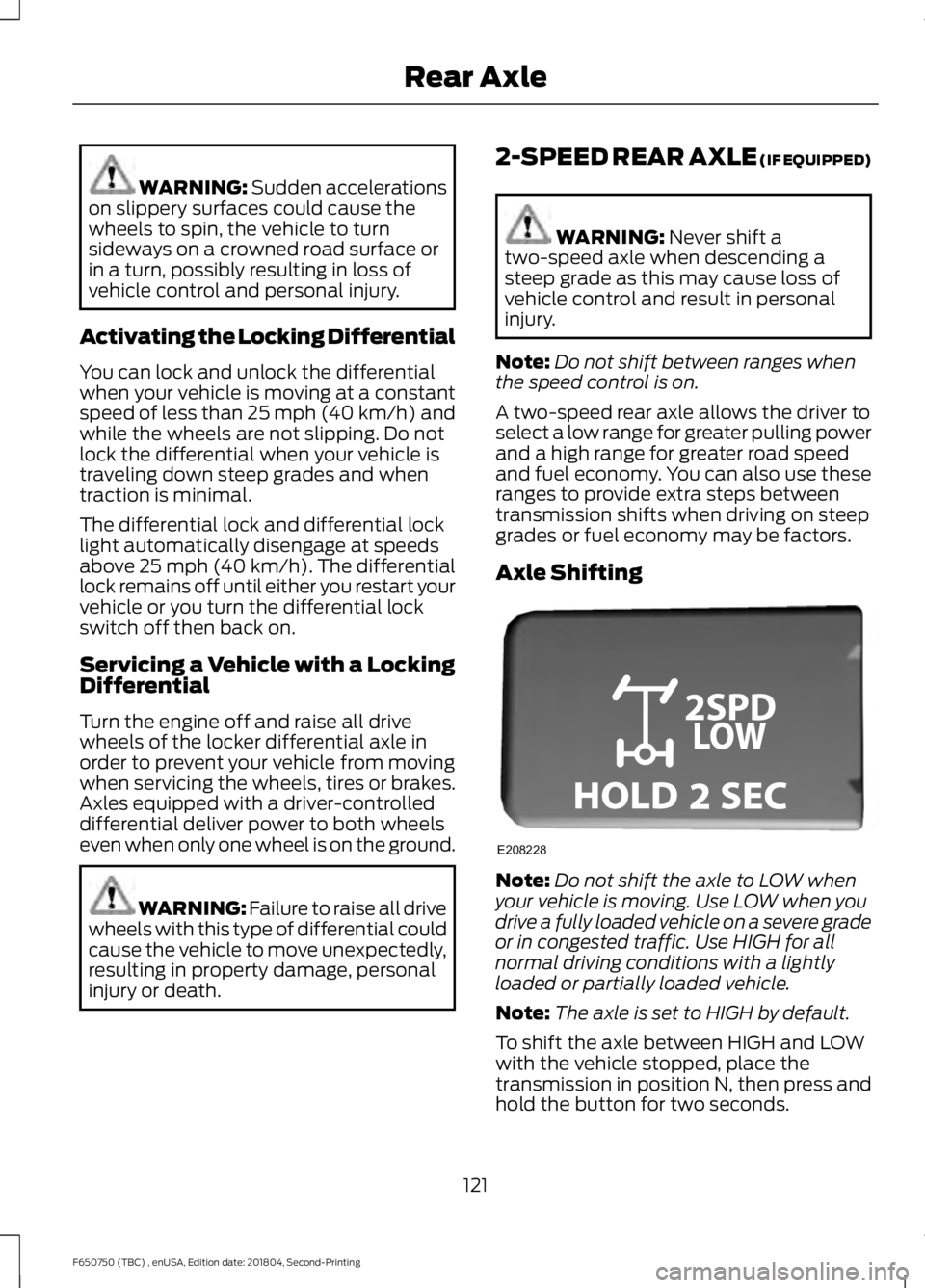
Axle Shifting Note:
Do not shift the axle to LOW when
your vehicle is moving. Use LOW when you
drive a fully loaded vehicle on a severe grade
or in congested traffic. Use HIGH for all
normal driving conditions with a lightly
loaded or partially loaded vehicle.
Note: The axle is set to HIGH by default.
To shift the axle between HIGH and LOW
with the vehicle stopped, place the
transmission in position N, then press and
hold the button for two seconds.
121
F650750 (TBC) , enUSA, Edition date: 201804, Second-Printing Rear AxleE208228
Page 265 of 387
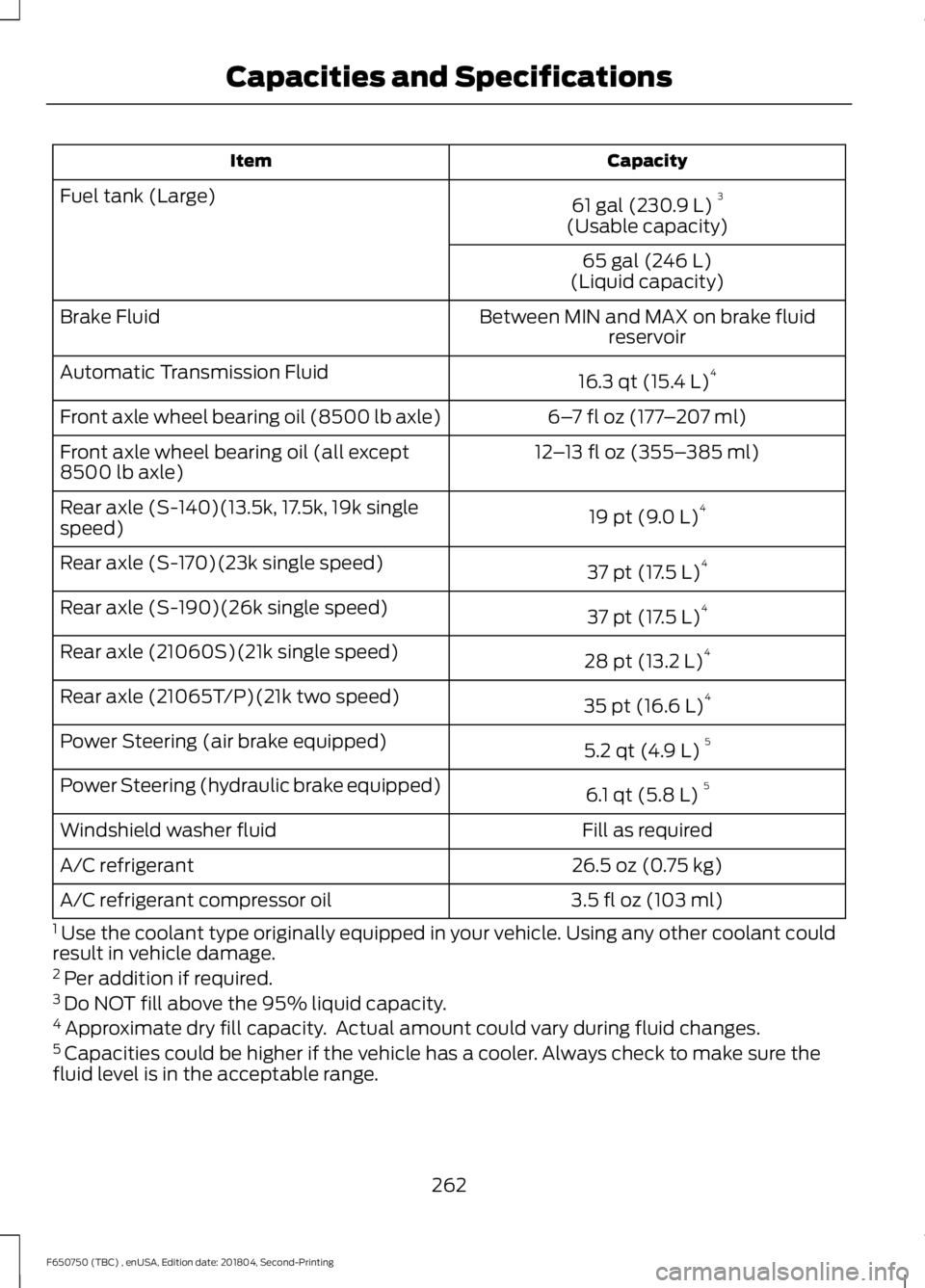
Capacity
Item
61 gal (230.9 L)3
Fuel tank (Large)
(Usable capacity)
65 gal (246 L)
(Liquid capacity)
Between MIN and MAX on brake fluid reservoir
Brake Fluid
16.3 qt (15.4 L)4
Automatic Transmission Fluid
6–7 fl oz (177 –207 ml)
Front axle wheel bearing oil (8500 lb axle)
12–13 fl oz (355– 385 ml)
Front axle wheel bearing oil (all except
8500 lb axle)
19 pt (9.0 L)4
Rear axle (S-140)(13.5k, 17.5k, 19k single
speed)
37 pt (17.5 L)4
Rear axle (S-170)(23k single speed)
37 pt (17.5 L)4
Rear axle (S-190)(26k single speed)
28 pt (13.2 L)4
Rear axle (21060S)(21k single speed)
35 pt (16.6 L)4
Rear axle (21065T/P)(21k two speed)
5.2 qt (4.9 L)5
Power Steering (air brake equipped)
6.1 qt (5.8 L)5
Power Steering (hydraulic brake equipped)
Fill as required
Windshield washer fluid
26.5 oz (0.75 kg)
A/C refrigerant
3.5 fl oz (103 ml)
A/C refrigerant compressor oil
1 Use the coolant type originally equipped in your vehicle. Using any other coolant could
result in vehicle damage.
2 Per addition if required.
3 Do NOT fill above the 95% liquid capacity.
4 Approximate dry fill capacity. Actual amount could vary during fluid changes.
5 Capacities could be higher if the vehicle has a cooler. Always check to make sure the
fluid level is in the acceptable range.
262
F650750 (TBC) , enUSA, Edition date: 201804, Second-Printing Capacities and Specifications
Page 327 of 387
There are three types of maintenance
intervals for general vehicle environments:
On-Highway, City and Severe Service. In
all applications, monitoring miles
(kilometers) and time and when the engine
is due for an oil change determine the
actual interval. When the engine oil change
is required before the truck lubrication
interval, perform the lubrication at the
same time in order to reduce your vehicle
’s
time out of service.
Air Brake Adjustment WARNING: Failure to maintain
proper air brake adjustment can result
in reduction or loss of braking ability.
A qualified service technician, keeping to
the instructions in the service manual,
should perform air brake inspection and
adjustment or repairs.
Cam Brakes - Automatic Slack
Adjusters WARNING:
Do not manually
adjust the automatic slack adjusters to
correct excessive push rod stroke as it
may result in reduced brake
effectiveness and a vehicle crash.
Excessive push rod stroke indicates that a problem exists with the automatic
adjuster, with the installation of the
adjuster, or with foundation brake
components that manual adjustment
does not remedy. Seek service from a
qualified facility for excessive push rod
stroke.
Inspect standard air brakes equipped with
automatic slack adjusters for proper brake
adjustment as listed in the maintenance
schedule charts.
However, inspect the brakes more
frequently when subjecting them to heavy
use or adverse operating conditions such
as:
• Frequent brake applications while fully
loaded.
• Operation on hilly or mountainous
terrain.
• Frequent operation on dirt, gravel or
mud.
Some aftermarket brake linings also
require more frequent inspections.
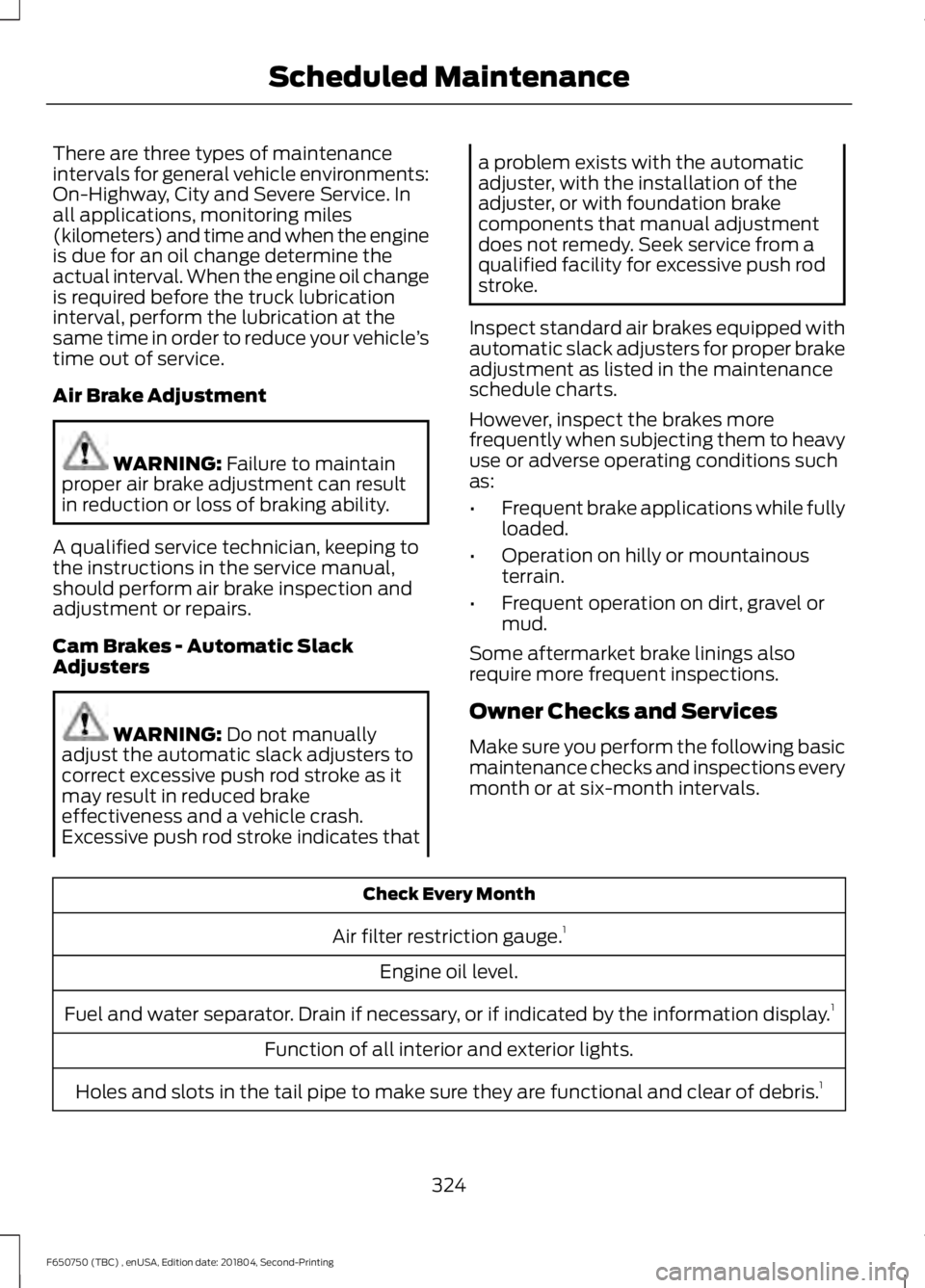
Owner Checks and Services
Make sure you perform the following basic
maintenance checks and inspections every
month or at six-month intervals. Check Every Month
Air filter restriction gauge. 1
Engine oil level.
Fuel and water separator. Drain if necessary, or if indicated by the information display. 1
Function of all interior and exterior lights.
Holes and slots in the tail pipe to make sure they are functional and clear of debris. 1
324
F650750 (TBC) , enUSA, Edition date: 201804, Second-Printing Scheduled Maintenance
Page 379 of 387
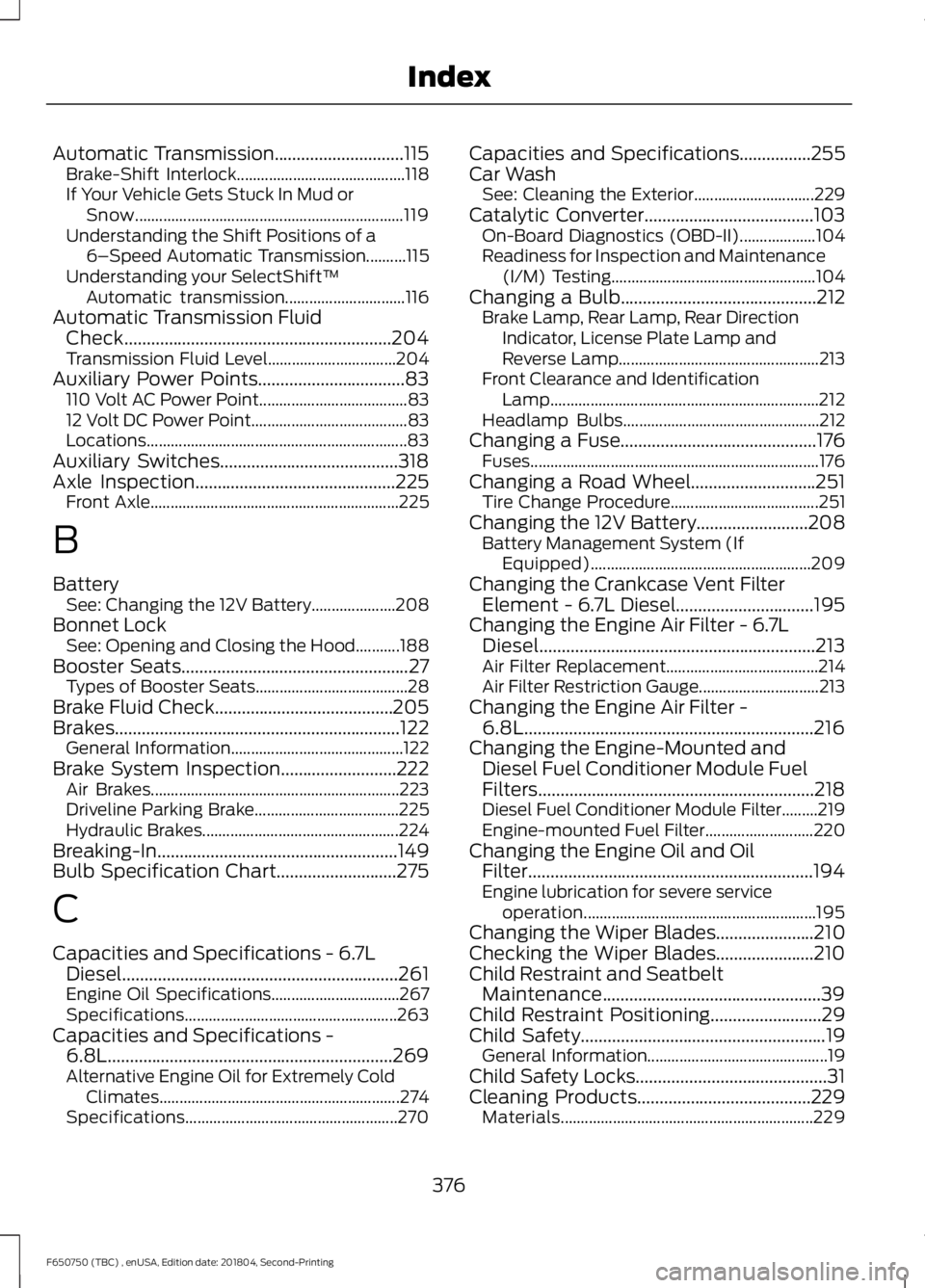
Automatic Transmission.............................115
Brake-Shift Interlock.......................................... 118
If Your Vehicle Gets Stuck In Mud or Snow................................................................... 119
Understanding the Shift Positions of a 6– Speed Automatic Transmission..........115
Understanding your SelectShift™ Automatic transmission.............................. 116
Automatic Transmission Fluid Check............................................................204
Transmission Fluid Level................................ 204
Auxiliary Power Points.................................83 110 Volt AC Power Point..................................... 83
12 Volt DC Power Point....................................... 83
Locations................................................................. 83
Auxiliary Switches........................................318
Axle Inspection.............................................225 Front Axle.............................................................. 225
B
Battery See: Changing the 12V Battery..................... 208
Bonnet Lock See: Opening and Closing the Hood...........188
Booster Seats...................................................27
Types of Booster Seats...................................... 28
Brake Fluid Check........................................205
Brakes................................................................122 General Information........................................... 122
Brake System Inspection
..........................222
Air Brakes.............................................................. 223
Driveline Parking Brake.................................... 225
Hydraulic Brakes................................................. 224
Breaking-In......................................................149
Bulb Specification Chart...........................275
C
Capacities and Specifications - 6.7L Diesel..............................................................261
Engine Oil Specifications................................ 267
Specifications..................................................... 263
Capacities and Specifications - 6.8L................................................................269
Alternative Engine Oil for Extremely Cold Climates............................................................ 274
Specifications..................................................... 270Capacities and Specifications
................255
Car Wash See: Cleaning the Exterior.............................. 229
Catalytic Converter
......................................103
On-Board Diagnostics (OBD-II)................... 104
Readiness for Inspection and Maintenance (I/M) Testing................................................... 104
Changing a Bulb............................................212 Brake Lamp, Rear Lamp, Rear Direction
Indicator, License Plate Lamp and
Reverse Lamp.................................................. 213
Front Clearance and Identification Lamp................................................................... 212
Headlamp Bulbs................................................. 212
Changing a Fuse
............................................176
Fuses........................................................................\
176
Changing a Road Wheel............................251 Tire Change Procedure..................................... 251
Changing the 12V Battery.........................208 Battery Management System (If
Equipped)....................................................... 209
Changing the Crankcase Vent Filter Element - 6.7L Diesel...............................195
Changing the Engine Air Filter - 6.7L Diesel..............................................................213
Air Filter Replacement...................................... 214
Air Filter Restriction Gauge.............................. 213
Changing the Engine Air Filter - 6.8L.................................................................216
Changing the Engine-Mounted and Diesel Fuel Conditioner Module Fuel
Filters..............................................................218
Diesel Fuel Conditioner Module Filter.........219
Engine-mounted Fuel Filter........................... 220
Changing the Engine Oil and Oil Filter................................................................194
Engine lubrication for severe service operation.......................................................... 195
Changing the Wiper Blades
......................210
Checking the Wiper Blades......................210
Child Restraint and Seatbelt Maintenance.................................................39
Child Restraint Positioning.........................29
Child Safety
.......................................................19
General Information............................................. 19
Child Safety Locks...........................................31
Cleaning Products
.......................................229
Materials............................................................... 229
376
F650750 (TBC) , enUSA, Edition date: 201804, Second-Printing Index