2019 FIAT 500E key
[x] Cancel search: keyPage 160 of 300
NOTE:
•If the key is held in the START position for more than 10
seconds “READY” mode will not be achieved. Return
the key to the OFF position, and then back to the START
position and hold for less than 10 seconds to achieve
“READY”.
• If the “READY” indicator fails to illuminate after you
have followed the normal starting procedure contact an
authorized dealer.
PARKING BRAKE
Before leaving the vehicle, make sure that the parking
brake is fully applied.
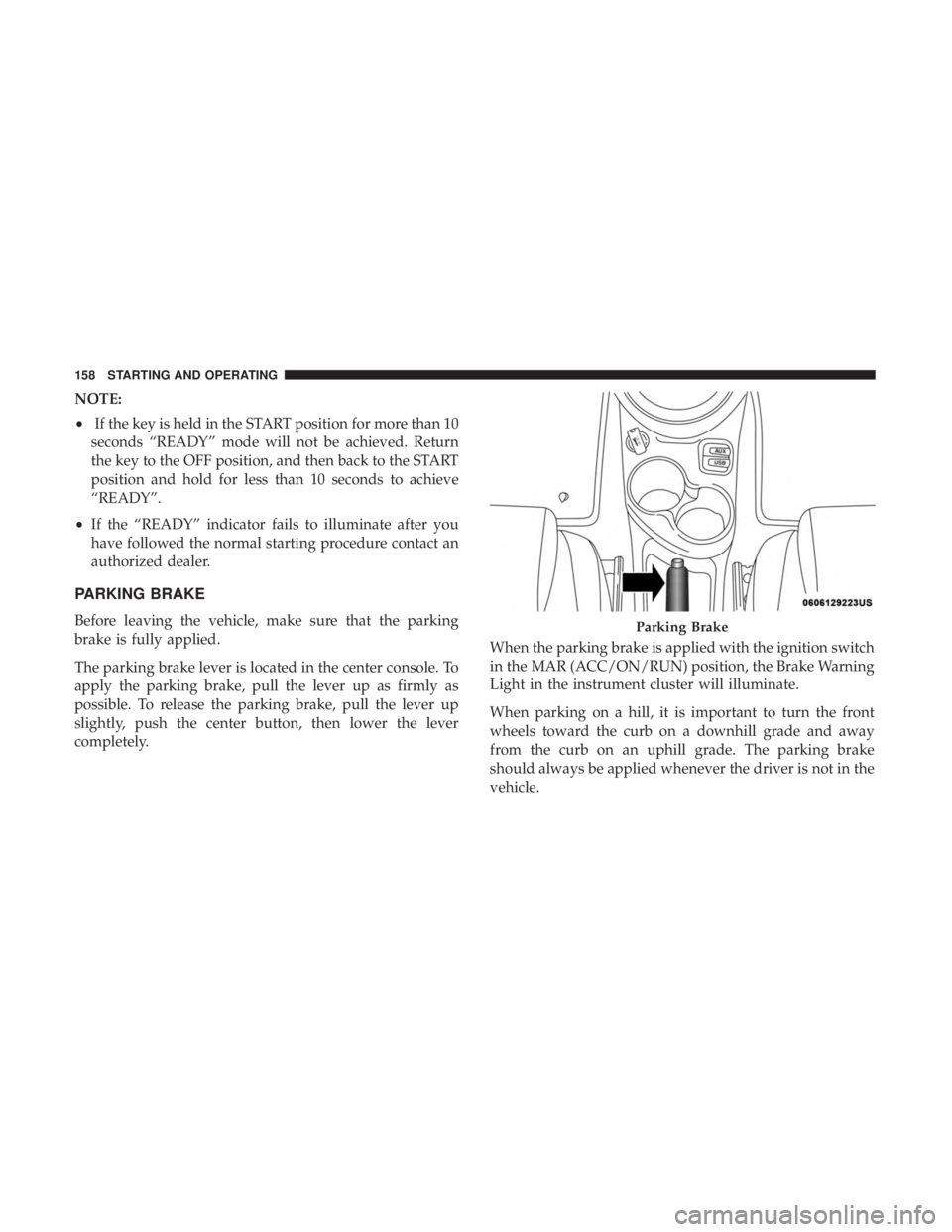
The parking brake lever is located in the center console. To
apply the parking brake, pull the lever up as firmly as
possible. To release the parking brake, pull the lever up
slightly, push the center button, then lower the lever
completely. When the parking brake is applied with the ignition switch
in the MAR (ACC/ON/RUN) position, the Brake Warning
Light in the instrument cluster will illuminate.
When parking on a hill, it is important to turn the front
wheels toward the curb on a downhill grade and away
from the curb on an uphill grade. The parking brake
should always be applied whenever the driver is not in the
vehicle.Parking Brake
158 STARTING AND OPERATING
Page 161 of 300

WARNING!
•Never leave children alone in a vehicle, or with
access to an unlocked vehicle.
• Allowing children to be in a vehicle unattended is
dangerous for a number of reasons. A child or others
could be seriously or fatally injured. Children
should be warned not to touch the parking brake,
brake pedal or the transmission push buttons.
• Do not leave the key fob in or near the vehicle (or in
a location accessible to children). A child could
operate power windows, other controls, or move the
vehicle.
• Be sure the parking brake is fully disengaged before
driving; failure to do so can lead to brake failure and
a collision.
• Always fully apply the parking brake when leaving
your vehicle, or it may roll and cause damage or
injury.
CAUTION!
If the Brake Warning Light remains on with the park-
ing brake released, a brake system malfunction is
indicated. Have the brake system serviced by an au-
thorized dealer immediately.
6
STARTING AND OPERATING 159
Page 162 of 300

SINGLE–SPEED TRANSMISSION
Your 500e uses a Single-Speed Transmission to direct the
output from the electric motor. The single-speed transmis-
sion is operated using push-buttons instead of a traditional
gear selector.
The push-buttons are located on the lower instrument
panel.
CAUTION!
Damage to the transmission may occur if the following
precautions are not observed:
•Place the transmission into PARK only after the
vehicle has come to a complete stop.
• Place the transmission into or out of REVERSE only
after the vehicle has come to a complete stop.
• Before placing the transmission into any range make
sure your foot is firmly pressing the brake pedal.
NOTE:
• You must press and hold the brake pedal while shifting
in or out of PARK.
• If all push-button LEDs are on when the key is ON, see
an authorized dealer.
WARNING!
• Only place the transmission into gear when your foot
is firmly pressing the brake pedal.
• Unintended movement of a vehicle could injure
those in or near the vehicle. As with all vehicles, you
(Continued)
Single-Speed Transmission Push-Buttons
160 STARTING AND OPERATING
Page 163 of 300
WARNING!(Continued)
should never exit a vehicle while the vehicle is in
“READY” mode. Before exiting a vehicle, always
apply the parking brake, shift the transmission into
PARK, and remove the ignition key. Once the key is
removed, the transmission is locked in PARK, secur-
ing the vehicle against unwanted movement.
• When leaving the vehicle, always remove the igni-
tion key and lock your vehicle.
• Never leave children alone in a vehicle, or with
access to an unlocked vehicle. Allowing children to
be in a vehicle unattended is dangerous for a number
of reasons. A child or others could be seriously or
fatally injured. Children should be warned not to
touch the parking brake, brake pedal or the trans-
mission range buttons.
• Do not leave the ignition key in or near the vehicle
(or in a location accessible to children). A child could
operate power windows, other controls, or move the
vehicle.
Key Ignition Park Interlock
This vehicle is equipped with a Key Ignition Park Interlock
which requires the transmission to be in PARK before the ignition can be turned to the OFF position. The key can
only be removed from the ignition when the ignition is in
the OFF position, and once removed, the transmission is
locked in PARK.
Gear Ranges
Push the desired push button to shift into gear.
NOTE:
•
The brake pedal must be depressed to select a transmis-
sion gear.
• After selecting any gear, wait a moment to allow the
selected gear to engage before accelerating.
PARK (P)
The PARK selection supplements the parking brake by
locking the transmission. The vehicle can be started in this
range. Never attempt to use PARK while the vehicle is in
motion. Apply the parking brake when exiting the vehicle
in PARK.
When parking on a level surface, you may place the
transmission into PARK first, and then apply the parking
brake.
6
STARTING AND OPERATING 161
Page 164 of 300

When parking on a hill, apply the parking brake before
placing the transmission into PARK. As an added precau-
tion, turn the front wheels toward the curb on a downhill
grade and away from the curb on an uphill grade.
When exiting the vehicle, always:
•Apply the parking brake.
• Shift the transmission into PARK.
• Turn the vehicle OFF.
• Remove the ignition key.
NOTE: Refer to the transmission range position displayed
in the instrument cluster and verify that it indicates the
PARK position.
WARNING!
• Never use the PARK position as a substitute for the
park brake. Always apply the park brake fully when
exiting the vehicle to guard against vehicle move-
ment and possible injury or damage.
• Your vehicle could move and injure you and others if
it is not in PARK. Check by trying to move the gear
selector out of PARK with the brake pedal released.
(Continued)
WARNING! (Continued)
Make sure the transmission is in PARK before exit-
ing the vehicle.
• It is dangerous to shift out of PARK or NEUTRAL if
your foot is not firmly pressing the brake pedal. The
vehicle could accelerate quickly forward or in re-
verse. You could lose control of the vehicle and hit
someone or something. Only shift the transmission
into gear when your foot is firmly pressing the brake
pedal.
• Unintended movement of a vehicle could injure
those in or near the vehicle. As with all vehicles, you
should never exit a vehicle while the engine is
running or the propulsion system is active. Before
exiting a vehicle, always come to a complete stop,
then apply the park brake, shift the transmission into
PARK, turn the ignition OFF, and remove the key
fob. When the ignition is in the OFF mode, the
transmission is locked in PARK, securing the vehicle
against unwanted movement.
• When leaving the vehicle, always remove the igni-
tion key and lock your vehicle.
(Continued)
162 STARTING AND OPERATING
Page 165 of 300

WARNING!(Continued)
•Never leave children alone in a vehicle, or with
access to an unlocked vehicle. Allowing children to
be in a vehicle unattended is dangerous for a number
of reasons. A child or others could be seriously or
fatally injured. Children should be warned not to
touch the parking brake, brake pedal or the trans-
mission range buttons.
• Do not leave the ignition key in or near the vehicle
(or in a location accessible to children). A child could
operate power windows, other controls, or move the
vehicle.
REVERSE (R)
This range is for moving the vehicle backward. Shift into
REVERSE only after the vehicle has come to a complete
stop.
NEUTRAL (N)
The vehicle may be started in this gear. Apply the parking
brake and place the transmission into PARK if you must
exit the vehicle.
WARNING!
Do not coast in NEUTRAL and never turn off the
ignition to coast down a hill. These are unsafe practices
that limit your response to changing traffic or road
conditions. You might lose control of the vehicle and
have a collision.
CAUTION!
Towing the vehicle, coasting, or driving for any other
reason with the transmission in NEUTRAL can cause
severe transmission damage. Refer to “Recreational
Towing” in “Starting And Operating” and “Towing A
Disabled Vehicle” in “In Case Of Emergency” for
further information.
DRIVE (D)
Use this gear for all city and highway driving.
Auto Park
The Auto Park feature automatically places the transmis-
sion into PARK if there is any indication that the driver
may exit the vehicle while the transmission is in D
(DRIVE), N (NEUTRAL) or R (REVERSE).
6
STARTING AND OPERATING 163
Page 166 of 300

Auto Park is enabled under the following condition:
•Key On (12 Volt ON and High Voltage OFF) or READY
mode (12 Volt ON and High Voltage ON).
NOTE:
• Auto Park is enabled (only once) at the beginning of
each key cycle and is re-enabled each time the vehicle
speed exceeds 8 mph (13 km/h).
The instrument cluster will display an Auto Shift To Park
message and chime once when Auto Park is activated.
Mode Of Operation With Key ON:
Auto Park will be engaged when the transmission is in
DRIVE, NEUTRAL or REVERSE and the following condi-
tions are detected:
• Seat Belt is unlatched
• Brake pedal is released
• Driver’s door is ajar
• Vehicle speed is less than 2 mph (3 km/h)
Mode Of Operation With Key OFF:
Auto Park will be engaged when the transmission is in
DRIVE, NEUTRAL or REVERSE and the vehicle speed is
less than 2 mph (3 km/h).POWER STEERING
The electric power steering system will give you good
vehicle response and increased ease of maneuverability in
tight spaces. The system will vary its assist to provide light
efforts while parking and good feel while driving. If the
electric steering system experiences a fault that prevents it
from providing assist, you will still have the ability to steer
the vehicle manually.
WARNING!
Continued operation with reduced or no power steer-
ing assist could pose a safety risk to yourself and
others. Service should be obtained as soon as possible.
If the Steering icon is flashing, it indicates that the vehicle
needs to be taken to an authorized dealer for service. It is
likely the vehicle has lost power steering assistance.
If the Steering icon is displayed and the “SERVICE POWER
STEERING” message is displayed on the instrument clus-
ter screen, they indicate that extreme steering maneuvers
may have occurred which caused an over temperature
condition in the power steering system. Once driving
conditions are safe, pull over and let the vehicle idle for a
164 STARTING AND OPERATING
Page 184 of 300
HAZARD WARNING FLASHERS
The Hazard Warning flasher switch is located on the
instrument panel below the radio.Push the switch to turn on the Hazard Warning
flashers. When the switch is activated, all direc-
tional turn signals will flash on and off to warn
oncoming traffic of an emergency. Push the
switch a second time to turn off the Hazard Warning
flashers. Do not use this emergency warning system when the
vehicle is in motion. Use it when your vehicle is disabled
and it is creating a safety hazard for other motorists.
If it is necessary to leave the vehicle to go for service, the
Hazard Warning flashers will continue to operate with the
ignition key removed and the vehicle locked.
NOTE:
With extended use, the Hazard Warning flashers
may wear down your battery.
BULB REPLACEMENT
Replacement Bulbs
Interior Bulbs
Bulb Number
Overhead Lamp C5W
Courtesy Lamp W5W
Rear Cargo Lamps W5W
182 IN CASE OF EMERGENCY