Page 219 of 332
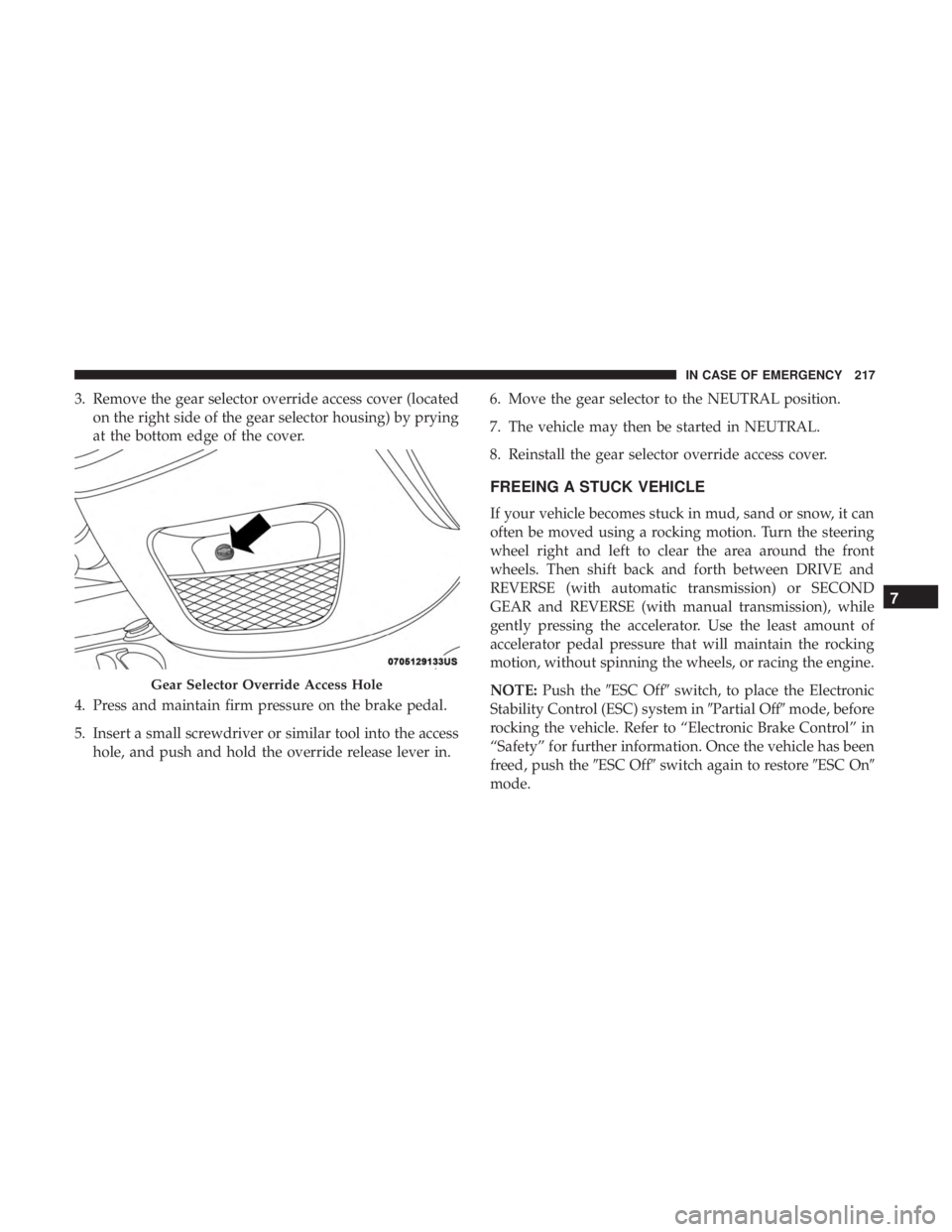
3. Remove the gear selector override access cover (locatedon the right side of the gear selector housing) by prying
at the bottom edge of the cover.
4. Press and maintain firm pressure on the brake pedal.
5. Insert a small screwdriver or similar tool into the access hole, and push and hold the override release lever in. 6. Move the gear selector to the NEUTRAL position.
7. The vehicle may then be started in NEUTRAL.
8. Reinstall the gear selector override access cover.
FREEING A STUCK VEHICLE
If your vehicle becomes stuck in mud, sand or snow, it can
often be moved using a rocking motion. Turn the steering
wheel right and left to clear the area around the front
wheels. Then shift back and forth between DRIVE and
REVERSE (with automatic transmission) or SECOND
GEAR and REVERSE (with manual transmission), while
gently pressing the accelerator. Use the least amount of
accelerator pedal pressure that will maintain the rocking
motion, without spinning the wheels, or racing the engine.
NOTE:
Push the �ESC Off� switch, to place the Electronic
Stability Control (ESC) system in �Partial Off�mode, before
rocking the vehicle. Refer to “Electronic Brake Control” in
“Safety” for further information. Once the vehicle has been
freed, push the �ESC Off�switch again to restore �ESC On�
mode.
Gear Selector Override Access Hole
7
IN CASE OF EMERGENCY 217
Page 220 of 332

WARNING!
Fast spinning tires can be dangerous. Forces generated
by excessive wheel speeds may cause damage, or even
failure, of the axle and tires. A tire could explode and
injure someone. Do not spin your vehicle’s wheels
faster than 30 mph (48 km/h) or for longer than 30
seconds continuously without stopping when you are
stuck and do not let anyone near a spinning wheel, no
matter what the speed.
CAUTION!
•Racing the engine or spinning the wheels may lead
to transmission overheating and failure. Allow the
engine to idle with the transmission in NEUTRAL
(Continued)
CAUTION! (Continued)
for at least one minute after every five rocking-
motion cycles. This will minimize overheating and
reduce the risk of clutch or transmission failure
during prolonged efforts to free a stuck vehicle.
• When “rocking” a stuck vehicle by shifting between
DRIVE/SECOND GEAR and REVERSE, do not spin
the wheels faster than 15 mph (24 km/h), or drive-
train damage may result.
• Revving the engine or spinning the wheels too fast
may lead to transmission overheating and failure. It
can also damage the tires. Do not spin the wheels
above 30 mph (48 km/h) while in gear (no transmis-
sion shifting occurring).
218 IN CASE OF EMERGENCY
Page 222 of 332

CAUTION!(Continued)
•When securing the vehicle to a flat bed truck, do not
attach to front or rear suspension components. Dam-
age to your vehicle may result from improper towing.
Automatic Transmission
• Vehicle can be towed with the front wheels elevated.
• Vehicle can be towed on a flatbed truck (all wheels off
the ground).
If the ignition key is unavailable, or the vehicle’s battery is
discharged, refer to “Gear Selector Override” in this section
for instructions on shifting the transmission out of PARK in
order to move the vehicle.
CAUTION!
• DO NOT flat tow any vehicle equipped with an
automatic transmission. Damage to the drivetrain
will result. If these vehicles require towing, make
sure all drive wheels are OFF the ground.
(Continued)
CAUTION! (Continued)
•Towing this vehicle in violation of the above require-
ments can cause severe transmission damage. Dam-
age from improper towing is not covered under the
New Vehicle Limited Warranty.
Manual Transmission
• Vehicle can be flat towed (all four wheels on the ground)
with the transmission in NEUTRAL.
• Vehicle can be towed with the front wheels elevated.
• Vehicle can be towed on a flatbed truck (all wheels off
the ground).
CAUTION!
Towing this vehicle in violation of the above require-
ments can cause severe engine and/or transmission
damage. Damage from improper towing is not covered
under the New Vehicle Limited Warranty.
220 IN CASE OF EMERGENCY
Page 225 of 332

SERVICING AND MAINTENANCE
CONTENTS
�SCHEDULED SERVICING .................225
▫ Maintenance Plan ...................... .226
� ENGINE COMPARTMENT — 1.4L TURBO .....229
▫ Checking Oil Level .....................230
▫ Adding Washer Fluid ...................230
▫ Maintenance-Free Battery .................231
� DEALER SERVICE ...................... .232
▫ Engine Oil .......................... .232
▫ Engine Oil Filter ...................... .234
▫ Engine Air Cleaner Filter .................234
▫ Air Conditioner Maintenance ..............235
▫ Body Lubrication ..................... .238
▫ Windshield Wiper Blades .................239
▫ Exhaust System ....................... .241▫
Cooling System ....................... .242
▫ Brake System ........................ .247
▫ Manual Transmission — If Equipped ........248
▫ Automatic Transmission — If Equipped ......248
� RAISING THE VEHICLE ..................250
� TIRES ............................... .250
▫ Tire Safety Information ..................250
▫ Tires — General Information ..............258
▫ Tire Types ........................... .264
▫ Spare Tires — If Equipped ................265
▫ Wheel And Wheel Trim Care ..............268
▫ Tire Chains (Traction Devices) .............269
▫ T
ire Rotation Recommendations ............270
8
Page 227 of 332

SCHEDULED SERVICING
Your vehicle is equipped with an automatic oil change
indicator system. The oil change indicator system will
remind you that it is time to take your vehicle in for
scheduled maintenance.
Based on engine operation conditions, the oil change
indicator message will illuminate. This means that service
is required for your vehicle. Operating conditions such as
frequent short-trips, trailer tow, extremely hot or cold
ambient temperatures, and E85 fuel usage will influence
when the “Change Oil” message is displayed. Severe
operating conditions can cause the change oil message to
illuminate as early as 3,500 miles (5,600 km) since last reset.
Have your vehicle serviced as soon as possible, within the
next 500 miles (805 km).Your authorized dealer will reset the oil change indicator
message after completing the scheduled oil change. If a
scheduled oil change is performed by someone other than
your authorized dealer, the message can be reset by
referring to the steps described under “Instrument Cluster
Display” in “Getting To Know Your Instrument Panel” for
further information.
NOTE:
Under no circumstances should oil change inter-
vals exceed 10,000 miles (16,000 km), twelve months or 350
hours of engine run time, whichever comes first. The 350
hours of engine run or idle time is generally only a concern
for fleet customers.
8
SERVICING AND MAINTENANCE 225
Page 228 of 332

Severe Duty All Models
Change Engine Oil at 4,000 miles (6,500 km) if the vehicle
is operated in a dusty and off road environment or is
operated predominately at idle or only very low engine
RPM’s. This type of vehicle use is considered Severe Duty.
Once A Month Or Before A Long Trip:
Check engine oil level.
Check windshield washer fluid level.
Check the tire inflation pressures and look for unusual
wear or damage.
Check the fluid levels of the coolant reservoir and brake
master cylinder as needed.
Check function of all interior and exterior lights.Maintenance Plan
Required Maintenance Intervals
Refer to the Maintenance Plan on the following pages for
required maintenance.
At Every Oil Change Interval As Indicated By OilChange Indicator System:
Change oil and filter.
Rotate the tires. Rotate at the first sign of irregular
wear, even if it occurs before the oil indicator system
turns on.
Inspect battery and clean and tighten terminals as
required.
Inspect brake pads, rotors, and park brake.
Inspect engine cooling system protection and hoses.
Inspect exhaust system.
Inspect engine air cleaner if using in dusty or off-road
conditions.
226 SERVICING AND MAINTENANCE
Page 229 of 332
Mileage or time passed (whichever comes first)
20,000
30,000
40,000
50,000
60,000
70,000
80,000
90,000
100,000
110,000
120,000
130,000
140,000
150,000
Or Years: 2 3 4 5 6 7 8 9 10 11 12 13 14 15
Or Kilometers:
32,000
48,000
64,000
80,000
96,000
112,000
128,000
144,000
160,000
176,000
192,000
208,000
224,000
240,000
Additional Inspections
Inspect the CV joints. XX X XX
Inspect front suspension, tie rod ends, boot seals,
and replace if necessary. XXX X X X X
Inspect brake linings, replace if needed. X X X X X X X
Inspect parking brake function, adjust as necessary. X X X X X X X
Additional Maintenance
Replace cabin/air conditioning filter. X X X X X X X
Clean and lube sun roof tracks. X X X X X X X X X X X X X X
Replace engine air filter. XX X XX
Replace the spark plugs. ** XX X XX
8
SERVICING AND MAINTENANCE 227
Page 230 of 332

Mileage or time passed (whichever comes first)
20,000
30,000
40,000
50,000
60,000
70,000
80,000
90,000
100,000
110,000
120,000
130,000
140,000
150,000
Or Years: 2 3 4 5 6 7 8 9 10 11 12 13 14 15
Or Kilometers:
32,000
48,000
64,000
80,000
96,000
112,000
128,000
144,000
160,000
176,000
192,000
208,000
224,000
240,000
Flush and replace the engine coolant at 10 years or
150,000 miles (240,000 km) whichever comes first. XX
Inspect and replace PCV valve if necessary. X
Replace accessory drive belt and tensioner. X
Replace the timing belt. X
** The spark plug change interval is mileage based only,
yearly intervals do not apply.
WARNING!
•You can be badly injured working on or around a
motor vehicle. Do only service work for which you
have the knowledge and the right equipment. If you
have any doubt about your ability to perform a
service job, take your vehicle to a competent me-
chanic.
(Continued)
WARNING! (Continued)
•Failure to properly inspect and maintain your vehicle
could result in a component malfunction and effect
vehicle handling and performance. This could cause
an accident.
228 SERVICING AND MAINTENANCE
