2019 DODGE CHARGER SRT radiator
[x] Cancel search: radiatorPage 350 of 496
Cooling System
WARNING!
•You or others can be badly burned by hot engine
coolant (antifreeze) or steam from your radiator. If
you see or hear steam coming from under the hood,
do not open the hood until the radiator has had time
to cool. Never open a cooling system pressure cap
when the radiator or coolant bottle is hot.
• Keep hands, tools, clothing, and jewelry away from
the radiator cooling fan when the hood is raised. The
fan starts automatically and may start at any time,
whether the engine is running or not.
• When working near the radiator cooling fan, discon-
nect the fan motor lead or turn the ignition to the
OFF mode. The fan is temperature controlled and can
start at any time the ignition is in the ON mode.
Coolant Checks
Check engine coolant (antifreeze) protection every 12
months (before the onset of freezing weather, where appli-
cable). If the engine coolant (antifreeze) is dirty, the system
should be drained, flushed, and refilled with fresh OAT
coolant (conforming to MS.90032) by an authorized dealer.
Check the front of the radiator for any accumulation of bugs, leaves, etc. If dirty, clean by gently spraying water
from a garden hose vertically down the face of the con-
denser.
Check the coolant recovery bottle tubing for brittle rubber,
cracking, tears, cuts, and tightness of the connection at the
bottle and radiator. Inspect the entire system for leaks. DO
NOT REMOVE THE COOLANT PRESSURE CAP WHEN
THE COOLING SYSTEM IS HOT.
Cooling System — Drain, Flush And Refill
NOTE:
Some vehicles require special tools to add coolant
properly. Failure to fill these systems properly could lead to
severe internal engine damage. If any coolant is needed to
be added to the system please contact an authorized dealer.
If the engine coolant (antifreeze) is dirty or contains visible
sediment, have an authorized dealer clean and flush with
OAT coolant (antifreeze) (conforming to MS.90032).
NOTE: If equipped with the 6.2L Supercharged engine the
intercooler must be vacuum flushed and filled. If any
coolant is needed to be added to the system please contact
an local authorized dealer.
Refer to the “Maintenance Plan” in this section for the
proper maintenance intervals.
348 SERVICING AND MAINTENANCE
Page 351 of 496
Selection Of Coolant
Refer to “Fluids And Lubricants” in “Technical Specifica-
tions” for further information.
NOTE:
•Mixing of engine coolant (antifreeze) other than speci-
fied Organic Additive Technology (OAT) engine coolant
(antifreeze), may result in engine damage and may
decrease corrosion protection. Organic Additive Tech-
nology (OAT) engine coolant is different and should not
be mixed with Hybrid Organic Additive Technology
(HOAT) engine coolant (antifreeze) or any “globally
compatible” coolant (antifreeze). If a non-OAT engine
coolant (antifreeze) is introduced into the cooling system
in an emergency, the cooling system will need to be
drained, flushed, and refilled with fresh OAT coolant
(conforming to MS.90032), by an authorized dealer as
soon as possible.
• Do not use water alone or alcohol-based engine coolant
(antifreeze) products. Do not use additional rust inhibi-
tors or antirust products, as they may not be compatible
with the radiator engine coolant and may plug the
radiator. •
This vehicle has not been designed for use with propyl-
ene glycol-based engine coolant (antifreeze). Use of
propylene glycolbased engine coolant (antifreeze) is not
recommended.
• Some vehicles require special tools to add coolant prop-
erly. Failure to fill these systems properly could lead to
severe internal engine damage. If any coolant is needed
to be added to the system please contact an authorized
dealer.
Adding Coolant
Your vehicle has been built with an improved engine
coolant (OAT coolant conforming to MS.90032) that allows
extended maintenance intervals. This engine coolant (anti-
freeze) can be used up to ten years or 150,000 miles
(240,000 km) before replacement. To prevent reducing this
extended maintenance period, it is important that you use
the same engine coolant (OAT coolant conforming to
MS.90032) throughout the life of your vehicle.
8
SERVICING AND MAINTENANCE 349
Page 353 of 496
Cooling System Pressure Cap
The cap must be fully tightened to prevent loss of engine
coolant (antifreeze), and to ensure that engine coolant
(antifreeze) will return to the radiator from the coolant
expansion bottle/recovery tank if so equipped.
The cap should be inspected and cleaned if there is any
accumulation of foreign material on the sealing surfaces.
NOTE:Be sure you do not mix the engine coolant system
pressure cap with the intercooler system pressure cap.
These caps are not interchangeable.
WARNING!
• Do not open hot engine cooling system. Never add
engine coolant (antifreeze) when the engine is over-
heated. Do not loosen or remove the cap to cool an
overheated engine. Heat causes pressure to build up
in the cooling system. To prevent scalding or injury,
do not remove the pressure cap while the system is
hot or under pressure.
• Do not use a pressure cap other than the one speci-
fied for your vehicle. Personal injury or engine
damage may result.
Disposal Of Used Coolant
Used ethylene glycol-based coolant (antifreeze) is a regu-
lated substance requiring proper disposal. Check with your
local authorities to determine the disposal rules for your
community. To prevent ingestion by animals or children,
do not store ethylene glycol-based coolant in open contain-
ers or allow it to remain in puddles on the ground. If
ingested by a child or pet, seek emergency assistance
immediately. Clean up any ground spills immediately.
Coolant Level
The coolant bottle provides a quick visual method for
determining that the coolant level is adequate. With the
engine OFF and cold, the level of the engine coolant
(antifreeze) in the bottle should be between the ranges
indicated on the bottle.
The radiator normally remains completely full, so there is
no need to remove the radiator/coolant pressure cap
unless checking for engine coolant (antifreeze) freeze point
or replacing coolant. Advise your service attendant of this.
As long as the engine operating temperature is satisfactory,
the coolant bottle need only be checked once a month.
8
SERVICING AND MAINTENANCE 351
Page 354 of 496
When additional engine coolant (antifreeze) is needed to
maintain the proper level, only OAT coolant that meets the
requirements of FCA Material Standard MS.90032 should
be added to the coolant bottle. Do not overfill.
Points To Remember
NOTE:When the vehicle is stopped after a few miles/
kilometers of operation, you may observe vapor coming
from the front of the engine compartment. This is normally
a result of moisture from rain, snow, or high humidity
accumulating on the radiator and being vaporized when
the thermostat opens, allowing hot engine coolant (anti-
freeze) to enter the radiator.
If an examination of your engine compartment shows no
evidence of radiator or hose leaks, the vehicle may be
safely driven. The vapor will soon dissipate.
• Do not overfill the coolant expansion bottle.
• Check the coolant freeze point in the radiator and in the
coolant expansion bottle. If engine coolant (antifreeze)
needs to be added, the contents of the coolant expansion
bottle must also be protected against freezing.
• If frequent engine coolant (antifreeze) additions are
required, the cooling system should be pressure tested
for leaks. •
Maintain engine coolant (antifreeze) concentration at a
minimum of 50% OAT coolant (conforming to
MS.90032) and distilled water for proper corrosion pro-
tection of your engine which contains aluminum com-
ponents.
• Make sure that the coolant expansion bottle overflow
hoses are not kinked or obstructed.
• Keep the front of the radiator clean. If your vehicle is
equipped with air conditioning, keep the front of the
condenser clean.
• Do not change the thermostat for Summer or Winter
operation. If replacement is ever necessary, install ONLY
the correct type thermostat. Other designs may result in
unsatisfactory engine coolant (antifreeze) performance,
poor gas mileage, and increased emissions.
Brake System
In order to assure brake system performance, all brake
system components should be inspected periodically. Refer
to the “Maintenance Plan” in this section for the proper
maintenance intervals.
352 SERVICING AND MAINTENANCE
Page 396 of 496

CAUTION!
•Mixing of engine coolant (antifreeze) other than
specified Organic Additive Technology (OAT) en-
gine coolant (antifreeze), may result in engine dam-
age and may decrease corrosion protection. Organic
Additive Technology (OAT) engine coolant is differ-
ent and should not be mixed with Hybrid Organic
Additive Technology (HOAT) engine coolant (anti-
freeze) or any “globally compatible” coolant (anti-
freeze). If a non-OAT engine coolant (antifreeze) is
introduced into the cooling system in an emergency,
the cooling system will need to be drained, flushed,
(Continued)
CAUTION! (Continued)
and refilled with fresh OAT coolant (conforming to
MS.90032), by an authorized dealer as soon as pos-
sible.
• Do not use water alone or alcohol-based engine
coolant (antifreeze) products. Do not use additional
rust inhibitors or antirust products, as they may not
be compatible with the radiator engine coolant and
may plug the radiator.
• This vehicle has not been designed for use with
propylene glycol-based engine coolant (antifreeze).
Use of propylene glycol-based engine coolant (anti-
freeze) is not recommended.
394 TECHNICAL SPECIFICATIONS
Page 451 of 496
change in increments of 250 RPM. Pressing and holding the
arrows will change the RPM values in increments of 500
RPM, ranging from 2000–6000 RPM (6.2L) and 2000–6250
(6.2L High Output). The Shift Light setup screen may only
be accessed if the feature is enabled. Press the “Reset to
Factory Default” button on the touchscreen to change back
to factory settings, or press the “Shift Light Off” button on
the touchscreen to turn the system off completely.
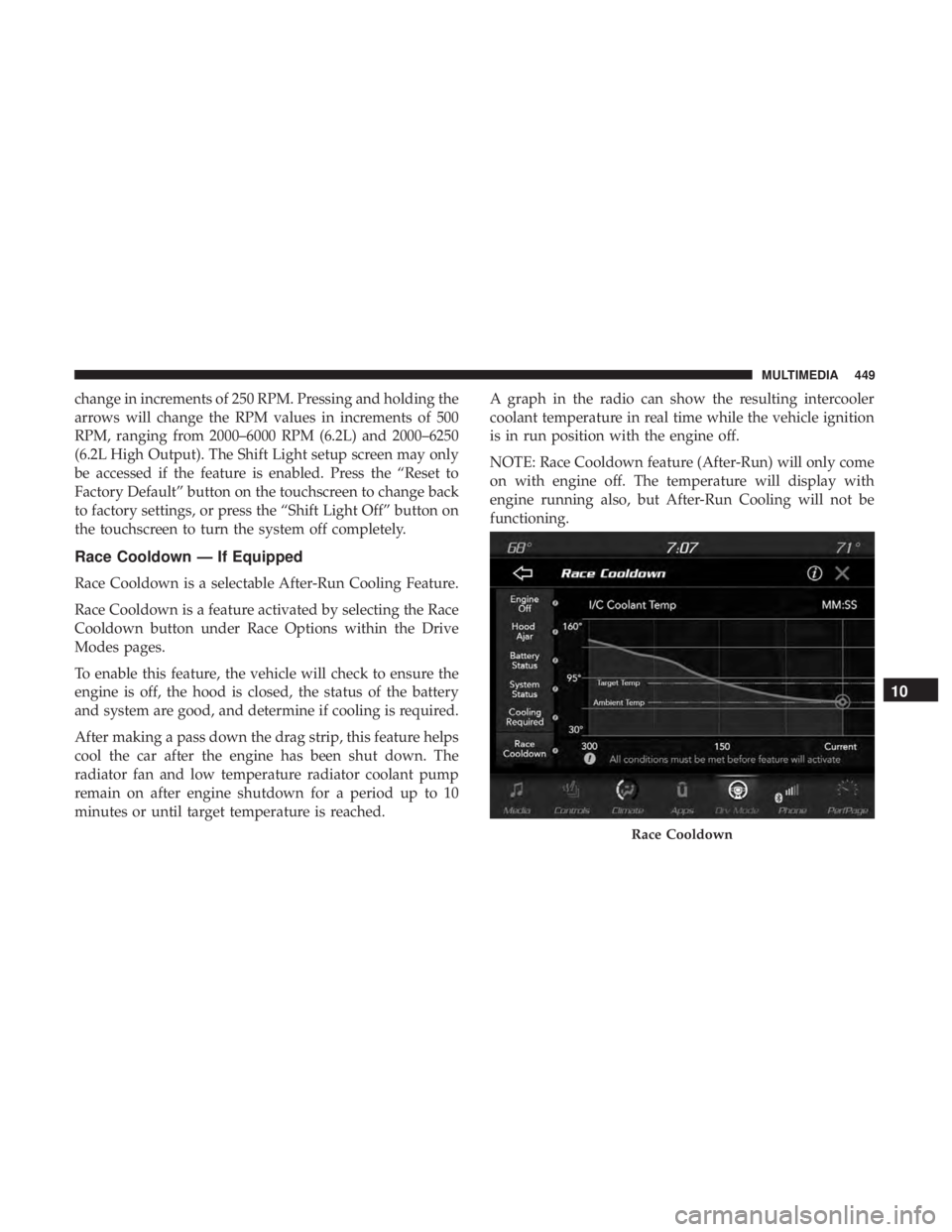
Race Cooldown — If Equipped
Race Cooldown is a selectable After-Run Cooling Feature.
Race Cooldown is a feature activated by selecting the Race
Cooldown button under Race Options within the Drive
Modes pages.
To enable this feature, the vehicle will check to ensure the
engine is off, the hood is closed, the status of the battery
and system are good, and determine if cooling is required.
After making a pass down the drag strip, this feature helps
cool the car after the engine has been shut down. The
radiator fan and low temperature radiator coolant pump
remain on after engine shutdown for a period up to 10
minutes or until target temperature is reached.A graph in the radio can show the resulting intercooler
coolant temperature in real time while the vehicle ignition
is in run position with the engine off.
NOTE: Race Cooldown feature (After-Run) will only come
on with engine off. The temperature will display with
engine running also, but After-Run Cooling will not be
functioning.
Race Cooldown
10
MULTIMEDIA 449
Page 482 of 496
Caps, FillerOil (Engine) ........................ .333, 337
Power Steering ......................... .235
Radiator (Coolant Pressure) .................351
Carbon Monoxide Warning ................204, 392
Cargo Vehicle Loading ......................... .275
Cargo Area Cover ...........................91
Cargo Compartment .........................91
Car Washes .............................. .380
Cellular Phone ........................... .454
Certification Label ......................... .276
Chains, Tire ............................. .376
Changing A Flat Tire ....................... .356
Charging Wireless .............................. .105
Chart, Tire Sizing .......................... .357
Check Engine Light (Malfunction Indicator Light). . . .135
Checking Your Vehicle For Safety ...............204
Checks, Safety ............................ .204
Child Restraint ........................... .189
Child Restraints Booster Seats ........................... .192
Child Seat Installation .....................200
How To Stow An unused ALR Seat Belt ........198Infant And Child Restraints
.................191
Lower Anchors And Tethers For Children .......194
Older Children And Child Restraints ...........191
Seating Positions ........................ .193
Child Safety Locks ..........................42
Clean Air Gasoline ........................ .389
Cleaning Wheels ............................... .375
Climate Control ............................73
Automatic ..............................74
Coin Holder ...............................99
Cold Weather Operation ..................... .216
Compact Spare Tire ........................ .373
Console Floor ..................................99
Contract, Service .......................... .474
Cooling
Pressure Cap (Radiator Cap) ............351
Cooling System ........................... .348
Adding Coolant (Antifreeze) .................349
Coolant Level ....................... .348, 351
Cooling Capacity ........................ .392
Disposal Of Used Coolant ..................351
Drain, Flush, And Refill ....................348
Inspection ............................. .351
Points To Remember ..................... .352
480 INDEX
Page 483 of 496
Pressure Cap........................... .351
Radiator Cap .......................... .351
Selection Of Coolant (Antifreeze) .......349, 392, 393
Corrosion Protection ....................... .379
Cruise Control (Speed Control) ..............236, 239
Cruise Light .......................... .131, 132
Cupholders .............................. .101
Customer Assistance ....................... .472
Cybersecurity ............................ .400
Daytime Running Lights ......................64
Dealer Service ............................ .336
Deck Lid Power Release ...........................89
Defroster, Windshield ....................... .205
Delay (Intermittent) Wipers ....................72
Diagnostic System, Onboard ...................133
Dimmer Switch Headlight ...............................64
Dipsticks Oil (Engine) ........................... .334
Power Steering ......................... .235
Disposal Antifreeze (Engine Coolant) .................351
Do Not Disturb ........................... .467Door Ajar
............................... .124
Door Ajar Light ........................... .124
Door Locks Automatic ..............................42
Child-Protection Door Lock — Rear Doors .......42
Doors ....................................37
Drag And Drop Menu ...................... .399
Drive Modes ............................. .230
Driver ’s Seat Back Tilt ........................43
Driving Through Flowing, Rising, Or Shallow Standing
Water ................................ .279
Electric Brake Control System ..................139
Anti-Lock Brake System ....................138
Electronic Roll Mitigation ...............140, 147
Electric Remote Mirrors .......................61
Electronic Power Distribution Center (Fuses) .......293
Electronic Speed Control (Cruise Control) .........236
Electr
onic Stability Control (ESC) ...............141
Electronic Throttle Control Warning Light .........124
Emergency, In Case Of Freeing Vehicle When Stuck .................323
Hazard Warning Flasher ...................283
Jacking ............................... .356
12
INDEX 481