Page 443 of 718

IN CASE OF EMERGENCY
CONTENTS
�HAZARD WARNING FLASHERS ............443
� ASSIST AND SOS MIRROR — IF EQUIPPED . . . .443
� BULB REPLACEMENT ....................449
▫ Replacement Bulbs ..................... .449
▫ Replacing Exterior Bulbs ..................451
� FUSES ............................... .456
▫ General Information .....................456
▫ Fuse Location ........................ .457
▫ Underhood Fuses ...................... .457
� JACKING AND TIRE CHANGING — IF
EQUIPPED ........................... .466
▫ Jack And Spare Tire Location ..............466
▫ Equipment Removal ....................467 ▫
Preparations For Jacking .................467
▫ Jacking Instructions .....................468
▫ Road Tire Installation ....................474
▫ Portable Air Compressor — If Equipped .......476
▫ Tire Service Kit For Inflating Tire — If
Equipped ........................... .479
▫ Return Inflatable Spare Tire ................484
� TIRE SERVICE KIT — IF EQUIPPED ..........484
� JUMP STARTING ....................... .495
▫ Preparations For Jump Start ...............496
▫ Jump Starting Procedure ..................497
� REFUELING IN EMERGENCY ..............499
� IF YOUR ENGINE OVERHEATS .............499
7
Page 468 of 718
JACKING AND TIRE CHANGING — IF EQUIPPED
WARNING!
•Do not attempt to change a tire on the side of the
vehicle close to moving traffic. Pull far enough off
the road to avoid the danger of being hit when
operating the jack or changing the wheel.
• Being under a jacked-up vehicle is dangerous. The
vehicle could slip off the jack and fall on you. You
could be crushed. Never put any part of your body
under a vehicle that is on a jack. If you need to get
under a raised vehicle, take it to a service center
where it can be raised on a lift.
• The jack is designed to be used as a tool for changing
tires only. The jack should not be used to lift the
vehicle for service purposes. The vehicle should be
jacked on a firm level surface only. Avoid ice or
slippery areas.
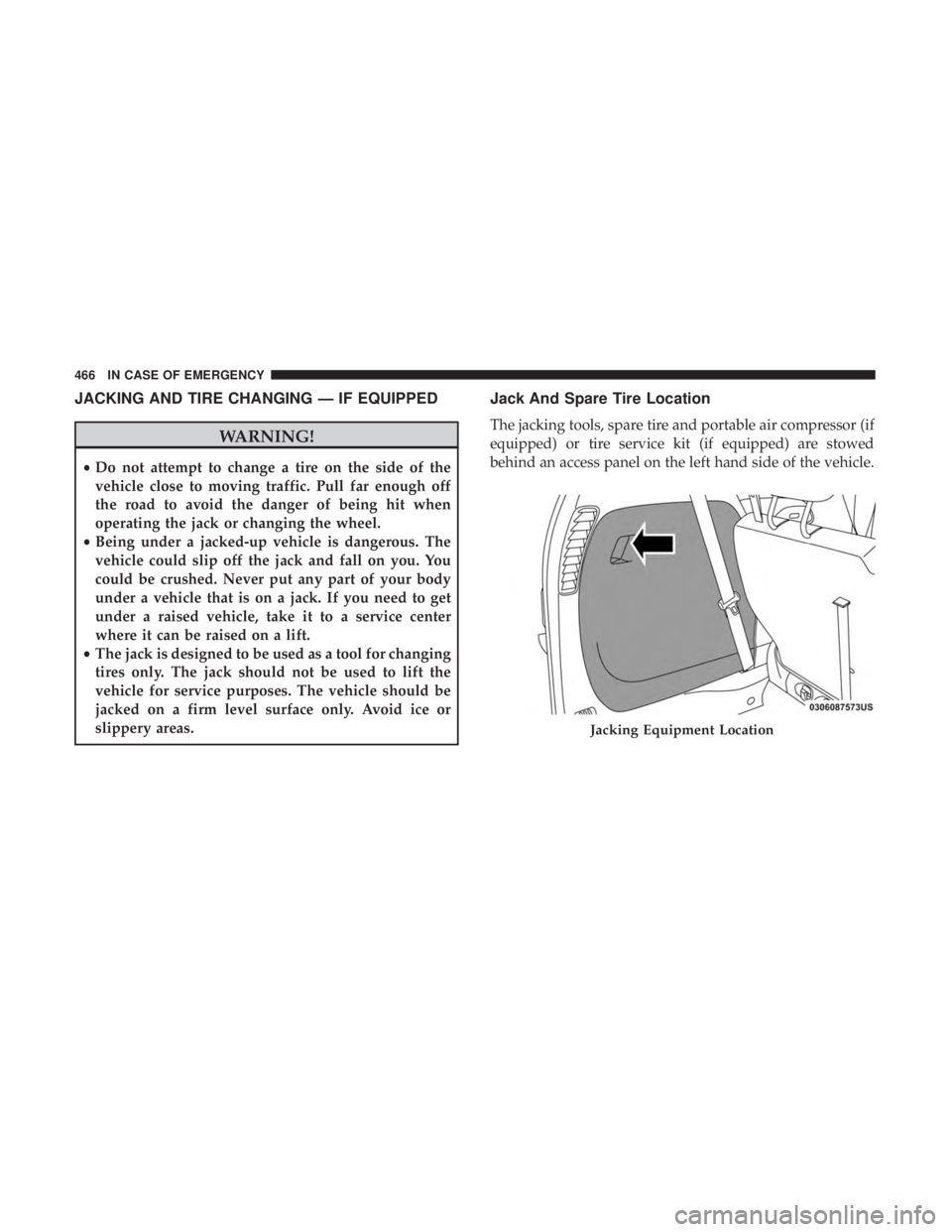
Jack And Spare Tire Location
The jacking tools, spare tire and portable air compressor (if
equipped) or tire service kit (if equipped) are stowed
behind an access panel on the left hand side of the vehicle.
Jacking Equipment Location
466 IN CASE OF EMERGENCY
Page 469 of 718
Equipment Removal
1. Remove the access panel to the jacking equipment.
2. Unlatch the Portable Air Compressor or Tire Service Kitif equipped. Unscrew the wing nut that is holding the
Inflatable Spare Tire and gently remove it from the
storage area. Remove wrench from foam tray. 3. Remove Jack by turning the jack screw counterclockwise
to collapse from storage area that is located behind the
tire.
Preparations For Jacking
1. Park the vehicle on a firm, level surface. Avoid ice orslippery areas.
Jacking Equipment
1 — Inflatable Spare Tire
2 — Tire Service Kit
3 — Wrench
4 — Fuel Filler Funnel
Jack Location
1 — Jack Screw
2 — Jack
7
IN CASE OF EMERGENCY 467
Page 471 of 718
CAUTION!
Do not attempt to raise the vehicle by jacking on
locations other than those indicated in the Jacking
Instructions for this vehicle.
NOTE: Refer to “Tires” in “Servicing And Maintenance �for
information about the inflatable spare tire, its use, and
operation. 1. Loosen (but do not remove) the wheel lug nuts by
turning them to the left one turn while the wheel is still
on the ground.
Jack Warning LabelExtending The Wrench
7
IN CASE OF EMERGENCY 469
Page 474 of 718

CAUTION!
Do not attempt to raise the vehicle by jacking on
locations other than those indicated.
3. Place the wrench on the jack screw and turn to the right until the jack head is properly engaged in the described
location. Do not raise the vehicle until you are sure the
jack is securely engaged.
4. Raise the vehicle by turning the jack screw to the right, using the swivel wrench. Raise the vehicle only until the tire just clears the surface and enough clearance is
obtained to install the compact spare tire. Minimum tire
lift provides maximum stability.
WARNING!
Raising the vehicle higher than necessary can make the
vehicle less stable. It could slip off the jack and hurt
someone near it. Raise the vehicle only enough to
remove the tire.
5. Remove the wheel lug nuts, for vehicles with wheel covers, remove the cover from the wheel by hand. Do
not pry the wheel cover off. Then pull the wheel off the
hub.
6. Install the inflatable spare on the vehicle, located in the rear cargo area of the vehicle.
WARNING!
To avoid the risk of forcing the vehicle off the jack, do
not tighten the wheel nuts fully until the vehicle has
been lowered. Failure to follow this warning may
result in serious injury.
Rear Jack Engaged
472 IN CASE OF EMERGENCY
Page 476 of 718
11. Lower the jack to its fully-closed position.
WARNING!
A loose tire or jack thrown forward in a collision or
hard stop could endanger the occupants of the vehicle.
Always stow the jack parts and the spare tire in the
places provided. Have the deflated (flat) tire repaired
or replaced immediately.
12. Place the deflated (flat) tire and foam tray cover assembly in the rear cargo area. Do not stow the
deflated tire in the inflatable spare tire location. Have
the full-sized tire repaired or replaced, as soon as
possible.
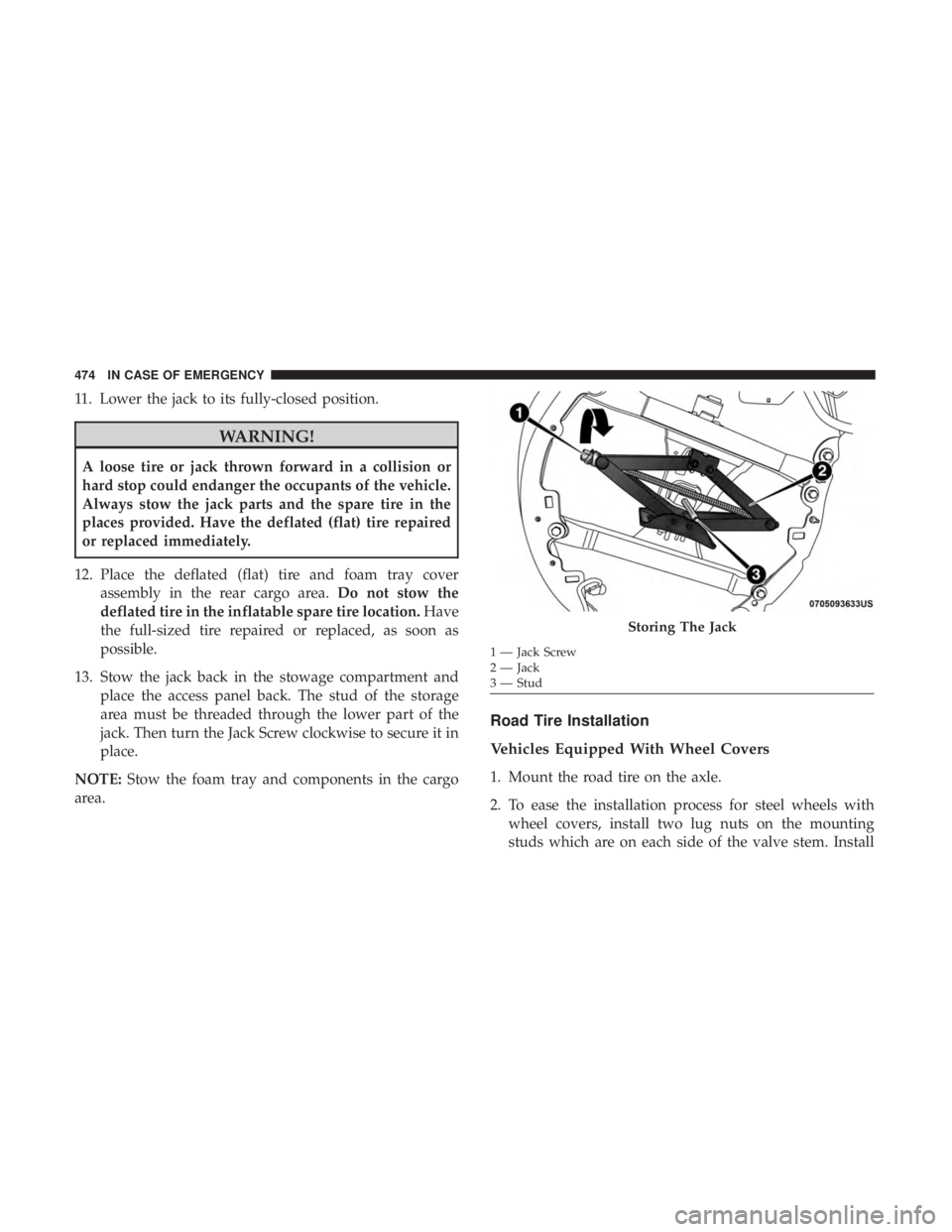
13. Stow the jack back in the stowage compartment and place the access panel back. The stud of the storage
area must be threaded through the lower part of the
jack. Then turn the Jack Screw clockwise to secure it in
place.
NOTE: Stow the foam tray and components in the cargo
area.
Road Tire Installation
Vehicles Equipped With Wheel Covers
1. Mount the road tire on the axle.
2. To ease the installation process for steel wheels with wheel covers, install two lug nuts on the mounting
studs which are on each side of the valve stem. Install
Storing The Jack
1 — Jack Screw
2 — Jack
3 — Stud
474 IN CASE OF EMERGENCY
Page 479 of 718
Portable Air Compressor Usage With Inflatable Spare
Tire
1. Remove the Portable Air Compressor from the storagelocation.
2. Raise the vehicle as described in the Jacking Instructions within this section.
3. Install the Inflatable Spare tire as described in the Jack Instructions section in this manual.
Make sure that the valve stem is
located near the ground, and then
screw the air hose of the Portable Air
Compressor to the valve stem.
Portable Air Compressor
1 — Power Plug
2 — Deflation Button
3 — Pressure Gauge
4 — Power Button
5 — Air Hose
7
IN CASE OF EMERGENCY 477
Page 486 of 718

11. Remove the speed limit label sticker from the TireService Kit and place it on the center
of the steering wheel.
12. Return the Tire Service Kit to the foam tray and secure it with the strap. Store the foam tray in the cargo area.
Return Inflatable Spare Tire
To return Inflatable Spare Tire to its storage location.
1. Return the Jack.
2. Deflate the spare tire. Use the Tire Service Kit or PortableAir Compressor and push the deflation button to do this
step. Refer to “Tire Service Kit” or “Portable Air Com-
pressor” if equipped in this section for additional infor-
mation. The inflatable spare tire will return to its origi-
nal shape. 3. Install the inflatable spare tire back into its original
stowage location and position facing outward.
4. Install the foam tray with wrench and funnel installed.
5. Install and tighten the wing nut by hand.
6. Install the Tire Service Kit or Portable Air Compressor if equipped and tighten the strap.
7. Install access panel door.
TIRE SERVICE KIT — IF EQUIPPED
Your vehicle may be equipped with a Tire Service Kit.
Small punctures up to 1/4 inch (6 mm) in the tire tread can
be sealed with Tire Service Kit. Foreign objects (e.g., screws
or nails) should not be removed from the tire. Tire Service
Kit can be used in outside temperatures down to approxi-
mately -4°F (-20°C). This kit will provide a temporary tire
seal, allowing you to drive your vehicle up to 100 miles
(160 km) with a maximum speed of 50 mph (80 km/h).
484 IN CASE OF EMERGENCY


