2019 Alfa Romeo Giulia child seat
[x] Cancel search: child seatPage 104 of 232

83)Always make sure that the chest section
of the seat belt does not pass under the
arms or behind the back of the child. In the
event of an accident the seat belt will not be
able to secure the child, with the risk of
injury, including fatal injury. Therefore the
child must always wear the seat belt
correctly.
84)Do not use the same lower anchorage to
install more than one child restraint system.
85)If a Universal ISOFIX child seat is not
fixed to all three anchorages, the child seat
will not be able to protect the child correctly.
In a crash, the child could be seriously or
fatally injured.
86)Fit the child restraint system when the
car is stationary. The child restraint system
is correctly fixed to the brackets when you
hear the click. Follow the instructions for
assembly, disassembly and positioning that
the Manufacturer must supply with the child
restraint system.
87)If the vehicle was involved in an accident
of a certain severity, have the ISOFIX
anchorages and the child restraint system
replaced.
88)If the vehicle was involved in an accident
of a certain severity, have both the child
restraint system and the seat belt it was
attached to replaced.SUPPLEMENTARY RESTRAINT
SYSTEM (SRS) - AIRBAG
The vehicle is equipped with:
front driver airbag;
front passenger airbag;
driver and passenger front side bags
for pelvis, chest and shoulder protection
(Side bags);
side bags for head protection of front
seat passengers and rear side seat
passengers (window bag).
The location of the airbags on the vehicle
is marked by the word "AIRBAG" in the
middle of the steering wheel below the
Alfa Romeo emblem, on the dashboard,
on the side trim or on a label placed next
to the airbag deployment area.
FRONT AIRBAGS
The front (driver and passenger) airbags
protect the front seat occupants in the
event of head-on crashes of medium-high
severity, by placing the cushion between
the occupant and the steering wheel or
dashboard.
Therefore non-activation of airbags in
other types of collisions (side impacts,
rear shunts, roll-overs, etc.) does not
indicate a system malfunction.
Driver and passenger front airbags are
not a replacement of but complementary
to the seat belts, which should always be
worn, as specified by law in Europe and
most non-European countries.
In the event of impact, those not wearing
a seat belt are projected forwards and
may come into contact with the bag
which is still inflating. The protection
offered by the bag is compromised in
these circumstances.
Front airbags may not activate in the
following situations:
frontal impacts against highly
deformable objects not involving the
front surface of the vehicle (e.g. wing
collision against guard rail, etc.);
vehicle wedging under other vehicles
or protective barriers (e.g. trucks or
guard rails).
102
SAFETY
Page 105 of 232

Failure to activate in the conditions
described above is due to the fact that
they may not provide any additional
protection compared with seat belts, so
their activation would be inappropriate.
In these cases, non-deployment does not
indicate a system malfunction.
Driver's side front airbag
This consists of an instantly inflating bag
contained in a special compartment in the
centre of the steering wheel fig. 85.Passenger side front airbag
This consists of an instantly inflating bag
contained in a special recess in the
dashboard fig. 86; this bag has a larger
volume than that of the driver's.Passenger side front airbag and child
restraint systems
Rearward facing child restraint systems
mustNEVERbe fitted on the front seat
with an active passenger side airbag
since in the event of an impact the airbag
activation may cause fatal injuries to the
transported child.
ALWAYScomply with the instructions on
the label stuck on the passenger side sun
visor fig. 87, and shown in table fig. 90.
8506106S0001EM
8606106S0002EM
8706106S0003EM
103
Page 115 of 232

carbon-ceramic discs, before using “Drive
Away Release” mode and moving the
vehicle, it is necessary to buckle the seat
belts or manually release the electric
handbrake to prevent damage to the
carbon-ceramic discs themselves.
"Safe Hold": if the vehicle speed is
lower than 2 mph (3 km/h), on vehicles
with automatic transmission, the gear
lever is not in P (Park) position and the
driver's intention of leaving the vehicle is
detected, the electric parking brake will
automatically engage to hold the vehicle
in safety conditions;
"Auto Park Brake": if the vehicle speed
is below 2 mph (3 km/h), the electric
parking break will automatically engage
when the gear lever is in P (Park) position.
The LED on the switch located on the
central tunnel fig. 93 switches on
together with the warning light
on
the instrument panel when the parking
brake is engaged and applied to the
wheels. Each automatic parking brake
engagement can be cancelled by pressing
the switch on the central tunnel and at
the same time moving the gear lever for
the transmission to position P (Park).
SAFE HOLD
It is a safety function that automatically
engages the electric parking brake in the
event of a dangerous condition for the
car.
If:
the car speed is below 2 mph (3 km/h);
on cars with automatic transmission, a
transmission operating mode different
from P (Park) is activated;
the driver's seat belt is not fastened;
the driver side door is open;
no attempts to apply pressure on the
brake pedal have been detected;
the car is parked on roads which
gradient higher than 4%;
the electric parking brake engages
automatically to prevent car movement.
The Safe Hold function can be
temporarily disabled by pressing the
switch located on the central tunnel and
the brake pedal at the same time, with
the vehicle stationary and the driver side
door open.
Once disabled, the function will activate
again when the vehicle speed reaches
18 mph (20 km/h) or the ignition device is
moved to STOP and then to ON.
WARNING
106)In the case of parking manoeuvres on
roads on a gradient, the front wheels must
be steered towards the pavement (when
parking downhill), or in the opposite
direction if the vehicle is parked uphill. Block
the wheels with a wedge or a stone if the car
is parked on a steep slope.
107)Never leave children alone in an
unattended vehicle; make sure that when
you move away from the vehicle, you have
the key with you.
108)The electric parking brake must
always be engaged when leaving the vehicle.
113
Page 223 of 232
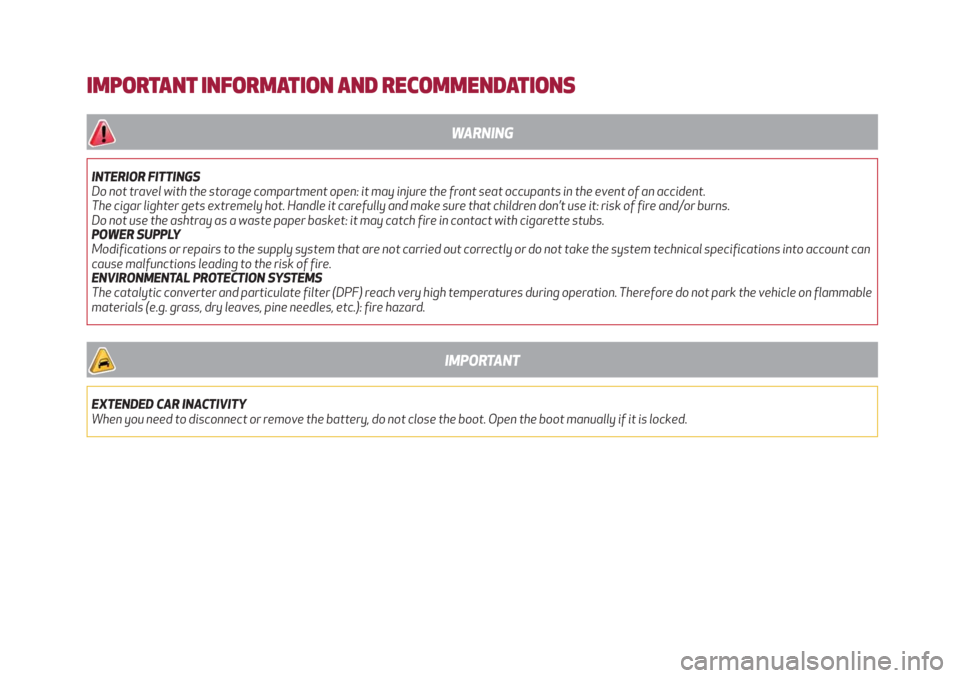
IMPORTANT INFORMATION AND RECOMMENDATIONS
WARNING
INTERIOR FITTINGS
Do not travel with the storage compartment open: it may injure the front seat occupants in the event of an accident.
The cigar lighter gets extremely hot. Handle it carefully and make sure that children don’t use it: risk of fire and/or burns.
Do not use the ashtray as a waste paper basket: it may catch fire in contact with cigarette stubs.
POWER SUPPLY
Modifications or repairs to the supply system that are not carried out correctly or do not take the system technical specifications into account can
cause malfunctions leading to the risk of fire.
ENVIRONMENTAL PROTECTIONSYSTEMS
The catalytic converter and particulate filter (DPF) reach very high temperatures during operation. Therefore do not park the vehicle on flammable
materials (e.g. grass, dry leaves, pine needles, etc.): fire hazard.
IMPORTANT
EXTENDED CAR INACTIVITY
When you need to disconnect or remove the battery, do not close the boot. Open the boot manually if it is locked.
Page 227 of 232

INDEX
ABS (system)................72
Active Cruise Control..........121
Active safety systems...........72
Additive for diesel emissions
AdBlue (UREA)............136
AFS function................28
Airbag
Front airbags.............102
Side airbags..............106
Airbag (SRS supplementary
restraint system)...........102
Alarm system................15
Alfa Connect...............219
Alfa DNA system.............117
ATV (Alfa™ Active Torque
Vectoring) system...........74
Automatic dual-zone climate
control system.............33
Automatic high beam headlights....29
Automatic transmission.........114
Automatic transmission gear lever
unlocking................156
Battery..................171
Battery recharging............173
Bodywork (cleaning and
maintenance).............178
Bonnet....................38
Brakes
brake fluid level............171Broken-down vehicle towing......157
BSM (Blind Spot Monitoring).......75
Carrying children safely.........90
Changing a bulb..............140
Checking levels..............167
Child protection systems.........90
Child safety device.............18
Climate control system..........33
CO2 emissions..............200
Connect system controls........206
Control panel and on-board
instruments...............44
Controls
Controls on steering wheel
summary table............208
Controls on tunnel..........206
Controls
Tunnel control summary table . . .206
Cruise Control...............120
Cybersecurity devices...........3
Daytime running lights (DRL) /
Side lights................27
Dimensions................190
Dipped headlights.............27
Dipped headlights (changing a bulb)......................143
Direction indicators (changing a
bulb)...................144
Display....................46
Doors.....................16
Driving assistance systems.......75DTC (system)................72
Dusk sensor . . ...............27
Electric parking brake..........111
Electric seat heating . . ..........21
Electric steering wheel heating.....24
Electric sunroof..............36
Electric windows..............35
Emergency starting...........154
End of vehicle life.............201
Engine...................183
engine coolant level.........171
Engine compartment..........167
Engine Immobilizer (system).......14
Engine oil
consumption . .............170
level check...............170
ESC (Electronic Stability Control)
system..................72
External lights . . .............26
Fluids and lubricants..........195
Fog lights (bulb replacement).....144
Forward Collision Warning (system).......................77
Front ceiling light..............31
Front fog lights . . .............27
Front light cluster with main
beam/dipped beam halogen
headlights (bulb replacement) . . .143
Front seats (electric adjustment)....19
Front seats (manual adjustments)....19
Page 228 of 232
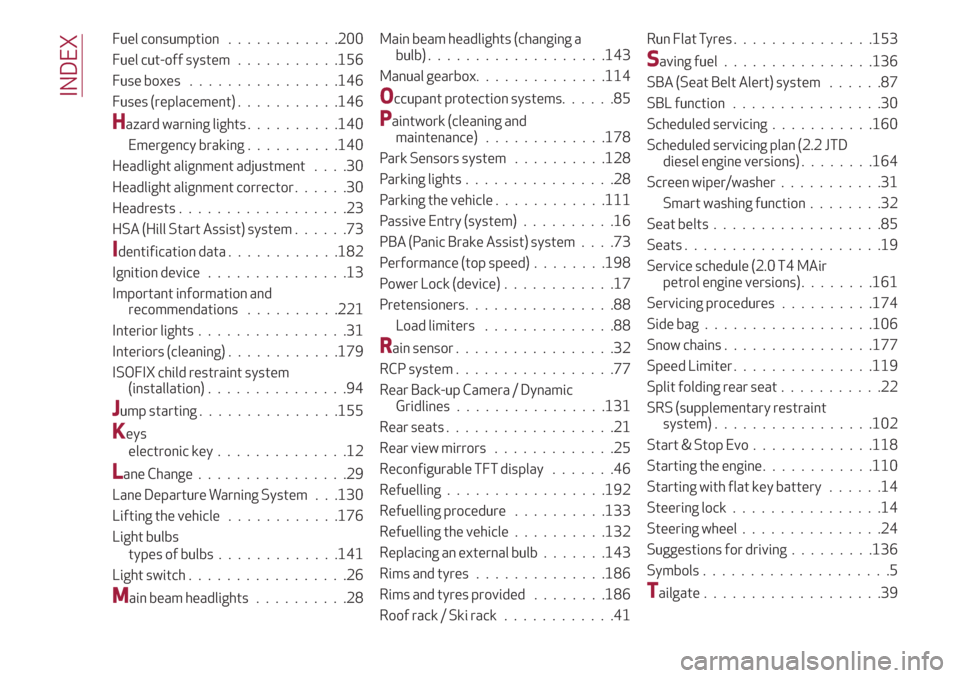
Fuel consumption............200
Fuel cut-off system...........156
Fuse boxes................146
Fuses (replacement)...........146
Hazard warning lights..........140
Emergency braking..........140
Headlight alignment adjustment....30
Headlight alignment corrector......30
Headrests..................23
HSA (Hill Start Assist) system......73
Identification data............182
Ignition device...............13
Important information and
recommendations..........221
Interior lights................31
Interiors (cleaning)............179
ISOFIX child restraint system
(installation)...............94
Jump starting...............155
Keys
electronic key..............12
Lane Change................29
Lane Departure Warning System . . .130
Lifting the vehicle............176
Light bulbs
types of bulbs.............141
Light switch.................26
Main beam headlights..........28Main beam headlights (changing a
bulb)...................143
Manual gearbox..............114
Occupant protection systems......85
Paintwork (cleaning and
maintenance).............178
Park Sensors system..........128
Parking lights................28
Parking the vehicle............111
Passive Entry (system)..........16
PBA (Panic Brake Assist) system....73
Performance (top speed)........198
Power Lock (device)............17
Pretensioners................88
Load limiters..............88
Rain sensor.................32
RCP system.................77
Rear Back-up Camera / Dynamic
Gridlines................131
Rear seats..................21
Rear view mirrors.............25
Reconfigurable TFT display.......46
Refuelling.................192
Refuelling procedure..........133
Refuelling the vehicle..........132
Replacing an external bulb.......143
Rims and tyres..............186
Rims and tyres provided........186
Roof rack / Ski rack............41Run Flat Tyres . ..............153
Saving fuel................136
SBA (Seat Belt Alert) system......87
SBL function . . ..............30
Scheduled servicing...........160
Scheduled servicing plan (2.2 JTD
diesel engine versions) . . ......164
Screen wiper/washer...........31
Smart washing function........32
Seat belts..................85
Seats.....................19
Service schedule (2.0 T4 MAir
petrol engine versions) . . ......161
Servicing procedures..........174
Side bag..................106
Snow chains................177
Speed Limiter . ..............119
Split folding rear seat...........22
SRS (supplementary restraint
system).................102
Start & Stop Evo.............118
Starting the engine............110
Starting with flat key battery......14
Steering lock . . ..............14
Steering wheel...............24
Suggestions for driving .........136
Symbols....................5
Tailgate...................39
INDEX