2019 Alfa Romeo Giulia washer fluid
[x] Cancel search: washer fluidPage 174 of 232

remaining on inside the passenger's
compartment;
switch off all roof lights inside the car:
the car is however equipped with a
system which switches all internal lights
off automatically;
do not keep accessories (e.g. Connect
system, hazard warning lights, etc.)
switched on for a long time when the
engine is not running;
before performing any operation on
the electrical system, disconnect the
cable from the negative battery terminal.
IMPORTANT If the charge level remains
under 50% for a long time, the battery is
damaged by sulphation, reducing its
capacity and efficiency at start-up. The
battery is also more prone to the risk of
freezing (already at 14 °F / -10°C).
WARNING
156)Never smoke while working in the
engine compartment: gas and inflammable
vapours may be present, with the risk of fire.
157)Be very careful when working in the
engine compartment when the engine is hot:
you may get burned. Do not get too close to
the radiator cooling fan: the electric fan may
start; danger of injury. Scarves, ties and
other loose clothing might be pulled by
moving parts.158)If the engine oil is being topped up, wait
for the engine to cool down before loosening
the filler cap, particularly for vehicles with
aluminium cap (where provided). WARNING:
risk of burns!
159)The cooling system is pressurised. If
necessary, only replace the plug with
another original or the operation of the
system may be adversely affected. Do not
remove the reservoir plug when the engine is
hot: you risk scalding yourself.
160)Do not travel with the windscreen
washer fluid reservoir empty: the
windscreen washer is essential for
improving visibility. Repeated operation of
the system without fluid could damage or
cause rapid deterioration of some system
components.
161)Some commercial additives for
windscreen washer fluid are flammable. The
engine compartment contains hot
components which may start a fire.
162)Battery fluid is poisonous and
corrosive. Avoid contact with the skin and
eyes. Keep open flames away from the
battery and do not use objects that might
create sparks: risk of explosion and fire.
163)Using the battery with insufficient
fluid irreparably damages the battery and
may cause an explosion.
164)If the vehicle must remain unused for a
long time at a very low temperature, remove
the battery and take it to a warm place, to
avoid freezing.
165)When performing any operation on the
battery or near it, always protect your eyes
with special goggles.
IMPORTANT
65)Be careful not to confuse the various
types of fluids while topping up: they are not
compatible with each other! Topping up with
an unsuitable fluid could severely damage
your vehicle.
66)The oil level must never exceed the MAX
mark.
67)If the MAX mark is exceeded (last notch
on the right turns red) after the top-up, go to
an Alfa Romeo Dealership as soon as
possible to have the oil in excess removed.
68)Do not add oil with specifications other
than those of the oil already in the engine.
69)Use a fluid of the same type as that
already present in the reservoir for any
topping up of the engine cooling system. The
fluid cannot be mixed with other types of
antifreeze fluids. In the event of topping up
with an unsuitable product, under no
circumstances start the engine and contact
an Alfa Romeo Dealership.
70)When you need to disconnect or remove
the battery, do not close the boot. Open the
boot manually if it is locked.
172
SERVICING AND CARE
Page 177 of 232

This function can only be activated within
2 minutes of setting the ignition device
to STOP.
To activate this function, move the lever
upwards (unstable position) for at least
three seconds.
If, after using the function, the ignition
device is set back to ON with the blades
in a position other than rest position (at
the base of the windscreen), they will only
return to rest position following a
command given using the stalk (stalk
upwards, into unstable position) or when
a speed of 3 mph (5 km/h) is exceeded.
Replacing the windscreen wiper blades
Proceed as follows:
raise the wiper arm, press tab
fig. 159 of the attachment spring and
remove the blade from the arm;
fit the new blade, inserting the tab in
the dedicated housing in the arm and
checking that it is locked;
lower the wiper arm onto the
windscreen.
IMPORTANT Do not operate the
windscreen wiper with the blades lifted
from the windscreen.
Windscreen washer
The window washer nozzles are fixed. If
there is no jet of fluid, firstly check that
there is fluid in the reservoir (see
paragraph “Engine compartment” in this
chapter).
Then check that the nozzle holes are not
clogged; use a needle to unblock them if
necessary.
WARNING
168)The air intake system (air cleaner,
rubber hoses, etc.) can be a protection in the
case of blowbacks from the engine. DO NOT
REMOVE this system unless you need to
carry out repair or servicing operations.
Before starting the engine, ensure that the
system has not been removed: failure to
observe this precaution may result in serious
injury.
169)Exhaust emissions are very dangerous,
and may be lethal. They contain carbon
monoxide, a colourless, odourless gas which
can cause fainting and poisoning if inhaled.
170)The exhaust system may reach high
temperatures and may cause a fire if the
vehicle is parked on flammable material. Dry
grass or leaves can also catch fire if they
come into contact with the exhaust system.
Do not park or use the vehicle in a place in
which the exhaust system might come into
contact with flammable material.
IMPORTANT
72)Incorrect servicing of the vehicle or
failure to carry out operations or repairs
(when necessary) may lead to more
expensive repairs, damage to other
components or have a negative impact on
the vehicle performance. Have any
malfunction inspected immediately by an
Alfa Romeo Dealership.
15809046S0001EM
15909046S0002EM
175
Page 181 of 232

83)Avoid washing with rollers and/or
brushes in washing stations. Wash the car
only by hand using neutral pH detergents; dry
it with a wet chamois leather. Abrasive
products and/or polishes should not be used
for cleaning the car. Bird droppings must be
washed off immediately and thoroughly as
the acid they contain is particularly
aggressive. Avoid (if at all possible) parking
the vehicle under trees; remove vegetable
resins immediately as, when dried, it may
only be possible to remove them with
abrasive products and/or polishes, which is
highly inadvisable as they could alter the
typical opaqueness of the paint. Do not use
pure windscreen washer fluid for cleaning
the front windscreen and rear window; dilute
it min. 50% with water. Only use pure screen
washer fluid when strictly necessary due to
outside temperature conditions.
IMPORTANT
7)Detergents pollute the environment. Only
wash your vehicle in areas equipped to
collect and treat wastewater from this type
of activity.
INTERIOR
174) 175) 176)
Periodically check the cleanliness of the
interior, beneath the mats, which could
cause oxidation of the sheet metal.
PLASTIC AND COATED PARTS
84)
Clean interior plastic parts with a damp
cloth (if possible made from microfibre),
and a solution of water and neutral,
non-abrasive detergent.
To clean oily or persistent stains, use
specific products free from solvents and
designed to maintain the original
appearance and colour of the
components.
Remove any dust using a microfibre
cloth, if necessary moistened with water.
The use of paper tissues is not
recommended as these may leave
residues.
WARNING
174)Never use flammable products, such as
petrol ether or rectified petrol to clean the
inside of the car. The electrostatic charges
which are generated by rubbing during the
cleaning operation may cause a fire.
175)Do not keep aerosol cans in the car:
they might explode. Aerosol cans must not
be exposed to a temperature exceeding
50°C. When the vehicle is exposed to
sunlight, the internal temperature can
greatly exceed this value.
176)There must be no obstacles on the
floor underneath the pedals; make sure that
mats are always flat and do not interfere
with the pedals.
177)Do not use aggressive organic
substance such as: gasoline, kerosene, oil,
acetone or solvents.
IMPORTANT
84)Never use alcohol, petrols and
derivatives to clean the dashboard and
instrument panel lens.
179
Page 195 of 232
![Alfa Romeo Giulia 2019 Owners Manual 2.0 T4 MAir 2.2 JTDPrescribed fuels and original
lubricants
Hydraulic brake circuit [UK gal
(litres)]0.2(0.9) 0.2 (0.9)TUTELA BRAKE FLUID
EXTREME HT
Windscreen washer tank [UK gal
(litres)]0.92 (4.2)](/manual-img/27/9392/w960_9392-194.png "Alfa Romeo Giulia 2019 Owners Manual 2.0 T4 MAir 2.2 JTDPrescribed fuels and original
lubricants
Hydraulic brake circuit [UK gal
(litres)]0.2(0.9) 0.2 (0.9)TUTELA BRAKE FLUID
EXTREME HT
Windscreen washer tank [UK gal
(litres)]0.92 (4.2)")
2.0 T4 MAir 2.2 JTDPrescribed fuels and original
lubricants
Hydraulic brake circuit [UK gal
(litres)]0.2(0.9) 0.2 (0.9)TUTELA BRAKE FLUID
EXTREME HT
Windscreen washer tank [UK gal
(litres)]0.92 (4.2) 0.92 (4.2) PETRONAS DURANCE SC 35
Automatic transmission
(2.0 T4 MAir engine) [UK gal
(litres)]2.07 (9.4) (RWD versions) / 2.06
(9.3) (AWD versions)–
TUTELA TRANSMISSION AS 8 Automatic transmission (2.2 JTD
190 HP RWD engine) [UK gal
(litres)]– 2.02 (9.2)
Automatic transmission (2.2 JTD
210 HP AWD engine) [UK gal
(litres)]– 2.0 (9.1)
GETRAG G217 manual
transmission [UK gal (litres)]0.31 (1.4) 0.31 (1.4)TUTELA TRANSMISSION
GEARSYNTH LV
RDU 230-LSD differential [UK
gal (litres)]0.2 (0.9) 0.2 (0.9)
TUTELA TRANSMISSION LS
AXLE FLUID RDU 210-eLSD differential
(where provided) [UK gal (litres)]0.31 (1.4) 0.31 (1.4)
RDU 210/215-LSD differential
[UK gal (litres)]0.24 (1.1) 0.24 (1.1)
193
Page 199 of 232
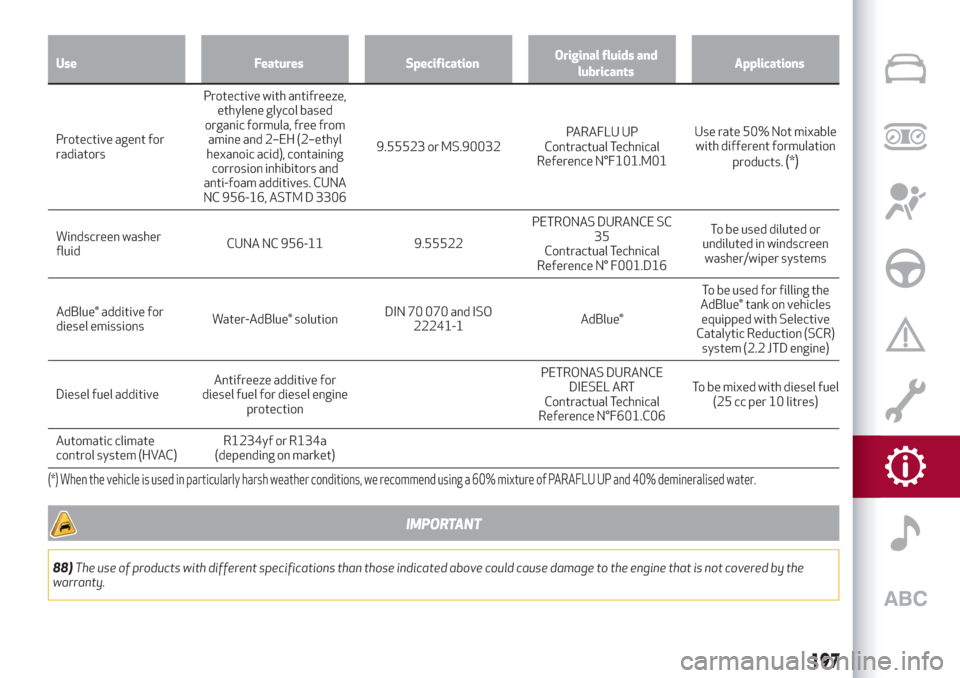
Use Features SpecificationOriginal fluids and
lubricantsApplications
Protective agent for
radiatorsP
rotective with antifreeze,
ethylene glycol based
organic formula, free from
amine and 2–EH (2–ethyl
hexanoic acid), containing
corrosion inhibitors and
anti-foam additives. CUNA
NC 956-16, ASTM D 33069.55523 or MS.90032PARAFLU UP
Contractual Technical
Reference N°F101.M01Use rate 50% Not mixable
with different formulation
products.
(*)
Windscreen washer
fluidCUNA NC 956-11 9.55522PETRONAS DURANCE SC
35
Contractual Technical
Reference N° F001.D16To be used diluted or
undiluted in windscreen
washer/wiper systems
AdBlue® additive for
diesel emissionsWater-AdBlue® solutionDIN 70 070 and ISO
22241-1AdBlue®To be used for filling the
AdBlue® tank on vehicles
equipped with Selective
Catalytic Reduction (SCR)
system (2.2 JTD engine)
Diesel fuel additiveAntifreeze additive for
diesel fuel for diesel engine
protectionPETRONAS DURANCE
DIESEL ART
Contractual Technical
Reference N°F601.C06To be mixed with diesel fuel
(25 cc per 10 litres)
Automatic climate
control system (HVAC)R1234yf or R134a
(depending on market)
(*) When the vehicle is used in particularly harsh weather conditions, we recommend using a 60% mixture of PARAFLU UP and 40% demineralised water.
IMPORTANT
88)The use of products with different specifications than those indicated above could cause damage to the engine that is not covered by the
warranty.
197
Page 229 of 232

TC (Traction Control) system.......73
The keys . ..................12
Tire Repair Kit...............151
Topping up AdBlue® diesel
emissions additive..........133
Towing the vehicle............157
Towing trailers..............138
TPMS (Tyre Pressure Monitoring
System)..................82
Tyres (inflation pressure)........188
Use of the Owner Handbook.......4
Vehicle changes/alterations.......5
Vehicle identification number.....182
Warning lights and messages......51
Washer fluid for
windscreen/headlights........171
Weights..................191
Wheels...................186
Wheels and tyres.............177
Window bag................106
Windscreen wiper .............31
replacing blades............175
Xenon gas discharge headlights
(bulb replacement)..........145