2018 YAMAHA XMAX 300 Tire
[x] Cancel search: TirePage 5 of 116

Table of contents
Safety information............................1-1
Further safe-riding points ................1-5
Description........................................2-1
Left view ..........................................2-1
Right view........................................2-2
Controls and instruments ................2-3
Smart key system ............................3-1
Smart key system............................3-1
Operating range of the smart key
system .........................................3-2
Handling of the smart key and
mechanical keys ..........................3-3
Smart key ........................................3-5
Replacing the smart key battery .....3-6
Main switch .....................................3-8
Instrument and control functions....4-1
Indicator lights and warning
lights ............................................4-1
Speedometer...................................4-2
Tachometer .....................................4-3
Multi-function display......................4-3
Handlebar switches.......................4-12
Front brake lever ...........................4-13
Rear brake lever ............................4-14
ABS ...............................................4-14
Traction control system.................4-15
Fuel tank cap.................................4-17
Fuel................................................4-18
Fuel tank overflow hose ................4-19
Catalytic converters .....................4-20
Storage compartments .................4-20
Windshield.....................................4-22
Handlebar position .......................4-25
Adjusting the shock absorber
assemblies .................................4-25
Sidestand ......................................4-26
Ignition circuit cut-off system........4-27
Auxiliary DC jack ..........................4-29For your safety – pre-operation
checks............................................... 5-1
Operation and important riding
points................................................. 6-1
Starting the engine.......................... 6-2
Starting off ...................................... 6-3
Acceleration and deceleration ........ 6-3
Braking............................................ 6-4
Tips for reducing fuel
consumption................................ 6-5
Engine break-in ............................... 6-5
Parking ............................................ 6-6
Periodic maintenance and
adjustment........................................ 7-1
Owner’s tool kit ............................... 7-2
Periodic maintenance chart for the
emission control system.............. 7-3
General maintenance and
lubrication chart........................... 7-4
Removing and installing the
panel ............................................ 7-7
Checking the spark plug ................. 7-8
Canister........................................... 7-9
Engine oil and oil filter element ....... 7-9
Final transmission oil .................... 7-12
Coolant ......................................... 7-13
Air filter and V-belt case air filter
elements .................................... 7-14
Checking the throttle grip free
play ............................................ 7-18
Valve clearance ............................. 7-19
Tires .............................................. 7-19
Cast wheels .................................. 7-21
Checking the front and rear brake
lever free play ............................ 7-22
Checking the front and rear brake
pads........................................... 7-23
Checking the brake fluid level....... 7-23
Changing the brake fluid............... 7-24
Checking the V-belt ...................... 7-25
Checking and lubricating the
cables ........................................ 7-25
Checking and lubricating the
throttle grip and cable ............... 7-26
UBY3E0E0.book Page 1 Friday, September 15, 2017 3:59 PM
Page 9 of 116

Safety information
1-3
1 engine exhaust. Deadly levels of car-
bon monoxide can collect rapidly and
you can quickly be overcome and un-
able to save yourself. Also, deadly lev-
els of carbon monoxide can linger for
hours or days in enclosed or poorly
ventilated areas. If you experience any
symptoms of carbon monoxide poi-
soning, leave the area immediately, get
fresh air, and SEEK MEDICAL TREAT-
MENT.
Do not run engine indoors. Even if
you try to ventilate engine exhaust
with fans or open windows and
doors, carbon monoxide can rap-
idly reach dangerous levels.
Do not run engine in poorly venti-
lated or partially enclosed areas
such as barns, garages, or car-
ports.
Do not run engine outdoors where
engine exhaust can be drawn into
a building through openings such
as windows and doors.
Loading
Adding accessories or cargo to your
scooter can adversely affect stability
and handling if the weight distribution
of the scooter is changed. To avoid the
possibility of an accident, use extreme
caution when adding cargo or acces-
sories to your scooter. Use extra care
when riding a scooter that has added
cargo or accessories. Here, along with
the information about accessories be-
low, are some general guidelines to fol-
low if loading cargo to your scooter:The total weight of the operator, pas-
senger, accessories and cargo must
not exceed the maximum load limit.
Operation of an overloaded vehicle
could cause an accident.
When loading within this weight limit,
keep the following in mind:
Cargo and accessory weight
should be kept as low and close to
the scooter as possible. Securely
pack your heaviest items as close
to the center of the vehicle as pos-
sible and make sure to distribute
the weight as evenly as possible
on both sides of the scooter to
minimize imbalance or instability.
Shifting weights can create a sud-
den imbalance. Make sure that
accessories and cargo are se-
curely attached to the scooter be-
fore riding. Check accessory
mounts and cargo restraints fre-
quently.
• Properly adjust the suspension
for your load (suspension-ad-
justable models only), and
check the condition and pres-
sure of your tires.
• Never attach any large or heavy
items to the handlebar, front
fork, or front fender. Such items
can create unstable handling or
a slow steering response.
This vehicle is not designed to
pull a trailer or to be attached to
a sidecar.
Maximum load:
161 kg (355 lb)
UBY3E0E0.book Page 3 Friday, September 15, 2017 3:59 PM
Page 11 of 116

Safety information
1-5
1 Aftermarket Tires and Rims
The tires and rims that came with your
scooter were designed to match the
performance capabilities and to pro-
vide the best combination of handling,
braking, and comfort. Other tires, rims,
sizes, and combinations may not be
appropriate. Refer to page 7-19 for tire
specifications and more information on
replacing your tires.
Transporting the Scooter
Be sure to observe following instruc-
tions before transporting the scooter in
another vehicle.
Remove all loose items from the
scooter.
Point the front wheel straight
ahead on the trailer or in the truck
bed, and choke it in a rail to pre-
vent movement.
Secure the scooter with tie-downs
or suitable straps that are at-
tached to solid parts of the scoot-
er, such as the frame or upper
front fork triple clamp (and not, for
example, to rubber-mounted han-
dlebars or turn signals, or parts
that could break). Choose the lo-
cation for the straps carefully so
the straps will not rub against
painted surfaces during transport.
The suspension should be com-
pressed somewhat by the tie-
downs, if possible, so that the
scooter will not bounce exces-
sively during transport.
EAU57600
Further safe-riding points
Be sure to signal clearly when
making turns.
Braking can be extremely difficult
on a wet road. Avoid hard braking,
because the scooter could slide.
Apply the brakes slowly when
stopping on a wet surface.
Slow down as you approach a
corner or turn. Once you have
completed a turn, accelerate
slowly.
Be careful when passing parked
cars. A driver might not see you
and open a door in your path.
Railroad crossings, streetcar rails,
iron plates on road construction
sites, and manhole covers be-
come extremely slippery when
wet. Slow down and cross them
with caution. Keep the scooter up-
right, otherwise it could slide out
from under you.
The brake pads or linings could
get wet when you wash the scoot-
er. After washing the scooter,
check the brakes before riding.
Always wear a helmet, gloves,
trousers (tapered around the cuff
and ankle so they do not flap), and
a brightly colored jacket.
Do not carry too much luggage on
the scooter. An overloaded scoot-
er is unstable. Use a strong cord
to secure any luggage to the carri-
er (if equipped). A loose load will
affect the stability of the scooter
and could divert your attention
from the road. (See page 1-3.)
UBY3E0E0.book Page 5 Friday, September 15, 2017 3:59 PM
Page 18 of 116
Smart key system
3-4
3Included with the vehicle is one smart
key, two mechanical keys, and one
identification number card. The identi-
fication number can also be found on
the inside of the smart key itself.
If the vehicle battery is discharged, the
mechanical key can be used to open
the seat. Carry one mechanical key
in addition to the smart key.
If the smart key is lost or the smart key
battery has discharged, the identifica-
tion number can be used to operate
the vehicle in emergency mode. (See
page 7-38.) Write down the identifi-
cation number in case of emergen-
cy.
If the smart key is lost and the smart
key system identification number is un-
known, the entire smart key system will
need to be replaced at considerable
cost. Keep the identification number
card in a safe place.
NOTICE
ECA21573
The smart key has precision elec-
tronic components. Observe the fol-
lowing precautions to prevent
possible malfunction or damage.
Do not place or store the smart
key in a storage compartment.
The smart key may be damaged
from road vibrations or exces-
sive heat.
Do not drop, bend, or subject
the smart key to strong impacts.
Do not submerge the smart key
in water or other liquids.
Do not place heavy items or ex-
cessive stress on the smart key.Do not leave the smart key in a
place exposed to direct sun-
light, high temperature or high
humidity.
Do not grind or attempt to mod-
ify the smart key.
Keep the smart key away from
strong magnetic fields and
magnetic objects such as key
hold
ers, TVs, and computers.
Keep the smart key away from
electric medical equipment.
Do not allow oils, polishing
agents, fuel, or any strong
chemicals to come in contact
with the smart key. The smart
key body may become discol-
ored or cracked.
TIP
The smart key battery life is ap-
proximately two years, but this
may vary according to operating
conditions.
Replace the smart key battery
when the smart key system indi-
cator light flashes for 20 seconds
when the vehicle is turned on, or
when the smart key indicator light
does not come on when the smart
key button is pushed. (See page
3-6.) After changing the smart key
battery, if the smart key system
still does not operate, check the
vehicle battery and then have a
Yamaha dealer check the vehicle.
If the smart key continually re-
ceives radio waves, the smart key
battery will discharge quickly. (For
example, when placed in the vicin-
ity of electrical products such as
televisions, radios, or computers.)
UBY3E0E0.book Page 4 Friday, September 15, 2017 3:59 PM
Page 42 of 116

Instrument and control functions
4-16
4When the vehicle is turned on, traction
control is automatically turned on.
To turn the traction control system off,
use the “INFO” switch to change the
information display to the traction con-
trol system display. Then push the “IN-
FO” switch for three seconds. The
display will show “TCSOFF” , and the
“TCS” indicator light will come on.
TIP
Turn the traction control system off to
help free the rear wheel if the vehicle
gets stuck in mud, sand, or other soft
surfaces.
NOTICE
ECA16801
Use only the specified tires. (See
page 7-19.) Using different sized
tires will prevent the traction control
system from controlling tire rotation
accurately.
Resetting the traction control sys-
tem
The traction control system will auto-
matically disable under certain condi-
tions; such as when a sensor fault is
detected, or when only one wheel is al-
lowed to rotate for more than a fewseconds. Should this happen, the “ ”
indicator light will come on, and possi-
bly the “ ” warning light, too.
TIP
When the vehicle is on the centerstand,
do not rev the engine for an extended
period of time. Otherwise, the traction
control system will automatically dis-
able and need to be reset.
If the traction control system automat-
ically disables, try resetting it as fol-
lows.
1. Stop the vehicle and turn it off
completely.
2. Wait a few seconds and then turn
the vehicle power on.
3. The Ž indicator light should
turn off and the system be en-
abled.
TIP
If the Ž indicator light remains on af-
ter resetting, the vehicle may still be
ridden; however, have a Yamaha deal-
er check the vehicle as soon as possi-
ble.
4. Have a Yamaha dealer check the
vehicle and turn off the Ž
warning light.
1. Traction control system indicator light Ž
2. Traction control system display
ZAUM1536
12
1. Traction control system indicator light Ž
2. Engine trouble warning light Ž
ZAUM1550
UBY3E0E0.book Page 16 Friday, September 15, 2017 3:59 PM
Page 57 of 116

For your safety – pre-operation checks
5-2
5
Control cables• Make sure that operation is smooth.
• Lubricate if necessary.7-25
Wheels and tires•Check for damage.
• Check tire condition and tread depth.
• Check air pressure.
• Correct if necessary.7-19,
7-21
Brake levers• Make sure that operation is smooth.
• Lubricate lever pivoting points if necessary.7-26
Centerstand, side-
stand• Make sure that operation is smooth.
• Lubricate pivots if necessary.7-27
Chassis fasteners• Make sure that all nuts, bolts and screws are properly
tightened.
• Tighten if necessary.—
Instruments, lights,
signals and switches• Check operation.
• Correct if necessary.—
Sidestand switch • Check operation of ignition circuit cut-off system.
• If system is not working correctly, have Yamaha dealer
check vehicle.4-26 ITEM CHECKS PAGE
UBY3E0E0.book Page 2 Friday, September 15, 2017 3:59 PM
Page 67 of 116

Periodic maintenance and adjustment
7-4
7
EAU71372
General maintenance and lubrication chart
NO. ITEM
1*Diagnostic system
check• Perform dynamic inspection
using Yamaha diagnostic tool.
• Check the error codes.√√√√√√
2*Air filter element• Replace.√√
3*Pre air filter ele-
ment• Clean.√√
4*Sub air filter ele-
ment• Replace.√√
5Air filter case
check hose• Clean.√√√√√
6*V-belt case air fil-
ter element• Clean.
• Replace if necessary.√√√√√
7*Front brake• Check operation, fluid level,
and for fluid leakage.
• Replace brake pads if neces-
sary.√√√√√√
8*Rear brake• Check operation, fluid level,
and for fluid leakage.
• Replace brake pads if neces-
sary.√√√√√√
9*Brake hoses• Check for cracks or damage.√√√√√
• Replace. Every 4 years
10*Brake fluid• Change. Every 2 years
11*Wheels• Check runout and for damage.
• Replace if necessary.√√√√
12*Tires• Check tread depth and for
damage.
• Replace if necessary.
• Check air pressure.
• Correct if necessary.√√√√√
13*Wheel bearings• Check bearing for looseness or
damage.√√√√X 1000 km CHECK OR
MAINTENANCE JOB
X 1000 mi
ODOMETER
READINGS
ANNUAL CHECK
110203040
0.66121824
UBY3E0E0.book Page 4 Friday, September 15, 2017 3:59 PM
Page 75 of 116
Periodic maintenance and adjustment
7-12
7
EAU20067
Final transmission oil
The final transmission case must be
checked for oil leakage before each
ride. If any leakage is found, have a
Yamaha dealer check and repair the
scooter. In addition, the final transmis-
sion oil must be changed as follows at
the intervals specified in the periodic
maintenance and lubrication chart.
1. Start the engine, warm up the final
transmission oil by riding the
scooter for several minutes, and
then stop the engine.
2. Place the scooter on the center-
stand.
3. Place an oil pan under the final
transmission case to collect the
used oil.
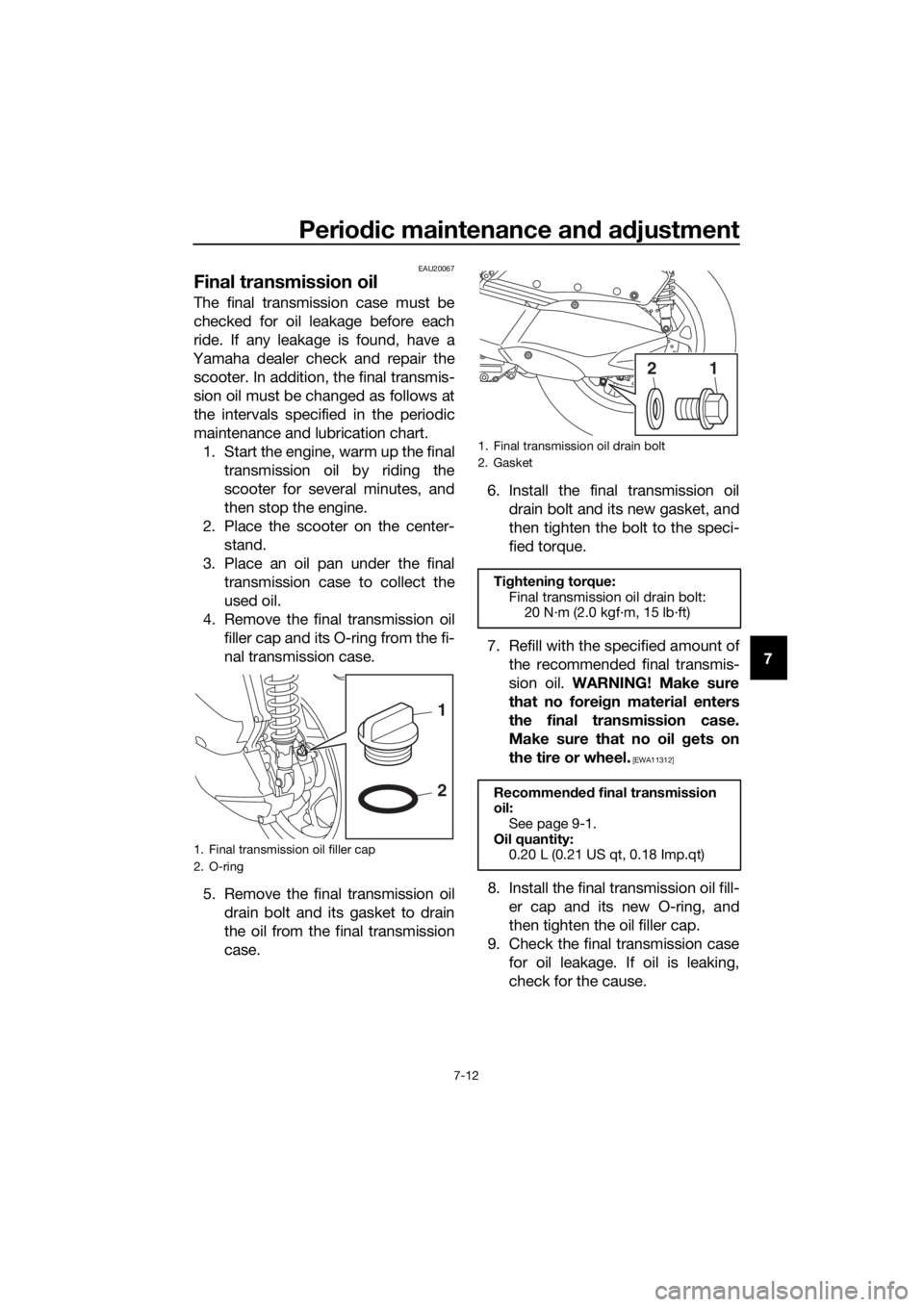
4. Remove the final transmission oil
filler cap and its O-ring from the fi-
nal transmission case.
5. Remove the final transmission oil
drain bolt and its gasket to drain
the oil from the final transmission
case.6. Install the final transmission oil
drain bolt and its new gasket, and
then tighten the bolt to the speci-
fied torque.
7. Refill with the specified amount of
the recommended final transmis-
sion oil. WARNING! Make sure
that no foreign material enters
the final transmission case.
Make sure that no oil gets on
the tire or wheel.
[EWA11312]
8. Install the final transmission oil fill-
er cap and its new O-ring, and
then tighten the oil filler cap.
9. Check the final transmission case
for oil leakage. If oil is leaking,
check for the cause.
1. Final transmission oil filler cap
2. O-ring
1
2
1. Final transmission oil drain bolt
2. Gasket
Tightening torque:
Final transmission oil drain bolt:
20 N·m (2.0 kgf·m, 15 lb·ft)
Recommended final transmission
oil:
See page 9-1.
Oil quantity:
0.20 L (0.21 US qt, 0.18 Imp.qt)
12
UBY3E0E0.book Page 12 Friday, September 15, 2017 3:59 PM