2018 YAMAHA XMAX 300 Tire
[x] Cancel search: TirePage 82 of 116
Periodic maintenance and adjustment
7-19
7
EAU21403
Valve clearance
The valves are an important engine
component, and since valve clearance
changes with use, they must be
checked and adjusted at the intervals
specified in the periodic maintenance
chart. Unadjusted valves can result in
improper air-fuel mixture, engine
noise, and eventually engine damage.
To prevent this from occurring, have
your Yamaha dealer check and adjust
the valve clearance at regular intervals.
TIP
This service must be performed when
the engine is cold.
EAU69760
Tires
Tires are the only contact between the
vehicle and the road. Safety in all con-
ditions of riding depends on a relatively
small area of road contact. Therefore, it
is essential to maintain the tires in good
condition at all times and replace them
at the appropriate time with the speci-
fied tires.
Tire air pressure
The tire air pressure should be
checked and, if necessary, adjusted
before each ride.
WARNING
EWA10504
Operation of this vehicle with im-
proper tire pressure may cause se-
vere injury or death from loss of
control.
The tire air pressure must be
checked and adjusted on cold
tires (i.e., when the temperature
of the tires equals the ambient
temperature).
The tire air pressure must be
adjusted in accordance with the
riding speed and with the total
weight of rider, passenger, car-
go, and accessories approved
for this model.
UBY3E0E0.book Page 19 Friday, September 15, 2017 3:59 PM
Page 83 of 116
Periodic maintenance and adjustment
7-20
7
WARNING
EWA10512
Never overload your vehicle. Opera-
tion of an overloaded vehicle could
cause an accident.
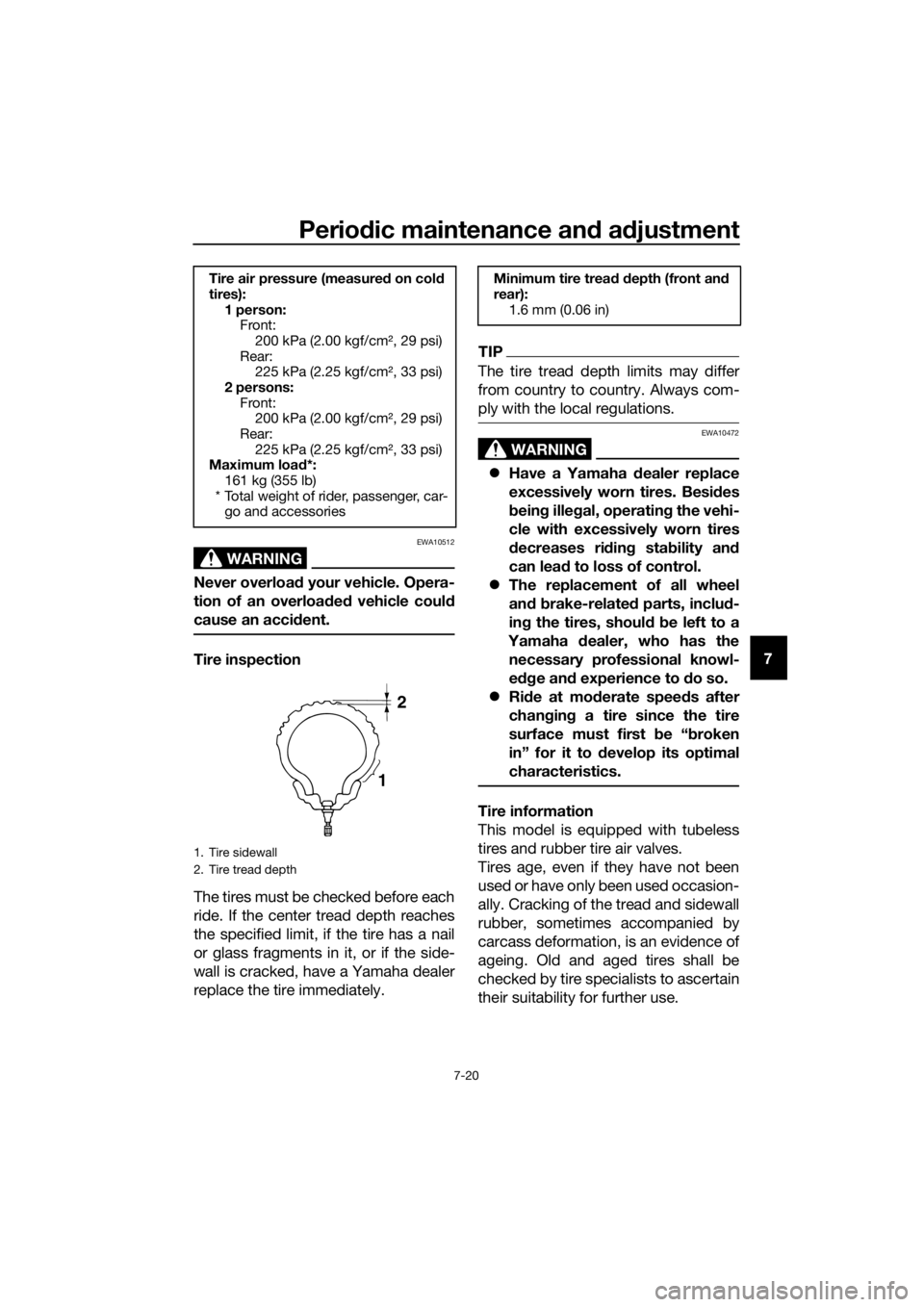
Tire inspection
The tires must be checked before each
ride. If the center tread depth reaches
the specified limit, if the tire has a nail
or glass fragments in it, or if the side-
wall is cracked, have a Yamaha dealer
replace the tire immediately.
TIP
The tire tread depth limits may differ
from country to country. Always com-
ply with the local regulations.
WARNING
EWA10472
Have a Yamaha dealer replace
excessively worn tires. Besides
being illegal, operating the vehi-
cle with excessively worn tires
decreases riding stability and
can lead to loss of control.
The replacement of all wheel
and brake-related parts, includ-
ing the tires, should be left to a
Yamaha dealer, who has the
necessary professional knowl-
edge and experience to do so.
Ride at moderate speeds after
changing a tire since the tire
surface must first be “broken
in” for it to develop its optimal
characteristics.
Tire information
This model is equipped with tubeless
tires and rubber tire air valves.
Tires age, even if they have not been
used or have only been used occasion-
ally. Cracking of the tread and sidewall
rubber, sometimes accompanied by
carcass deformation, is an evidence of
ageing. Old and aged tires shall be
checked by tire specialists to ascertain
their suitability for further use.
Tire air pressure (measured on cold
tires):
1 person:
Front:
200 kPa (2.00 kgf/cm², 29 psi)
Rear:
225 kPa (2.25 kgf/cm², 33 psi)
2 persons:
Front:
200 kPa (2.00 kgf/cm², 29 psi)
Rear:
225 kPa (2.25 kgf/cm², 33 psi)
Maximum load*:
161 kg (355 lb)
* Total weight of rider, passenger, car-
go and accessories
1. Tire sidewall
2. Tire tread depth
12
Minimum tire tread depth (front and
rear):
1.6 mm (0.06 in)
UBY3E0E0.book Page 20 Friday, September 15, 2017 3:59 PM
Page 84 of 116

Periodic maintenance and adjustment
7-21
7
WARNING
EWA10462
The front and rear tires should be of
the same make and design, other-
wise the handling characteristics of
the vehicle may be different, which
could lead to an accident.
After extensive tests, only the tires list-
ed below have been approved for this
model by Yamaha.
EAU21963
Cast wheels
To maximize the performance, durabil-
ity, and safe operation of your vehicle,
note the following points regarding the
specified wheels.
The wheel rims should be
checked for cracks, bends, warp-
age or other damage before each
ride. If any damage is found, have
a Yamaha dealer replace the
wheel. Do not attempt even the
smallest repair to the wheel. A de-
formed or cracked wheel must be
replaced.
The wheel should be balanced
whenever either the tire or wheel
has been changed or replaced. An
unbalanced wheel can result in
poor performance, adverse han-
dling characteristics, and a short-
ened tire life.
Front tire:
Size:
120/70-15 M/C 56S
Manufacturer/model:
MICHELIN/CITY GRIP
Rear tire:
Size:
140/70-14 M/C 68S
Manufacturer/model:
MICHELIN/CITY GRIP
UBY3E0E0.book Page 21 Friday, September 15, 2017 3:59 PM
Page 105 of 116
Scooter care and storage
8-3
8 Cleaning the windshield
Avoid using any alkaline or strong acid
cleaner, gasoline, brake fluid, or any
other solvent. Clean the windshield
with a cloth or sponge dampened with
a neutral detergent, and after cleaning,
thoroughly wash it off with water. For
additional cleaning, use Yamaha Wind-
shield Cleaner or other quality cleaner.
Some cleaning compounds for plastics
may leave scratches on surfaces of the
windshield. Before using them, make a
test by polishing an area which does
not affect your visibility.
After cleaning
1. Dry the scooter with a chamois or
an absorbing cloth.
2. Use a chrome polish to shine
chrome, aluminum and stainless-
steel parts, including the exhaust
system. (Even the thermally in-
duced discoloring of stainless-
steel exhaust systems can be re-
moved through polishing.)
3. To prevent corrosion, it is recom-
mended to apply a corrosion pro-
tection spray on all metal,
including chrome- and nickel-plat-
ed, surfaces.
4. Use spray oil as a universal clean-
er to remove any remaining dirt.
5. Touch up minor paint damage
caused by stones, etc.
6. Wax all painted surfaces.
7. Let the scooter dry completely be-
fore storing or covering it.
WARNING
EWA10943
Contaminants on the brakes or tires
can cause loss of control.Make sure that there is no oil or
wax on the brakes or tires. If
necessary, clean the brake
discs and brake linings with a
regular brake disc cleaner or
acetone, and wash the tires with
warm water and a mild deter-
gent.
Before operating the scooter
test its braking performance
and cornering behavior.
NOTICE
ECAU0022
Apply spray oil and wax spar-
ingly and make sure to wipe off
any excess.
Never apply oil or wax to any
rubber parts, plastic parts or
headlight, taillight and meter
lenses, but treat them with a
suitable care product.
Avoid using abrasive polishing
compounds as they will wear
away the paint.
TIP
Consult a Yamaha dealer for ad-
vice on what products to use.
Washing, rainy weather or humid
climates can cause the headlight
lens to fog. Turning the headlight
on for a short period of time will
help remove the moisture from the
lens.
UBY3E0E0.book Page 3 Friday, September 15, 2017 3:59 PM
Page 106 of 116

Scooter care and storage
8-4
8
EAU36564
Storage
Short-term
Always store your scooter in a cool, dry
place and, if necessary, protect it
against dust with a porous cover. Be
sure the engine and the exhaust sys-
tem are cool before covering the
scooter.
NOTICE
ECA10821
Storing the scooter in a poorly
ventilated room or covering it
with a tarp, while it is still wet,
will allow water and humidity to
seep in and cause rust.
To prevent corrosion, avoid
damp cellars, stables (because
of the presence of ammonia)
and areas where strong chemi-
cals are stored.
Long-term
Before storing your scooter for several
months:
1. Follow all the instructions in the
“Care” section of this chapter.
2. Fill up the fuel tank and add fuel
stabilizer (if available) to prevent
the fuel tank from rusting and the
fuel from deteriorating.
3. Perform the following steps to
protect the cylinder, piston rings,
etc. from corrosion.
a. Remove the spark plug cap
and spark plug.
b. Pour a teaspoonful of engine
oil into the spark plug bore.
c. Install the spark plug cap onto
the spark plug, and then place
the spark plug on the cylinderhead so that the electrodes are
grounded. (This will limit spark-
ing during the next step.)
d. Turn the engine over several
times with the starter. (This will
coat the cylinder wall with oil.)
e. Remove the spark plug cap
from the spark plug, and then
install the spark plug and the
spark plug cap. WARNING! To
prevent damage or injury
from sparking, make sure to
ground the spark plug elec-
trodes while turning the en-
gine over.
[EWA10952]
4. Lubricate all control cables and
the pivoting points of all levers and
pedals as well as of the side-
stand/centerstand.
5. Check and, if necessary, correct
the tire air pressure, and then lift
the scooter so that both of its
wheels are off the ground. Alterna-
tively, turn the wheels a little every
month in order to prevent the tires
from becoming degraded in one
spot.
6. Cover the muffler outlet with a
plastic bag to prevent moisture
from entering it.
7. Remove the battery and fully
charge it. Store it in a cool, dry
place and charge it once a month.
Do not store the battery in an ex-
cessively cold or warm place [less
than 0 °C (30 °F) or more than 30
°C (90 °F)]. For more information
on storing the battery, see page
7-29.
UBY3E0E0.book Page 4 Friday, September 15, 2017 3:59 PM
Page 109 of 116

Specifications
9-2
9
Front tire:
Type:
Tubeless
Size:
120/70-15 M/C 56S
Manufacturer/model:
MICHELIN/CITY GRIP
Rear tire:
Type:
Tubeless
Size:
140/70-14 M/C 68S
Manufacturer/model:
MICHELIN/CITY GRIP
Loading:
Maximum load:
161 kg (355 lb)
(Total weight of rider, passenger, cargo
and accessories)
Tire air pressure (measured on cold
tires):
1 person:
Front:
200 kPa (2.00 kgf/cm², 29 psi)
Rear:
225 kPa (2.25 kgf/cm², 33 psi)
2 persons:
Front:
200 kPa (2.00 kgf/cm², 29 psi)
Rear:
225 kPa (2.25 kgf/cm², 33 psi)
Front wheel:
Wheel type:
Cast wheel
Rim size:
15 x MT3.50
Rear wheel:
Wheel type:
Cast wheel
Rim size:
14 x MT4.00
Front brake:
Type:
Hydraulic single disc brake
Specified brake fluid:
DOT 4
Rear brake:
Type:
Hydraulic single disc brakeSpecified brake fluid:
DOT 4
Front suspension:
Type:
Telescopic fork
Spring:
Coil spring
Shock absorber:
Hydraulic damper
Wheel travel:
110 mm (4.3 in)
Rear suspension:
Type:
Unit swing
Spring:
Coil spring
Shock absorber:
Hydraulic damper
Wheel travel:
79 mm (3.1 in)
Electrical system:
System voltage:
12 V
Ignition system:
TCI
Charging system:
AC magneto
Battery:
Model:
GTZ8V
Voltage, capacity:
12 V, 7.0 Ah (10 HR)
Bulb wattage:
Headlight:
LED
Brake/tail light:
LED
Front turn signal light:
10.0 W × 2
Rear turn signal light:
10.0 W × 2
Auxiliary light:
LED
License plate light:
5.0 W × 1
Meter lighting:
LED
High beam indicator light:
LED
UBY3E0E0.book Page 2 Friday, September 15, 2017 3:59 PM
Page 114 of 116

Index
11-2
11
Throttle grip and cable, checking and
lubricating ........................................... 7-26
Throttle grip free play, checking ........... 7-18
Tires ...................................................... 7-19
Tool kit .................................................... 7-2
Traction control system ........................ 4-15
Traction control system indicator light ... 4-2
TRIP/INFO switch ................................. 4-12
Troubleshooting .................................... 7-35
Troubleshooting charts ......................... 7-36
Turn signal indicator lights ...................... 4-1
Turn signal switch ................................. 4-12
V
Valve clearance..................................... 7-19
V-belt, checking .................................... 7-25
Vehicle identification number ............... 10-1
W
Wheel bearings, checking..................... 7-28
Wheels .................................................. 7-21
Windshield ............................................ 4-22
UBY3E0E0.book Page 2 Friday, September 15, 2017 3:59 PM