2018 YAMAHA AEROX50 warning
[x] Cancel search: warningPage 53 of 78
Periodic maintenance and adjustment
6-18
6 indicator groove has almost disap-
peared, have a Yamaha dealer replace
the brake pads as a set.
EAU22501
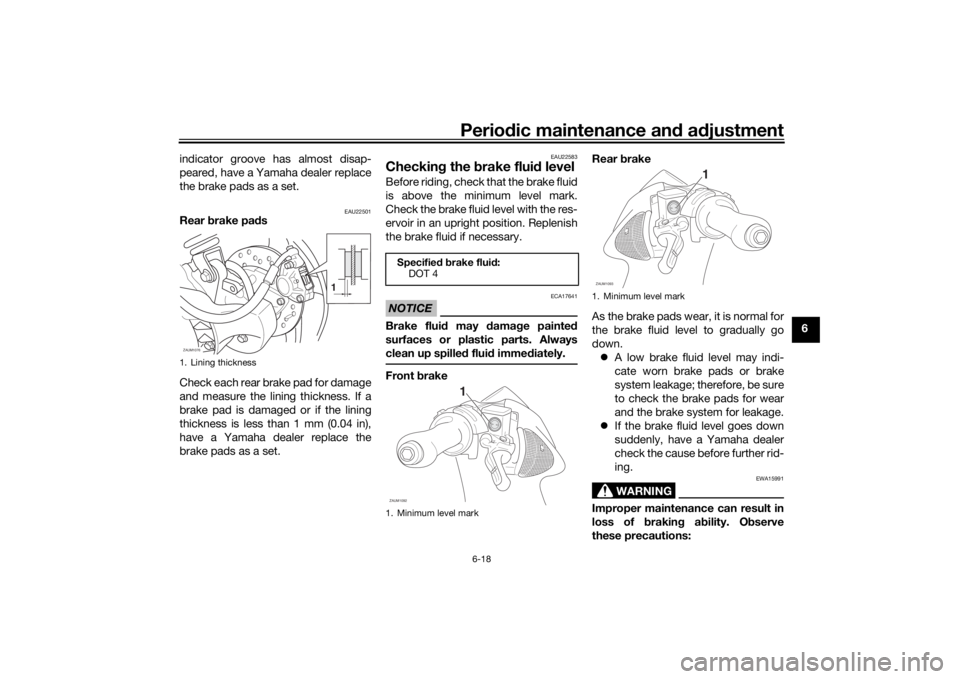
Rear brake pads
Check each rear brake pad for damage
and measure the lining thickness. If a
brake pad is damaged or if the lining
thickness is less than 1 mm (0.04 in),
have a Yamaha dealer replace the
brake pads as a set.
EAU22583
Checking the brake fluid levelBefore riding, check that the brake fluid
is above the minimum level mark.
Check the brake fluid level with the res-
ervoir in an upright position. Replenish
the brake fluid if necessary.NOTICE
ECA17641
Brake fluid may damage painted
surfaces or plastic parts. Always
clean up spilled fluid immediately.Front brakeRear brake
As the brake pads wear, it is normal for
the brake fluid level to gradually go
down.
A low brake fluid level may indi-
cate worn brake pads or brake
system leakage; therefore, be sure
to check the brake pads for wear
and the brake system for leakage.
If the brake fluid level goes down
suddenly, have a Yamaha dealer
check the cause before further rid-
ing.
WARNING
EWA15991
Improper maintenance can result in
loss of braking ability. Observe
these precautions:
1. Lining thickness
1
ZAUM1076
Specified brake fluid:
DOT 4
1. Minimum level mark
1
ZAUM1092
1. Minimum level mark
1
ZAUM1093
U1GBE1E0.book Page 18 Tuesday, October 17, 2017 11:45 AM
Page 54 of 78

Periodic maintenance and adjustment
6-19
6Insufficient brake fluid may al-
low air to enter the brake sys-
tem, reducing braking
performance.
Clean the filler cap before re-
moving. Use only DOT 4 brake
fluid from a sealed container.
Use only the specified brake flu-
id; otherwise, the rubber seals
may deteriorate, causing leak-
age.
Refill with the same type of
brake fluid. Adding a brake fluid
other than DOT 4 may result in a
harmful chemical reaction.
Be careful that water does not
enter the brake fluid reservoir
when refilling. Water will signifi-
cantly lower the boiling point of
the fluid and may result in vapor
lock.
EAUM1362
Changing the brake fluidHave a Yamaha dealer change the
brake fluid at the intervals specified in
the periodic maintenance and lubrica-
tion chart. In addition, have the brake
hose replaced every four years and
whenever it is damaged or leaking.
EAU23098
Checking and lubricating the
cablesThe operation of all control cables and
the condition of the cables should be
checked before each ride, and the ca-
bles and cable ends should be lubri-
cated if necessary. If a cable is
damaged or does not move smoothly,
have a Yamaha dealer check or re-
place it. WARNING! Damage to the
outer housing of cables may result
in internal rusting and cause inter-
ference with cable movement. Re-
place damaged cables as soon as
possible to prevent unsafe condi-
tions.
[EWA10712]
Recommended lubricant:
Yamaha cable lubricant or other
suitable cable lubricant
U1GBE1E0.book Page 19 Tuesday, October 17, 2017 11:45 AM
Page 56 of 78
Periodic maintenance and adjustment
6-21
6
EAU23193
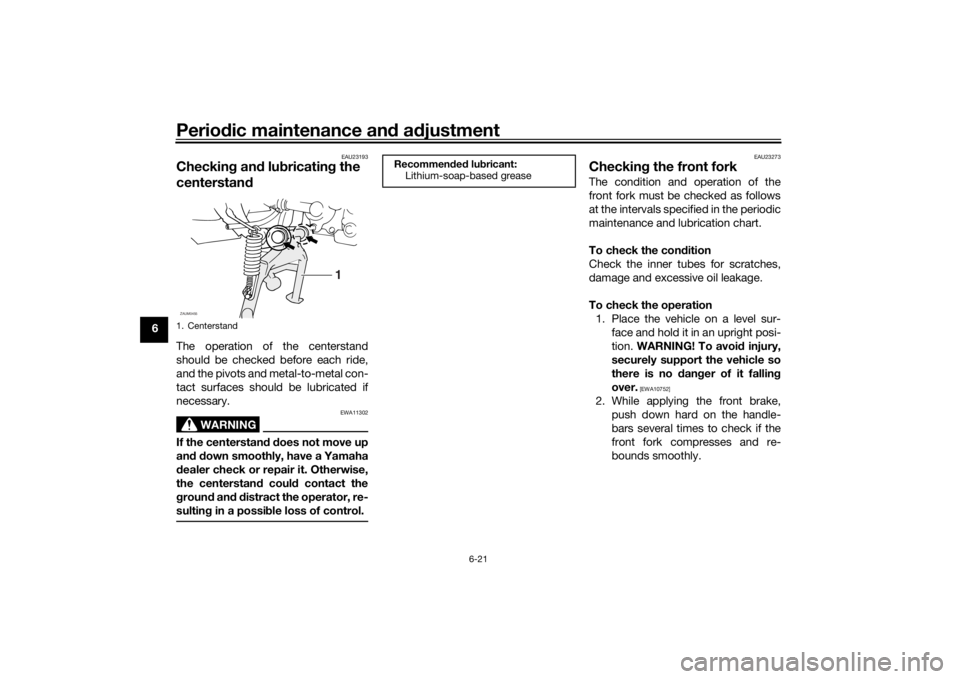
Checking and lubricating the
centerstandThe operation of the centerstand
should be checked before each ride,
and the pivots and metal-to-metal con-
tact surfaces should be lubricated if
necessary.
WARNING
EWA11302
If the centerstand does not move up
and down smoothly, have a Yamaha
dealer check or repair it. Otherwise,
the centerstand could contact the
ground and distract the operator, re-
sulting in a possible loss of control.
EAU23273
Checking the front forkThe condition and operation of the
front fork must be checked as follows
at the intervals specified in the periodic
maintenance and lubrication chart.
To check the condition
Check the inner tubes for scratches,
damage and excessive oil leakage.
To check the operation
1. Place the vehicle on a level sur-
face and hold it in an upright posi-
tion. WARNING! To avoid injury,
securely support the vehicle so
there is no danger of it falling
over.
[EWA10752]
2. While applying the front brake,
push down hard on the handle-
bars several times to check if the
front fork compresses and re-
bounds smoothly.
1. Centerstand
1
ZAUM0455
Recommended lubricant:
Lithium-soap-based grease
U1GBE1E0.book Page 21 Tuesday, October 17, 2017 11:45 AM
Page 57 of 78
Periodic maintenance and adjustment
6-22
6
NOTICE
ECA10591
If any damage is found or the front
fork does not operate smoothly,
have a Yamaha dealer check or re-
pair it.
EAU45512
Checking the steeringWorn or loose steering bearings may
cause danger. Therefore, the operation
of the steering must be checked as fol-
lows at the intervals specified in the
periodic maintenance and lubrication
chart.
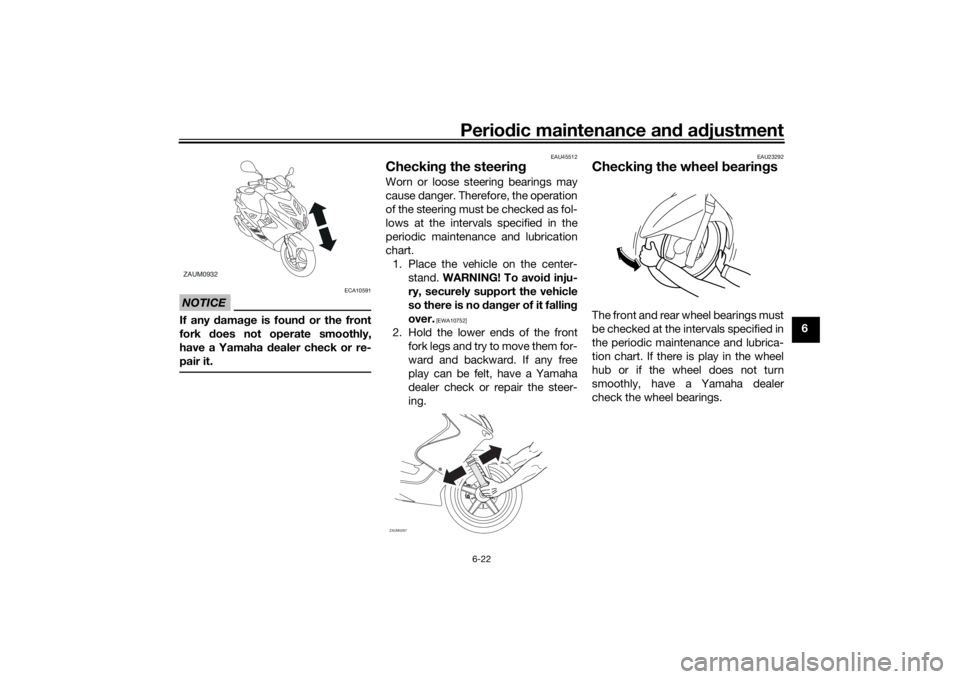
1. Place the vehicle on the center-
stand. WARNING! To avoid inju-
ry, securely support the vehicle
so there is no danger of it falling
over.
[EWA10752]
2. Hold the lower ends of the front
fork legs and try to move them for-
ward and backward. If any free
play can be felt, have a Yamaha
dealer check or repair the steer-
ing.
EAU23292
Checking the wheel bearingsThe front and rear wheel bearings must
be checked at the intervals specified in
the periodic maintenance and lubrica-
tion chart. If there is play in the wheel
hub or if the wheel does not turn
smoothly, have a Yamaha dealer
check the wheel bearings.
ZAUM0932
ZAUM0297
U1GBE1E0.book Page 22 Tuesday, October 17, 2017 11:45 AM
Page 58 of 78
Periodic maintenance and adjustment
6-23
6
EAUM3281
BatteryA poorly maintained battery will cor-
rode and discharge quickly. The elec-
trolyte level, battery lead connections
and breather hose routing should be
checked before each ride and at the in-
tervals specified in the periodic main-
tenance and lubrication chart.
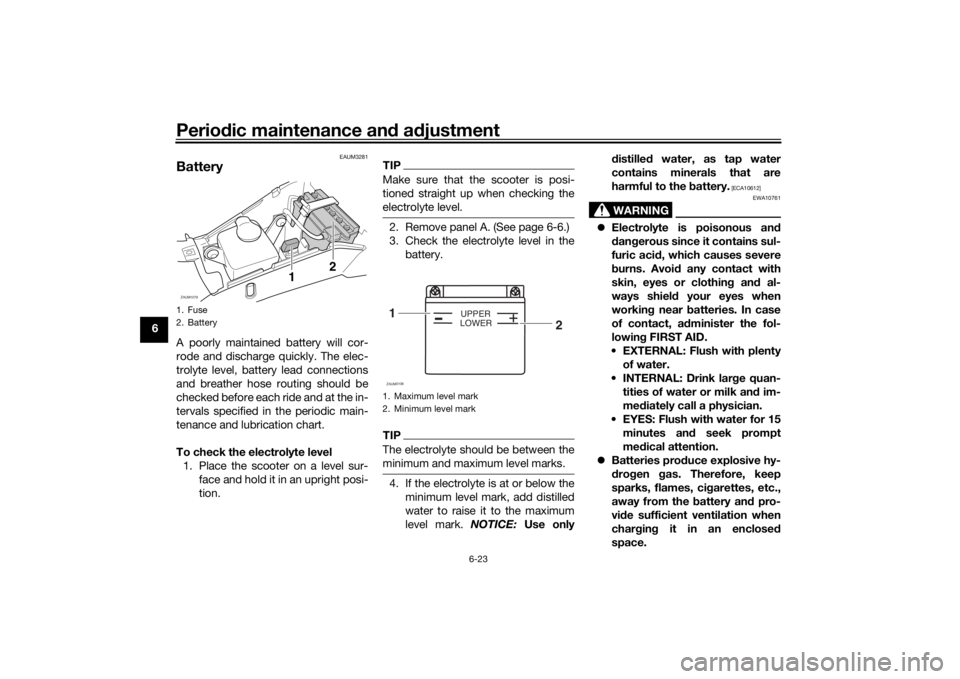
To check the electrolyte level
1. Place the scooter on a level sur-
face and hold it in an upright posi-
tion.
TIPMake sure that the scooter is posi-
tioned straight up when checking the
electrolyte level.2. Remove panel A. (See page 6-6.)
3. Check the electrolyte level in the
battery.TIPThe electrolyte should be between the
minimum and maximum level marks.4. If the electrolyte is at or below the
minimum level mark, add distilled
water to raise it to the maximum
level mark. NOTICE: Use onlydistilled water, as tap water
contains minerals that are
harmful to the battery.
[ECA10612]
WARNING
EWA10761
Electrolyte is poisonous and
dangerous since it contains sul-
furic acid, which causes severe
burns. Avoid any contact with
skin, eyes or clothing and al-
ways shield your eyes when
working near batteries. In case
of contact, administer the fol-
lowing FIRST AID.
EXTERNAL: Flush with plenty
of water.
INTERNAL: Drink large quan-
tities of water or milk and im-
mediately call a physician.
EYES: Flush with water for 15
minutes and seek prompt
medical attention.
Batteries produce explosive hy-
drogen gas. Therefore, keep
sparks, flames, cigarettes, etc.,
away from the battery and pro-
vide sufficient ventilation when
charging it in an enclosed
space.
1. Fuse
2. BatteryZAUM1079
12
1. Maximum level mark
2. Minimum level mark
+
UPPER
LOWER
1
2ZAUM0106
U1GBE1E0.book Page 23 Tuesday, October 17, 2017 11:45 AM
Page 59 of 78
Periodic maintenance and adjustment
6-24
6 KEEP THIS AND ALL BATTER-
IES OUT OF THE REACH OF
CHILDREN.
5. Check and, if necessary, tighten
the battery lead connections and
correct the breather hose routing.
To store the battery
1. If the scooter will not be used for
more than one month, remove the
battery, fully charge it, and then
place it in a cool, dry place.
NOTICE: When removing the
battery, be sure the key is
turned to “ ”, then disconnect
the negative lead before discon-
necting the positive lead.
[ECA17712]
2. If the battery will be stored for
more than two months, check the
specific gravity of the electrolyte
at least once a month and fully
charge the battery whenever nec-
essary.
3. Fully charge the battery before in-
stallation. NOTICE: When install-
ing the battery, be sure the keyis turned to “ ”, then connect
the positive lead before con-
necting the negative lead.
[ECA17722]
4. After installation, make sure that
the battery leads are properly con-
nected to the battery terminals
and that the breather hose is
properly routed, in good condi-
tion, and not obstructed. NOTICE:
If the breather hose is posi-
tioned in such a way that the
frame is exposed to electrolyte
or gas expelled from the bat-
tery, the frame could suffer
structural and external damag-
es.
[ECA10602]
NOTICE
ECAM1120
Always keep the battery
charged. Storing a discharged
battery can cause permanent
battery damage.
After installing the battery, be
sure to turn the main switch
from“” to“” three times in
3 seconds intervals to initialize
the idle speed control system.
EAUM3271
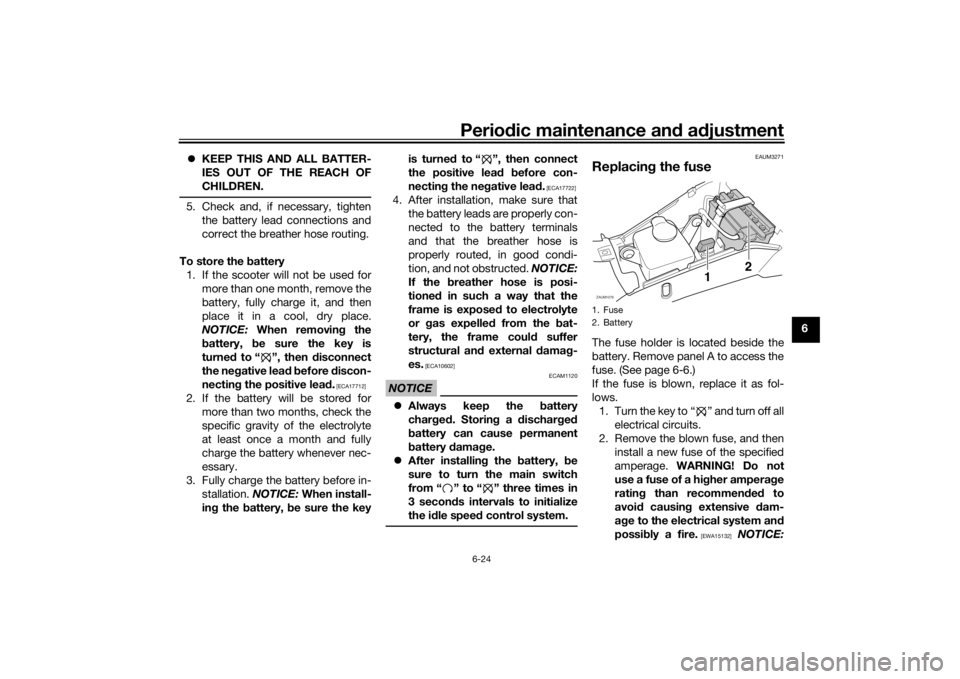
Replacing the fuseThe fuse holder is located beside the
battery. Remove panel A to access the
fuse. (See page 6-6.)
If the fuse is blown, replace it as fol-
lows.
1. Turn the key to “ ” and turn off all
electrical circuits.
2. Remove the blown fuse, and then
install a new fuse of the specified
amperage. WARNING! Do not
use a fuse of a higher amperage
rating than recommended to
avoid causing extensive dam-
age to the electrical system and
possibly a fire.
[EWA15132]
NOTICE:
1. Fuse
2. BatteryZAUM1079
12
U1GBE1E0.book Page 24 Tuesday, October 17, 2017 11:45 AM
Page 63 of 78
Periodic maintenance and adjustment
6-28
6
EAU24331
License plate lightIf the license plate light does not come
on, have a Yamaha dealer check the
electrical circuit or replace the bulb.
EAU25883
TroubleshootingAlthough Yamaha scooters receive a
thorough inspection before shipment
from the factory, trouble may occur
during operation. Any problem in the
fuel, compression, or ignition systems,
for example, can cause poor starting
and loss of power.
The following troubleshooting charts
represent quick and easy procedures
for checking these vital systems your-
self. However, should your scooter re-
quire any repair, take it to a Yamaha
dealer, whose skilled technicians have
the necessary tools, experience, and
know-how to service the scooter prop-
erly.
Use only genuine Yamaha replace-
ment parts. Imitation parts may look
like Yamaha parts, but they are often
inferior, have a shorter service life and
can lead to expensive repair bills.
WARNING
EWA15142
When checking the fuel system, do
not smoke, and make sure there are
no open flames or sparks in the ar-
ea, including pilot lights from waterheaters or furnaces. Gasoline or
gasoline vapors can ignite or ex-
plode, causing severe injury or prop-
erty damage.
U1GBE1E0.book Page 28 Tuesday, October 17, 2017 11:45 AM
Page 65 of 78
Periodic maintenance and adjustment
6-30
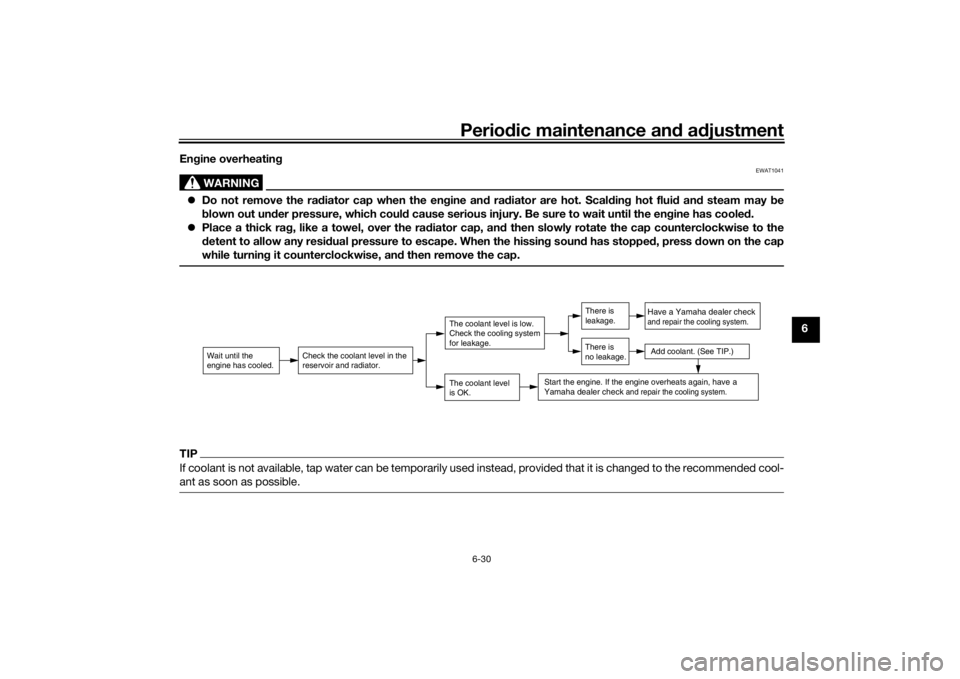
6 Engine overheating
WARNING
EWAT1041
Do not remove the radiator cap when the engine and radiator are hot. Scalding hot fluid and steam may be
blown out under pressure, which could cause serious injury. Be sure to wait until the engine has cooled.
Place a thick rag, like a towel, over the radiator cap, and then slowly rotate the cap counterclockwise to the
detent to allow any residual pressure to escape. When the hissing sound has stopped, press down on the cap
while turning it counterclockwise, and then remove the cap.TIPIf coolant is not available, tap water can be temporarily used instead, provided that it is changed to the recommended cool-
ant as soon as possible.
Wait until the
engine has cooled.
Check the coolant level in the
reservoir and radiator.
The coolant level
is OK.The coolant level is low.
Check the cooling system
for leakage.
Have a Yamaha dealer checkand repair the cooling system.Add coolant. (See TIP.)
Start the engine. If the engine overheats again,
have a
Yamaha dealer check
and repair the cooling system.
There is
leakage.
There is
no leakage.
U1GBE1E0.book Page 30 Tuesday, October 17, 2017 11:45 AM