Page 546 of 576
546
YARIS iA_OM_OM99Q46z_(U)
7-7. Tire Information (U.S.A.)
Examples: Based on a single occupant weight of 150 lb. (68 kg), and
a value of 849 lb. (385 kg) for the “combination weight of occupants
and cargo should never exceed”:
The cargo weight limit with one occupant is 849 lb. (385 kg) - 150 lb.
(68 kg) = 699 lb. (317 kg)
The cargo weight limit with two occupants is 849 lb. (385 kg) - (150 x
2) lb. ((68 x 2) kg) = 549 lb. (249 kg)
If the weight of the occupant increases, the cargo weight limit
decreases by that much.
GAW (Gross Axle Weight) is the total weight placed on each axle
(front and rear) - including vehi cle curb weight and all payload.
GAWR (Gross Axle Weight Rating) is the maximum allowable weight
that can be carried by a single axle (front or rear). These numbers are
shown on the Safety Compliance Certification Label located on the
driver’s door frame or door pilla r. The total load on each axle must
never exceed its GAWR.
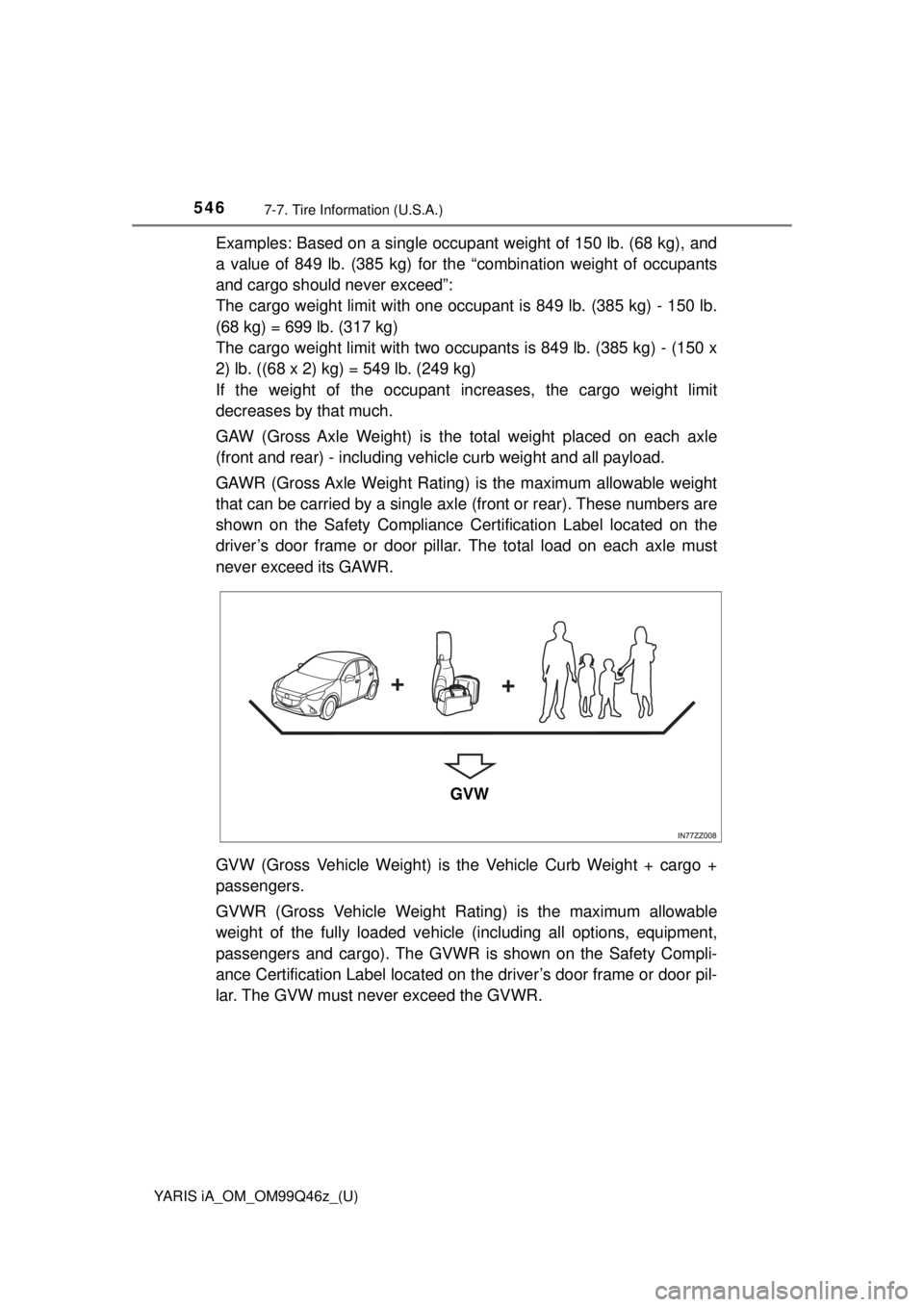
GVW (Gross Vehicle Weight) is the Vehicle Curb Weight + cargo +
passengers.
GVWR (Gross Vehicle Weight Rating) is the maximum allowable
weight of the fully loaded vehicle (including all options, equipment,
passengers and cargo). The GVWR is shown on the Safety Compli-
ance Certification Label located on the driver’s door frame or door pil-
lar. The GVW must never exceed the GVWR.
GVW
Page 547 of 576
YARIS iA_OM_OM99Q46z_(U)
5477-7. Tire Information (U.S.A.)
7
Customer Information and Reporting Safety Defects
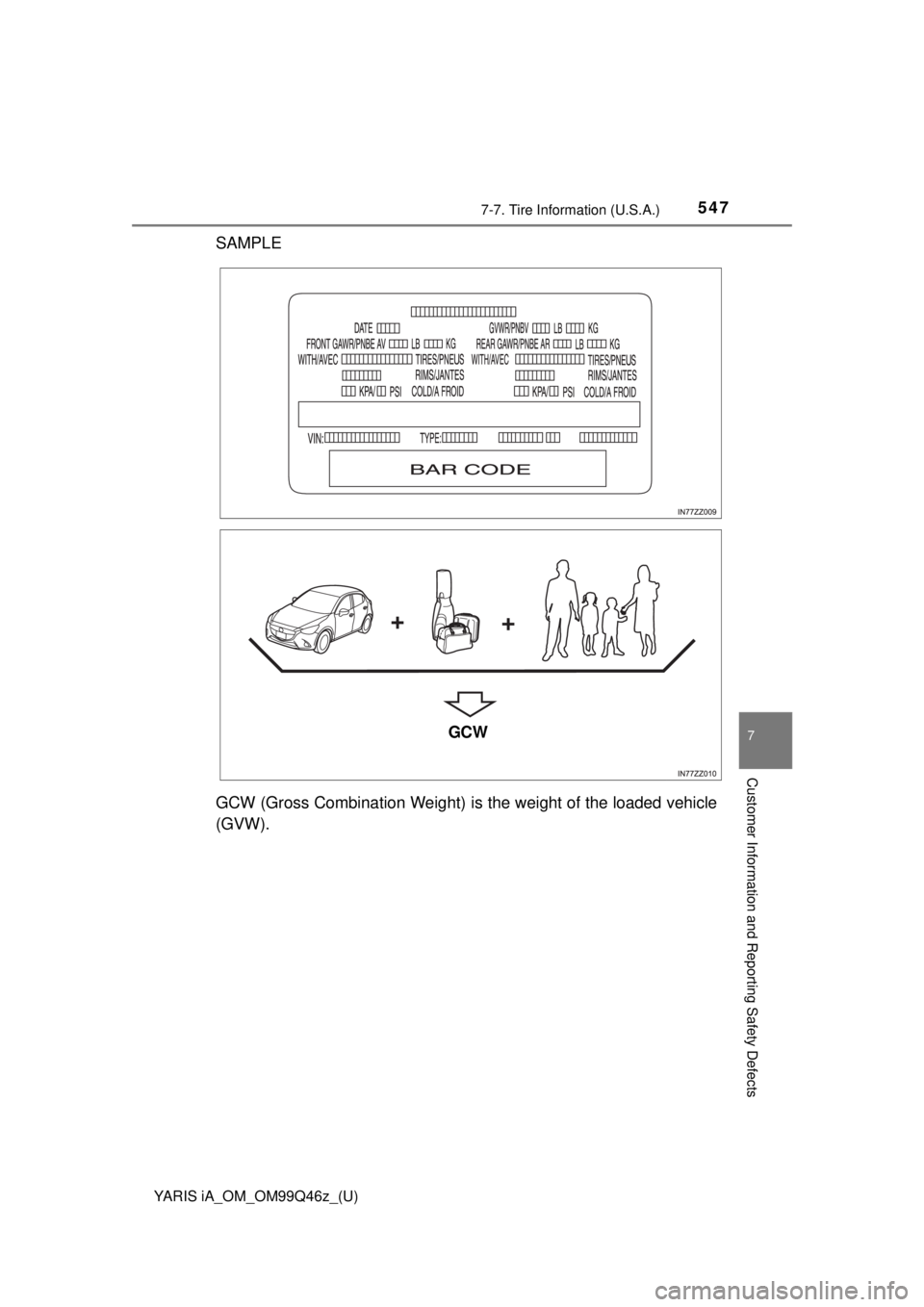
SAMPLE
GCW (Gross Combination Weight) is the weight of the loaded vehicle
(GVW).
GCW
Page 548 of 576
548
YARIS iA_OM_OM99Q46z_(U)
7-7. Tire Information (U.S.A.)
GCWR (Gross Combination Weight Rating) is the maximum allowable
weight of the vehicle - including all cargo and passengers - that the
vehicle can handle without risking damage. The GCW must never
exceed the GCWR.
WARNING
■Do not tow a trailer with this vehicle
Towing a trailer with this vehicle is dangerous because it has not been
designed to tow a trailer and doing so will affect the drive system which
could result in vehicle damage.
■Overloaded Vehicle
Overloading a vehicle is dangerous. The results of overloading can
have serious consequences in terms of passenger safety. Too much
weight on a vehicle’s suspension system can cause spring or shock
absorber failure, brake failure, handling or steering problems, irregular
tire wear, tire failure or other damage.
Overloading makes a vehicle harder to drive and control. It also
increases the distance requ ired for stopping. In cases of serious over-
loading, brakes can fail completely, particularly on steep grades. The
load a tire will carry safely is a combin ation of the size of the tire, its load
range, and corresponding inflation pressure.
Never overload the vehicle and always observe the vehicle’s weight rat-
ings from the vehicle’s Safety Cert ification and Tire and Load Informa-
tion labels.
■Never Exceed Axle Weight Rating Limits
Exceeding the Safety Certification Label axle weight rating limits is dan-
gerous and could result in death or serious injury as a result of substan-
dard vehicle handling, performanc e, engine, transmission and/or
structural damage, serious damage to the vehicle, or loss of control.
Always keep the vehicle within the axle weight rating limits.
■Never Exceed GVWR or GAWR Specifications
Exceeding the GVWR or the GAWR sp ecified on the certification label is
dangerous. Exceeding any vehicle rating limitation could result in a seri-
ous accident, injury, or damage to the vehicle.
Do not use replacement tires with lower load carrying capacities than
the originals because they may lo wer the vehicle’s GVWR and GAWR
limitations. Replacement tires with a higher limit than the originals do
not increase the GVWR and GAWR limitations. Never exceed the
GVWR or the GAWR specified on the certification label.
Page 549 of 576
549
YARIS iA_OM_OM99Q46z_(U)
7-7. Tire Information (U.S.A.)
7
Customer Information and Reporting Safety Defects
Steps for Determining the Correct Load
Limit
Steps for Determini ng Correct Load Limit-
(1) Locate the statement “The comb ined weight of occupants and
cargo should never exceed XXX kg or XXX lbs.” on your vehicle’s
placard.
(2) Determine the combined weight of the driver and passengers that
will be riding in your vehicle.
(3) Subtract the combined weight of the driver and passengers from
XXX kg or XXX lbs.
(4) The resulting figure equals the available amount of cargo and lug- gage load capacity. For example, if the “XXX” amount equals 1400
lbs. and there will be five 150 lb passengers in your vehicle, the
amount of available cargo and lu ggage load capacity is 650 lbs.
(1400 - 750 (5 x 150) = 650 lbs.)
(5) Determine the combined weight of luggage and cargo being loaded on the vehicle. That weight ma y not safely exceed the available
cargo and luggage load capacity calculated in Step 4.
(6) If your vehicle will be towing a tr ailer, load from your trailer will be
transferred to your vehicle. Consult this manual to determine how
this reduces the available cargo and luggage load capacity of your
vehicle.
Page 558 of 576
5588-2. Specifications
YARIS iA_OM_OM99Q46z_(U)
Dimensions
ItemVehicle specification
Overall length171.7 in. (4,360 mm)
Overall width66.7 in. (1,695 mm)
Overall height58.3 in. (1,480 mm)
Front track58.9 in. (1,495 mm)
Rear track58.5 in. (1,485 mm)
Wheelbase101.2 in. (2,570 mm)
Weights
ItemWeight
Manual transaxleAutomatic transaxle
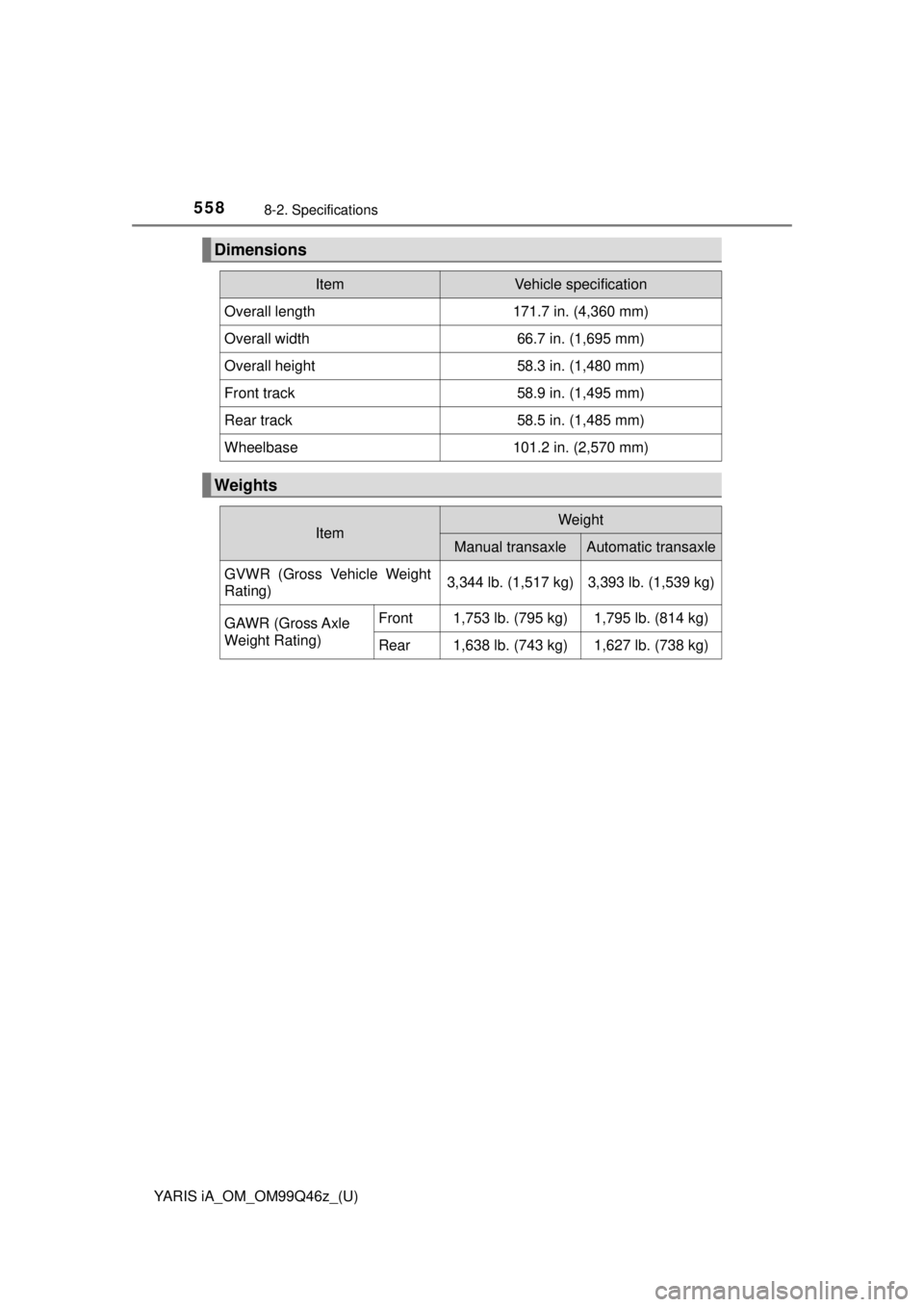
GVWR (Gross Vehicle Weight
Rating)3,344 lb. (1,517 kg)3,393 lb. (1,539 kg)
GAWR (Gross Axle
Weight Rating)Front1,753 lb. (795 kg)1,795 lb. (814 kg)
Rear1,638 lb. (743 kg)1,627 lb. (738 kg)
Page 576 of 576
576Alphabetical index
YARIS iA_OM_OM99Q46z_(U)
Warranty ................................... 522
Weights..................................... 558
WindowsPower windows ..................... 116
Windshield Washer ................. 184
Windshield Wipers .................. 183
Winter Driving .......................... 130
Wiper
Replacing Windshield Wiper Blades ................................ 432
Page:
< prev 1-8 9-16 17-24