Page 158 of 576
158
YARIS iA_OM_OM99Q46z_(U)
3-2. Combination Meter and Display
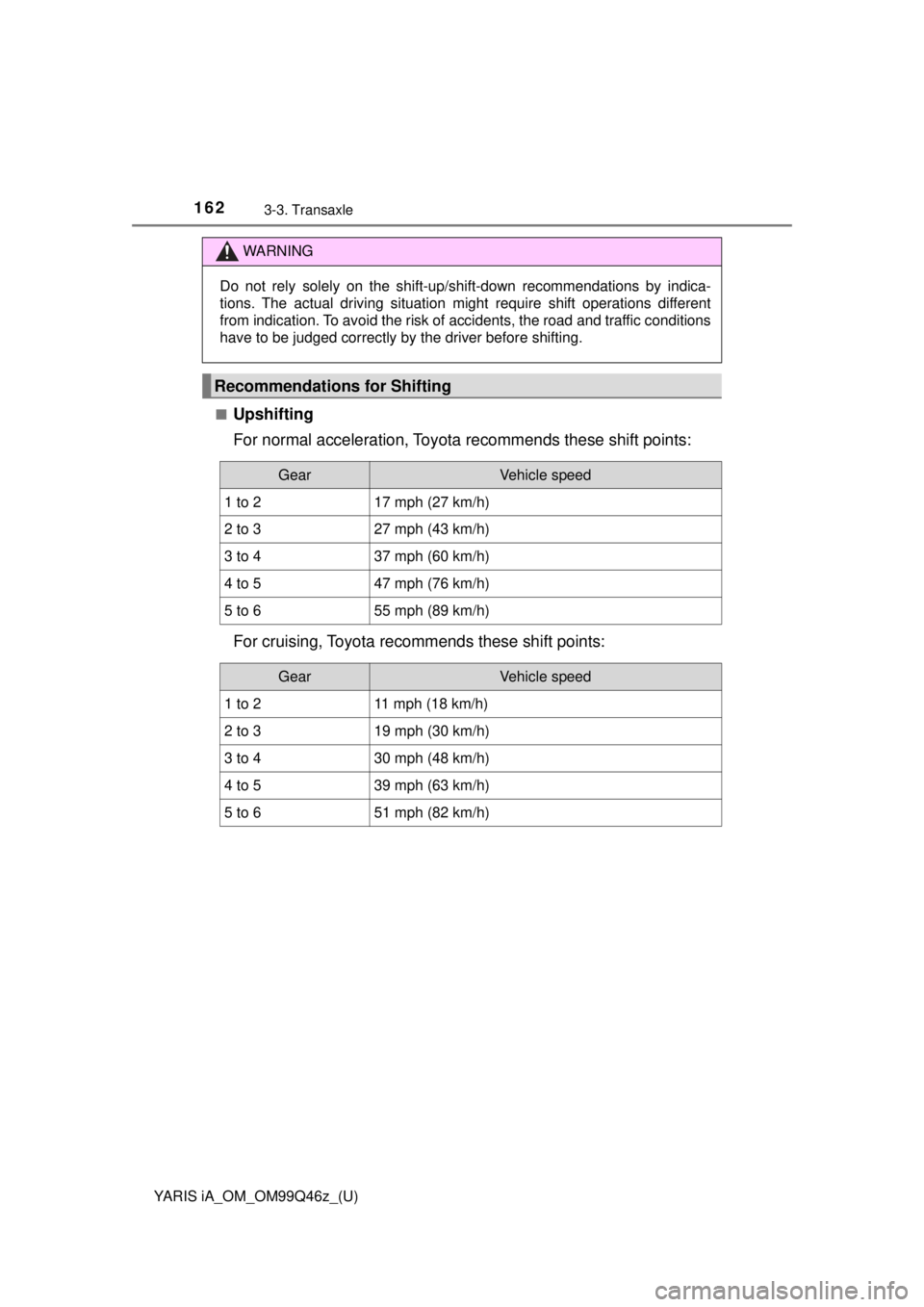
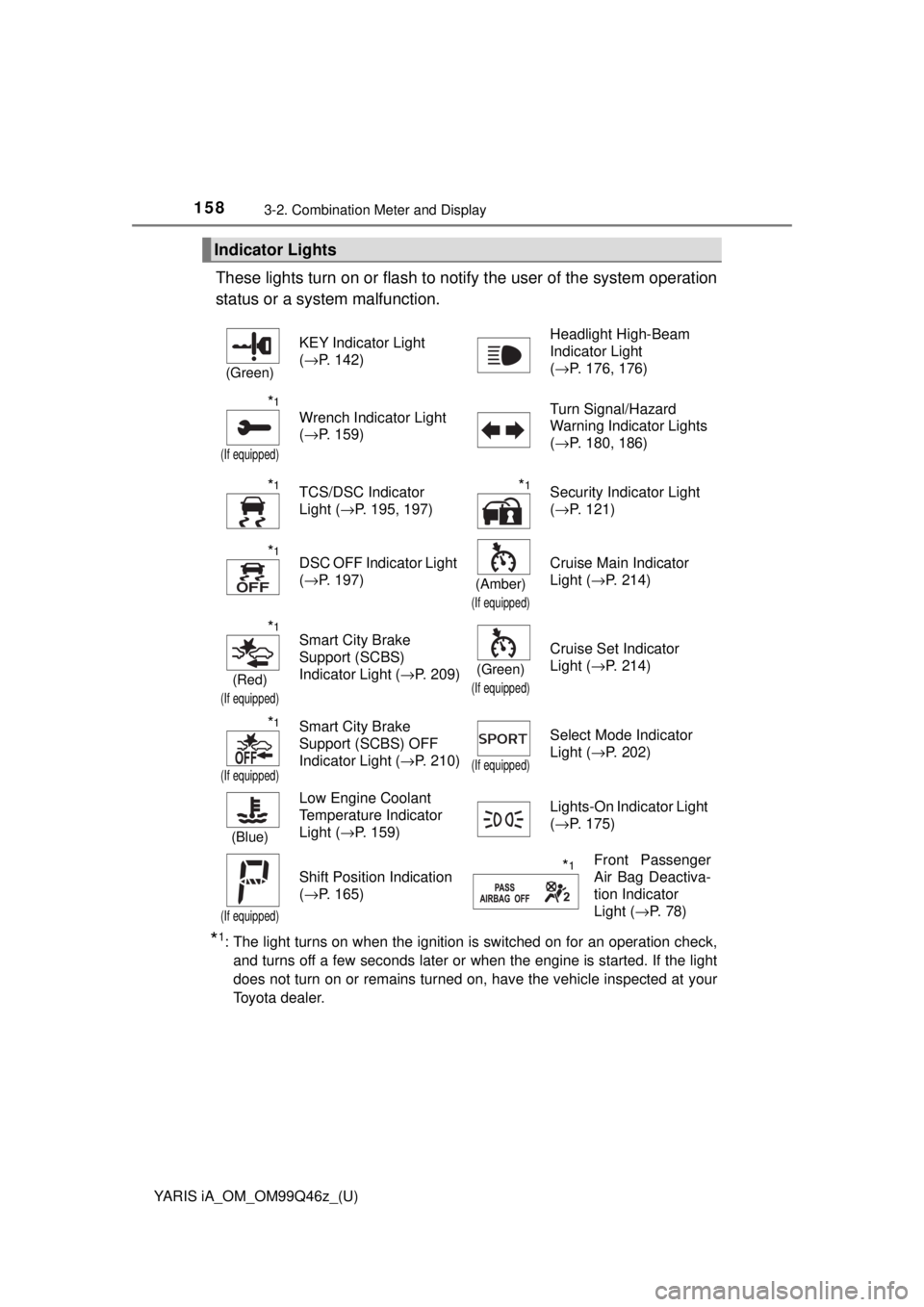
These lights turn on or flash to notify the user of the system operation
status or a system malfunction.
*1: The light turns on when the ignition is switched on for an operation chec\
k, and turns off a few seconds later or when the engine is started. If the light
does not turn on or remains turned on, have the vehicle inspected at your
Toyota dealer.
Indicator Lights
(Green)
KEY Indicator Light
(→P. 142) Headlight High-Beam
Indicator Light
(
→P. 176, 176)
*1
(If equipped)
Wrench Indicator Light
(→P. 159) Turn Signal/Hazard
Warning Indicator Lights
(
→P. 180, 186)
*1TCS/DSC Indicator
Light ( →P. 195, 197)*1Security Indicator Light
(→P. 121)
*1DSC OFF Indicator Light
(→P. 197)
(Amber)
(If equipped)
Cruise Main Indicator
Light ( →P. 214)
*1
(Red)
(If equipped)
Smart City Brake
Support (SCBS)
Indicator Light ( →P. 209)
(Green)
(If equipped)
Cruise Set Indicator
Light (→P. 214)
*1
(If equipped)
Smart City Brake
Support (SCBS) OFF
Indicator Light ( →P. 210)
(If equipped)
Select Mode Indicator
Light (→P. 202)
(Blue)
Low Engine Coolant
Temperature Indicator
Light (→P. 159) Lights-On Indicator Light
(
→P. 175)
(If equipped)
Shift Position Indication
(→P. 165)*1Front Passenger
Air Bag Deactiva-
tion Indicator
Light ( →P. 78)
Page 160 of 576
160
YARIS iA_OM_OM99Q46z_(U)
3-3. Transaxle
Manual Transaxle Operation
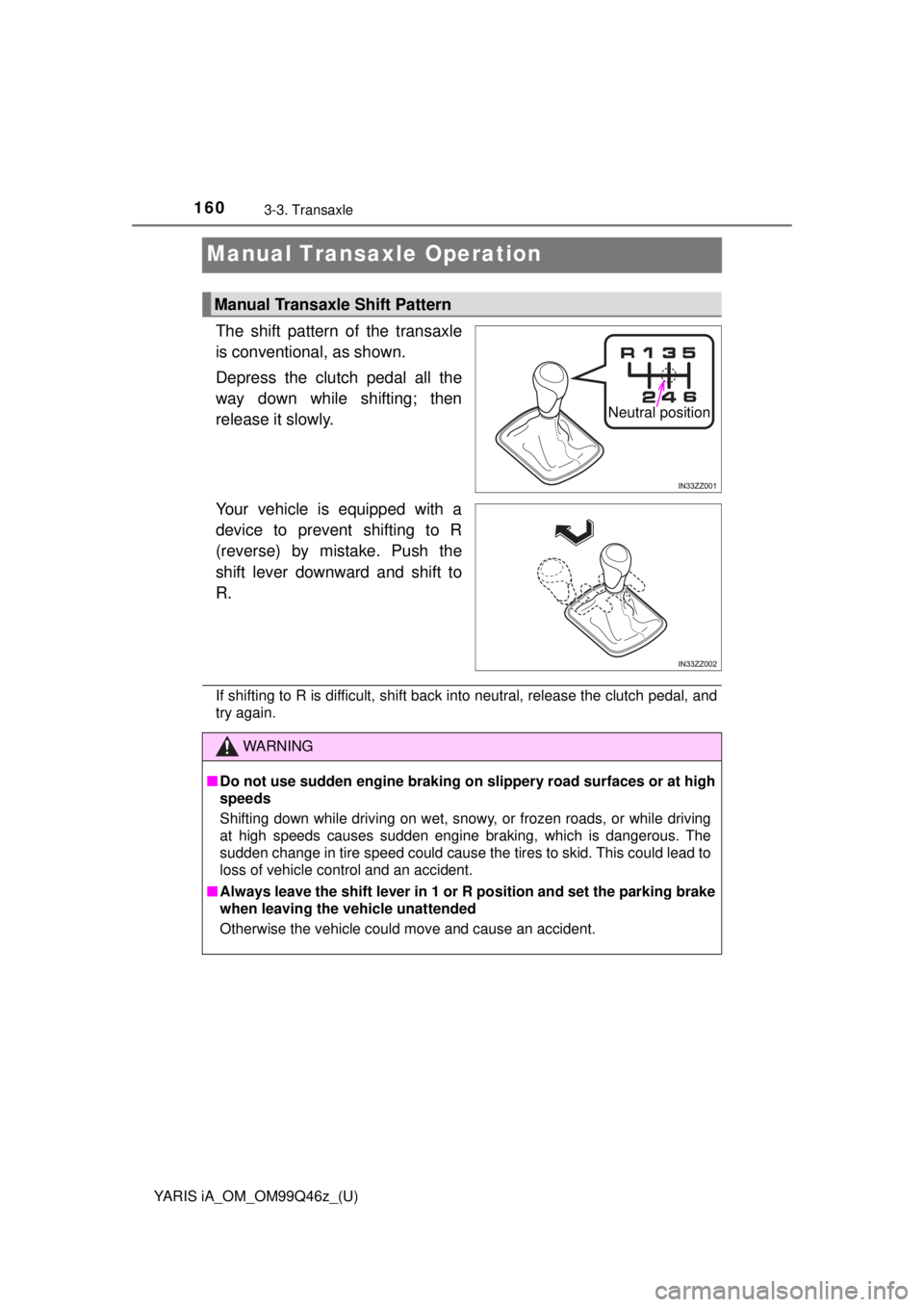
The shift pattern of the transaxle
is conventional, as shown.
Depress the clutch pedal all the
way down while shifting; then
release it slowly.
Your vehicle is equipped with a
device to prevent shifting to R
(reverse) by mistake. Push the
shift lever downward and shift to
R.
If shifting to R is difficult, shift back into neutral, release the clutch pedal, and
try again.
Manual Transaxle Shift Pattern
Neutral position
WARNING
■ Do not use sudden engine braking on slippery road surfaces or at high
speeds
Shifting down while driving on wet, snowy, or frozen roads, or while driving
at high speeds causes sudden engine braking, which is dangerous. The
sudden change in tire speed could cause the tires to skid. This could lead to
loss of vehicle control and an accident.
■ Always leave the shift lever in 1 or R position and set the parking brake
when leaving the vehicle unattended
Otherwise the vehicle could move and cause an accident.
Page 162 of 576
162
YARIS iA_OM_OM99Q46z_(U)
3-3. Transaxle
■Upshifting
For normal acceleration, Toyota recommends these shift points:
For cruising, Toyota recommends these shift points:
WARNING
Do not rely solely on the shift-up/shift-down recommendations by indica-
tions. The actual driving situation might require shift operations different
from indication. To avoid the risk of accidents, the road and traffic conditions
have to be judged correctly by the driver before shifting.
Recommendations for Shifting
GearVehicle speed
1 to 217 mph (27 km/h)
2 to 327 mph (43 km/h)
3 to 437 mph (60 km/h)
4 to 547 mph (76 km/h)
5 to 655 mph (89 km/h)
GearVehicle speed
1 to 211 mph (18 km/h)
2 to 319 mph (30 km/h)
3 to 430 mph (48 km/h)
4 to 539 mph (63 km/h)
5 to 651 mph (82 km/h)
Page 165 of 576
YARIS iA_OM_OM99Q46z_(U)
1653-3. Transaxle
3
When Driving
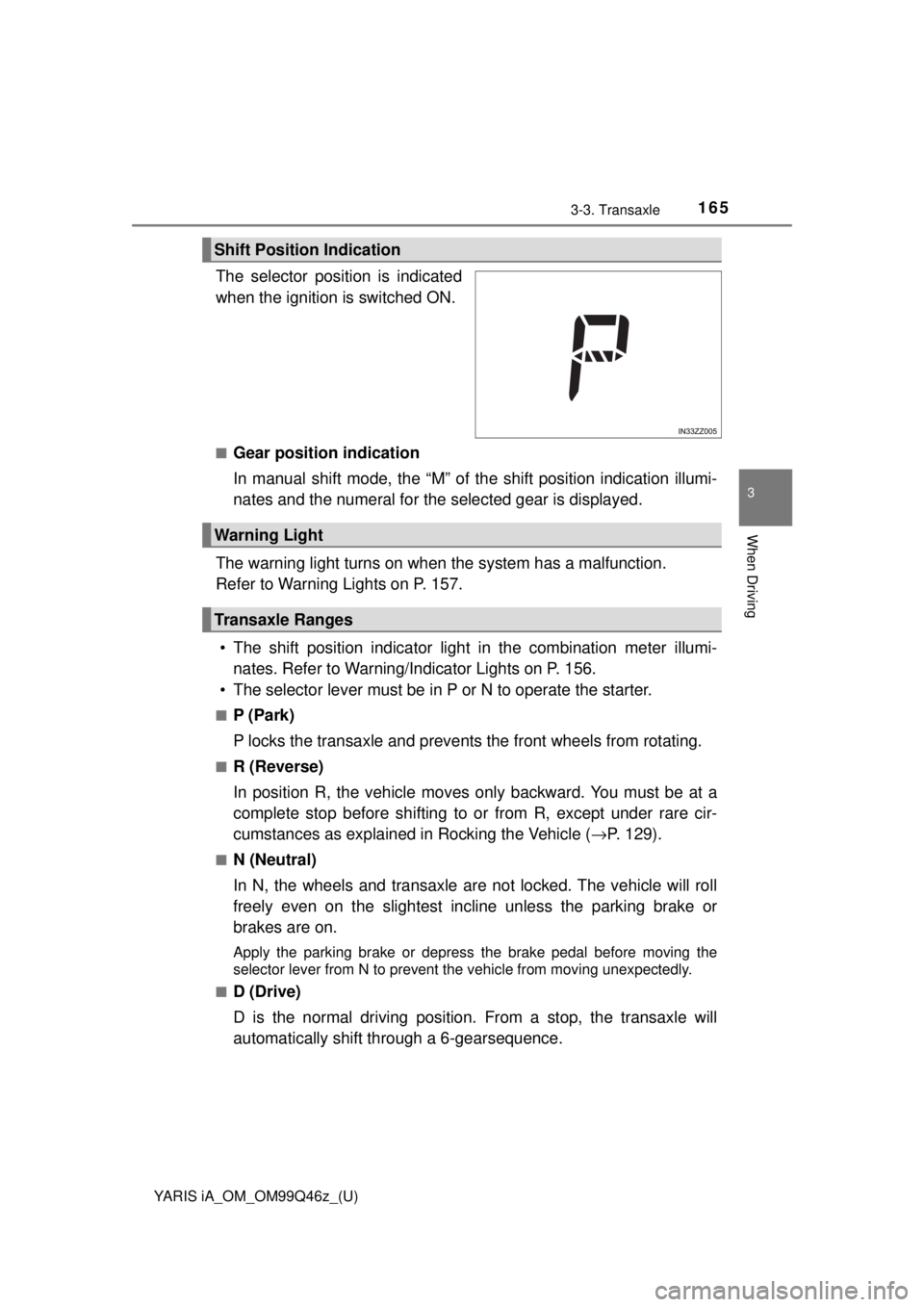
The selector position is indicated
when the ignition is switched ON.
■Gear position indication
In manual shift mode, the “M” of the shift position indication illumi-
nates and the numeral for the selected gear is displayed.
The warning light turns on when the system has a malfunction.
Refer to Warning Lights on P. 157.
• The shift position indicator light in the combination meter illumi- nates. Refer to Warning/Indicator Lights on P. 156.
• The selector lever must be in P or N to operate the starter.
■P (Park)
P locks the transaxle and prevents the front wheels from rotating.
■R (Reverse)
In position R, the vehicle moves only backward. You must be at a
complete stop before shifting to or from R, except under rare cir-
cumstances as explained in Rocking the Vehicle ( →P. 129).
■N (Neutral)
In N, the wheels and transaxle are not locked. The vehicle will roll
freely even on the slightest in cline unless the parking brake or
brakes are on.
Apply the parking brake or depress the brake pedal before moving the
selector lever from N to prevent the vehicle from moving unexpectedly.
■
D (Drive)
D is the normal driving position. From a stop, the transaxle will
automatically shift through a 6-gearsequence.
Shift Position Indication
Warning Light
Transaxle Ranges
Page 166 of 576

166
YARIS iA_OM_OM99Q46z_(U)
3-3. Transaxle
■M (Manual)
M is the manual shift mode position. Gears can be shifted up or
down by operating the selector lever. Refer to Manual Shift Mode
on P. 168.
WARNING
■Always set the selector lever to P and set the parking brake when park-
ing
Only setting the selector lever to the P position without using the parking
brake to hold the vehicle is dangerous. If P fails to hold, the vehicle could
move and cause an accident.
■ If the engine is running faster than idle, do not shift from N or P into a
driving gear
It’s dangerous to shift from N or P into a driving gear when the engine is run-
ning faster than idle. If this is done, the vehicle could move suddenly, caus-
ing an accident or serious injury.
■ Do not shift into N wh en driving the vehicle
Shifting into N while driving is dangerous. Engine braking cannot be applied
when decelerating which could lead to an accident or serious injury.
NOTICE
●Shifting into P, N or R while the vehicle is moving can damage your tran-
saxle.
● Shifting into a driving gear or reverse when the engine is running faster
than idle can damage the transaxle.
● Do not shift into N when driving the vehicle. Doing so can cause transax\
le
damage.
Page 173 of 576

YARIS iA_OM_OM99Q46z_(U)
1733-3. Transaxle
3
When Driving
■Manually shifting up
●When driving slowly, the gears may not shift up.
● In manual shift mode, do not run the engine with the tachometer needle in
the RED ZONE. When the engine rpm is high, a gear may shift up automat-
ically to protect the engine.
● When depressing the accelerator fully, the transaxle will shift to a lower
gear, depending on vehicle speed.
■ Manually shifting down
●When driving at high speeds, the gear may not shift down.
● During deceleration, the gear may automatically shift down depending on
vehicle speed.
● When depressing the accelerator fully, the transaxle will shift to a lower
gear, depending on vehicle speed.
WARNING
■Do not use engine braking on slippery road surfaces or at high speeds
Shifting down while driving on wet, snowy, or frozen roads, or while driving
at high speeds causes sudden engine braking, which is dangerous. The
sudden change in tire speed could cause the tires to skid. This could lead to
loss of vehicle control and an accident.
Page 174 of 576

174
YARIS iA_OM_OM99Q46z_(U)
3-3. Transaxle
■Passing
For extra power when passing another vehicle or climbing steep
grades, depress the accelerator fully. The transaxle will shift to a
lower gear, depending on vehicle speed.
Some models:
The accelerator pedal may initially feel heavy as it is being depressed,
then feel lighter as it is depressed further. This change in pedal force
aids the engine control system in determining how much the accelerator
pedal has been depressed for performing kickdown, and functions to
control whether or not kickdown should be performed.
■
Climbing steep grades from a stop
To climb a steep grade from a stopped position:
Depress the brake pedal.
Shift to D or M1, depending on the load weight and grade steep-
ness.
Release the brake pedal while gradually accelerating.
■Descending steep grades
When descending a steep grade, shift to lower gears, depending on
load weight and grade steepness. Descend slowly, using the
brakes only occasionally to pr event them from overheating.
Driving Tips
WARNING
■Do not let the vehicle move in a di rection opposite to the direction
selected by the selector lever
Do not let the vehicle move backward with the selector lever in a forward
position, or do not let the vehicle move forward with the selector lever in the
reverse position. Otherwise, the engine may stop, causing the loss of the
power brake and power steering functions , and make it difficult to control
the vehicle which could result in an accident.
1
2
3
Page 182 of 576

182
YARIS iA_OM_OM99Q46z_(U)
3-4. Switches and Controls
Windshield Wipers and Washer
The ignition must be switched ON to use the wipers.
Because heavy ice and snow can jam the wiper blades, the wiper motor is
protected from motor breakdown, overheating and possible fire by a circuit
breaker. This mechanism will automatically stop operation of the blades, but
only for about 5 minutes.
If this happens, turn off the wiper switch and park off the right-of-way, and
remove the snow and ice.
After 5 minutes, turn on the switch and the blades should operate normally. If
they do not resume functioning, consult your Toyota dealer as soon as possi-
ble. Drive to the side of the road and park off the right-of-way. Wait until the
weather clears before trying to drive with the wipers inoperative.
WARNING
■Use only windshield washer fluid or plain water in the reservoir
Using radiator antifreeze as washer fluid is dangerous. If sprayed on the
windshield, it will dirty the windshield, affect your visibility, and could result
in an accident.
■ Only use windshield washer fluid mixed with anti-freeze protection in
freezing weather conditions
Using windshield washer fluid without anti-freeze protection in freezing
weather conditions is dangerous as it could freeze on the windshield and
block your vision which could cause an accident. In addition, make sure the
windshield is sufficiently warmed using the defroster before spraying the
washer fluid.