Page 43 of 520

431-1. For safe use
1
For safety and security
WARNING
■SRS airbag precautions
● If breathing becomes difficult after the SRS airbags have deployed, open a
door or window to allow fresh air in, or leave the vehicle if it is safe to do
so. Wash off any residue as soon as possible to prevent skin irritation.
● If the areas where the SRS airbags are stored, such as the steering wheel
pad and front and rear pillar garnishes, are damaged or cracked, have
them replaced by your Toyota dealer.
● Do not place anything, such as a cushion, on the front passenger’s seat.
Doing so will disperse the passenger’s weight, which prevents the sensor
from detecting the passenger’s weight properly. As a result, the SRS front
airbags for the front passenger may not deploy in the event of a collisi\
on.
■ Modification and disposal of SRS airbag system components
Do not dispose of your vehicle or per form any of the following modifications
without consulting your Toyota dealer. The SRS airbags may malfunction or
deploy (inflate) accidentally, causing death or serious injury.
● Installation, removal, disassembly and repair of the SRS airbags
● Repairs, modifications, removal or replacement of the steering wheel,
instrument panel, dashboard, seats or seat upholstery, front, side and rear
pillars or roof side rails
● Repairs or modifications of the front fender, front bumper, or side of the
occupant compartment
● Installation of a grille guard (bull bars, kangaroo bar, etc.), snow plows,
winches
● Modifications to the vehicle’s suspension system
● Installation of electronic devices such as mobile two-way radios and CD
players
● Modifications to your vehicle for a person with a physical disability.
Page 45 of 520
451-1. For safe use
1
For safety and security
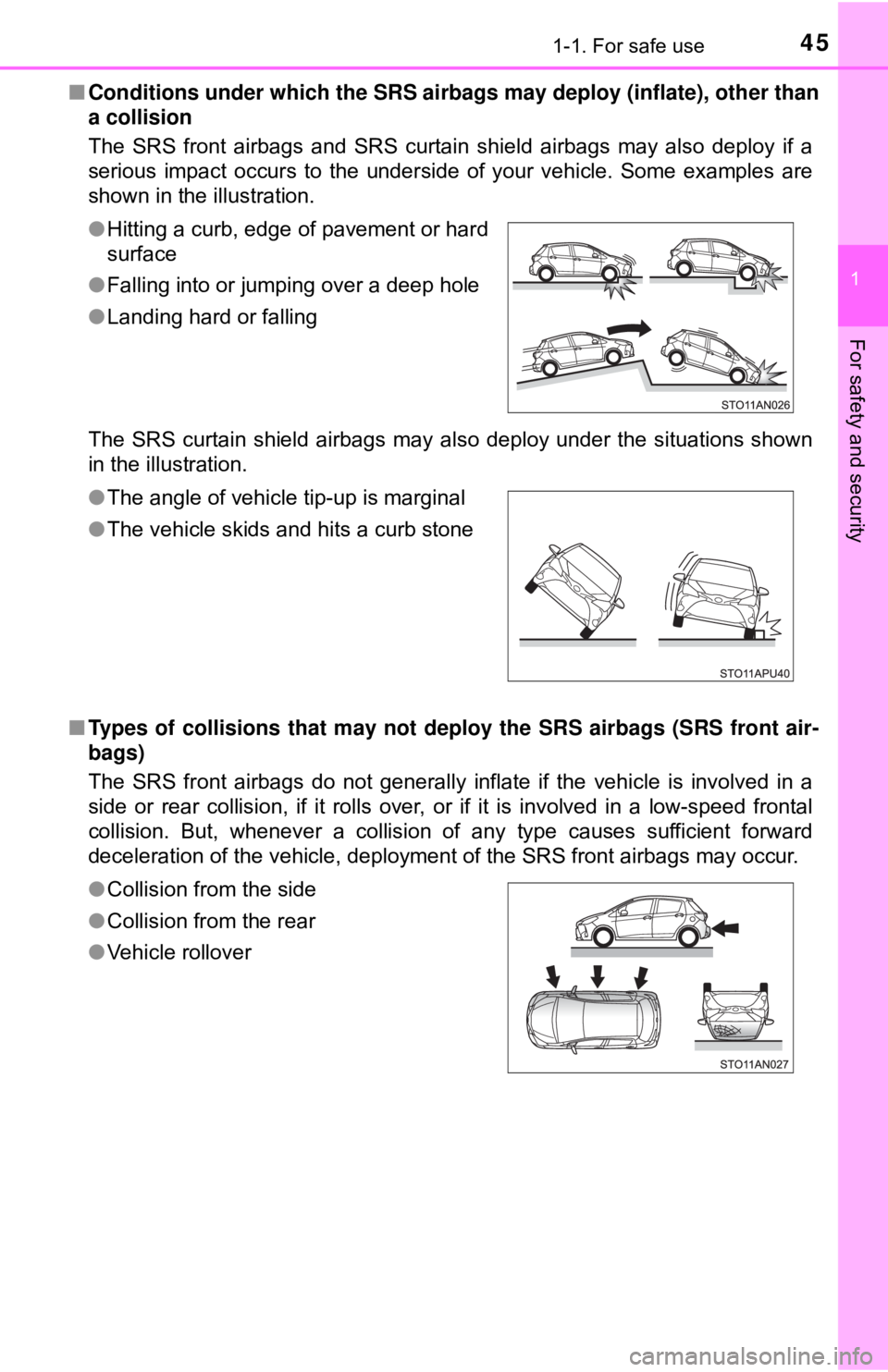
■Conditions under which the SRS airbags may deploy (inflate), other than
a collision
The SRS front airbags and SRS curtain shield airbags may also deploy if a
serious impact occurs to the underside of your vehicle. Some examples are
shown in the illustration.
The SRS curtain shield airbags may also deploy under the situations shown
in the illustration.
■ Types of collisions that may not depl oy the SRS airbags (SRS front air-
bags)
The SRS front airbags do not generally inflate if the vehicle is involved in a
side or rear collision, if it rolls over, or if it is involved in a low-speed frontal
collision. But, whenever a collision of any type causes sufficient forward
deceleration of the vehicle, deployment of the SRS front airbags may occur. ● Hitting a curb, edge of pavement or hard
surface
● Falling into or jumping over a deep hole
● Landing hard or falling
● The angle of vehicle tip-up is marginal
● The vehicle skids and hits a curb stone
● Collision from the side
● Collision from the rear
● Vehicle rollover
Page 47 of 520
471-1. For safe use
1
For safety and security
■When to contact your Toyota dealer
In the following cases, the vehicle will require inspection and/or repair. Con-
tact your Toyota dealer as soon as possible.
●Any of the SRS airbags have been inflated.
● The front of the vehicle is damaged or
deformed, or was involved in an acci-
dent that was not severe enough to
cause the SRS front airbags to inflate.
● A portion of a door or its surrounding
area is damaged or deformed, or the
vehicle was involved in an accident that
was not severe enough to cause the
SRS side and curtain shield airbags to
inflate.
● The pad section of the steering wheel,
dashboard near the front passenger air-
bag or lower portion of the instrument
panel is scratched, cracked, or other-
wise damaged.
● The front seat cushion surface is
scratched, cracked, or otherwise dam-
aged.
Page 49 of 520
491-1. For safe use
1
For safety and security
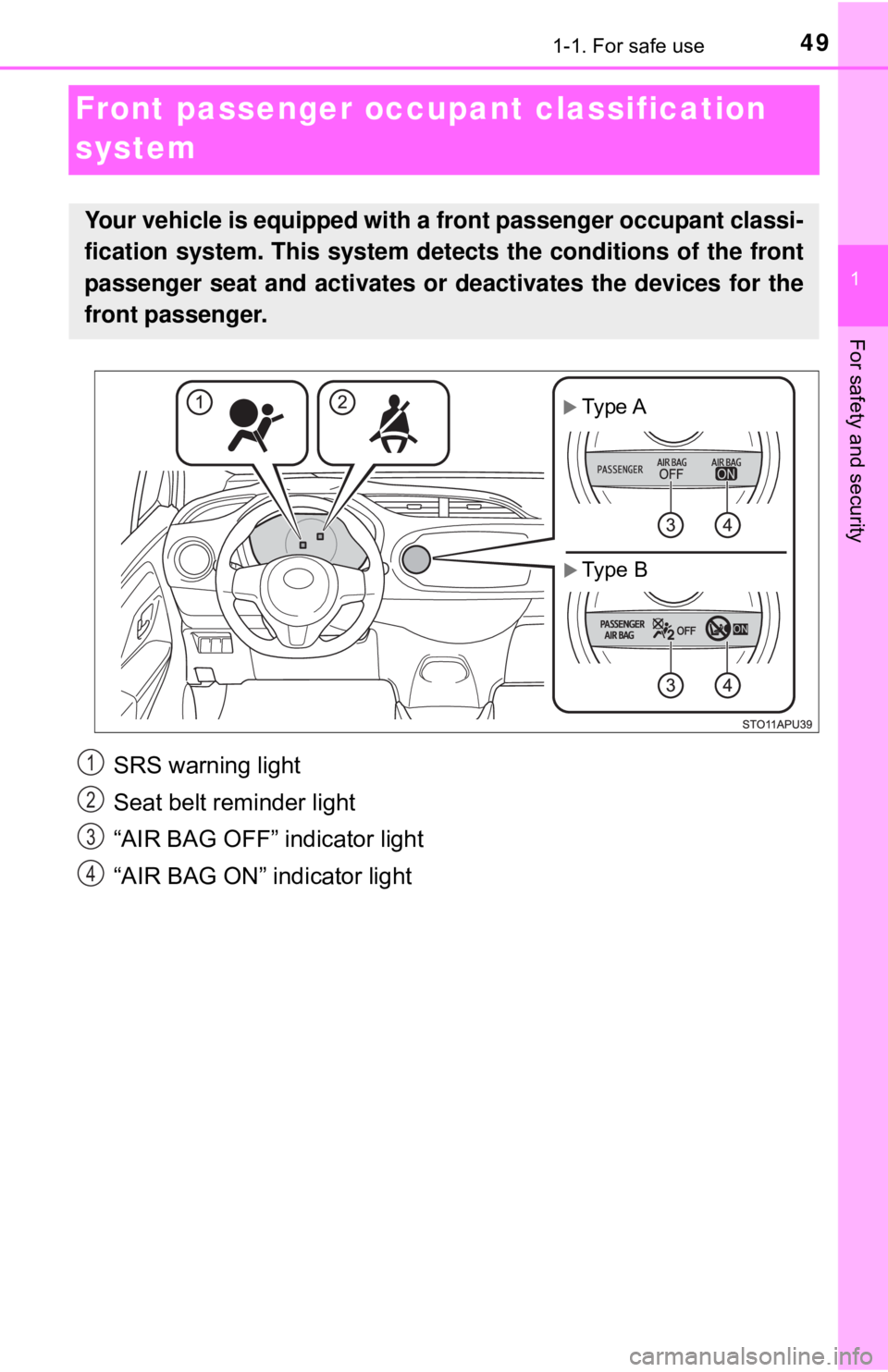
Front passenger occupant classification
system
SRS warning light
Seat belt reminder light
“AIR BAG OFF” indicator light
“AIR BAG ON” indicator light
Your vehicle is equipped with a front passenger occupant classi-
fication system. This system detects the conditions of the front
passenger seat and activates or deactivates the devices for the
front passenger.
Type A
Type B
1
2
3
4
Page 51 of 520
511-1. For safe use
1
For safety and security
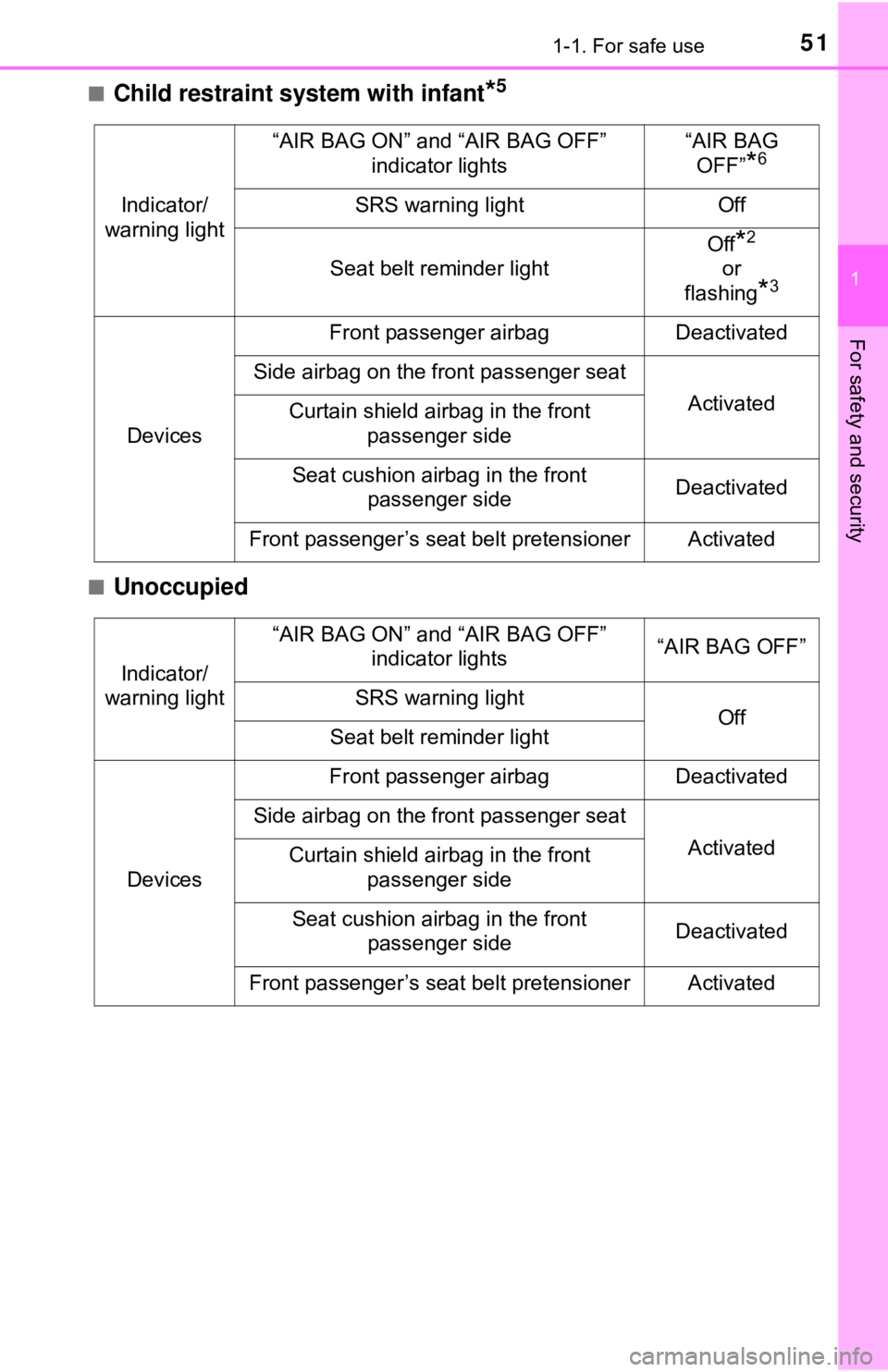
■Child restraint system with infant*5
■Unoccupied
Indicator/
warning light
“AIR BAG ON” and “AIR BAG OFF” indicator lights“AIR BAG OFF”
*6
SRS warning lightOff
Seat belt reminder light
Off*2
or
flashing
*3
Devices
Front passenger airbagDeactivated
Side airbag on the front passenger seat
ActivatedCurtain shield airbag in the front passenger side
Seat cushion airbag in the front passenger sideDeactivated
Front passenger’s seat belt pretensionerActivated
Indicator/
warning light
“AIR BAG ON” and “AIR BAG OFF” indicator lights“AIR BAG OFF”
SRS warning lightOffSeat belt reminder light
Devices
Front passenger airbagDeactivated
Side airbag on the front passenger seat
ActivatedCurtain shield airbag in the front passenger side
Seat cushion airbag in the front passenger sideDeactivated
Front passenger’s seat belt pretensionerActivated
Page 53 of 520

531-1. For safe use
1
For safety and security
WARNING
■Front passenger occupant classi fication system precautions
Observe the following precautions regarding the front passenger occupant
classification system.
Failure to do so may cause death or serious injury.
● Wear the seat belt properly.
● Make sure the front passenger’s seat belt plate has not been left inserted
into the buckle before someone sits in the front passenger seat.
● Make sure the “AIR BAG OFF” indicator light is not illuminated when using
the seat belt extender for the front passenger seat. If the “AIR BAG OFF”
indicator light is illuminated, disconnect the extender tongue from the seat
belt buckle, and reconnect the seat belt. Reconnect the seat belt extender
after making sure the “AIR BAG ON” indicator light is illuminated. If you
use the seat belt extender while the “AIR BAG OFF” indicator light is illumi-
nated, the SRS airbags for the front passenger will not activate correctly,
which could cause death or serious injury in the event of collision.
● Do not apply a heavy load to the front passenger seat or equipment (e.g.
seatback pocket).
● Do not put weight on the front passenger seat by putting your hands or
feet on the front passenger seat seatback from the rear passenger seat.
● Do not let a rear passenger lift the front passenger seat with their fee\
t or
press on the seatback with their legs.
● Do not put objects under the front passenger seat.
● Do not recline the front passenger seatback so far that it touches a rear
seat. This may cause the “AIR BAG OFF” indicator light to be illuminated,
which indicates that the SRS airbags for the front passenger will not acti-
vate in the event of a severe accident. If the seatback touches the rear
seat, return the seatback to a position where it does not touch the rear
seat. Keep the front passenger seatback as upright as possible when the
vehicle is moving. Reclining the seatback excessively may lessen the
effectiveness of the seat belt system.
Page 55 of 520

551-1. For safe use
1
For safety and security
Exhaust gas precautions
Harmful substances to the human body are included in exhaust
gases if inhaled.
WARNING
Exhaust gases contain harmful carbon monoxide (CO), which is colorless and
odorless. Observe the following precautions.
Failure to do so may cause exhaust gases enter the vehicle and may lead to
an accident caused by light-headedness, or may lead to death or a serious
health hazard.
■ Important points while driving
● Keep the back door closed.
● If you smell exhaust gases in the vehicle even when the back door is
closed, open the windows and have the vehicle inspected at your Toyota
dealer as soon as possible.
■ When parking
● If the vehicle is in a poorly ventilated area or a closed area, such as a
garage, stop the engine.
● Do not leave the vehicle with the engine running for a long time.
If such a situation cannot be avoided, park the vehicle in an open space
and ensure that exhaust fumes do not enter the vehicle interior.
● Do not leave the engine running in an area with snow build-up, or where it
is snowing. If snowbanks build up around the vehicle while the engine is
running, exhaust gases may collect and enter the vehicle.
■ Exhaust pipe
The exhaust system needs to be checked periodically. If there is a hole or
crack caused by corrosion, damage to a joint or abnormal exhaust noise, be
sure to have the vehicle inspected and repaired by your Toyota dealer.
Page 57 of 520
571-2. Child safety
1
For safety and security
Child restraint systems
Points to remember...................................................................... P. 57
Child restraint system .................................................................. P. 59
When using a child restraint system ............................................ P. 60
Child restraint system installation method • Fixed with a seat belt ............................................................... P. 63
• Fixed with a child re straint LATCH anchor ............................... P. 69
• Using an anchor bracket (for top tether strap) ......................... P. 72
The laws of all 50 states of the U.S.A. as well as Canada now require
the use of child restraint systems.
● Prioritize and observe the warnings, as well as the laws and regula-
tions for child re straint systems.
● Use a child restraint system until the child becomes large enough to
properly wear the vehicle’s seat belt.
● Choose a child restraint system that suits your vehicle and is appro-
priate to the age and size of the child.
Before installing a child restraint system in the vehicle, there are
precautions that need to be observed, different types of child
restraint systems, as we ll as installation methods, etc., written in
this manual.
● Use a child restraint system when riding with a small child that
cannot properly use a seat belt. For the child’s safety, install the
child restraint system to a rear sea t. Be sure to follow the installa-
tion method that is in the operation manual enclosed with the
restraint system.
Table of contents
Points to remember