Page 140 of 660
1403-2. Opening, closing and locking the doors
AVENSIS_OM_OM20C79E_(EE)
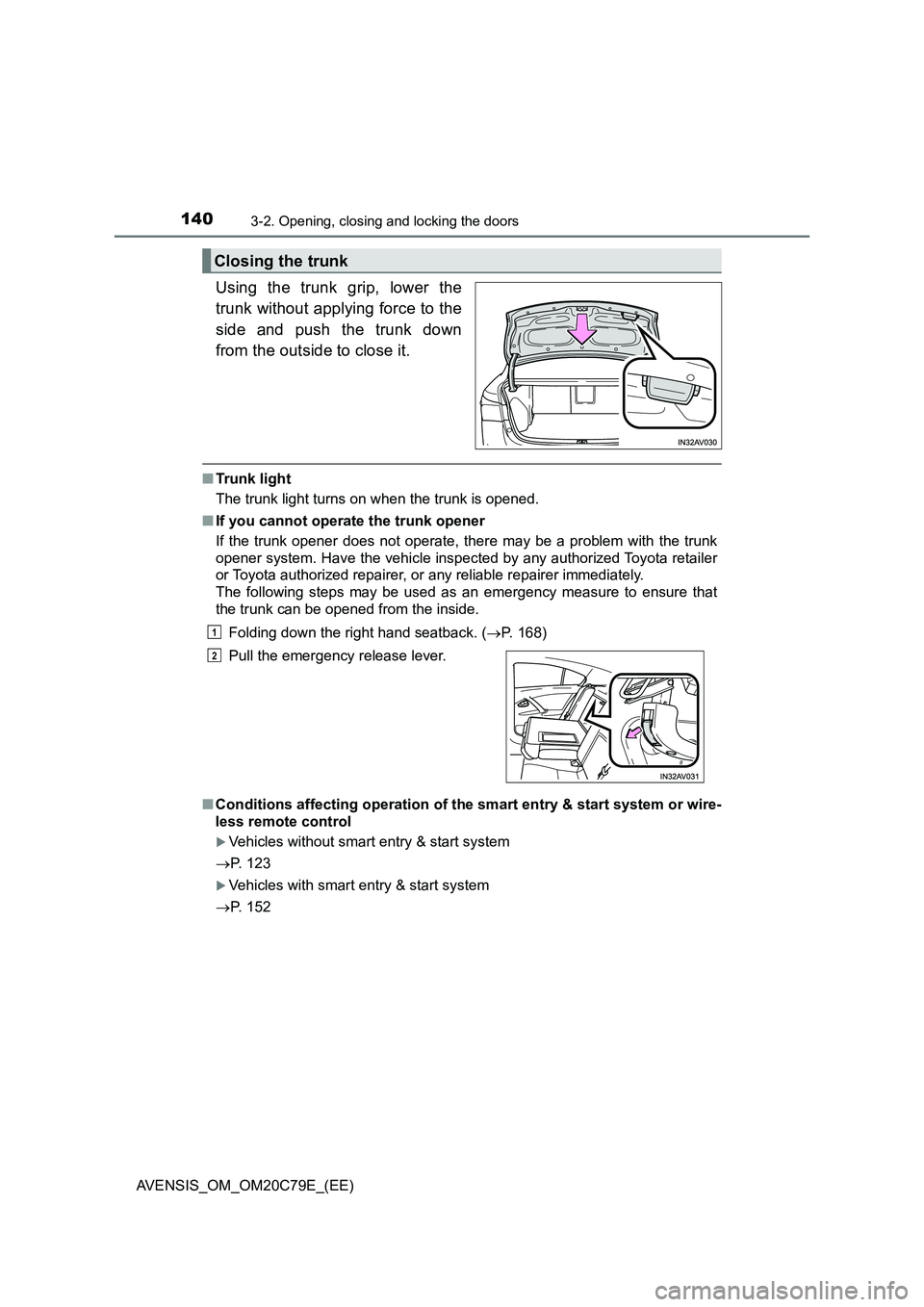
Using the trunk grip, lower the
trunk without applying force to the
side and push the trunk down
from the outside to close it.
■Trunk light
The trunk light turns on when the trunk is opened.
■If you cannot operate the trunk opener
If the trunk opener does not operate, there may be a problem with the trunk
opener system. Have the vehicle inspected by any authorized Toyota retailer
or Toyota authorized repairer, or any reliable repairer immediately.
The following steps may be used as an emergency measure to ensure that
the trunk can be opened from the inside.
Folding down the right hand seatback. (P. 168)
■Conditions affecting operation of the smart entry & start system or wire-
less remote control
Vehicles without smart entry & start system
P. 123
Vehicles with smart entry & start system
P. 152
Closing the trunk
Pull the emergency release lever.
1
2
Page 143 of 660
143
3
3-2. Opening, closing and locking the doors
Operation of each component
AVENSIS_OM_OM20C79E_(EE)
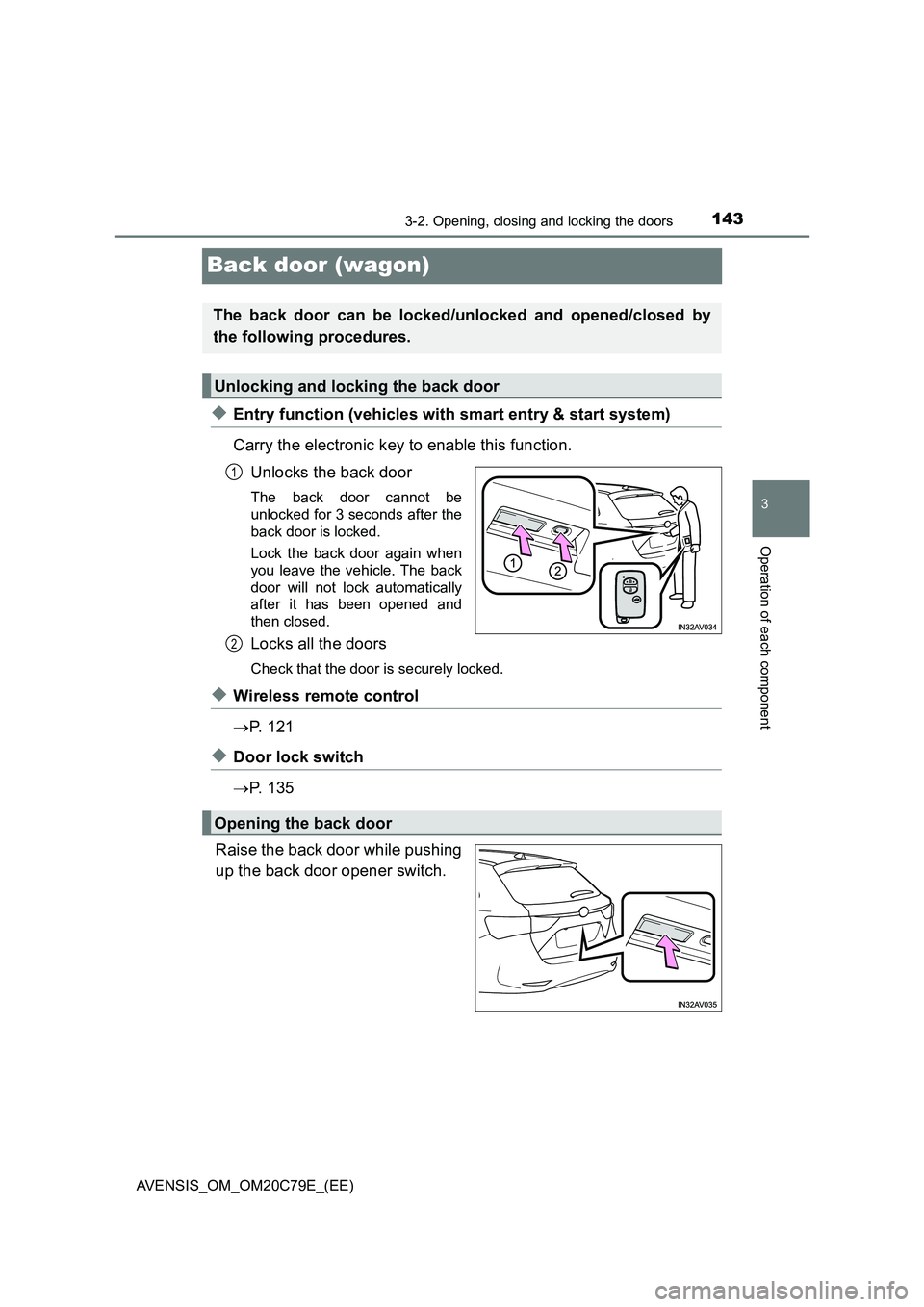
Back door (wagon)
◆Entry function (vehicles with smart entry & start system)
Carry the electronic key to enable this function.
Unlocks the back door
The back door cannot be
unlocked for 3 seconds after the
back door is locked.
Lock the back door again when
you leave the vehicle. The back
door will not lock automatically
after it has been opened and
then closed.
Locks all the doors
Check that the door is securely locked.
◆Wireless remote control
P. 1 2 1
◆Door lock switch
P. 1 3 5
Raise the back door while pushing
up the back door opener switch.
The back door can be locked/unlocked and opened/closed by
the following procedures.
Unlocking and locking the back door
1
2
Opening the back door
Page 144 of 660
1443-2. Opening, closing and locking the doors
AVENSIS_OM_OM20C79E_(EE)
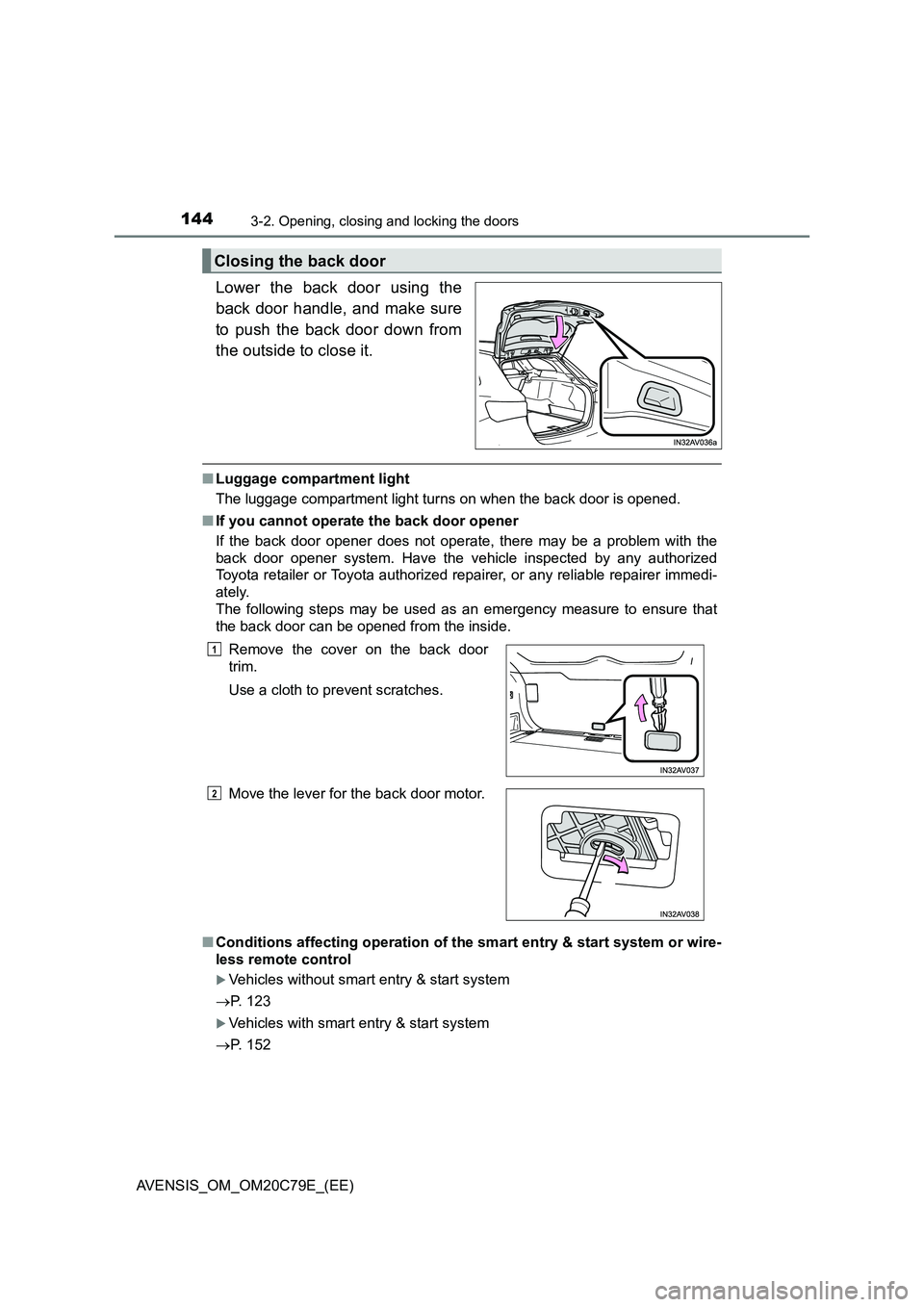
Lower the back door using the
back door handle, and make sure
to push the back door down from
the outside to close it.
■Luggage compartment light
The luggage compartment light turns on when the back door is opened.
■If you cannot operate the back door opener
If the back door opener does not operate, there may be a problem with the
back door opener system. Have the vehicle inspected by any authorized
Toyota retailer or Toyota authorized repairer, or any reliable repairer immedi-
ately.
The following steps may be used as an emergency measure to ensure that
the back door can be opened from the inside.
■Conditions affecting operation of the smart entry & start system or wire-
less remote control
Vehicles without smart entry & start system
P. 123
Vehicles with smart entry & start system
P. 152
Closing the back door
Remove the cover on the back door
trim.
Use a cloth to prevent scratches.
Move the lever for the back door motor.1
2
Page 152 of 660
1523-2. Opening, closing and locking the doors
AVENSIS_OM_OM20C79E_(EE)■Battery-saving function
In the following circumstances, the smart entry & start system is disabled in
order to prevent the vehicle and electronic key batteries from discharging.
●When the smart entry & start system has not been used for 5 days or more
●When the electronic key has been left within approximately 1 m (3 ft.) of the
vehicle for 10 minutes or more
The system will resume operation when...
●The vehicle is locked touching the door handle lock sensor area.
●The vehicle is locked/unlocked using the wireless remote control function.
(P. 133)
●The vehicle is locked/unlocked using the mechanical key. (P. 592)
■Conditions affecting operation
The smart entry & start system uses weak radio waves. In the following situa-
tions, the communication between the electronic key and the vehicle may be
affected, preventing the smart entry & start system and wireless remote con-
trol from operating properly. (Ways of coping: P. 592)
●When the electronic key battery is depleted
●Near a TV tower, electric power plant, gas station, radio station, large dis-
play, airport or other facility that generates strong radio waves or electrical
noise
●When carrying a portable radio, cellular phone, cordless phone or other
wireless communication devices
●When the electronic key is in contact with, or is covered by the following
metallic objects
• Cards to which aluminum foil is attached
• Cigarette boxes that have aluminum foil inside
• Metallic wallets or bags
• Coins
• Hand warmers made of metal
• Media such as CDs and DVDs
●When multiple electronic keys are in the vicinity
●When another wireless key (that emits radio waves) is being used nearby
●When carrying or using the electronic key together with the following
devices that emit radio waves
• Another vehicle’s electronic key or a wireless key that emits radio waves
• Personal computer or personal digital assistants (PDAs)
• Digital audio players
• Portable game systems
●If window tint with a metallic content or metallic objects are attached to the
rear window
●Sedan: If a metallic object is placed on the package tray
Page 153 of 660
1533-2. Opening, closing and locking the doors
3
Operation of each component
AVENSIS_OM_OM20C79E_(EE)■Note for the entry function
●Even when the electronic key is within the effective range (detection areas),
the system may not operate properly in the following cases.
• The electronic key is too close to the window or outside door handle, near
the ground, or in a high place when the doors are locked or unlocked.
• The electronic key is near the ground or in a high place, or too close to
the rear bumper center when the trunk or back door is locked/unlocked.
• The electronic key is on the instrument panel, package tray (sedan), lug-
gage cover (wagon), floor or in the glove box when the engine is started
or engine switch modes are changed.
●Do not leave the electronic key on top of the instrument panel or near the
door pockets when exiting the vehicle. Depending on the radio wave recep-
tion conditions, it may be detected by the antenna outside the cabin and the
door will become lockable from the outside, possibly trapping the electronic
key inside the vehicle.
●As long as the electronic key is within the effective range, the doors may be
locked or unlocked by anyone.
●Even if the electronic key is not inside the vehicle, it may be possible to start
the engine if the electronic key is near the window.
●The doors may unlock or lock if a large amount of water splashes on the
door handle, such as in the rain or in a car wash when the electronic key is
within the effective range. (The doors will automatically be locked after
approximately 30 seconds if the doors are not opened and closed.)
●If the key is kept near the vehicle while it is being washed, water applied to a
door handle may cause the door to lock and unlock repeatedly. In this event,
place the key in a location 2 m (6 ft.) or more from the vehicle, taking care
not to lose the key.
●If the key is inside the vehicle while it is being washed, water applied to a
door handle may cause a buzzer to sound and a message to be displayed.
In this event, locking all doors will cause the message to extinguish and the
buzzer to stop sounding.
●It may not be possible to lock the doors if the sensor area is covered by
mud, ice, snow etc. In this event, try locking again after cleaning the area, or
lock by touching the sensor area on the underside of the door handle.
●Gripping the door handle when wearing a glove may not unlock or lock the
door.
●If the wireless remote control is used to lock the doors when the electronic
key is near the vehicle, there is a possibility that the door may not be
unlocked by the smart entry & start system. (Use the wireless remote control
to unlock the doors.)
●A sudden approach to the effective range or door handle operation may pre-
vent the doors from being unlocked. In this case, return the door handle to
the original position and check that the doors unlock before pulling the door
handle again.
Page 154 of 660
1543-2. Opening, closing and locking the doors
AVENSIS_OM_OM20C79E_(EE)■When the vehicle is not driven for extended periods
To prevent theft of the vehicle, do not leave the electronic key within 2 m (6 ft.)
of the vehicle.
■To operate the system properly
Make sure to carry the electronic key when operating the system. Do not get
the electronic key too close to the vehicle when operating the system from the
outside of the vehicle.
Depending on the position and holding condition of the electronic key, the key
may not be detected correctly and the system may not operate properly. (The
alarm may go off accidentally, or the door lock prevention may not function.)
■If the smart entry & start system does not operate properly
●Locking and unlocking the doors: Use the mechanical key. (P. 592)
●Starting the engine: P. 593
■Customization
Settings (e.g. smart entry & start system) can be changed.
(Customizable features P. 629)
■If the smart entry & start system has been deactivated in a customized
setting
●Locking and unlocking the doors:
Use the wireless remote control or mechanical key. (P. 121, 592)
●Starting the engine and changing engine switch modes: P. 593
●Stopping the engine: P. 214
Page 384 of 660
3845-10. Bluetooth®
AVENSIS_OM_OM20C79E_(EE)■
About Bluetooth®
Bluetooth is a registered trade-
mark of Bluetooth SIG, Inc.
■Compatible models
●Bluetooth
® specifications:
Ver. 1.1, or higher (recommended: Ver. 2.1 + EDR or higher)
●Following Profiles:
• A2DP (Advanced Audio Distribution Profile) Ver. 1.0, or higher
(recommended: Ver. 1.2 or higher)
• AVRCP (Audio/Video Remote Control Profile) Ver. 1.0 or
higher (recommended: Ver. 1.3 or higher)
Portable players must correspond to the above specifications in
order to be connected to the Bluetooth
® audio system. However,
please note that some functions may be limited depending on the
type of portable player.
●Cellular phone
• HFP (Hands Free Profile) Ver. 1.0 or higher (Recommended:
Ver. 1.5)
• OPP (Object Push Profile) Ver. 1.1
• PBAP (Phone Book Access Profile) Ver. 1.0
Page 435 of 660
435
7Maintenance and care
AVENSIS_OM_OM20C79E_(EE)7-1. Maintenance and care
Cleaning and
protecting the
vehicle exterior ................ 436
Cleaning and
protecting the
vehicle interior ................. 440
7-2. Maintenance
Maintenance
requirements.................... 443
7-3. Do-it-yourself maintenance
Do-it-yourself service
precautions ...................... 446
Hood .................................. 450
Positioning a floor jack ....... 452
Engine compartment.......... 453
Tires ................................... 468
Tire inflation pressure ........ 486
Wheels ............................... 488
Air conditioning filter .......... 491
Wireless remote control/
electronic key battery....... 493
Checking and replacing
fuses ................................ 496
Light bulbs ......................... 501