Page 597 of 660
5978-2. Steps to take in an emergency
AVENSIS_OM_OM20C79E_(EE)
8
When trouble arises
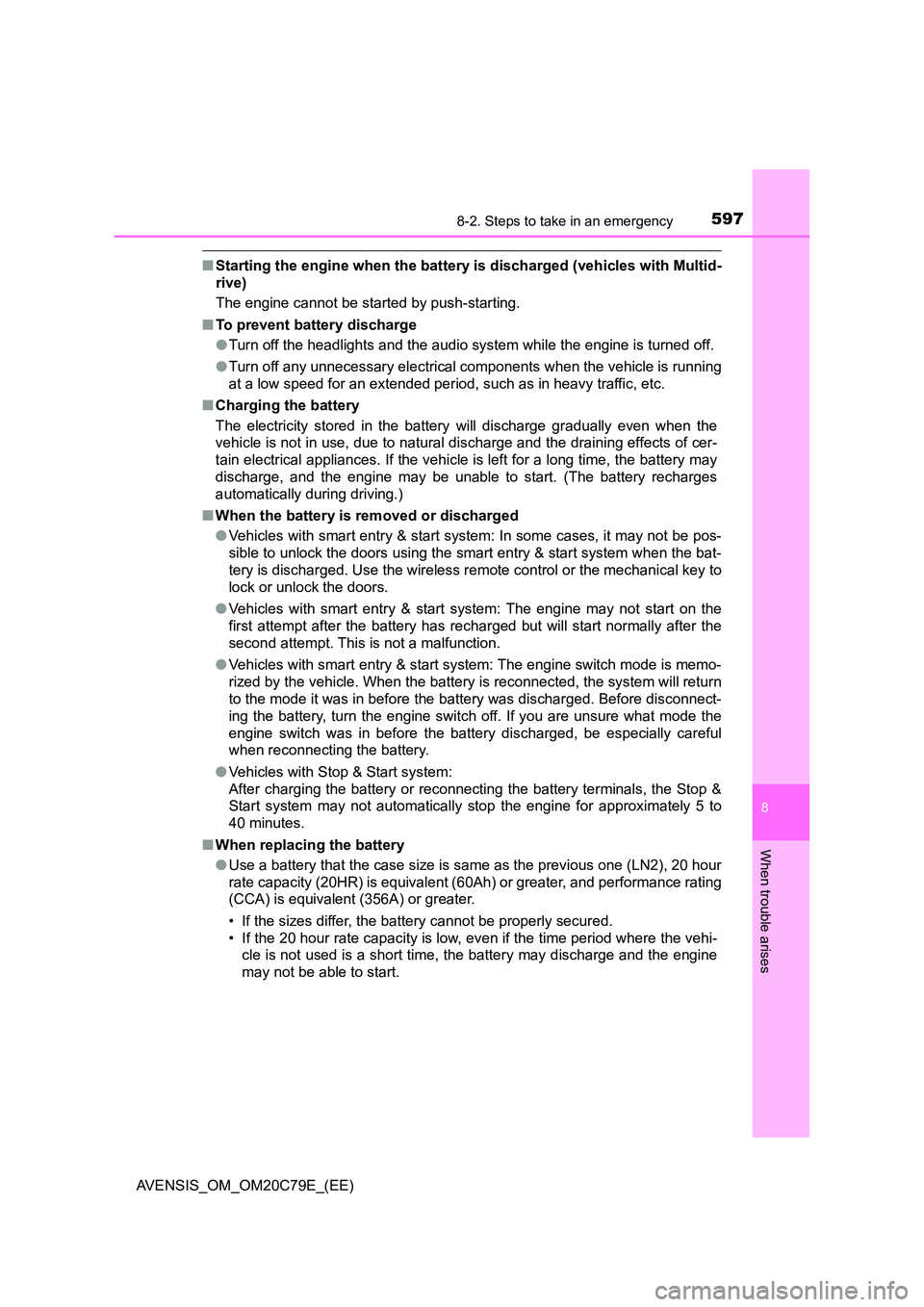
■Starting the engine when the battery is discharged (vehicles with Multid-
rive)
The engine cannot be started by push-starting.
■ To prevent battery discharge
● Turn off the headlights and the audio system while the engine is turned off.
● Turn off any unnecessary electrical components when the vehicle is running
at a low speed for an extended period, such as in heavy traffic, etc.
■ Charging the battery
The electricity stored in the battery will discharge gradually even when the
vehicle is not in use, due to natural discharge and the draining effects of cer-
tain electrical appliances. If the vehicle is left for a long time, the battery may
discharge, and the engine may be unable to start. (The battery recharges
automatically during driving.)
■ When the battery is removed or discharged
● Vehicles with smart entry & start system: In some cases, it may not be pos-
sible to unlock the doors using the smart entry & start system when the bat-
tery is discharged. Use the wireless remote control or the mechanical key to
lock or unlock the doors.
● Vehicles with smart entry & start system: The engine may not start on the
first attempt after the battery has recharged but will start normally after the
second attempt. This is not a malfunction.
● Vehicles with smart entry & start system: The engine switch mode is memo-
rized by the vehicle. When the battery is reconnected, the system will return
to the mode it was in before the battery was discharged. Before disconnect-
ing the battery, turn the engine switch off. If you are unsure what mode the
engine switch was in before the battery discharged, be especially careful
when reconnecting the battery.
● Vehicles with Stop & Start system:
After charging the battery or reconnecti ng the battery terminals, the Stop &
Start system may not automatically stop the engine for approximately 5 to
40 minutes.
■ When replacing the battery
● Use a battery that the case size is same as the previous one (LN2), 20 hour
rate capacity (20HR) is equivalent (60Ah) or greater, and performance rating
(CCA) is equivalent (356A) or greater.
• If the sizes differ, the battery cannot be properly secured.
• If the 20 hour rate capacity is low, even if the time period where the vehi-
cle is not used is a short time, the battery may discharge and the engine
may not be able to start.
Page 620 of 660
6209-1. Specifications
AVENSIS_OM_OM20C79E_(EE)
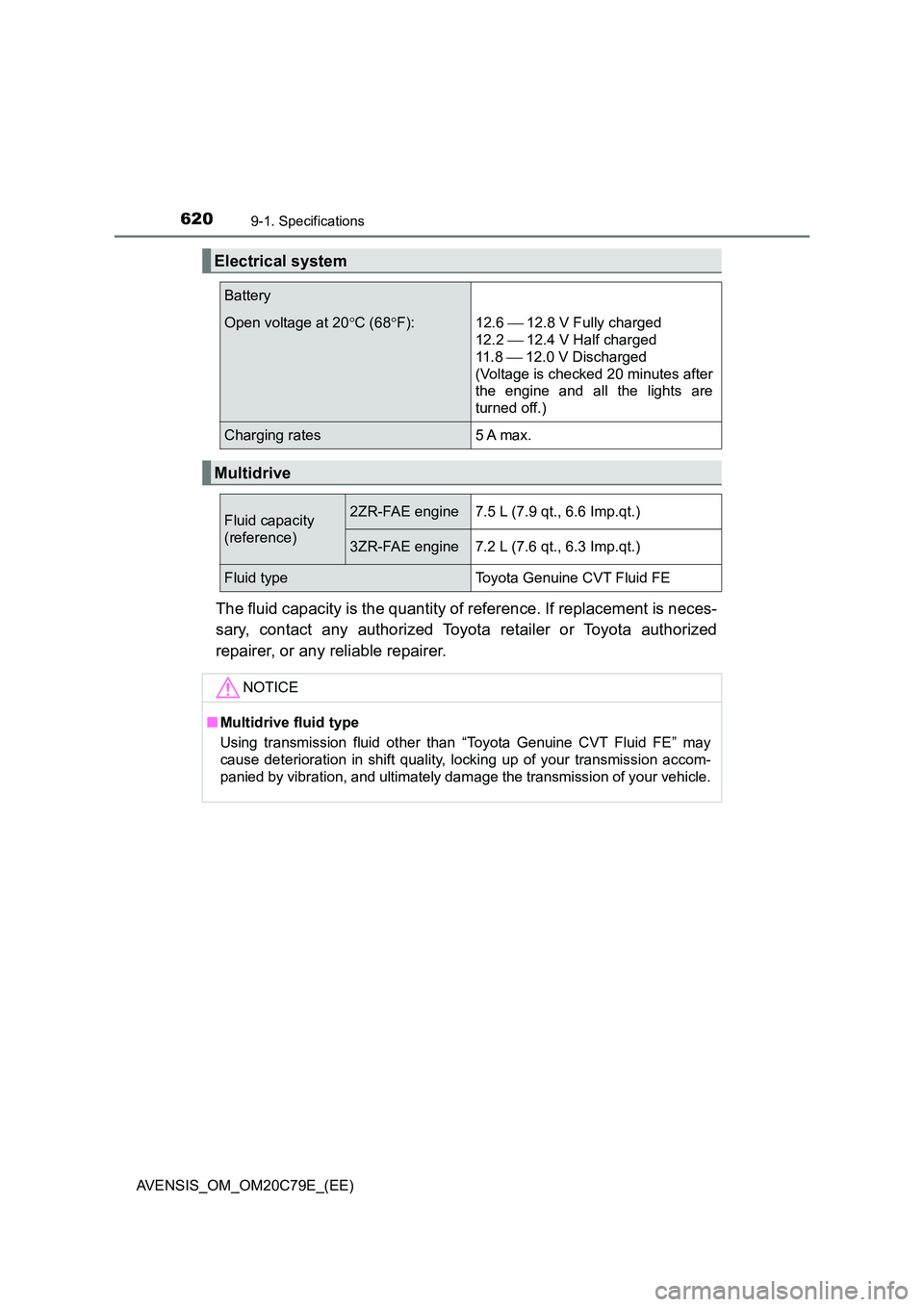
The fluid capacity is the quantity of reference. If replacement is neces-
sary, contact any authorized Toyota retailer or Toyota authorized
repairer, or any reliable repairer.
Electrical system
Battery
Open voltage at 20 C (68F): 12.6 12.8 V Fully charged
12.2 12.4 V Half charged
11 . 8 12.0 V Discharged
(Voltage is checked 20 minutes after
the engine and all the lights are
turned off.)
Charging rates 5 A max.
Multidrive
Fluid capacity
(reference)
2ZR-FAE engine7.5 L (7.9 qt., 6.6 Imp.qt.)
3ZR-FAE engine7.2 L (7.6 qt., 6.3 Imp.qt.)
Fluid typeToyota Genuine CVT Fluid FE
NOTICE
■ Multidrive fluid type
Using transmission fluid other than “Toyota Genuine CVT Fluid FE” may
cause deterioration in shift quality, locking up of your transmission accom-
panied by vibration, and ultimately dam age the transmission of your vehicle.
Page 657 of 660
657Alphabetical index
AVENSIS_OM_OM20C79E_(EE)
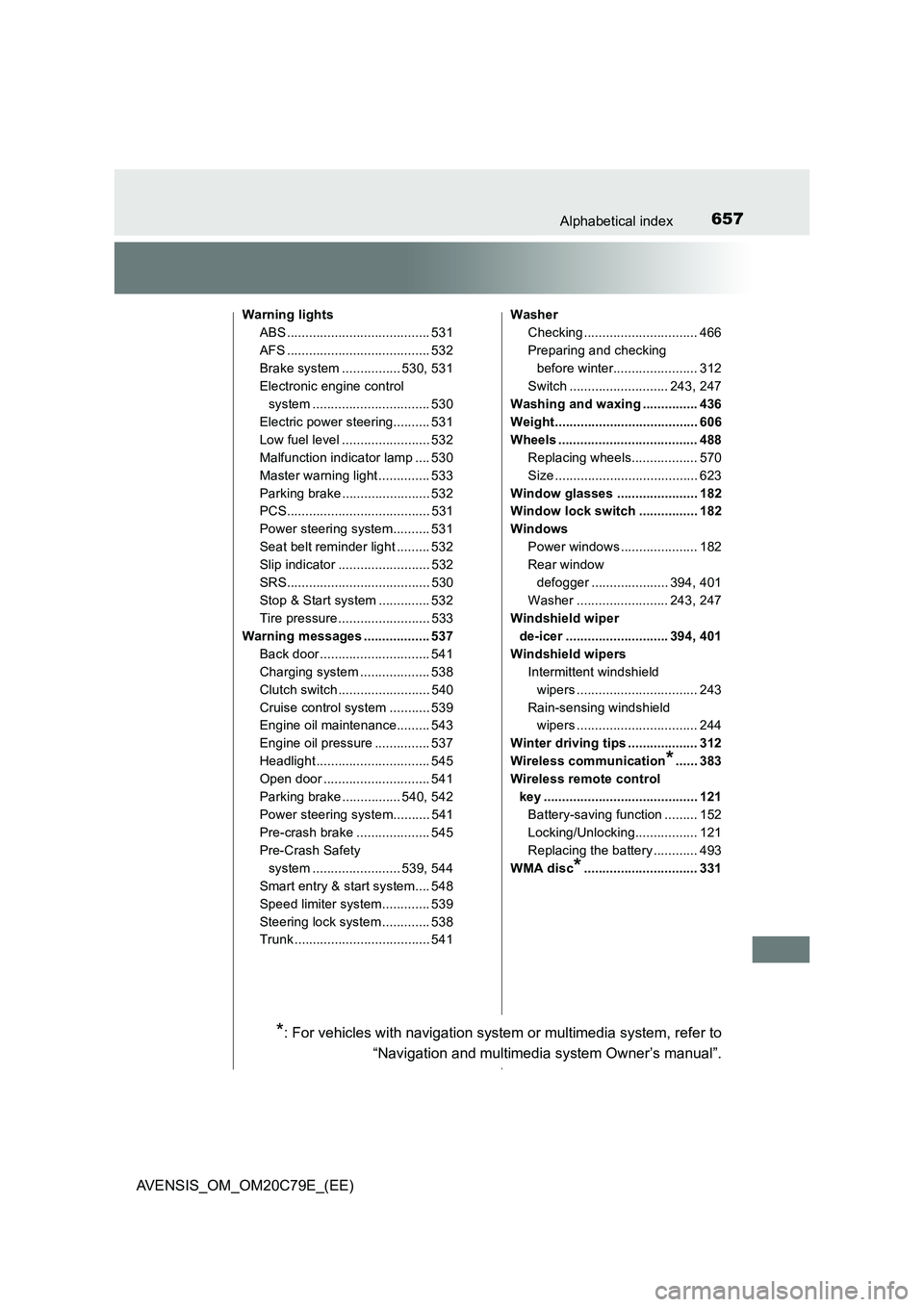
Warning lights
ABS ....................................... 531
AFS ....................................... 532
Brake system ................ 530, 531
Electronic engine control
system ................................ 530
Electric power steering.......... 531
Low fuel level ........................ 532
Malfunction indicator lamp .... 530
Master warning light .............. 533
Parking brake ........................ 532
PCS....................................... 531
Power steering system.......... 531
Seat belt reminder light ......... 532
Slip indicator ......................... 532
SRS....................................... 530
Stop & Start system .............. 532
Tire pressure ......................... 533
Warning messages .................. 537
Back door .............................. 541
Charging system ................... 538
Clutch switch ......................... 540
Cruise control system ........... 539
Engine oil maintenance......... 543
Engine oil pressure ............... 537
Headlight ............................... 545
Open door ............................. 541
Parking brake ................ 540, 542
Power steering system.......... 541
Pre-crash brake .................... 545
Pre-Crash Safety
system ........................ 539, 544
Smart entry & start system.... 548
Speed limiter system............. 539
Steering lock system ............. 538
Trunk ..................................... 541Washer
Checking ............................... 466
Preparing and checking
before winter....................... 312
Switch ........................... 243, 247
Washing and waxing ............... 436
Weight....................................... 606
Wheels ...................................... 488
Replacing wheels.................. 570
Size ....................................... 623
Window glasses ...................... 182
Window lock switch ................ 182
Windows
Power windows ..................... 182
Rear window
defogger ..................... 394, 401
Washer ......................... 243, 247
Windshield wiper
de-icer ............................ 394, 401
Windshield wipers
Intermittent windshield
wipers ................................. 243
Rain-sensing windshield
wipers ................................. 244
Winter driving tips ................... 312
Wireless communication
*...... 383
Wireless remote control
key .......................................... 121
Battery-saving function ......... 152
Locking/Unlocking................. 121
Replacing the battery ............ 493
WMA disc
*............................... 331
*: For vehicles with navigation system or multimedia system, refer to
“Navigation and multimedia system Owner’s manual”.