2018 SUBARU WRX service
[x] Cancel search: servicePage 500 of 578

(521,1)
北米Model "A1700BE-B" EDITED: 2017/ 10/ 11
Front differential gear oil
(CVT models) and rear differ-
ential gear oilIt is not necessary to check the gear oil
level. Check that there are no cracks,
damage or leakage. However, have the oil
inspected by your SUBARU dealer ac-
cording to the maintenance schedule in
the“Warranty and Maintenance Booklet”.
Consult your SUBARU dealer for details.&Recommended grade and
viscosityEach oil manufacturer has its own base
oils and additives. Never use different
brands together. For details, refer to
“Manual transmission, front differential
and rear differential gear oil”F12-6.
CAUTION
Using a differential gear oil other
than the specified oil may cause a
decline in vehicle performance.
Power steering fluid (STI)&Checking the fluid levelThe power steering fluid expands greatly
as its temperature rises; the fluid level
differs according to fluid temperature.
Therefore, the reservoir tank has two
different checking ranges for hot and cold
fluids.
Check the power steering fluid level
monthly.
1. Park the vehicle on a level surface, and
stop the engine.
2. Check the fluid level of the reservoir
tank.
When the fluid is hot after the vehicle has
been run: Check that the oil level is
between“HOT MIN”and“HOT MAX”onthe surface of the reservoir tank.
When the fluid is cool before the vehicle is
run: Check that the oil level is between
“COLD MIN”and“COLD MAX”on the
surface of the reservoir tank.
3. If the fluid level is lower than the
applicable“MIN”line, add the recom-
mended fluid as necessary to bring the
level between the“MIN”and“MAX”line.
If the fluid level is extremely low, it may
indicate possible leakage. Consult your
SUBARU dealer for an inspection.
WARNING
Be careful not to burn yourself
because the fluid may be hot.
CAUTION
.When you add power steering
fluid, use only clean fluid, and
be careful not to allow any dirt
into the tank. And never use
different brands together.
.Be careful not to spill power
steering fluid when adding it. If
power steering fluid touches the
exhaust pipe, it may cause a bad
smell, smoke, and/or a fire. If
power steering fluid gets on the
–CONTINUED–
Maintenance and service/Front differential gear oil (CVT models) and rear differential gear oil
11-23
11
Page 501 of 578
(522,1)
北米Model "A1700BE-B" EDITED: 2017/ 10/ 11
exhaust pipe, be sure to wipe it
off.
&Recommended fluidRefer to“Fluids”F12-7.
Brake fluid&Checking the fluid level
WARNING
.Never let brake fluid contact your
eyes because brake fluid can be
harmful to your eyes. If brake
fluid gets in your eyes, immedi-
ately flush them thoroughly with
clean water. For safety, when
performing this work, wearing
eye protection is advisable.
.Brake fluid absorbs moisture
from the air. Any absorbed moist-
ure can cause a dangerous loss
of braking performance.
.If the vehicle requires frequent
refilling, there may be a leak. If
you suspect a problem, have the
vehicle checked at your SUBARU
dealer.
CAUTION
.When adding brake fluid, be care-
ful not to allow any dirt into the
reservoir.
.Never splash the brake fluid over
painted surfaces or rubber parts.Alcohol contained in the brake
fluid may damage them.
.Be careful not to spill brake fluid
when adding it. If brake fluid
touches the exhaust pipe, it may
cause a bad smell, smoke, and/or
a fire. If brake fluid gets on the
exhaust pipe, be sure to wipe it
off.
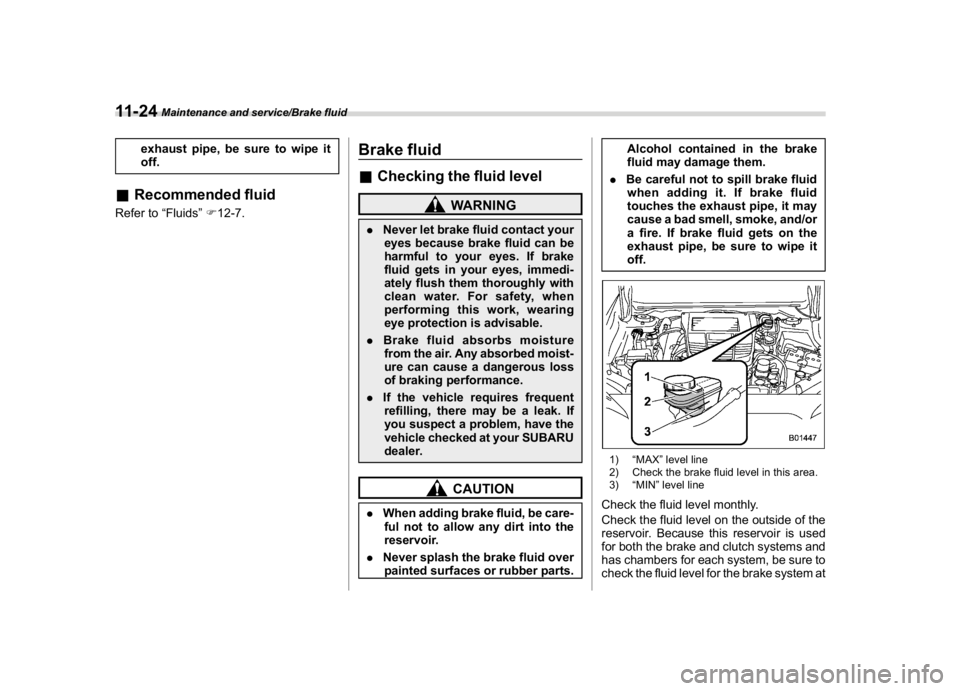
1)“MAX”level line
2) Check the brake fluid level in this area.
3)“MIN”level lineCheck the fluid level monthly.
Check the fluid level on the outside of the
reservoir. Because this reservoir is used
for both the brake and clutch systems and
has chambers for each system, be sure to
check the fluid level for the brake system at
Maintenance and service/Brake fluid
11-24
Page 502 of 578
(523,1)
北米Model "A1700BE-B" EDITED: 2017/ 10/ 11
thefront part of the reservoir(shaded
area in the illustration). If the fluid level is
below“MIN”, add the recommended brake
fluid to“MAX”.
Use only brake fluid from a sealed contain-
er.&Recommended brake fluidRefer to“Fluids”F12-7.
CAUTION
Never use different brands of brake
fluid together. Also, avoid mixing
DOT 3 and DOT 4 brake fluids even if
they are the same brand.
Clutch fluid (MT models)&Checking the fluid level
WARNING
Never let clutch fluid contact your
eyes because clutch fluid can be
harmful to your eyes. If clutch fluid
gets in your eyes, immediately flush
them thoroughly with clean water.
For safety, when performing this
work, wearing eye protection is
advisable.
CAUTION
.Clutch fluid absorbs moisture
from the air. Any absorbed moist-
ure can cause improper clutch
operation.
.If the vehicle requires frequent
refilling, there may be a leak. If
you suspect a problem, have the
vehicle checked at your SUBARU
dealer.
.When you add clutch fluid, be
careful not to allow any dirt into
the tank.
.Never splash the clutch fluid over
painted surfaces or rubber parts.Alcohol contained in the clutch
fluid may damage them.
.Be careful not to spill clutch fluid
when adding it. If clutch fluid
touches the exhaust pipe, it may
cause a bad smell, smoke, and/or
a fire. If clutch fluid gets on the
exhaust pipe, be sure to wipe it
off.
.Check the fluid level for the clutch
system at the inboard side of the
reservoir. You cannot check the
fluid level at the outboard side of
the reservoir.
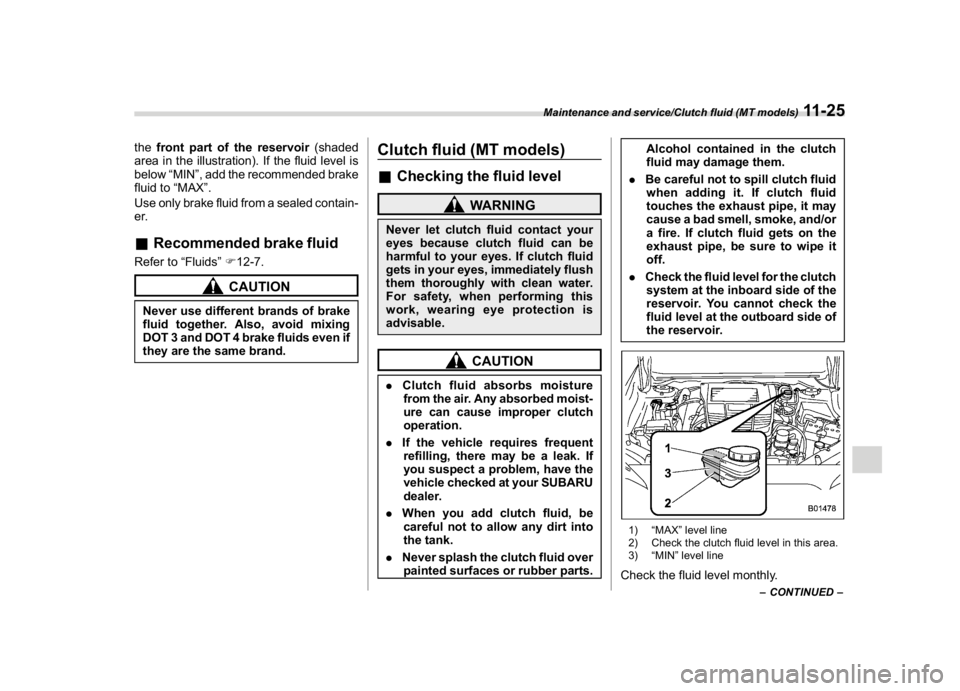
1)“MAX”level line
2) Check the clutch fluid level in this area.
3)“MIN”level lineCheck the fluid level monthly.
–CONTINUED–
Maintenance and service/Clutch fluid (MT models)
11-25
11
Page 503 of 578

(524,1)
北米Model "A1700BE-B" EDITED: 2017/ 10/ 11
Check the fluid level on the outside of the
reservoir. Because this reservoir is used
for both the brake and clutch systems and
has chambers for each system, be sure to
check the fluid level for the clutch system
at theinboard side of the reservoir
(shaded area in the illustration). If the fluid
level is below“MIN”, add the recom-
mended clutch fluid to“MAX”.
Use only clutch fluid from a sealed contain-
er.&Recommended clutch fluidRefer to“Fluids”F12-7.
CAUTION
Never use different brands of clutch
fluid together. Also, avoid mixing
DOT 3 and DOT 4 brake fluids even if
they are the same brand.
Brake boosterIf the brake booster does not operate as
described in the following, have it checked
by your SUBARU dealer.
1. With the engine off, depress the brake
pedal several times, applying the same
pedal force each time. The distance the
pedal travels should not vary.
2. With the brake pedal depressed, start
the engine. The pedal should move slightly
down to the floor.
3. With the brake pedal depressed, stop
the engine and keep the pedal depressed
for 30 seconds. The pedal height should
not change.
4. Start the engine again and run for
approximately one minute then turn it off.
Depress the brake pedal several times to
check the brake booster. The brake
booster operates properly if the pedal
stroke decreases with each depression.NOTEWhen you depress the brake pedal
strongly or suddenly, you might feel
that lighter depression of the brake
pedal generates a greater braking
force. However, even though these
occur, they do not indicate any mal-
functions, and the brake assist systemis operating properly.
Brake assist is not a system that brings
more braking ability to the vehicle
beyond its breaking capability.
Maintenance and service/Brake booster
11-26
Page 504 of 578
(525,1)
北米Model "A1700BE-B" EDITED: 2017/ 10/ 11
Brake pedalCheck the brake pedal free play and
reserve distance according to the main-
tenance schedule in the“Warranty and
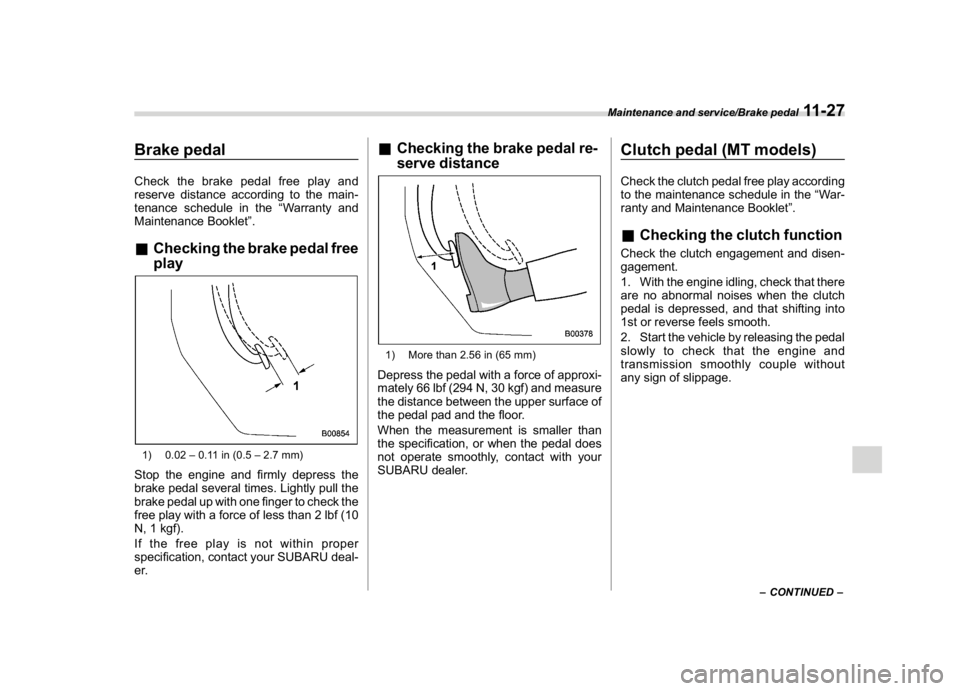
Maintenance Booklet”.&Checking the brake pedal free
play1) 0.02–0.11 in (0.5–2.7 mm)Stop the engine and firmly depress the
brake pedal several times. Lightly pull the
brake pedal up with one finger to check the
free play with a force of less than 2 lbf (10
N, 1 kgf).
If the free play is not within proper
specification, contact your SUBARU deal-
er.
&Checking the brake pedal re-
serve distance1) More than 2.56 in (65 mm)Depress the pedal with a force of approxi-
mately 66 lbf (294 N, 30 kgf) and measure
the distance between the upper surface of
the pedal pad and the floor.
When the measurement is smaller than
the specification, or when the pedal does
not operate smoothly, contact with your
SUBARU dealer.
Clutch pedal (MT models)Check the clutch pedal free play according
to the maintenance schedule in the“War-
ranty and Maintenance Booklet”.&Checking the clutch functionCheck the clutch engagement and disen-
gagement.
1. With the engine idling, check that there
are no abnormal noises when the clutch
pedal is depressed, and that shifting into
1st or reverse feels smooth.
2. Start the vehicle by releasing the pedal
slowly to check that the engine and
transmission smoothly couple without
any sign of slippage.
–CONTINUED–
Maintenance and service/Brake pedal
11-27
11
Page 505 of 578

(526,1)
北米Model "A1700BE-B" EDITED: 2017/ 10/ 11
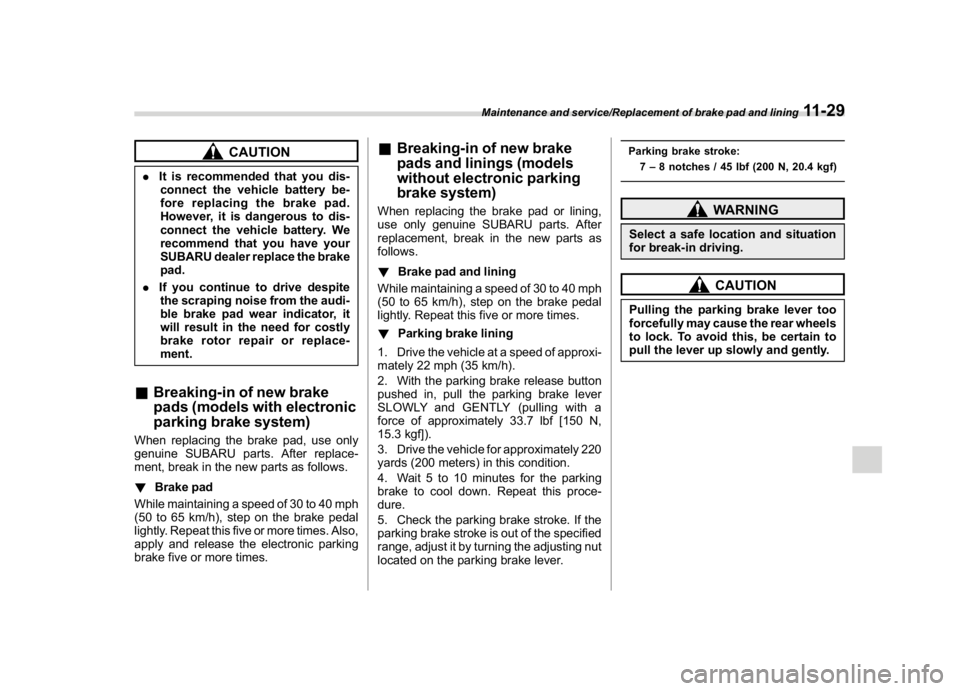
&Checking the clutch pedal
free play1) 0.16–0.43 in (4.0–11.0 mm)Lightly depress the clutch pedal down with
your finger until you feel resistance, and
check the free play.
If the free play is not within proper
specification, contact your SUBARU deal-
er.
Hill start assist systemEnsure that the Hill start assist system
operates properly under the following
circumstances.
1. Stop the vehicle on an uphill grade by
depressing the brake pedal (all models)
and clutch pedal (MT models only), with
the engine running.
2. Make sure that the vehicle does not
move backward for several seconds after
the brake pedal is released.
3. Then make sure the vehicle starts
climbing the grade by following the normal
starting procedures.
If the Hill start assist system does not
operate as described above, contact your
SUBARU dealer.
Replacement of brake pad
and liningThe disc brakes have audible wear in-
dicators on the brake pads. If the brake
pads wear close to their service limit, the
wear indicator makes a very audible
scraping noise when the brake pedal is
applied.
If you hear this scraping noise each time
you apply the brake pedal, have the brake
pads serviced by your SUBARU dealer as
soon as possible.
Maintenance and service/Hill start assist system
11-28
Page 506 of 578
(527,1)
北米Model "A1700BE-B" EDITED: 2017/ 10/ 11
CAUTION
.It is recommended that you dis-
connect the vehicle battery be-
fore replacing the brake pad.
However, it is dangerous to dis-
connect the vehicle battery. We
recommend that you have your
SUBARU dealer replace the brake
pad.
.If you continue to drive despite
the scraping noise from the audi-
ble brake pad wear indicator, it
will result in the need for costly
brake rotor repair or replace-
ment.&Breaking-in of new brake
pads (models with electronic
parking brake system)When replacing the brake pad, use only
genuine SUBARU parts. After replace-
ment, break in the new parts as follows.
!Brake pad
While maintaining a speed of 30 to 40 mph
(50 to 65 km/h), step on the brake pedal
lightly. Repeat this five or more times. Also,
apply and release the electronic parking
brake five or more times.
&Breaking-in of new brake
pads and linings (models
without electronic parking
brake system)When replacing the brake pad or lining,
use only genuine SUBARU parts. After
replacement, break in the new parts as
follows.
!Brake pad and lining
While maintaining a speed of 30 to 40 mph
(50 to 65 km/h), step on the brake pedal
lightly. Repeat this five or more times.
!Parking brake lining
1. Drive the vehicle at a speed of approxi-
mately 22 mph (35 km/h).
2. With the parking brake release button
pushed in, pull the parking brake lever
SLOWLY and GENTLY (pulling with a
force of approximately 33.7 lbf [150 N,
15.3 kgf]).
3. Drive the vehicle for approximately 220
yards (200 meters) in this condition.
4. Wait 5 to 10 minutes for the parking
brake to cool down. Repeat this proce-
dure.
5. Check the parking brake stroke. If the
parking brake stroke is out of the specified
range, adjust it by turning the adjusting nut
located on the parking brake lever.
Parking brake stroke:
7–8 notches / 45 lbf (200 N, 20.4 kgf)
WARNING
Select a safe location and situation
for break-in driving.
CAUTION
Pulling the parking brake lever too
forcefully may cause the rear wheels
to lock. To avoid this, be certain to
pull the lever up slowly and gently.
Maintenance and service/Replacement of brake pad and lining
11-29
11
Page 507 of 578

(528,1)
北米Model "A1700BE-B" EDITED: 2017/ 10/ 11
Parking brake stroke (models
without electronic parking
brake system)Check the parking brake stroke according
to the maintenance schedule in the“War-
ranty and Maintenance Booklet”.
When the parking brake is properly ad-
justed, braking power is fully applied by
pulling the lever up 7 to 8 notches gently
but firmly (approximately 45 lbf [200 N,
20.4 kgf]). If the parking brake lever stroke
is not within the specified range, have the
brake system checked and adjusted at
your SUBARU dealer.
Tires and wheels&Types of tiresYou should be familiar with type of tires
present on your vehicle.
!All season tires
All season tires are designed to provide an
adequate measure of traction, handling
and braking performance in year-round
driving including snowy and icy road
conditions. However all season tires do
not offer as much traction performance as
winter (snow) tires in heavy or loose snow
or on icy roads.
All season tires are identified by“ALL
SEASON”and/or“M+S”(Mud & Snow) on
the tire sidewall.
!Summer tires
Summer tires are high-speed capability
tires best suited for highway driving under
dry conditions.
Summer tires are inadequate for driving on
slippery roads such as on snow-covered or
icy roads.
If you drive your vehicle on snow-covered
or icy roads, we strongly recommend the
use of winter (snow) tires.
When installing winter tires, be sure to
replace all four tires.!Winter (snow) tires
Winter tires are best suited for driving on
snow-covered and icy roads. However
winter tires do not perform as well as
summer tires and all season tires on roads
other than snow-covered and icy roads.
&Tire pressure monitoring
system (TPMS) (if equipped)The tire pressure monitoring system pro-
vides the driver with a warning message by
sending a signal from a sensor that is
installed in each wheel when tire pressure
is severely low. The tire pressure monitor-
ing system will activate only when the
vehicle is driven. Also, this system may not
react immediately to a sudden drop in tire
pressure (for example, a blow-out caused
by running over a sharp object).
Maintenance and service/Parking brake stroke (models without electronic parking brake system)
11-30