2018 SUBARU WRX change time
[x] Cancel search: change timePage 468 of 578
(485,1)
北米Model "A1700BE-B" EDITED: 2017/ 10/ 11
“ACC”
.Under other conditions:“ON”
5. When the keyless access with push-
button start system is deactivated, press
the push-button ignition switch with the
clutch pedal (MT models) or brake pedal
(CVT models) released. The status of the
push-button ignition switch then changes
to“ON”.
NOTEIf the power does not switch even
though the above procedure was fol-
lowed precisely, contact your SUBARU
dealer.
&Starting engine1. Apply the parking brake.
2. Shift the shift lever into neutral (MT
models) or the select lever into the“P”
position (CVT models).
3. Depress the brake pedal (all models).
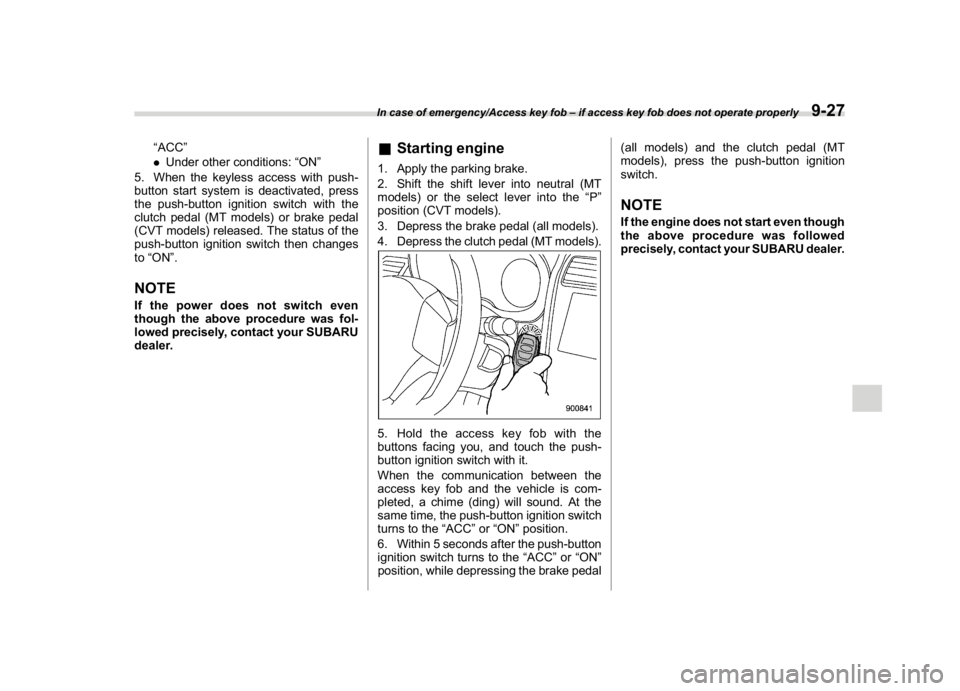
4. Depress the clutch pedal (MT models).5. Holdtheaccesskeyfobwiththe
buttons facing you, and touch the push-
button ignition switch with it.
When the communication between the
access key fob and the vehicle is com-
pleted, a chime (ding) will sound. At the
same time, the push-button ignition switch
turns to the“ACC”or“ON”position.
6. Within 5 seconds after the push-button
ignition switch turns to the“ACC”or“ON”
position, while depressing the brake pedal(all models) and the clutch pedal (MT
models), press the push-button ignition
switch.
NOTEIf the engine does not start even though
the above procedure was followed
precisely, contact your SUBARU dealer.
In case of emergency/Access key fob–if access key fob does not operate properly
9-27
9
Page 472 of 578

(491,1)
北米Model "A1700BE-B" EDITED: 2017/ 10/ 11
CAUTION
.Be careful not to damage brake
hoses, sensor harnesses, and
other parts when washing sus-
pension components.
.Be careful not to flush the engine
bottom for a long time. It may
cause damage of some electrical
parts.
!Using a warm water washer
.Keep a good distance of 12 in (30 cm)
or more between the washer nozzle and
the vehicle.
.Do not wash the same area continu-
ously.
.If a stain will not come out easily, wash
by hand. Some warm water washers are of
the high temperature, high pressure type,
and they can damage or deform the resin
parts such as moldings, or cause water to
leak into the vehicle.!Precautions for TYPE RA
!Precautions when cleaning the
carbon roof and rear wing
CAUTION
.When cleaning, take care that you
do not apply strong force to a
single point. Depending on the
degree of force and the location,
there is the risk of denting the
carbon roof or rear wing.
.After acid rain falls, it is recom-
mended that the vehicle be
washed before the water on the
paint evaporates.
.Promptly wash off any bird drop-
pings, insects, pollen, tree sap, or
similar substance that adheres to
the paint. If it is not promptly
washed off, it may penetrate the
paint.
.Remove any dirt using a neutral deter-
gent. Do not use hard brushes or abrasive
cleaners. Do not use strong or harsh
chemical cleaners.
.As the CFRP parts may change color if
they are exposed to ultraviolet rays for
extended periods of time, we recommend
that your vehicle be stored in a placewhere it will not be exposed to direct
sunlight.
.Do not use wax that contains abrasives.
NOTEDue to the characteristics of the carbon
roof, white cloudy areas may occur in
spots on the roof, however these do not
affect performance in any way.
!Precautions when cleaning
around the rear bumper cherry
red stripeRear bumper cherry red stripePrecautions when using a high-pres-
sure washer:
.Keep a distance of 12 in (30 cm) or
more between the washer nozzle and the
stripe.
–CONTINUED–
Appearance care/Exterior care
10-3
10
Page 490 of 578

(511,1)
北米Model "A1700BE-B" EDITED: 2017/ 10/ 11
Engine oil
CAUTION
.If the level gauge is not pulled out
easily, twist the level gauge right
and left, then pull it out. Other-
wise, you may be injured acci-
dentally straining yourself.
.Use only engine oil with the
recommended grade and vis-
cosity.
.Be careful not to spill engine oil
when adding it. If oil touches the
exhaust pipe, it may cause a bad
smell, smoke, and/or a fire. If
engine oil gets on the exhaust
pipe, be sure to wipe it off.&Engine oil consumptionSome engine oil will be consumed while
driving. The rate of consumption can be
affected by such factors as transmission
type, driving style, terrain and tempera-
ture. Under the following conditions, oil
consumption can be increased and thus
require refilling between maintenance in-
tervals:
.When the engine is new and within the
break-in period.When the engine oil is of lower quality
.When the incorrect oil viscosity is used
.When engine braking is employed
(repeatedly)
.When the engine is operated at high
engine speeds (for extended periods of
time)
.When the engine is operated under
heavy loads (for extended periods of time)
.When the engine idles for extended
periods of time
.When the vehicle is operated in stop
and go and/or heavy traffic situations
.When the vehicle is used under severe
thermal conditions
.When the vehicle accelerates and
decelerates frequently
Under these or similar conditions, you
should check your oil at least every 2nd
fuel fill-up and change your engine oil more
frequently. Different drivers in the same
car may experience different results. If
your oil consumption rate is greater than
expected, contact your authorized
SUBARU retailer who may perform a test
under controlled conditions.
&Checking the oil level1. Park the vehicle on a level surface and
stop the engine. If you check the oil level
just after stopping the engine, wait a few
minutes for the oil to drain back into the oil
pan before checking the level.STI
1) Oil level gauge
2) Oil filler cap
–CONTINUED–Maintenance and service/Engine oil
11-13
11
Page 503 of 578

(524,1)
北米Model "A1700BE-B" EDITED: 2017/ 10/ 11
Check the fluid level on the outside of the
reservoir. Because this reservoir is used
for both the brake and clutch systems and
has chambers for each system, be sure to
check the fluid level for the clutch system
at theinboard side of the reservoir
(shaded area in the illustration). If the fluid
level is below“MIN”, add the recom-
mended clutch fluid to“MAX”.
Use only clutch fluid from a sealed contain-
er.&Recommended clutch fluidRefer to“Fluids”F12-7.
CAUTION
Never use different brands of clutch
fluid together. Also, avoid mixing
DOT 3 and DOT 4 brake fluids even if
they are the same brand.
Brake boosterIf the brake booster does not operate as
described in the following, have it checked
by your SUBARU dealer.
1. With the engine off, depress the brake
pedal several times, applying the same
pedal force each time. The distance the
pedal travels should not vary.
2. With the brake pedal depressed, start
the engine. The pedal should move slightly
down to the floor.
3. With the brake pedal depressed, stop
the engine and keep the pedal depressed
for 30 seconds. The pedal height should
not change.
4. Start the engine again and run for
approximately one minute then turn it off.
Depress the brake pedal several times to
check the brake booster. The brake
booster operates properly if the pedal
stroke decreases with each depression.NOTEWhen you depress the brake pedal
strongly or suddenly, you might feel
that lighter depression of the brake
pedal generates a greater braking
force. However, even though these
occur, they do not indicate any mal-
functions, and the brake assist systemis operating properly.
Brake assist is not a system that brings
more braking ability to the vehicle
beyond its breaking capability.
Maintenance and service/Brake booster
11-26
Page 513 of 578
(534,1)
北米Model "A1700BE-B" EDITED: 2017/ 10/ 11
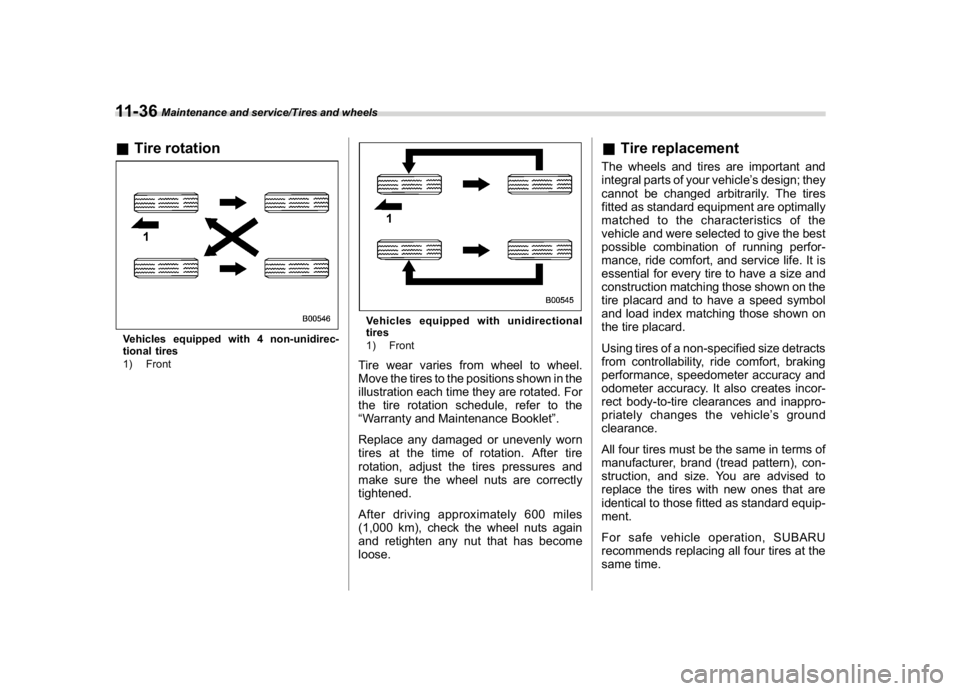
&Tire rotationVehicles equipped with 4 non-unidirec-
tional tires
1) Front
Vehicles equipped with unidirectional
tires
1) FrontTire wear varies from wheel to wheel.
Move the tires to the positions shown in the
illustration each time they are rotated. For
the tire rotation schedule, refer to the
“Warranty and Maintenance Booklet”.
Replace any damaged or unevenly worn
tires at the time of rotation. After tire
rotation, adjust the tires pressures and
make sure the wheel nuts are correctly
tightened.
After driving approximately 600 miles
(1,000 km), check the wheel nuts again
and retighten any nut that has become
loose.
&Tire replacementThe wheels and tires are important and
integral parts of your vehicle’s design; they
cannot be changed arbitrarily. The tires
fitted as standard equipment are optimally
matched to the characteristics of the
vehicle and were selected to give the best
possible combination of running perfor-
mance, ride comfort, and service life. It is
essential for every tire to have a size and
construction matching those shown on the
tire placard and to have a speed symbol
and load index matching those shown on
the tire placard.
Using tires of a non-specified size detracts
from controllability, ride comfort, braking
performance, speedometer accuracy and
odometer accuracy. It also creates incor-
rect body-to-tire clearances and inappro-
priately changes the vehicle’s ground
clearance.
All four tires must be the same in terms of
manufacturer, brand (tread pattern), con-
struction, and size. You are advised to
replace the tires with new ones that are
identical to those fitted as standard equip-
ment.
For safe vehicle operation, SUBARU
recommends replacing all four tires at the
same time.
Maintenance and service/Tires and wheels
11-36