2018 SUBARU WRX warning
[x] Cancel search: warningPage 36 of 578

(37,1)
北米Model "A1700BE-B" EDITED: 2017/ 10/ 11
&Power seat (driver’s seat–if
equipped)1)Seat position forward/backward con-
trol switch
To adjust the seat forward or backward,
move the control switch forward or
backward. During forward/backward ad-justment of the seat, you cannot adjust
the seat cushion angle or seat cushion
height.
2)Seat cushion angle control switch
To adjust the seat cushion angle, pull up
or push down the front end of the control
switch.
3)Seat height control switch
To adjust the seat height, pull up or push
down the rear end of the control switch.
4)Seatback angle (reclining) control
switch
To adjust the angle of the seatback, move
the control switch.
5)Lumbar support control switch (dri-
ver’s seat only)
To increase lower back support, push the
front side of the switch. To decrease
lower back support, push the rear side of
the switch.
&Head restraint adjustment
WARNING
.Never drive the vehicle with the
head restraints removed because
they are designed to reduce the
risk of serious neck injury in the
event that the vehicle is struck
from the rear. Also, never install
the head restraints the opposite
way round. Doing so will prevent
the head restraints from function-ing as intended. Therefore, when
you remove the head restraints,
you must reinstall all head re-
straints correctly to protect vehi-
cle occupants.
.All occupants, including the dri-
ver, should not operate a vehicle
or sit in a vehicle’s seat until the
head restraints are placed in their
proper positions in order to mini-
mize the risk of neck injury in the
event of a crash.
.The front seat head restraints are
designed to be installed into the
front seats only. The rear seat
head restraints are designed to
be installed into the rear seats
only. Do not attempt to install the
front seat head restraints into the
rear seats, or the rear seat head
restraints into the front seats.
NOTEIt is possible to adjust the angle of the
front seat head restraints only. When
installing the front seat head restraints,
make sure that the angle of the head
restraints can be adjusted.
Both the driver’s seat and front passen-
ger’s seat are equipped with head re-
straints. Both head restraints are adjusta-
–CONTINUED–
Seat, seatbelt and SRS airbags/Front seats
1-5
1
Page 39 of 578

(40,1)
北米Model "A1700BE-B" EDITED: 2017/ 10/ 11
Rear seats
WARNING
Seatbelts provide maximum re-
straint when the occupant sits well
back and upright in the seat. Do not
put cushions or any other materials
between occupants and seatbacks
or seat cushions. If you do so, the
risk of sliding under the lap belt and
of the lap belt sliding up over the
abdomen will increase, and both can
result in serious internal injury or
death.
WARNING
Never stack luggage or other cargo
higher than the top of the seatback
because it could tumble forward and
injure passengers in the event of a
sudden stop or accident.
&Head restraint adjustmentBoth the rear window side seats and the
rear center seat are equipped with head
restraints.
WARNING
.Never drive the vehicle with the
head restraints removed because
they are designed to reduce the
risk of serious neck injury in the
event that the vehicle is struck
from the rear. Therefore, when
you have removed the head re-
straints, you must reinstall all
head restraints to protect vehicle
occupants.
.All occupants, including the dri-
ver, should not operate a vehicle
or sit in a vehicle’s seat until the
head restraints are placed in their
proper positions in order to mini-
mize the risk of neck injury in the
event of a crash.
Seat, seatbelt and SRS airbags/Rear seats
1-8
Page 41 of 578

(42,1)
北米Model "A1700BE-B" EDITED: 2017/ 10/ 11
When the rear-center seating position is
occupied, raise the head restraint to the
extended position. When the rear center
seating position is not occupied, lower the
head restraint to improve rearward visibi-
lity.&Folding down the rear seat-
back
WARNING
.When you fold down the seat-
back, check that there are no
passengers or objects on the rear
seat. Not doing so creates a risk
of injury or property damage if
the seatback suddenly folds
down.
.Never allow passengers to ride
on the folded rear seatback or in
the trunk. Doing so may result in
serious injury or death.
.Secure all objects and especially
long items properly to prevent
them from being thrown around
inside the vehicle and causing
serious injury during a sudden
stop, a sudden steering maneu-
ver or a rapid acceleration.
.When you return the seatback to
its original position, shake theseatback slightly to confirm that
it is securely fixed in place. If the
seatback is not securely fixed in
place, the seatback may sud-
denly fold down in the event of
sudden braking, or objects may
move out from the trunk, which
could cause serious injury or
death.
Lock release knob
1) Unlocked
2) Locked
A) Unlocking marker in red
1) Securing hook
WARNING
When the seatback is returned to its
original position, observe the fol-
Seat, seatbelt and SRS airbags/Rear seats
1-10
Page 42 of 578
(43,1)
北米Model "A1700BE-B" EDITED: 2017/ 10/ 11
lowing precautions. Failure to do so
may lead to serious injury or an
accident because the operation effi-
ciency of the seatbelt is inhibited.
.The seatbelt should not be
caught in the seatback and it
should be fully visible.
.The seatbelt should not pass
behind the securing hook for the
seatback.
CAUTION
Do not hang luggage etc. on the
securing hook. The possibility ex-
ists that the seatback may not be
able to be fixed firmly in place. This
could lead to unexpected accidents.
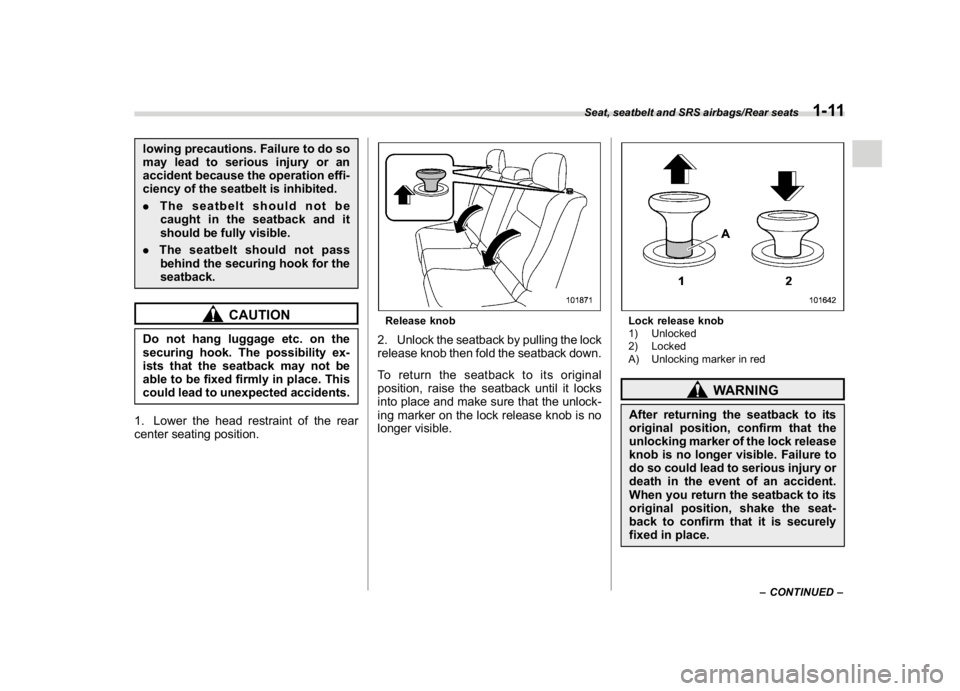
1. Lower the head restraint of the rear
center seating position.
Release knob2. Unlock the seatback by pulling the lock
release knob then fold the seatback down.
To return the seatback to its original
position, raise the seatback until it locks
into place and make sure that the unlock-
ing marker on the lock release knob is no
longer visible.
Lock release knob
1) Unlocked
2) Locked
A) Unlocking marker in red
WARNING
After returning the seatback to its
original position, confirm that the
unlocking marker of the lock release
knob is no longer visible. Failure to
do so could lead to serious injury or
death in the event of an accident.
When you return the seatback to its
original position, shake the seat-
back to confirm that it is securely
fixed in place.
–CONTINUED–
Seat, seatbelt and SRS airbags/Rear seats
1-11
1
Page 43 of 578

(44,1)
北米Model "A1700BE-B" EDITED: 2017/ 10/ 11
&Armrest (except TYPE RA)To lower the armrest, pull the armrest’s top
edge.
WARNING
.Make sure to have the rear pas-
sengers wear the seatbelts be-
fore lowering the armrest. If the
rear passengers wear the seat-
belts after lowering the armrest,
seatbelts cannot provide maxi-
mum restraint, causing serious
injuries.
.To avoid serious injury, never
allow passengers to sit on the
center armrest while the vehicle
is in motion.
Seatbelts&Seatbelt safety tips
WARNING
.All persons in the vehicle should
fasten their seatbelts BEFORE
the vehicle starts to move. Other-
wise, the possibility of serious
injury becomes greater in the
event of a sudden stop or acci-
dent.
.All belts should fit snugly in order
to provide full restraint. Loose
fitting belts are not as effective in
preventing or reducing injury.
.Each seatbelt is designed to sup-
port only one person. Never use a
single belt for two or more per-
sons–even children. Otherwise,
in an accident, serious injury or
death could result.
.Replace all seatbelt assemblies
including retractors and attach-
ing hardware worn by occupants
of a vehicle that has been in a
serious accident. Also, be sure to
replace seatbelt assemblies that
show signs of severe fraying or
having been cut. The entire as-
sembly should be replaced evenif damage is not obvious.
.Place children in the rear seat
properly restrained at all times.
The SRS airbag deploys with
considerable speed and force
and can injure or even kill chil-
dren, especially if they are not
restrained or improperly re-
strained. Because children are
lighter and weaker than adults,
their risk of being injured from
deployment is greater. For that
reason, we strongly recommend
thatALLchildren(including
those in child seats and those
that have outgrown child re-
straint devices) sit in the REAR
seat properly restrained at all
times in a child restraint device
or in a seatbelt, whichever is
appropriate for the child’s height
and weight.
Secure ALL types of child re-
straint devices (including for-
ward facing child seats) in the
REAR seats at all times.
NEVER INSTALL A FORWARD
OR REARWARD FACING CHILD
SEAT IN THE FRONT SEAT.
DOING SO RISKS SERIOUS IN-
JURY OR DEATH TO THE CHILD
BY PLACING THE CHILD’S HEAD
Seat, seatbelt and SRS airbags/Seatbelts
1-12
Page 45 of 578
(46,1)
北米Model "A1700BE-B" EDITED: 2017/ 10/ 11
retracted fully, the ALR mode is released.
When securing a child restraint system on
the rear seats by the use of the seatbelt,
change the seatbelt over to the Automatic
Locking Retractor (ALR) mode.
After removing the child restraint system,
make sure that the seatbelt retracts fully
and the retractor returned to the Emer-
gency Locking Retractor (ELR) mode.
For instructions on how to convert the
retractor to the ALR mode and restore it to
the ELR mode, refer to“Installing child
restraint systems with ALR/ELR seatbelt”
F1-25.&Seatbelt warning light
and chimeRefer to“Seatbelt warning light and chime”
F3-14.&Fastening the seatbelt
WARNING
.Never use a belt that is twisted or
reversed. In an accident, this can
increase the risk or severity of
injury.
.Keep the lap belt as low as
possible on your hips. In a colli-sion, this spreads the force of the
lap belt over stronger hip bones
instead of across the weaker
abdomen.
.Seatbelts provide maximum re-
straint when the occupant sits
well back and upright in the seat.
To reduce the risk of sliding
under the seatbelt in a collision,
the front seatbacks should be
always used in the upright posi-
tion while the vehicle is running.
If the front seatbacks are not
used in the upright position in a
collision, the risk of sliding under
the lap belt and of the lap belt
sliding up over the abdomen will
increase, and both can result in
serious internal injury or death.
.Do not put cushions or any other
materials between occupants
and seatbacks or seat cushions.
If you do so, the risk of sliding
under the lap belt and of the lap
belt sliding up over the abdomen
will increase, and both can result
in serious internal injury or death.
WARNING
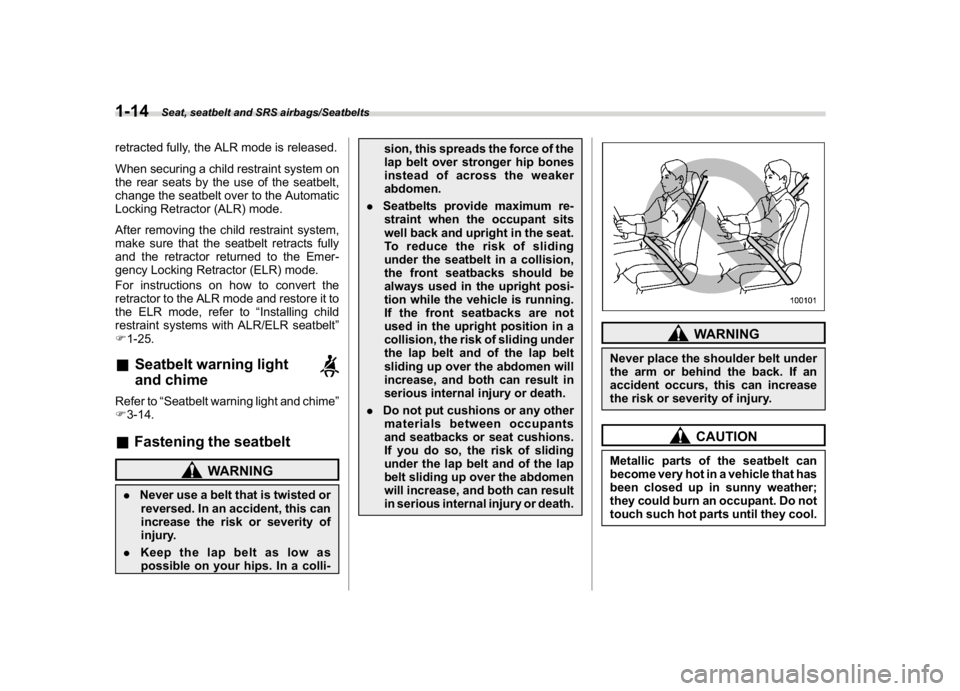
Never place the shoulder belt under
the arm or behind the back. If an
accident occurs, this can increase
the risk or severity of injury.
CAUTION
Metallic parts of the seatbelt can
become very hot in a vehicle that has
been closed up in sunny weather;
they could burn an occupant. Do not
touch such hot parts until they cool.
Seat, seatbelt and SRS airbags/Seatbelts
1-14
Page 47 of 578
(48,1)
北米Model "A1700BE-B" EDITED: 2017/ 10/ 11
WARNING
When wearing the seatbelts, make
sure the shoulder portion of the
webbing does not pass over your
neck. If it does, adjust the seatbelt
anchor to a lower position. Placing
the shoulder belt over the neck may
result in neck injury during sudden
braking or in a collision.
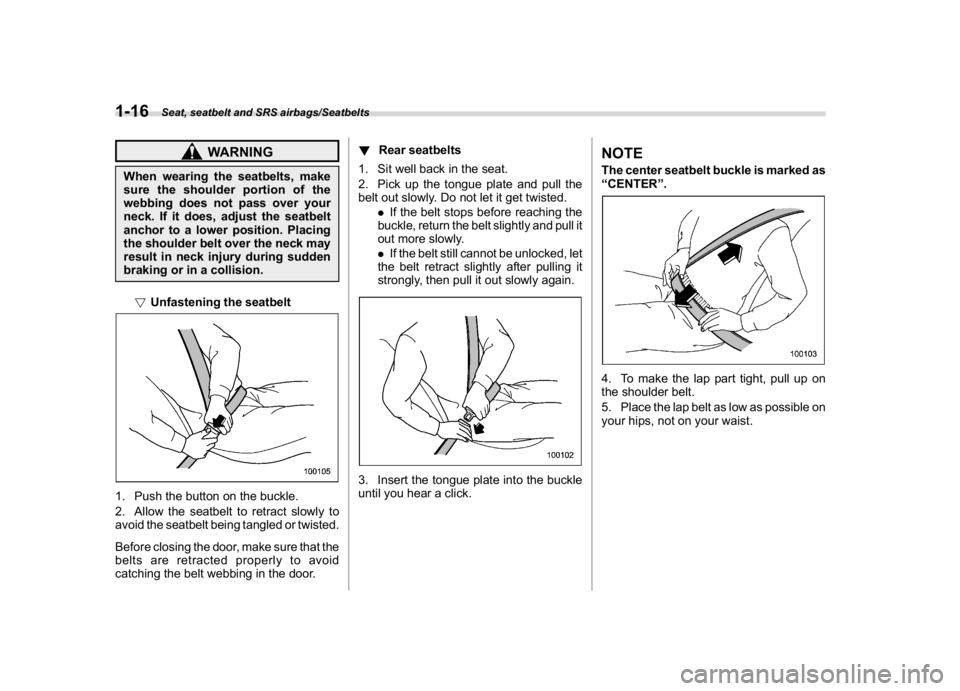
!Unfastening the seatbelt1. Push the button on the buckle.
2. Allow the seatbelt to retract slowly to
avoid the seatbelt being tangled or twisted.
Before closing the door, make sure that the
belts are retracted properly to avoid
catching the belt webbing in the door.!Rear seatbelts
1. Sit well back in the seat.
2. Pick up the tongue plate and pull the
belt out slowly. Do not let it get twisted.
.If the belt stops before reaching the
buckle, return the belt slightly and pull it
out more slowly.
.If the belt still cannot be unlocked, let
the belt retract slightly after pulling it
strongly, then pull it out slowly again.
3. Insert the tongue plate into the buckle
until you hear a click.
NOTEThe center seatbelt buckle is marked as
“CENTER”.4. To make the lap part tight, pull up on
the shoulder belt.
5. Place the lap belt as low as possible on
your hips, not on your waist.
Seat, seatbelt and SRS airbags/Seatbelts
1-16
Page 48 of 578
(49,1)
北米Model "A1700BE-B" EDITED: 2017/ 10/ 11
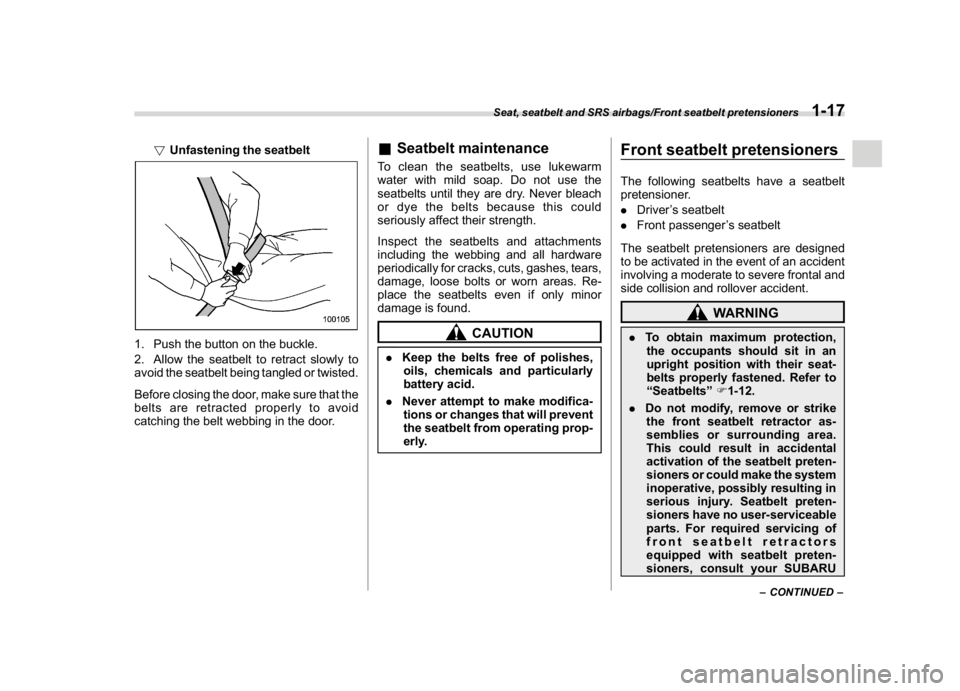
!Unfastening the seatbelt
1. Push the button on the buckle.
2. Allow the seatbelt to retract slowly to
avoid the seatbelt being tangled or twisted.
Before closing the door, make sure that the
belts are retracted properly to avoid
catching the belt webbing in the door.
&Seatbelt maintenanceTo clean the seatbelts, use lukewarm
water with mild soap. Do not use the
seatbelts until they are dry. Never bleach
or dye the belts because this could
seriously affect their strength.
Inspect the seatbelts and attachments
including the webbing and all hardware
periodically for cracks, cuts, gashes, tears,
damage, loose bolts or worn areas. Re-
place the seatbelts even if only minor
damage is found.
CAUTION
.Keep the belts free of polishes,
oils, chemicals and particularly
battery acid.
.Never attempt to make modifica-
tions or changes that will prevent
the seatbelt from operating prop-
erly.
Front seatbelt pretensionersThe following seatbelts have a seatbelt
pretensioner.
.Driver’s seatbelt
.Front passenger’s seatbelt
The seatbelt pretensioners are designed
to be activated in the event of an accident
involving a moderate to severe frontal and
side collision and rollover accident.
WARNING
.To obtain maximum protection,
the occupants should sit in an
upright position with their seat-
belts properly fastened. Refer to
“Seatbelts”F1-12.
.Do not modify, remove or strike
the front seatbelt retractor as-
semblies or surrounding area.
This could result in accidental
activation of the seatbelt preten-
sioners or could make the system
inoperative, possibly resulting in
serious injury. Seatbelt preten-
sioners have no user-serviceable
parts. For required servicing of
front seatbelt retractors
equipped with seatbelt preten-
sioners, consult your SUBARU
–CONTINUED–
Seat, seatbelt and SRS airbags/Front seatbelt pretensioners
1-17
1