(401,1)
北米Model "A1700BE-B" EDITED: 2017/ 10/ 11
system unable to operate correctly.&Vehicle Dynamics Control
system monitorRefer to“Vehicle Dynamics Control warn-
ing light/Vehicle Dynamics Control opera-
tion indicator light”F3-26 and“Vehicle
Dynamics Control OFF indicator light/
Traction mode indicator light /”F3-27.&Vehicle Dynamics Control
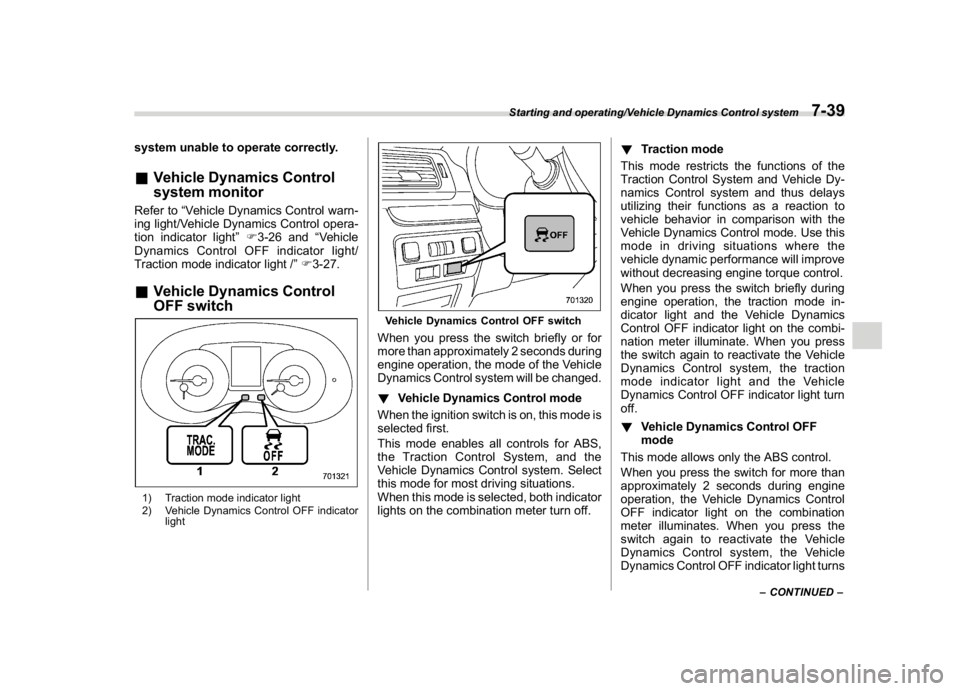
OFF switch1) Traction mode indicator light
2) Vehicle Dynamics Control OFF indicator
light
Vehicle Dynamics Control OFF switchWhen you press the switch briefly or for
more than approximately 2 seconds during
engine operation, the mode of the Vehicle
Dynamics Control system will be changed.
!Vehicle Dynamics Control mode
When the ignition switch is on, this mode is
selected first.
This mode enables all controls for ABS,
the Traction Control System, and the
Vehicle Dynamics Control system. Select
this mode for most driving situations.
When this mode is selected, both indicator
lights on the combination meter turn off.!Traction mode
This mode restricts the functions of the
Traction Control System and Vehicle Dy-
namics Control system and thus delays
utilizing their functions as a reaction to
vehicle behavior in comparison with the
Vehicle Dynamics Control mode. Use this
mode in driving situations where the
vehicle dynamic performance will improve
without decreasing engine torque control.
When you press the switch briefly during
engine operation, the traction mode in-
dicator light and the Vehicle Dynamics
Control OFF indicator light on the combi-
nation meter illuminate. When you press
the switch again to reactivate the Vehicle
Dynamics Control system, the traction
mode indicator light and the Vehicle
Dynamics Control OFF indicator light turn
off.
!Vehicle Dynamics Control OFF
mode
This mode allows only the ABS control.
When you press the switch for more than
approximately 2 seconds during engine
operation, the Vehicle Dynamics Control
OFF indicator light on the combination
meter illuminates. When you press the
switch again to reactivate the Vehicle
Dynamics Control system, the Vehicle
Dynamics Control OFF indicator light turns
–CONTINUED–
Starting and operating/Vehicle Dynamics Control system
7-39
7
(445,1)
北米Model "A1700BE-B" EDITED: 2017/ 10/ 11
Driving tips for AWD models
WARNING
.Always maintain a safe driving
speed according to the road and
weather conditions in order to
avoid having an accident on a
sharp turn, during sudden brak-
ing or under other similar condi-
tions.
.Always use the utmost care in
driving–overconfidence be-
cause you are driving an All-
Wheel Drive vehicle could easily
lead to a serious accident.
.When you replacing or installing
tire(s), all four tires must be the
same for following items.
(a) Size
(b) Circumference
(c) Speed symbol
(d) Load index
(e) Construction
(f) Manufacturer
(g) Brand (tread pattern)
(h) Degrees of wear
For the items (a) to (d), you must
obey the specification that isprinted on the tire placard. The
tire placard is located on the
bottom of driver’s door pillar.
If all of four tires are not the same
for items (a) to (h), there is a
possibility that serious mechan-
ical damage could occur to the
drive train of your car, and affect
the following.
—Ride
—Handling
—Braking
—Speedometer/Odometer
calibration
—Clearance between the body
and tires
It also may be dangerous and
lead to loss of vehicle control,
and it can lead to an accident.
CAUTION
If you use a temporary spare tire to
replace a flat tire, be sure to use the
original temporary spare tire stored
in the vehicle. Using other sizes may
result in severe mechanical damage
to the drive train of your vehicle.
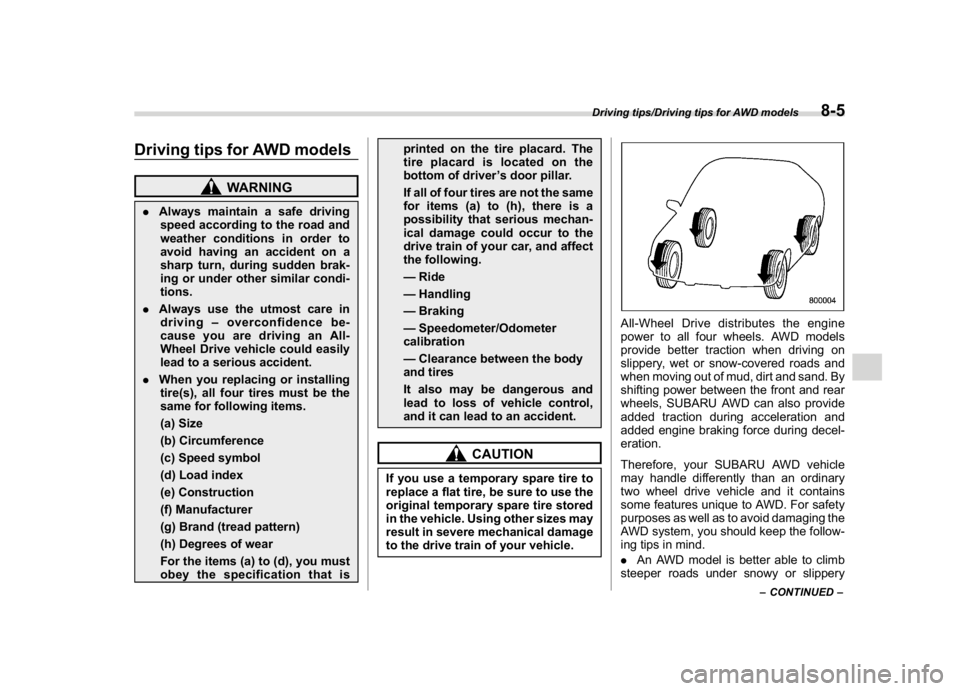
All-Wheel Drive distributes the engine
power to all four wheels. AWD models
provide better traction when driving on
slippery, wet or snow-covered roads and
when moving out of mud, dirt and sand. By
shifting power between the front and rear
wheels, SUBARU AWD can also provide
added traction during acceleration and
added engine braking force during decel-
eration.
Therefore, your SUBARU AWD vehicle
may handle differently than an ordinary
two wheel drive vehicle and it contains
some features unique to AWD. For safety
purposes as well as to avoid damaging the
AWD system, you should keep the follow-
ing tips in mind.
.An AWD model is better able to climb
steeper roads under snowy or slippery
–CONTINUED–
Driving tips/Driving tips for AWD models
8-5
8
(587,1)
北米Model "A1700BE-B" EDITED: 2017/ 10/ 11
Uniform tire quality grading
standardsThis information indicates the rela-
tive performance of passenger car
tires in the area of treadwear,
traction, and temperature resis-
tance. This is to aid the consumer
in making an informed choice in the
purchase of tires.
Quality grades can be found where
applicable on the tire sidewall be-
tween tread shoulder and maximum
section width. For example:Treadwear 200 Traction AA Tem-
perature AThe quality grades apply to new
pneumatic tires for use on passen-
ger cars. However, they do not
apply to deep tread, winter type
snow tires, space-saver or tempor-
ary use spare tires, tires with
nominal rim diameters of 12 inches
or less, or to some limited produc-
tion tires.
All passenger car tires must con-form to Federal Safety Require-
ments in addition to these grades.
&TreadwearThe treadwear grade is a compara-
tive rating based on the wear rate of
the tire when tested under con-
trolled conditions on a specified
government test course.
For example, a tire graded 150
would wear one and one-half (1-
1/2) times as well on the govern-
ment course as a tire graded 100.
The relative performance of tires
depends upon the actual conditions
of their use, however, and may
depart significantly from the norm
due to variations in driving habits,
service practices and differences in
road characteristics and climate.&Traction AA, A, B, CThe traction grades, from highest to
lowest, are AA, A, B and C. Those
grades represent the tire’s ability to
stop on wet pavement as measured
under controlled conditions on spe-cified government test surfaces of
asphalt and concrete. A tire marked
C may have poor traction perfor-
mance.
WARNING
The traction grade assigned to
this tire is based on straight-
ahead braking traction tests,
and does not include accelera-
tion, cornering, hydroplaning,
or peak traction characteris-
tics.&Temperature A, B, CThe temperature grades are A (the
highest), B, and C, representing the
tire’s resistance to the generation of
heat and its ability to dissipate heat
when tested under controlled con-
ditions on a specified indoor labora-
tory test wheel. Sustained high
temperature can cause the material
of the tire to degenerate and reduce
tire life, and excessive temperature
can lead to sudden tire failure. The
–CONTINUED–
Consumer information and Reporting safety defects/Uniform tire quality grading standards
13-15
13