2018 SUBARU WRX steering
[x] Cancel search: steeringPage 476 of 578

(495,1)
北米Model "A1700BE-B" EDITED: 2017/ 10/ 11
&Climate control panel, audio
panel, instrument panel, con-
sole panel, and switchesUse a soft, damp cloth to clean the climate
control panel, audio equipment, instru-
ment panel, center console, combination
meter panel, and switches.
CAUTION
.Do not use organic solvents such
as paint thinners or fuel, or
strong cleaning agents that con-
tain those solvents. Doing so
could damage the surface and
cause the color to deteriorate.
.Do not use chemical solvents that
contain silicone on the vehicle
audio system, electrical compo-
nents of the air-conditioner or
any switches. If silicone adheres
to these parts, it may cause
damage to electrical compo-
nents.
&MonitorTo clean the audio/navigation/multi-func-
tion display monitor, wipe it with a silicone
cloth or with a soft cloth. If the monitor is
extremely dirty, clean it with a soft cloth
moistened with neutral detergent then
carefully wipe off any remaining detergent.
CAUTION
.Do not spray neutral detergent
directly onto the monitor. Doing
so could damage the monitor’s
components.
.Do not wipe the monitor with a
hard cloth. Doing so could
scratch the monitor.
.Do not use cleaning fluid that
contains thinner, fuel, or any
other volatile substance. Such
cleaning fluid could erase the
lettering on the switches at the
bottom of the monitor.
Steering wheel with ultra-
suede covering (if equipped)In order to maintain the characteristic
texture and appearance of ultra-suede,
regular cleaning of the steering wheel is
recommended.NOTEIf the steering wheel is used continually
without cleaning, the surface will ap-
pear worn. This is due to dirt from
hands and other sources which causes
the ultra-suede fibers to harden. This is
not a defect.
Follow the procedure below and perform
cleaning.&Regular cleaningIt is recommended that regular cleaning
(approximately once a month) be per-
formed by following the procedure below.
1. Dampen a cloth or similar item with
warm water at approximately 1048F
(408C), then strongly wring it out and wipe
over the entire steering wheel.
2. When the surface of the ultra-suede is
dry, use a lint brush or similar means to
straighten the fibers.
–CONTINUED–
Appearance care/Steering wheel with ultra-suede covering
10-7
10
Page 477 of 578

(496,1)
北米Model "A1700BE-B" EDITED: 2017/ 10/ 11
NOTE.When wiping, be careful not to
strongly disturb the ultra-suede piles.
.Use a clean cloth. When wiping,
rinse the cloth carefully and fully re-
move all dirt from it.&Liquid dirtFor any spillage cleaning, carry out the
following methods.
.Spilled liquids: Use tissue paper or
similar material to gently absorb the liquid.
.If mud, coffee, or other dirt hardens
after drying, use a lint brush or similar
means and gently brush the spot to
remove the dirt.
If the dirt cannot be removed after per-
forming the above cleaning, refer to“Dirt
from hands”F10-8.&Dirt from handsIf the texture or appearance has been
diminished by dirt from hands or other
sources, follow the procedure below for
cleaning.
Items to prepare:
A) Cloth dampened with neutral detergent
solution (5 - 10%) and strongly wrung out
B) Cloth dampened with warm water at
approximately 1048F (408C)Procedure:
1. Use a lint brush or similar means and
gently brush to remove adhering dust and
dirt.
2. Use the cloth that was dampened with
neutral detergent solution (5 - 10%) and
strongly wrung out (A) and grip the steer-
ing wheel with it, then wipe by moving the
cloth around the steering wheel as shown
in the figure.
3. In order to remove the remaining
neutral detergent on the ultra-suede, use
the cloth that was dampened with warm
water at approximately 1048F (408C) (B) to
grip the steering wheel with it, then wipe by
moving the cloth around the steering
wheel. Rinse the cloth with warm water
and repeat this step 3 times.
4. If the surface piles become disturbed,brush gently using a lint brush or similar
means.
CAUTION
.Do not use benzene, gasoline, or
other organic solvent, acidic or
alkaline detergents, dyes, bleach,
or similar substances. Doing so
may cause discoloration, wrin-
kles, or peeling of the paint.
.Do not use commercially avail-
able cleaners. They may contain
components that cause disco-
loration, wrinkles, and paint to
peel off.
.Strongly wring out the cloth dam-
pened with the neutral detergent
solution or warm water. If water
or detergent enters the steering
wheel switches or airbag, there is
the risk of causing malfunctions.
Appearance care/Steering wheel with ultra-suede covering
10-8
Page 478 of 578

(499,1)
北米Model "A1700BE-B" EDITED: 2017/ 10/ 11
Maintenance schedule.......................................... 11-3
Maintenance precautions..................................... 11-3
Before checking or servicing in the engine
compartment...................................................... 11-4
When checking or servicing in the engine
compartment...................................................... 11-5
When checking or servicing in the engine
compartment while the engine is running............ 11-5
Maintenance tips................................................... 11-6
Removing and reinstalling clips............................ 11-6
Engine hood.......................................................... 11-9
Engine compartment overview.......................... 11-11
STI...................................................................... 11-11
Except STI.......................................................... 11-12
Engine oil............................................................. 11-13
Engine oil consumption...................................... 11-13
Checking the oil level.......................................... 11-13
Changing the oil and oil filter.............................. 11-15
Recommended grade and viscosity..................... 11-15
Synthetic oil........................................................ 11-16
Cooling system................................................... 11-16
Cooling fan, hose and connections..................... 11-17
Engine coolant.................................................... 11-17
Air cleaner element............................................. 11-18
Replacing the air cleaner element........................ 11-19
Spark plugs......................................................... 11-21
Recommended spark plugs................................. 11-21
Drive belts........................................................... 11-21Manual transmission oil......................................11-22
Recommended grade and viscosity..................... 11-22
Continuously variable transmission fluid..........11-22
Front differential gear oil (CVT models) and
rear differential gear oil....................................11-23
Recommended grade and viscosity..................... 11-23
Power steering fluid (STI)...................................11-23
Checking the fluid level...................................... 11-23
Recommended fluid............................................ 11-24
Brake fluid............................................................11-24
Checking the fluid level...................................... 11-24
Recommended brake fluid.................................. 11-25
Clutch fluid (MT models).....................................11-25
Checking the fluid level...................................... 11-25
Recommended clutch fluid................................. 11-26
Brake booster......................................................11-26
Brake pedal..........................................................11-27
Checking the brake pedal free play..................... 11-27
Checking the brake pedal reserve distance ......... 11-27
Clutch pedal (MT models)...................................11-27
Checking the clutch function .............................. 11-27
Checking the clutch pedal free play.................... 11-28
Hill start assist system.......................................11-28
Replacement of brake pad andlining................11-28
Breaking-in of new brake pads (models with
electronic parking brake system)..................... 11-29
Breaking-in of new brake pads and linings
(models without electronic parking brake
system)........................................................... 11-29
Maintenance and service
11
Page 488 of 578
(509,1)
北米Model "A1700BE-B" EDITED: 2017/ 10/ 11
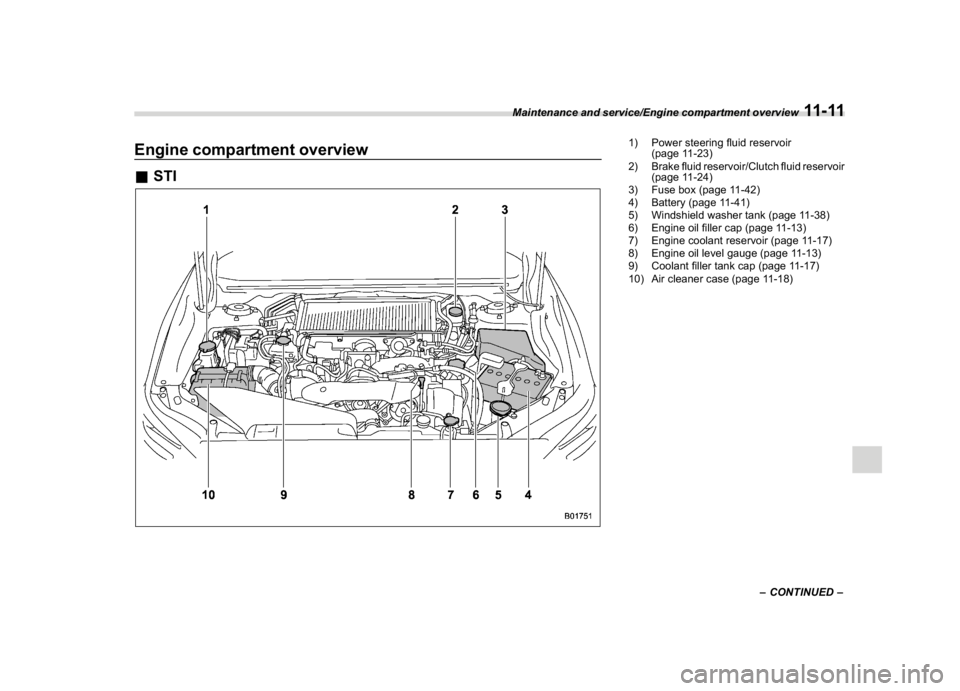
Engine compartment overview&STI
1) Power steering fluid reservoir
(page 11-23)
2) Brake fluid reservoir/Clutch fluid reservoir
(page 11-24)
3) Fuse box (page 11-42)
4) Battery (page 11-41)
5) Windshield washer tank (page 11-38)
6) Engine oil filler cap (page 11-13)
7) Engine coolant reservoir (page 11-17)
8) Engine oil level gauge (page 11-13)
9) Coolant filler tank cap (page 11-17)
10) Air cleaner case (page 11-18)
–CONTINUED–
Maintenance and service/Engine compartment overview
11-11
11
Page 498 of 578

(519,1)
北米Model "A1700BE-B" EDITED: 2017/ 10/ 11
Spark plugsIt may be difficult to replace the spark
plugs. It is recommended that you have the
spark plugs replaced by your SUBARU
dealer.
Have the spark plugs replaced according
to the maintenance schedule in the“War-
ranty and Maintenance Booklet”.&Recommended spark plugsFor the recommended spark plugs, refer to
“Electrical system”F12-8.
Drive beltsNOTEFor models except STI, it is unneces-
sary to check the deflection of the drive
belt periodically because this engine is
equipped with an automatic belt ten-
sion adjuster. However, have the belt
replaced according to the maintenance
schedule in the“Warranty and Main-
tenance Booklet”. Consult your
SUBARU dealer for replacement.
If the drive belt is loose, cracked or
worn, contact your SUBARU dealer.
STI
1) Power steering oil pump pulley
2) Front side belt
3) Alternator pulley
4) Air conditioner compressor pulley
5) Rear side belt
6) Crank pulley
A) 22 lbf (98 N, 10 kgf)
CAUTION
The front side belt, which runs in
conjunction with the following com-
ponents, must be used within the
specified deflection.
.Power steering oil pump pulley
.Alternator pulley
.Crank pulley
Check the deflection of the front side
–CONTINUED–
Maintenance and service/Spark plugs
11-21
11
Page 500 of 578

(521,1)
北米Model "A1700BE-B" EDITED: 2017/ 10/ 11
Front differential gear oil
(CVT models) and rear differ-
ential gear oilIt is not necessary to check the gear oil
level. Check that there are no cracks,
damage or leakage. However, have the oil
inspected by your SUBARU dealer ac-
cording to the maintenance schedule in
the“Warranty and Maintenance Booklet”.
Consult your SUBARU dealer for details.&Recommended grade and
viscosityEach oil manufacturer has its own base
oils and additives. Never use different
brands together. For details, refer to
“Manual transmission, front differential
and rear differential gear oil”F12-6.
CAUTION
Using a differential gear oil other
than the specified oil may cause a
decline in vehicle performance.
Power steering fluid (STI)&Checking the fluid levelThe power steering fluid expands greatly
as its temperature rises; the fluid level
differs according to fluid temperature.
Therefore, the reservoir tank has two
different checking ranges for hot and cold
fluids.
Check the power steering fluid level
monthly.
1. Park the vehicle on a level surface, and
stop the engine.
2. Check the fluid level of the reservoir
tank.
When the fluid is hot after the vehicle has
been run: Check that the oil level is
between“HOT MIN”and“HOT MAX”onthe surface of the reservoir tank.
When the fluid is cool before the vehicle is
run: Check that the oil level is between
“COLD MIN”and“COLD MAX”on the
surface of the reservoir tank.
3. If the fluid level is lower than the
applicable“MIN”line, add the recom-
mended fluid as necessary to bring the
level between the“MIN”and“MAX”line.
If the fluid level is extremely low, it may
indicate possible leakage. Consult your
SUBARU dealer for an inspection.
WARNING
Be careful not to burn yourself
because the fluid may be hot.
CAUTION
.When you add power steering
fluid, use only clean fluid, and
be careful not to allow any dirt
into the tank. And never use
different brands together.
.Be careful not to spill power
steering fluid when adding it. If
power steering fluid touches the
exhaust pipe, it may cause a bad
smell, smoke, and/or a fire. If
power steering fluid gets on the
–CONTINUED–
Maintenance and service/Front differential gear oil (CVT models) and rear differential gear oil
11-23
11
Page 510 of 578
(531,1)
北米Model "A1700BE-B" EDITED: 2017/ 10/ 11
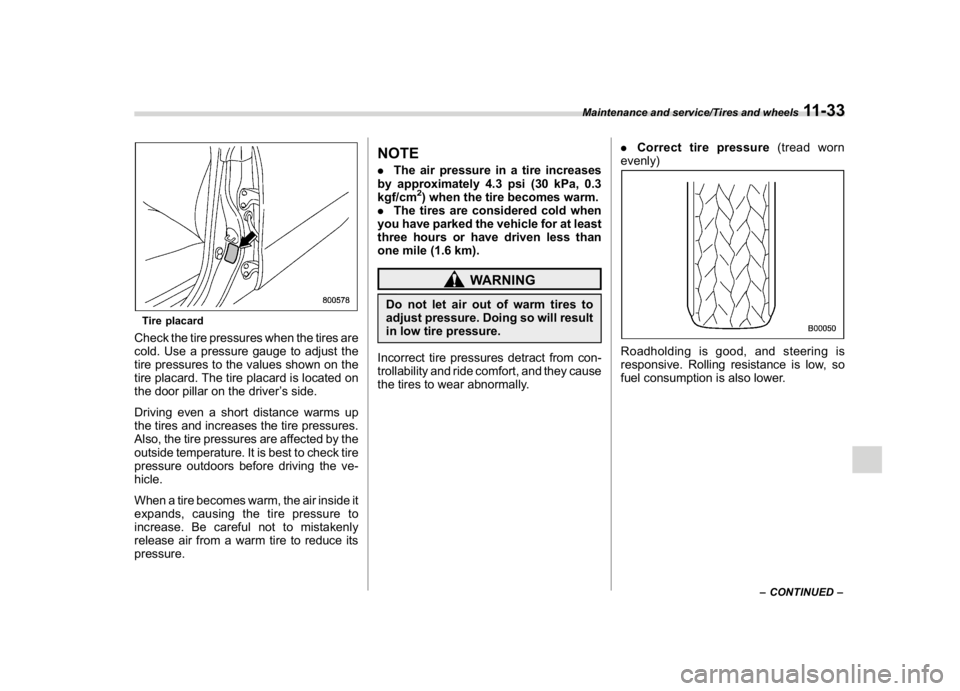
Tire placardCheck the tire pressures when the tires are
cold. Use a pressure gauge to adjust the
tire pressures to the values shown on the
tire placard. The tire placard is located on
the door pillar on the driver’s side.
Driving even a short distance warms up
the tires and increases the tire pressures.
Also, the tire pressures are affected by the
outside temperature. It is best to check tire
pressure outdoors before driving the ve-
hicle.
When a tire becomes warm, the air inside it
expands, causing the tire pressure to
increase. Be careful not to mistakenly
release air from a warm tire to reduce its
pressure.
NOTE.The air pressure in a tire increases
by approximately 4.3 psi (30 kPa, 0.3
kgf/cm
2) when the tire becomes warm.
.The tires are considered cold when
you have parked the vehicle for at least
three hours or have driven less than
one mile (1.6 km).
WARNING
Do not let air out of warm tires to
adjust pressure. Doing so will result
in low tire pressure.
Incorrect tire pressures detract from con-
trollability and ride comfort, and they cause
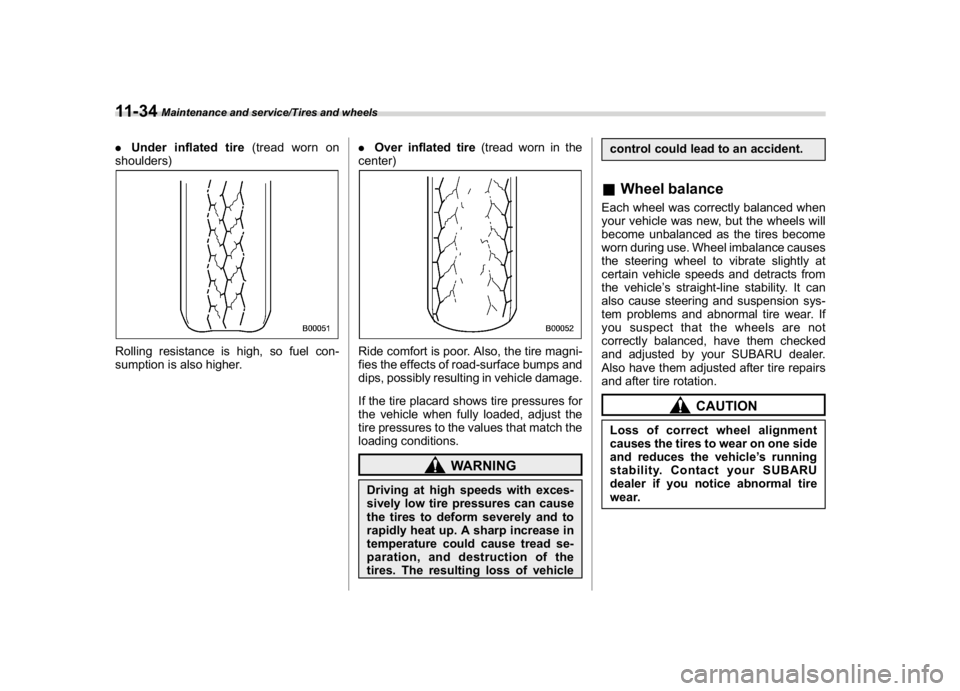
the tires to wear abnormally..Correct tire pressure(tread worn
evenly)
Roadholding is good, and steering is
responsive. Rolling resistance is low, so
fuel consumption is also lower.
–CONTINUED–
Maintenance and service/Tires and wheels
11-33
11
Page 511 of 578
(532,1)
北米Model "A1700BE-B" EDITED: 2017/ 10/ 11
.Under inflated tire(tread worn on
shoulders)Rolling resistance is high, so fuel con-
sumption is also higher..Over inflated tire(tread worn in the
center)
Ride comfort is poor. Also, the tire magni-
fies the effects of road-surface bumps and
dips, possibly resulting in vehicle damage.
If the tire placard shows tire pressures for
the vehicle when fully loaded, adjust the
tire pressures to the values that match the
loading conditions.
WARNING
Driving at high speeds with exces-
sively low tire pressures can cause
the tires to deform severely and to
rapidly heat up. A sharp increase in
temperature could cause tread se-
paration, and destruction of the
tires. The resulting loss of vehiclecontrol could lead to an accident.
&Wheel balanceEach wheel was correctly balanced when
your vehicle was new, but the wheels will
become unbalanced as the tires become
worn during use. Wheel imbalance causes
the steering wheel to vibrate slightly at
certain vehicle speeds and detracts from
the vehicle’s straight-line stability. It can
also cause steering and suspension sys-
tem problems and abnormal tire wear. If
you suspect that the wheels are not
correctly balanced, have them checked
and adjusted by your SUBARU dealer.
Also have them adjusted after tire repairs
and after tire rotation.
CAUTION
Loss of correct wheel alignment
causes the tires to wear on one side
and reduces the vehicle’s running
stability. Contact your SUBARU
dealer if you notice abnormal tire
wear.
Maintenance and service/Tires and wheels
11-34