2018 SUBARU CROSSTREK electrical
[x] Cancel search: electricalPage 376 of 474

(389,1)
北米Model "A1320BE-C" EDITED: 2017/ 10/ 10
!Washing the underbody
Chemicals, salts and gravel used for
deicing road surfaces are extremely cor-
rosive, accelerating the corrosion of un-
derbody components, such as the exhaust
system, fuel and brake lines, brake cables,
floor pan and fenders, and suspension.
Thoroughly flush the underbody and inside
of the fenders with lukewarm or cold water
at frequent intervals to reduce the harmful
effects of such agents.
Mud and sand adhering to the underbody
components may accelerate their corro-
sion.
After driving off-road or on muddy or sandy
roads, wash the mud and sand off the
underbody. Carefully flush the suspension
and axle parts, as they are particularly
prone to mud and sand buildup. Do not use
a sharp-edged tool to remove caked mud.
CAUTION
.Be careful not to damage brake
hoses, sensor harnesses, and
other parts when washing sus-
pension components.
.Be careful not to flush the engine
bottom for a long time. It may
cause damage of some electrical
parts.
!Using a warm water washer
.Keep a good distance of 12 in (30 cm)
or more between the washer nozzle and
the vehicle.
.Do not wash the same area continu-
ously.
.If a stain will not come out easily, wash
by hand. Some warm water washers are of
the high temperature, high pressure type,
and they can damage or deform the resin
parts such as moldings, or cause water to
leak into the vehicle.
&Waxing and polishingAlways wash and dry the vehicle before
waxing and polishing.
Use a good quality polish and wax and
apply them according to the manufac-
turer’s instructions. Wax or polish when
the painted surface is cool.
Be sure to polish and wax the chrome trim,
as well as the painted surfaces. Loss of
wax on a painted surface leads to loss of
the original luster and also quickens the
deterioration of the surface. It is recom-
mended that a coat of wax be applied at
least once a month, or whenever the
surface no longer repels water.
If the appearance of the paint has dimin-
ished to the point where the luster or tone
cannot be restored, lightly polish the sur-
face with a fine-grained compound. Never
polish just the affected area, but include
the surrounding area as well. Always
polish in only one direction. A No. 2000
grain compound is recommended. Never
use a coarse-grained compound. Coarse-
grained compounds have a smaller grain-
size number and could damage the paint.
After polishing with a compound, coat with
wax to restore the original luster. Frequent
polishing with a compound or an incorrect
polishing technique will result in removing
the paint layer and exposing the under-
–CONTINUED–
Appearance care/Exterior care
10-3
10
Page 379 of 474
(392,1)
北米Model "A1320BE-C" EDITED: 2017/ 10/ 10
make sure it does not affect the fabric
adversely. Use the cleaner according to its
instructions.
CAUTION
When cleaning the seat, do not use
benzine, paint thinner, or any similar
materials. Doing so could damage
the surface and cause the color to
deteriorate.&Leather seat materialsThe leather used by SUBARU is a high
quality natural product which will retain its
distinctive appearance and feel for many
years with proper care.
Allowing dust or road dirt to build up on the
surface can cause the material to become
brittle and to wear prematurely. Regular
cleaning with a soft, moist, natural fiber
cloth should be performed monthly, taking
care not to soak the leather or allow water
to penetrate the stitched seams.
A mild detergent suitable for cleaning
woolen fabrics may be used to remove
difficult dirt spots, rubbing with a soft, dry
cloth afterwards to restore the luster. If
your SUBARU is to be parked for a long
time in bright sunlight, it is recommended
that the seats and head restraints becovered, or the windows shaded, to pre-
vent fading or shrinkage.
Minor surface blemishes or bald patches
may be treated with a commercial leather
spray lacquer. You will discover that each
leather seat section will develop soft folds
or wrinkles, which is characteristic of
genuine leather.
&Synthetic leather upholsteryThe synthetic leather material used on the
SUBARU may be cleaned using mild soap
or detergent and water, after first vacuum-
ing or brushing away loose dirt. Allow the
soap to soak in for a few minutes and wipe
off with a clean, damp cloth. Commercial
foam-type cleaners suitable for synthetic
leather materials may be used when
necessary.
CAUTION
Strong cleaning agents such as
solvents, paint thinners, window
cleaner or fuel must never be used
on leather or synthetic interior ma-
terials. Doing so could damage the
surface and cause the color to
deteriorate.
&SeatbeltFor details about how to clean the seatbelt,
refer to“Seatbelt maintenance”F1-20.&Climate control panel, audio
panel, instrument panel, con-
sole panel, and switchesUse a soft, damp cloth to clean the climate
control panel, audio equipment, instru-
ment panel, center console, combination
meter panel, and switches.
CAUTION
.Do not use organic solvents such
as paint thinners or fuel, or
strong cleaning agents that con-
tain those solvents. Doing so
could damage the surface and
cause the color to deteriorate.
.Do not use chemical solvents that
contain silicone on the vehicle
audio system, electrical compo-
nents of the air-conditioner or
any switches. If silicone adheres
to these parts, it may cause
damage to electrical compo-
nents.
Appearance care/Cleaning the interior
10-6
Page 395 of 474

(408,1)
北米Model "A1320BE-C" EDITED: 2017/ 10/ 10
Spark plugsIt may be difficult to replace the spark
plugs. It is recommended that you have the
spark plugs replaced by your SUBARU
dealer.
The spark plugs should be replaced
according to the maintenance schedule
in the“Warranty and Maintenance Book-
let”.
CAUTION
Make sure the cables are replaced in
the correct order.&Recommended spark plugsFor the recommended spark plugs, refer to
“Electrical system”F12-8.
Drive beltsIt is unnecessary to check the deflection of
the drive belt periodically because your
engine is equipped with an automatic belt
tension adjuster. However, replacement of
the belt should be done according to the
maintenance schedule in the“Warranty
and Maintenance Booklet”. Consult your
SUBARU dealer for replacement.
If the drive belt is loose, cracked or worn,
contact your SUBARU dealer.
Manual transmission oilIt is not necessary to check the transmis-
sion oil level. Check that there are no
cracks, damage or leakage. However, the
oil inspection should be performed accord-
ing to the maintenance schedule in the
“Warranty and Maintenance Booklet”.
Consult your SUBARU dealer for details.&Recommended grade and
viscosityEach oil manufacturer has its own base
oils and additives. Never use different
brands together. For details, refer to
“Manual transmission, front differential
and rear differential gear oil”F12-6.
Maintenance and service/Spark plugs
11-14
Page 415 of 474

(428,1)
北米Model "A1320BE-C" EDITED: 2017/ 10/ 10
1) Cap
2) Upper level
3) Lower levelIt is unnecessary to periodically check the
battery fluid level or periodically refill with
distilled water.
However, if the battery fluid level is below
the lower level, remove the cap. Fill to the
upper level with distilled water.
CAUTION
Never use more than 10 amperes
when charging the battery because
it will shorten battery life.
Fuses
CAUTION
Never replace a fuse with one having
a higher rating or with material other
than a fuse because serious damage
or a fire could result.
The fuses are designed to melt during an
overload to prevent damage to the wiring
harness and electrical equipment. The
fuses are located in two fuse boxes.One is located under the instrument panel
behind the fuse box cover on the driver’s
seat side. To remove the cover, pull it out.
1) Spare fusesThe other one (main fuse box) is housed in
the engine compartment. Also, the spare
fuses are stored in the fuse box cover.The fuse puller is stored in the main fuse
box in the engine compartment.
Maintenance and service/Fuses
11-34
Page 416 of 474

(429,1)
北米Model "A1320BE-C" EDITED: 2017/ 10/ 10
Pinch the upper part of the fuse puller
when removing it from the main fuse box.1) Good
2) BlownIf any lights, accessories or other electrical
controls do not operate, inspect the corre-
sponding fuse. If a fuse has blown, replace
it.
1. Turn the ignition switch to the“LOCK”/
“OFF”position and turn off all electrical
accessories.
2. Remove the cover.
3. Determine which fuse may be blown.
Look at the back side of each fuse box
cover and refer to“Fuses and circuits”
F12-10.
4. Pull out the fuse with the fuse puller.
5. Inspect the fuse. If it has blown,
replace it with a spare fuse of the same
rating.
6. If the same fuse blows again, this
indicates that its system has a problem.
Contact your SUBARU dealer for repairs.
Installation of accessoriesAlways consult your SUBARU dealer
before installing fog lights or any other
electrical equipment in your vehicle. Such
accessories may cause the electronic
system to malfunction if they are incor-
rectly installed or if they are not suited for
the vehicle.
Maintenance and service/Installation of accessories
11-35
11
Page 418 of 474
(431,1)
北米Model "A1320BE-C" EDITED: 2017/ 10/ 10
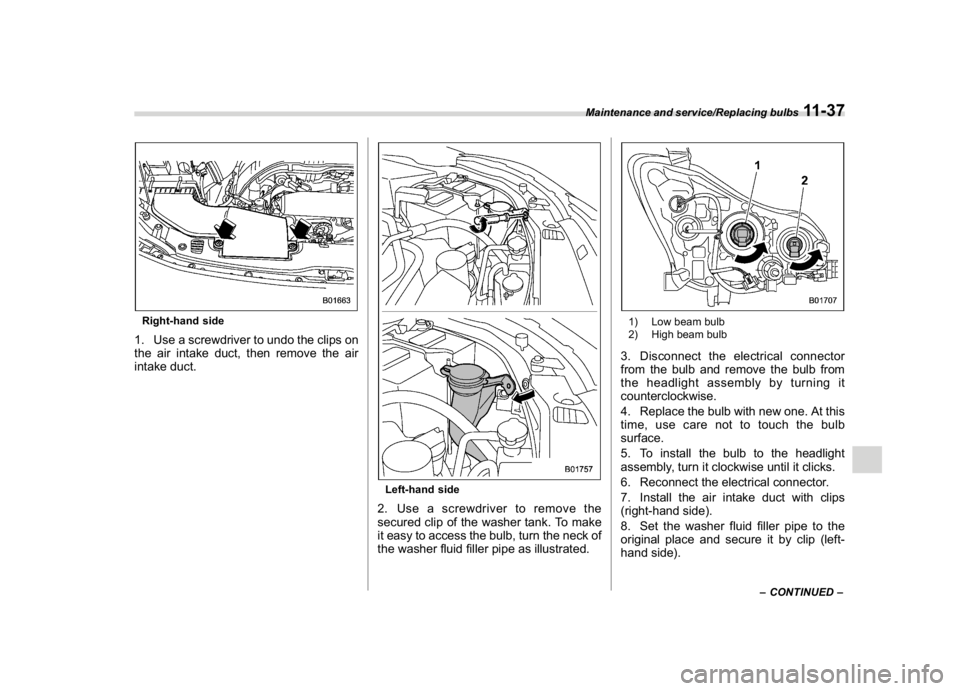
Right-hand side1. Use a screwdriver to undo the clips on
the air intake duct, then remove the air
intake duct.
Left-hand side2. Use a screwdriver to remove the
secured clip of the washer tank. To make
it easy to access the bulb, turn the neck of
the washer fluid filler pipe as illustrated.
1) Low beam bulb
2) High beam bulb3. Disconnect the electrical connector
from the bulb and remove the bulb from
the headlight assembly by turning it
counterclockwise.
4. Replace the bulb with new one. At this
time, use care not to touch the bulb
surface.
5. To install the bulb to the headlight
assembly, turn it clockwise until it clicks.
6. Reconnect the electrical connector.
7. Install the air intake duct with clips
(right-hand side).
8. Set the washer fluid filler pipe to the
original place and secure it by clip (left-
hand side).
–CONTINUED–
Maintenance and service/Replacing bulbs
11-37
11
Page 426 of 474

(441,1)
北米Model "A1320BE-C" EDITED: 2017/ 10/ 10
Specifications........................................................12-2
Dimensions...........................................................12-2
Engine..................................................................12-3
Fuel......................................................................12-3
Engine oil.............................................................12-4
Manual transmission, front differential and rear
differential gear oil..............................................12-6
Fluids...................................................................12-7
Engine coolant......................................................12-7
Electrical system..................................................12-8
Tires .....................................................................12-8Temporary spare tires...........................................12-9
Brake disc............................................................12-9
Fuses and circuits..............................................12-10
Fuse panel located in the passenger
compartment...................................................12-10
Fuse panel located in the engine compartment ... 12-12
Bulb chart............................................................12-14
Safety precautions..............................................12-14
Bulb chart..........................................................12-15
Vehicle identification..........................................12-18
Specifications
12
Page 433 of 474

(448,1)
北米Model "A1320BE-C" EDITED: 2017/ 10/ 10
&Electrical systemBattery type
75D23L
Alternator12V-130A
Spark plugsDILKAR7B8 (NGK)&TiresTire size P225/60R17 98H 225/55R18 98H
Wheel size
1767J 1867J
Pressure Front
33 psi (230 kPa, 2.3 kgf/cm
2)
Rear
32 psi (220 kPa, 2.2 kgf/cm2)
Wheel nut tightening torque
89 lbf·ft (120 N·m, 12 kgf·m)*1
*1: This torque is equivalent to applying approximately 88 to 110 lbf (40 to 50 kgf) at the end of the wheel nut wrench. If you have tightened the wheel nuts
by yourself, have the tightening torque checked at the nearest automotive service facility as soon as possible. For the wheel nut tightening procedure,
refer to“
Changing a flat tire”F9-5.Specifications/Specifications
12-8