2018 SUBARU CROSSTREK spare wheel
[x] Cancel search: spare wheelPage 355 of 474

(366,1)
北米Model "A1320BE-C" EDITED: 2017/ 10/ 10
If you park your vehicle in
case of an emergencyThe hazard warning flasher should be
used in day or night to warn other drivers
when you have to park your vehicle under
emergency conditions.
Avoid stopping on the road. It is best to
safely pull off the road if a problem occurs.
The hazard warning flasher can be acti-
vated regardless of the ignition switch
position.
Turn on the hazard warning by pushing the
hazard warning flasher switch. Turn it off
by pushing the switch again.
NOTEWhen the hazard warning flasher is on,
the turn signals do not work.
Temporary spare tire
WARNING
.Never tow a trailer when the
temporary spare tire is used.
The temporary spare tire is not
designed to sustain the towing
load. Use of the temporary spare
tire when towing can result in
failure of the spare tire and/or
less stability of the vehicle and
may lead to an accident.
.When a spare tire is mounted or a
wheel rim is replaced without the
original pressure sensor/trans-
mitter being transferred, the low
tire pressure warning light will
illuminate steadily after blinking
for approximately one minute.
This indicates the tire pressure
monitoring system (TPMS) is un-
able to monitor all four road
wheels. Contact your SUBARU
dealer as soon as possible for
tire and sensor replacement and/
or system resetting.
In case of emergency/If you park your vehicle in case of an emergency
9-2
Page 356 of 474

(367,1)
北米Model "A1320BE-C" EDITED: 2017/ 10/ 10
CAUTION
Never use any temporary spare tire
other than the original. Using other
sizes may result in severe mechan-
ical damage to the drive train of your
vehicle.
The temporary spare tire is smaller and
lighter than a conventional tire and is
designed for emergency use only. Re-
move the temporary spare tire and re-
install the conventional tire as soon as
possible because the spare tire is de-
signed only for temporary use.
Check the inflation pressure of the tem-
porary spare tire periodically to keep the
tire ready for use. The correct pressure is
60 psi (420 kPa, 4.2 kg/cm
2).
When using the temporary spare tire, note
the following.
.Drive with caution when the temporary
spare tire is installed. Avoid hard accel-
eration and braking, or fast cornering, as
control of the vehicle may be lost.
.Do not exceed 50 mph (80 km/h).
.Do not put a tire chain on the temporary
spare tire. Because of the smaller tire size,
a tire chain will not fit properly.
.Do not use two or more temporary
spare tires at the same time..Do not drive over obstacles. This tire
has a smaller diameter, so road clearance
is reduced.
1) Tread wear indicator bar
2) Indicator location mark.When the wear indicator appears on
the tread, replace the tire.
.The temporary spare tire must be used
only on a rear wheel. If a front wheel tire
gets punctured, replace the wheel with a
rear wheel and install the temporary spare
tire in place of the removed rear wheel.
Maintenance toolsYour vehicle is equipped with the following
maintenance tools.
.Jack
.Jack handle
.Screwdriver
.Towing hook (eye bolt)
.Wheel nut wrench
–CONTINUED–
In case of emergency/Maintenance tools
9-3
9
Page 357 of 474

(368,1)
北米Model "A1320BE-C" EDITED: 2017/ 10/ 10
&Tool locations1) Jack handle1) Tool bucket
2) Spare tire
1) Wheel nut wrench
2) Screwdriver
3) Jack
4) Towing hook (eye bolt)A jack handle is stored under the cargo
area. A jack and a towing hook are stored
in the tool bucket that is located in the
recess of the spare tire wheel.
Also, a tool bag that contains a wheel nut
wrench and a screwdriver is equipped with
the vehicle. Open the tool bag and store
the tools in the tool bucket as illustrated in
order that all tools are ready for use at any
time.
&Using the jack1. Park on a hard, level surface, when-
ever possible, then stop the engine.
2. Apply the parking brake securely and
shift the shift lever in reverse (MT models)
or the select lever to the“P”(Park) position
(CVT models).
3. Turn on the hazard warning flasher and
have everyone get out of the vehicle.4. Put wheel blocks at the front and rear
of the tire diagonally opposite the tire that
you are going to replace.
5. Take out the jack and jack handle.
In case of emergency/Maintenance tools
9-4
Page 359 of 474

(370,1)
北米Model "A1320BE-C" EDITED: 2017/ 10/ 10
dent.
1. Park on a hard, level surface, when-
ever possible, then stop the engine.
2. Apply the parking brake securely and
shift the shift lever in reverse (MT models)
or the select lever to the“P”(Park) position
(CVT models).
3. Turn on the hazard warning flasher and
have everyone get out of the vehicle.
4. Put wheel blocks at the front and rear
of the tire diagonally opposite the flat tire.
5. Take out the jack, jack handle and
wheel nut wrench.
The tools and the spare tire are stored
under the cargo area. Refer to“Mainte-
nance tools”F9-3.
NOTEMake sure that the jack is well lubri-
cated before using it.6. Take out the tool bucket and turn the
attaching bolt counterclockwise, then take
the spare tire out.NOTEIf the spare tire provided in your vehicle
is a temporary spare tire, carefully read
“Temporary spare tire”F9-2 and
strictly follow the instructions.
7. Loosen the wheel nuts using the wheel
nut wrench but do not remove the nuts.Jack-up points8. Place the jack under the side sill at the
front or rear jack-up point closest to the flat
tire.
In case of emergency/Flat tires
9-6
Page 360 of 474
(371,1)
北米Model "A1320BE-C" EDITED: 2017/ 10/ 10
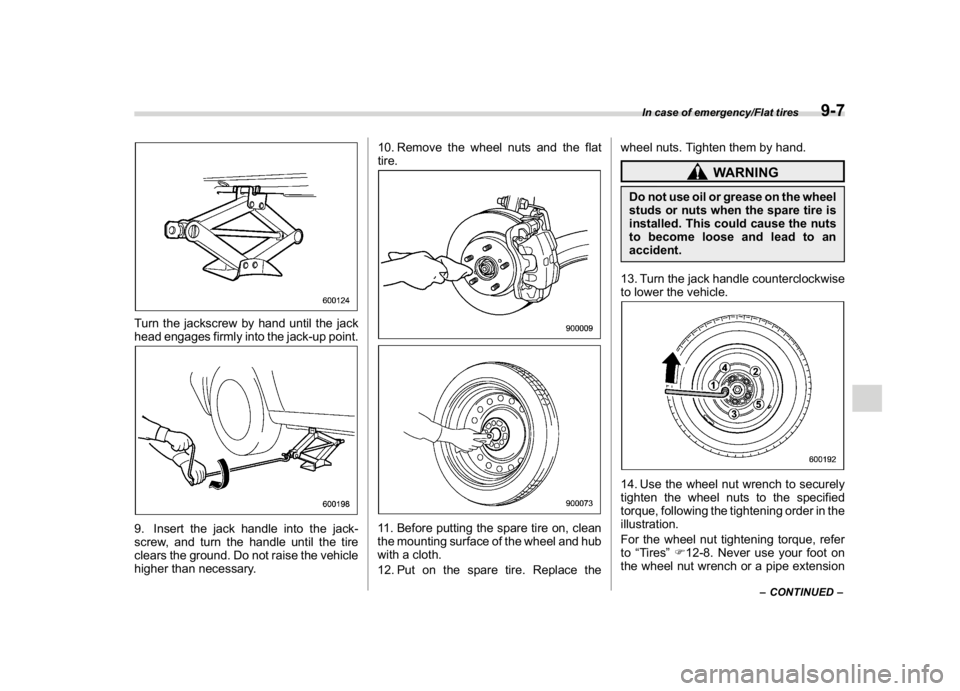
Turn the jackscrew by hand until the jack
head engages firmly into the jack-up point.9. Insert the jack handle into the jack-
screw, and turn the handle until the tire
clears the ground. Do not raise the vehicle
higher than necessary.10. Remove the wheel nuts and the flat
tire.
11. Before putting the spare tire on, clean
the mounting surface of the wheel and hub
with a cloth.
12. Put on the spare tire. Replace thewheel nuts. Tighten them by hand.
WARNING
Do not use oil or grease on the wheel
studs or nuts when the spare tire is
installed. This could cause the nuts
to become loose and lead to an
accident.
13. Turn the jack handle counterclockwise
to lower the vehicle.14. Use the wheel nut wrench to securely
tighten the wheel nuts to the specified
torque, following the tightening order in the
illustration.
For the wheel nut tightening torque, refer
to“Tires”F12-8. Never use your foot on
the wheel nut wrench or a pipe extension
–CONTINUED–
In case of emergency/Flat tires
9-7
9
Page 361 of 474

(372,1)
北米Model "A1320BE-C" EDITED: 2017/ 10/ 10
on the wrench because you may exceed
the specified torque. Have the wheel nut
torque checked at the nearest automotive
service facility.1) Support holder15. Store the flat tire in the spare tire
compartment. Install with the support
holder facing upward and secure the flat
tire by firmly tightening the attaching bolt.NOTEIf you cannot fix the flat tire firmly, try
turning the support holder upside
down.
16. Store the jack, jack handle and wheel
nut wrench in their storage locations.
WARNING
Never place a tire or tire changing
tools in the passenger compartment
after changing wheels. In a sudden
stop or collision, loose equipment
could strike occupants and cause
injury. Store the tire and all tools in
the proper place.&Tire pressure monitoring
system (TPMS) (U.S.-spec.
models)The tire pressure monitoring system pro-
vides the driver with the warning message
indicated by sending a signal from a
sensor that is installed in each wheel when
tire pressure is severely low.The tire pressure monitoring system will
activate only when the vehicle is driven.
Also, this system may not react immedi-
ately to a sudden drop in tire pressure (for
example, a blow-out caused running over
a sharp object).
WARNING
.If the low tire pressure warning
light illuminates while driving,
never brake suddenly. Instead,
perform the following procedure.
(1) Keep driving straight ahead
while gradually reducing
speed.
(2) Slowly pull off the road to a
safe place. Otherwise an acci-
dent involving serious vehicle
damage and serious personal
injury could occur.
(3) Check the pressure for all four
tires and adjust the pressure
to the COLD tire pressure
shown on the vehicle placard
on the door pillar on the
driver’s side.
If this light still illuminates while
driving after adjusting the tire
pressure, a tire may have signifi-
cant damage and a fast leak that
causes the tire to lose air rapidly.
In case of emergency/Flat tires
9-8
Page 362 of 474

(373,1)
北米Model "A1320BE-C" EDITED: 2017/ 10/ 10
If you have a flat tire, replace it
with a spare tire as soon as
possible.
.When a spare tire is mounted or a
wheel rim is replaced without the
original pressure sensor/trans-
mitter being transferred, the low
tire pressure warning light will
illuminate steadily after blinking
for approximately one minute.
This indicates the TPMS is unable
to monitor all four road wheels.
Contact your SUBARU dealer as
soon as possible for tire and
sensor replacement and/or sys-
tem resetting.
.When a tire is repaired with liquid
sealant, the tire pressure warning
valve and transmitter may not
operate properly. If a liquid sea-
lant is used, contact your nearest
SUBARU dealer or other qualified
service shop as soon as possi-
ble. Make sure to replace the tire
pressure warning valve and
transmitter when replacing the
tire. You may reuse the wheel if
there is no damage to it and if the
sealant residue is properly
cleaned off.
If the light illuminates steadily
after blinking for approximatelyone minute, promptly contact a
SUBARU dealer to have the sys-
tem inspected.
Jump starting
WARNING
.Battery fluid is SULFURIC ACID.
Do not let it come in contact with
the eyes, skin, clothing or the
vehicle.
If battery fluid gets on you, thor-
oughly flush the exposed area
with water immediately. Get med-
ical help if the fluid has entered
your eyes.
If battery fluid is accidentally
swallowed, immediately drink a
large amount of milk or water,
and obtain immediate medical
help.
Keep everyone including chil-
dren away from the battery.
.The gas generated by a battery
explodes if a flame or spark is
brought near it. Do not smoke or
light a match while jump starting.
.Never attempt jump starting if the
discharged battery is frozen. It
could cause the battery to burst
or explode.
.Whenever working on or around a
battery, always wear suitable eye
–CONTINUED–
In case of emergency/Jump starting
9-9
9
Page 403 of 474

(416,1)
北米Model "A1320BE-C" EDITED: 2017/ 10/ 10
the tire pressure monitoring system may
not be functioning normally. In this event,
gotoaSUBARUdealertohavethe
system inspected as soon as possible.
While the vehicle is driven, friction be-
tween tires and the road surface causes
the tires to warm up. After illumination of
the low tire pressure warning light, any
increase in the tire pressures caused by an
increase in the outside air temperature or
by an increase in the temperature in the
tires can cause the low tire pressure
warning light to turn off.
System resetting is necessary when the
wheels are changed (for example, a switch
to snow tires) and new TPMS valves are
installed on the newly fitted wheels. Have
this work performed by a SUBARU dealer
following wheel replacement.
It may not be possible to install TPMS
valves on certain wheels that are on the
market. Therefore, if you change the
wheels (for example, a switch to snow
tires), use wheels that have the same part
number as the standard-equipment
wheels. Without four operational TPMS
valve/sensors on the wheels, the TPMS
will not fully function and the warning light
on the combination meter will illuminate
steadily after blinking for approximately
one minute.When a tire is replaced, adjustments are
necessary to ensure continued normal
operation of the tire pressure monitoring
system. As with wheel replacement, there-
fore, you should have the work performed
by a SUBARU dealer.
WARNING
If the low tire pressure warning light
does not illuminate briefly after the
ignition switch is turned ON or the
light illuminates steadily after blink-
ing for approximately one minute,
you should have your Tire Pressure
Monitoring System checked at a
SUBARU dealer as soon as possi-
ble.
If this light illuminates while driving,
never brake suddenly and keep
driving straight ahead while gradu-
ally reducing speed. Then slowly
pull off the road to a safe place.
Otherwise an accident involving
serious vehicle damage and serious
personal injury could occur.
If this light still illuminates while
driving after adjusting the tire pres-
sure, a tire may have significant
damage and a fast leak that causes
the tire to lose air rapidly. If you have
a flat tire, replace it with a spare tireas soon as possible.
When a spare tire is mounted or a
wheel rim is replaced without the
original pressure sensor/transmitter
being transferred, the low tire pres-
sure warning light will illuminate
steadily after blinking for approxi-
mately one minute. This indicates
the TPMS is unable to monitor all
four road wheels. Contact your
SUBARU dealer as soon as possible
for tire and sensor replacement and/
or system resetting. If the light
illuminates steadily after blinking
for approximately one minute,
promptly contact a SUBARU dealer
to have the system inspected.
&Tire inspectionCheck on a daily basis that the tires are
free from serious damage, nails, and
stones. At the same time, check the tires
for abnormal wear.
Contact your SUBARU dealer immediately
if you find any problem.NOTE.When the wheels and tires strike
curbs or are subjected to harsh treat-
ment as when the vehicle is driven on a
rough surface, they can suffer damage
Maintenance and service/Tires and wheels
11-22