2018 SUBARU CROSSTREK warning light
[x] Cancel search: warning lightPage 387 of 474
(400,1)
北米Model "A1320BE-C" EDITED: 2017/ 10/ 10
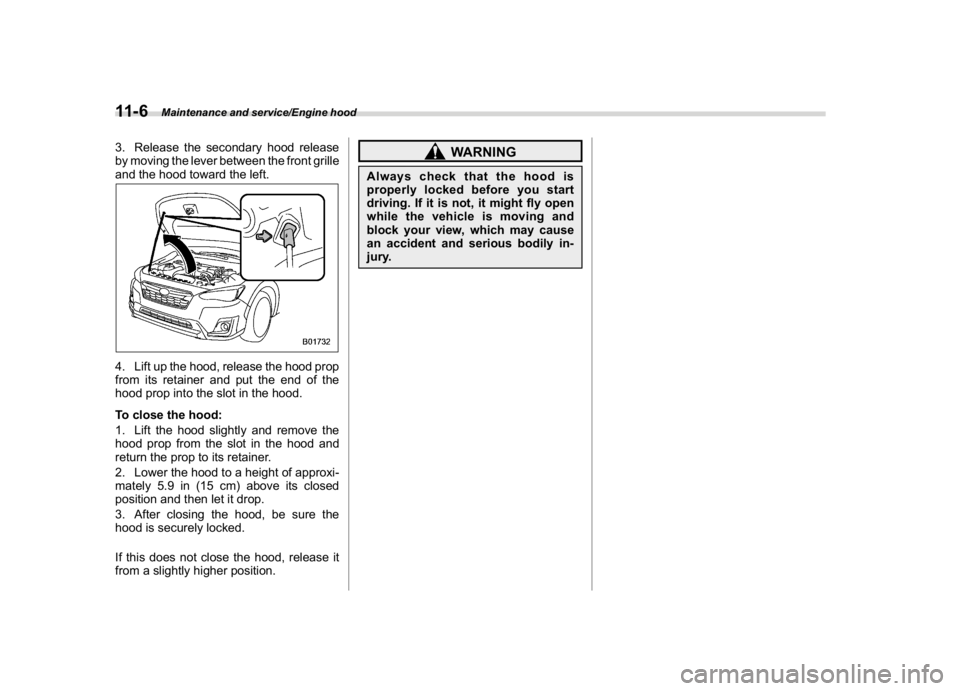
3. Release the secondary hood release
by moving the lever between the front grille
and the hood toward the left.4. Lift up the hood, release the hood prop
from its retainer and put the end of the
hood prop into the slot in the hood.
To close the hood:
1. Lift the hood slightly and remove the
hood prop from the slot in the hood and
return the prop to its retainer.
2. Lower the hood to a height of approxi-
mately 5.9 in (15 cm) above its closed
position and then let it drop.
3. After closing the hood, be sure the
hood is securely locked.
If this does not close the hood, release it
from a slightly higher position.
WARNING
Always check that the hood is
properly locked before you start
driving. If it is not, it might fly open
while the vehicle is moving and
block your view, which may cause
an accident and serious bodily in-
jury.
Maintenance and service/Engine hood
11-6
Page 390 of 474

(403,1)
北米Model "A1320BE-C" EDITED: 2017/ 10/ 10
CAUTION
If the level gauge cannot be pulled
out easily, twist the level gauge right
and left, then gently pull it out.
Otherwise, you may be injured acci-
dentally straining yourself.
2. Pull out the level gauge, wipe it clean,
and insert it again.
3. Be sure the level gauge is correctly
inserted until it stops.1) Full level
2) Low level
3) Approximately 1.1 US qt (1.0 liter, 0.9 Imp
qt) from low level to full level4. Pull out the oil level gauge again.
5. Check the oil levels on both sides of the
level gauge. The engine oil level must bejudged by the lowest of the two levels. If
the oil level is below the low level mark,
add oil so that the full level is reached.
CAUTION
.Be careful not to touch the engine
oil filter when removing the oil
filler cap. Doing so may result in a
burn, a pinched finger, or may
cause some other injury.
.Useonlyengineoilwiththe
recommended grade and vis-
cosity.
.Be careful not to spill engine oil
when adding it. If oil touches the
exhaust pipe, it may cause a bad
smell, smoke, and/or a fire. If
engine oil gets on the exhaust
pipe, be sure to wipe it off.
To add engine oil, remove the engine oil
filler cap and slowly pour engine oil
through the filler neck. After pouring oil
into the engine, you must use the level
gauge to confirm that the oil level is
correct.NOTE.To prevent overfilling the engine oil,
do not add any additional oil above the
upper level when the engine is cold..The engine low oil level warning light
may stay illuminated when the engine
is started straight after topping up or
changing the engine oil. In such cases,
park the vehicle on a level surface and
wait for more than a minute until the oil
level settles, after which the warning
light will turn off. Refer to“Engine low
oil level warning light”F3-18.
&Changing the oil and oil filterChange the oil and oil filter according to
the maintenance schedule in the“War-
ranty and Maintenance Booklet”.
The engine oil and oil filter must be
changed more frequently than listed in
the maintenance schedule when driving
on dusty roads, when short trips are
frequently made, or when driving in ex-
tremely cold weather.NOTE.Changing the engine oil and oil filter
should be performed by a well-trained
expert. Contact your SUBARU dealer
for changing the engine oil and oil filter.
Fully trained mechanics are on standby
at a SUBARU dealer to utilize the
special tools, spare parts and recom-
mended oil for this work, and also, used
oils are properly disposed of.
.If performing oil replacement your-
–CONTINUED–
Maintenance and service/Engine oil
11-9
11
Page 392 of 474

(405,1)
北米Model "A1320BE-C" EDITED: 2017/ 10/ 10
type, the maintenance interval is
shortened to that of the mixing
coolant.
.Do not splash the engine coolant
over painted parts. The alcohol
contained in the engine coolant
may damage the paint surface.
&Cooling fan, hose and con-
nectionsYour vehicle employs an electric cooling
fan which is thermostatically controlled to
operate when the engine coolant reaches
a specific temperature.
If the radiator cooling fan does not operate
even when the coolant temperature high
warning light blinks or illuminates inRED,
the cooling fan circuit may be defective.
Refer to“Coolant temperature low indica-
tor light/Coolant temperature high warning
light”F3-16.
Check the fuse and replace it if necessary.
Refer to“Fuses”F11-34 and“Fuse panel
located in the engine compartment”F12-
12.
If the fuse is not blown, have the cooling
system checked by your SUBARU dealer.
If frequent addition of coolant is necessary,
there may be a leak in the engine coolingsystem. It is recommended that the cooling
system and connections be checked for
leaks, damage, or looseness.
&Engine coolant!Checking the coolant level
WARNING
Never attempt to remove the radiator
cap until the engine has been shut
off and has cooled down completely.
Since the coolant is under pressure,
you may suffer serious burns from a
spray of boiling hot coolant when
the cap is removed.
1)“FULL”level mark
2)“LOW”level markCheck the coolant level at each fuel stop.
1. Check the coolant level on the outside
of the reservoir while the engine is cool.
2. If the level is close to or lower than the
“LOW”level mark, add coolant up to the
“FULL”level mark. If the reserve tank is
empty, remove the radiator cap and refill
coolant up to just below the filler neck as
shown in the following illustration.
–CONTINUED–
Maintenance and service/Cooling system
11-11
11
Page 401 of 474
(414,1)
北米Model "A1320BE-C" EDITED: 2017/ 10/ 10
result in the need for costly brake
rotor repair or replacement.&Breaking-in of new brake
pads and liningsWhen replacing the brake pad or lining,
use only genuine SUBARU parts. After
replacement, the new parts must be
broken in as follows.
!Brake pad and lining
While maintaining a speed of 30 to 40 mph
(50 to 65 km/h), step on the brake pedal
lightly. Repeat this five or more times.
!Parking brake lining
1. Drive the vehicle at a speed of approxi-
mately 22 mph (35 km/h).
2. With the parking brake release button
pushed in, pull the parking brake lever
SLOWLY and GENTLY (pulling with a
force of approximately 33.7 lbf [150 N,
15.3 kgf]).
3. Drive the vehicle for approximately 220
yards (200 meters) in this condition.
4. Wait 5 to 10 minutes for the parking
brake to cool down. Repeat this proce-
dure.
5. Check the parking brake stroke. If the
parking brake stroke is out of the specified
range, adjust it by turning the adjusting nutlocated on the parking brake lever.
Parking brake stroke:
7–8 notches / 45 lbf (200 N, 20.4 kgf)
WARNING
A safe location and situation should
be selected for break-in driving.
CAUTION
Pulling the parking brake lever too
forcefully may cause the rear wheels
to lock. To avoid this, be certain to
pull the lever up slowly and gently.
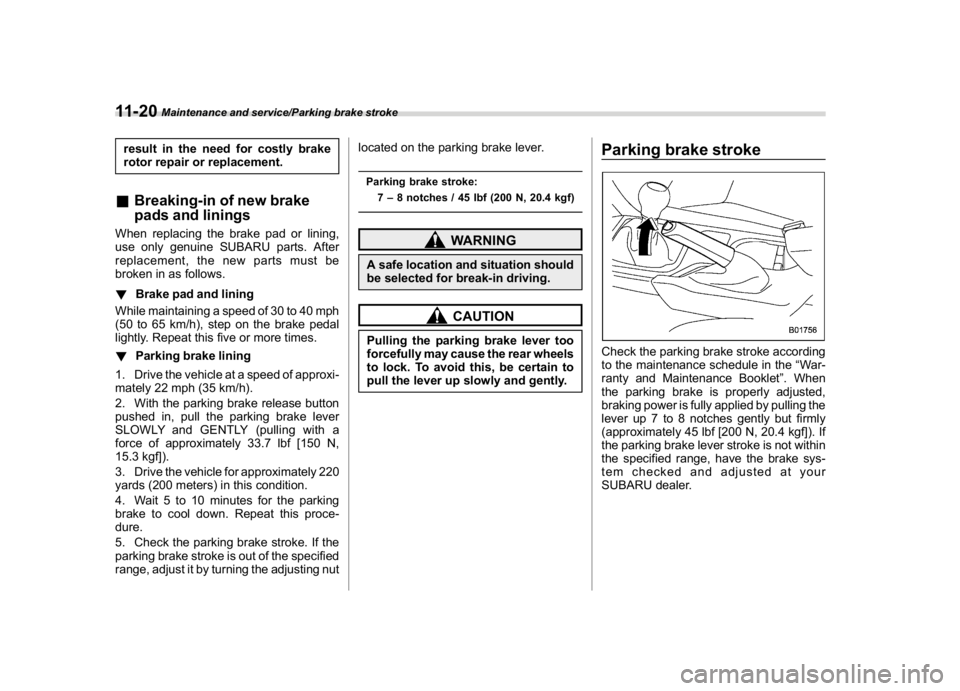
Parking brake strokeCheck the parking brake stroke according
to the maintenance schedule in the“War-
ranty and Maintenance Booklet”. When
the parking brake is properly adjusted,
braking power is fully applied by pulling the
lever up 7 to 8 notches gently but firmly
(approximately 45 lbf [200 N, 20.4 kgf]). If
the parking brake lever stroke is not within
the specified range, have the brake sys-
tem checked and adjusted at your
SUBARU dealer.
Maintenance and service/Parking brake stroke
11-20
Page 402 of 474

(415,1)
北米Model "A1320BE-C" EDITED: 2017/ 10/ 10
Tires and wheels&Types of tiresYou should be familiar with type of tires
present on your vehicle.
!All season tires
All season tires are designed to provide an
adequate measure of traction, handling
and braking performance in year-round
driving including snowy and icy road
conditions. However all season tires do
not offer as much traction performance as
winter (snow) tires in heavy or loose snow
or on icy roads.
All season tires are identified by“ALL
SEASON”and/or“M+S”(Mud & Snow) on
the tire sidewall.
!Summer tires
Summer tires are high-speed capability
tires best suited for highway driving under
dry conditions.
Summer tires are inadequate for driving on
slippery roads such as on snow-covered or
icy roads.
If you drive your vehicle on snow-covered
or icy roads, we strongly recommend the
use of winter (snow) tires.
When installing winter tires, be sure to
replace all four tires.!Winter (snow) tires
Winter tires are best suited for driving on
snow-covered and icy roads. However
winter tires do not perform as well as
summer tires and all season tires on roads
other than snow-covered and icy roads.
&Tire pressure monitoring
system (TPMS) (if equipped)The tire pressure monitoring system pro-
vides the driver with a warning message by
sending a signal from a sensor that is
installed in each wheel when tire pressure
is severely low. The tire pressure monitor-
ing system will activate only when the
vehicle is driven. Also, this system may not
react immediately to a sudden drop in tire
pressure (for example, a blow-out caused
by running over a sharp object).
If you adjust the tire pressures in a warm
garage and will then drive the vehicle in
cold outside air, the resulting drop in tire
pressures may cause the low tire pressure
warning light to illuminate. To avoid this
problem when adjusting the tire pressures
in a warm garage, inflate the tires to
pressures higher than those shown on
the tire placard. Specifically, inflate them
by an extra 1 psi (6.9 kPa, 0.07 kgf/cm
2) for
every difference of 108F (5.68C) between
the temperature in the garage and thetemperature outside. By way of example,
the following table shows the required tire
pressures that correspond to various out-
side temperatures when the temperature
in the garage is 608F (15.68C).
Example:
Tire size: P225/60R17 98H and
P225/55R18 97H
Standard tire pressures:
Front: 33 psi (230 kPa, 2.3 kgf/cm
2)
Rear: 32 psi (220 kPa, 2.2 kgf/cm2)
Garage temperature: 608F (15.68C)
Outside
temperatureAdjusted pressure
[psi (kPa, kgf/cm
2)]
Front Rear
308F(18C) 36 (250, 2.5) 35 (240, 2.4)
108F(128C)38
(265, 2.65)37
(255, 2.55)
108F(238C) 40 (280, 2.8)39 (270, 2.7)
If the low tire pressure warning light
illuminates when you drive the vehicle in
cold outside air after adjusting the tire
pressures in a warm garage, re-adjust the
tire pressures using the method described
above. Then, increase the vehicle speed
to at least 20 mph (32 km/h) and check to
see that the low tire pressure warning light
turns off a few minutes later. If the low tire
pressure warning light does not turn off,
–CONTINUED–
Maintenance and service/Tires and wheels
11-21
11
Page 403 of 474

(416,1)
北米Model "A1320BE-C" EDITED: 2017/ 10/ 10
the tire pressure monitoring system may
not be functioning normally. In this event,
gotoaSUBARUdealertohavethe
system inspected as soon as possible.
While the vehicle is driven, friction be-
tween tires and the road surface causes
the tires to warm up. After illumination of
the low tire pressure warning light, any
increase in the tire pressures caused by an
increase in the outside air temperature or
by an increase in the temperature in the
tires can cause the low tire pressure
warning light to turn off.
System resetting is necessary when the
wheels are changed (for example, a switch
to snow tires) and new TPMS valves are
installed on the newly fitted wheels. Have
this work performed by a SUBARU dealer
following wheel replacement.
It may not be possible to install TPMS
valves on certain wheels that are on the
market. Therefore, if you change the
wheels (for example, a switch to snow
tires), use wheels that have the same part
number as the standard-equipment
wheels. Without four operational TPMS
valve/sensors on the wheels, the TPMS
will not fully function and the warning light
on the combination meter will illuminate
steadily after blinking for approximately
one minute.When a tire is replaced, adjustments are
necessary to ensure continued normal
operation of the tire pressure monitoring
system. As with wheel replacement, there-
fore, you should have the work performed
by a SUBARU dealer.
WARNING
If the low tire pressure warning light
does not illuminate briefly after the
ignition switch is turned ON or the
light illuminates steadily after blink-
ing for approximately one minute,
you should have your Tire Pressure
Monitoring System checked at a
SUBARU dealer as soon as possi-
ble.
If this light illuminates while driving,
never brake suddenly and keep
driving straight ahead while gradu-
ally reducing speed. Then slowly
pull off the road to a safe place.
Otherwise an accident involving
serious vehicle damage and serious
personal injury could occur.
If this light still illuminates while
driving after adjusting the tire pres-
sure, a tire may have significant
damage and a fast leak that causes
the tire to lose air rapidly. If you have
a flat tire, replace it with a spare tireas soon as possible.
When a spare tire is mounted or a
wheel rim is replaced without the
original pressure sensor/transmitter
being transferred, the low tire pres-
sure warning light will illuminate
steadily after blinking for approxi-
mately one minute. This indicates
the TPMS is unable to monitor all
four road wheels. Contact your
SUBARU dealer as soon as possible
for tire and sensor replacement and/
or system resetting. If the light
illuminates steadily after blinking
for approximately one minute,
promptly contact a SUBARU dealer
to have the system inspected.
&Tire inspectionCheck on a daily basis that the tires are
free from serious damage, nails, and
stones. At the same time, check the tires
for abnormal wear.
Contact your SUBARU dealer immediately
if you find any problem.NOTE.When the wheels and tires strike
curbs or are subjected to harsh treat-
ment as when the vehicle is driven on a
rough surface, they can suffer damage
Maintenance and service/Tires and wheels
11-22
Page 405 of 474

(418,1)
北米Model "A1320BE-C" EDITED: 2017/ 10/ 10
1) Correct tire pressure (tread worn evenly)
Roadholding is good, and steering is
responsive. Rolling resistance is low, so
fuel consumption is also lower.
2) Under inflated tire (tread worn on
shoulders)
Rolling resistance is high, so fuel con-
sumption is also higher.3) Over inflated (tread worn in the center)
Ride comfort is poor. Also, the tire
magnifies the effects of road-surface
bumps and dips, possibly resulting in
vehicle damage.
If the tire placard shows tire pressures for
the vehicle when fully loaded, adjust the
tire pressures to the values that match the
loading conditions.
WARNING
Driving at high speeds with exces-
sively low tire pressures can cause
the tires to deform severely and to
rapidly heat up. A sharp increase in
temperature could cause tread se-
paration, and destruction of the
tires. The resulting loss of vehicle
control could lead to an accident.&Wheel balanceEach wheel was correctly balanced when
your vehicle was new, but the wheels will
become unbalanced as the tires become
worn during use. Wheel imbalance causes
the steering wheel to vibrate slightly at
certain vehicle speeds and detracts from
the vehicle’s straight-line stability. It can
also cause steering and suspension sys-
tem problems and abnormal tire wear. If
you suspect that the wheels are notcorrectly balanced, have them checked
and adjusted by your SUBARU dealer.
Also have them adjusted after tire repairs
and after tire rotation.
CAUTION
Loss of correct wheel alignment
causes the tires to wear on one side
and reduces the vehicle’s running
stability. Contact your SUBARU
dealer if you notice abnormal tire
wear.NOTEThe suspension system is designed to
hold each wheel at a certain alignment
(relative to the other wheels and to the
road) for optimum straight-line stability
and cornering performance.
Maintenance and service/Tires and wheels
11-24
Page 409 of 474
(422,1)
北米Model "A1320BE-C" EDITED: 2017/ 10/ 10
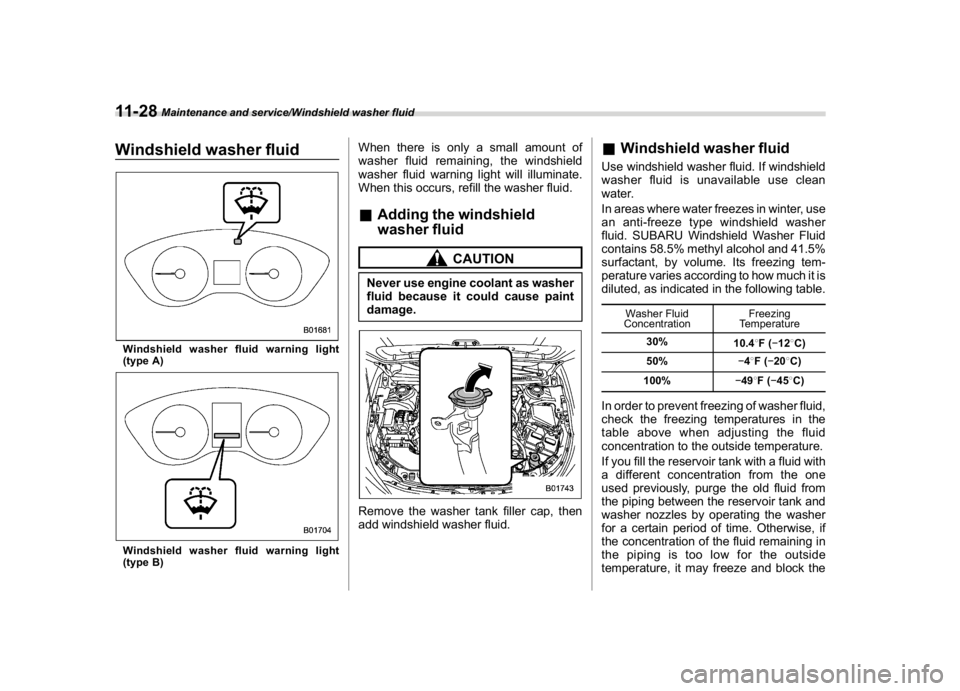
Windshield washer fluidWindshield washer fluid warning light
(type A)Windshield washer fluid warning light
(type B)
When there is only a small amount of
washer fluid remaining, the windshield
washer fluid warning light will illuminate.
When this occurs, refill the washer fluid.&Adding the windshield
washer fluid
CAUTION
Never use engine coolant as washer
fluid because it could cause paint
damage.Remove the washer tank filler cap, then
add windshield washer fluid.
&Windshield washer fluidUse windshield washer fluid. If windshield
washer fluid is unavailable use clean
water.
In areas where water freezes in winter, use
an anti-freeze type windshield washer
fluid. SUBARU Windshield Washer Fluid
contains 58.5% methyl alcohol and 41.5%
surfactant, by volume. Its freezing tem-
perature varies according to how much it is
diluted, as indicated in the following table.
Washer Fluid
ConcentrationFreezing
Temperature
30%
10.48F(128C)
50%48F(208C)
100%498F(458C)
In order to prevent freezing of washer fluid,
check the freezing temperatures in the
table above when adjusting the fluid
concentration to the outside temperature.
If you fill the reservoir tank with a fluid with
a different concentration from the one
used previously, purge the old fluid from
the piping between the reservoir tank and
washer nozzles by operating the washer
for a certain period of time. Otherwise, if
the concentration of the fluid remaining in
the piping is too low for the outside
temperature, it may freeze and block the
Maintenance and service/Windshield washer fluid
11-28