Page 384 of 568
384 4-3. Do-it-yourself maintenance
BRZ_U (A4450BE-A)
■Effects of incorrect tire inflation pressure
Driving with incorrect tire inflation pressure may result in the following:
●Reduced fuel economy
●Reduced driving comfort and poor handling
●Reduced tire life due to wear
●Reduced safety
●Damage to the drive train
If a tire needs frequent refilling, have it checked by your SUBARU dealer.
■Instructions for checking tire inflation pressure
When checking tire inflation pressure, observe the following:
●Check only when the tires are cold.
If your vehicle has been parked for at least 3 hours and has not been
driven for more than 1 mile or 1.5 km, you will get an accurate cold
tire inflation pressure reading.
●Always use a tire pressure gauge.
It is difficult to judge if a tire is properly inflated based only on its
appearance.
●It is normal for the tire inflation pressure to be higher after driving as
heat is generated in the tire. Do not reduce tire inflation pressure after
driving.
●Never exceed the vehicle capacity weight.
Passengers and luggage weight should be placed so that the vehicle
is balanced.
Page 385 of 568
385
4-3. Do-it-yourself maintenance
4
Maintenance and care
BRZ_U (A4450BE-A)
WARNING
■Proper inflation is critical
to save tire performance
Keep your tires properly inflated.
If the tires are not properly inflated, the following conditions may occur
which could lead to an accident resulting in death or serious injury:
●Excessive wear
●Uneven wear
●Poor handling
●Possibility of blowouts resulting from overheated tires
●Air leaking from between tire and wheel
●Wheel deformation and/or tire damage
●Greater possibility of tire damage while driving (due to road hazards,
expansion joints, sharp edges in the road, etc.)
CAUTION
■When inspecting and adjusting tire inflation pressure
Be sure to reinstall the tire valve caps.
If a valve cap is not installed, dirt or moisture may get into the valve and
cause an air leak, resulting in decreased tire inflation pressure.
Page 387 of 568
387
4-3. Do-it-yourself maintenance
4
Maintenance and care
BRZ_U (A4450BE-A)
■When replacing wheels (vehicles with a tire pressure monitoring
system)
The wheels of your SUBARU are equipped with tire pressure warning
valves and transmitters that allow the tire pressure monitoring system to
provide advanced warning in the event of a loss in tire inflation pressure.
Whenever wheels are replaced, the tire pressure warning valves and
transmitters must be installed. (
→P. 375)
WARNING
■When replacing wheels
●Do not use wheels that are a different size from those recommended in
the Owner’s Manual, as this may result in loss of handling control.
●Never use an inner tube in a leaking wheel which is designed for a
tubeless tire. Doing so may result in an accident, causing death or seri-
ous injury.
■When installing the wheel nuts
●Never use oil or grease on the wheel bolts or wheel nuts.
Oil and grease may cause the wheel nuts to be excessively tightened,
leading to bolt or disc wheel damage. In addition, the oil or grease can
cause the wheel nuts to loosen and the wheel may fall off, causing an
accident and resulting in death or serious injury. Remove any oil or
grease from the wheel bolts or wheel nuts.
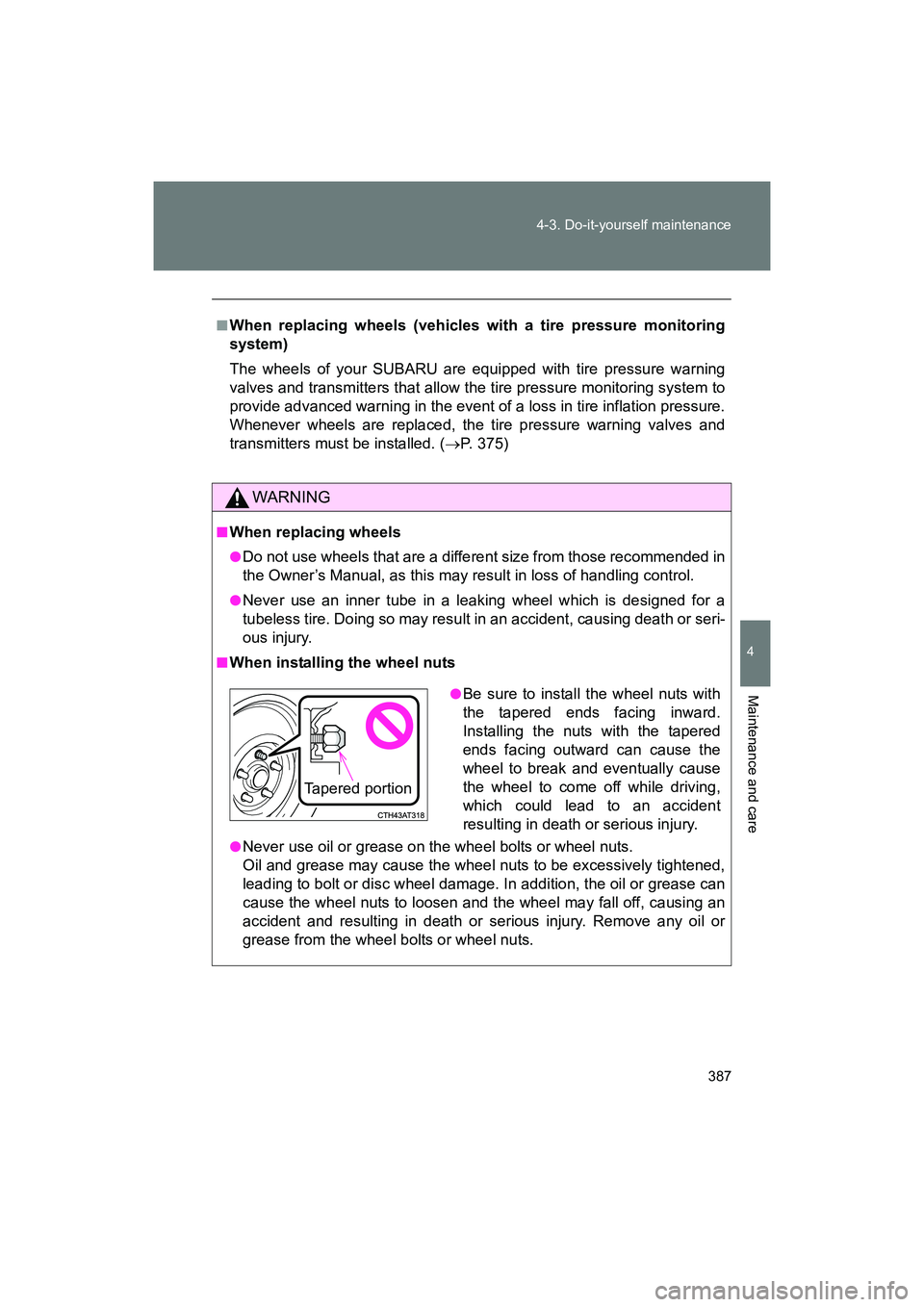
●Be sure to install the wheel nuts with
the tapered ends facing inward.
Installing the nuts with the tapered
ends facing outward can cause the
wheel to break and eventually cause
the wheel to come off while driving,
which could lead to an accident
resulting in death or serious injury.
Tapered portion
Page 388 of 568
388 4-3. Do-it-yourself maintenance
BRZ_U (A4450BE-A)
CAUTION
■Replacing tire inflation pressure warning valves and transmitters
(vehicles with a tire pressure monitoring system)
●Because tire repair or replacement may affect the tire pressure warn-
ing valves and transmitters, make sure to have tires serviced by your
SUBARU dealer or other qualified service shop. In addition, make sure
to purchase your tire pressure warning valves and transmitters at your
SUBARU dealer.
●Ensure that only genuine SUBARU wheels are used on your vehicle.
Tire pressure warning valves and transmitters may not work properly
with non-genuine wheels.
Page 417 of 568
When trouble arises5
417
BRZ_U (A4450BE-A)
5-1. Essential informationHazard warning flashers .......................... 418
If your vehicle needs to be towed ........................ 419
If you think something is wrong ............................. 426
Fuel pump shut off system ........................... 427
5-2. Steps to take in an emergency
If a warning light turns on or a warning buzzer
sounds... ....................... 428
If a warning message is displayed........................ 440
If you have a flat tire......... 457
If the engine will not start ................................ 471 If the select lever cannot
be shifted from P ............ 474
If you lose your keys ........ 475
If the access key does not operate properly....... 476
If the battery is discharged ..................... 480
If your vehicle overheats ....................... 485
If the vehicle becomes stuck .............................. 488
Page 426 of 568
426
5-1. Essential information
BRZ_U (A4450BE-A)
If you think something is wrong
If you notice any of the following symptoms, your vehicle probably
needs adjustment or repair. Contact your SUBARU dealer as soon as
possible.
■Visible symptoms
● Fluid leaks under the vehicle
(Water dripping from the air conditioning after use is normal.)
● Flat-looking tires or uneven tire wear
● Vehicles with a monochrome multi-information display: The
engine coolant temperature gauge needle continually points
higher than normal
● Vehicles with a color multi-information display: The high
engine coolant temperature warning light flashes or illumi-
nates
■ Audible symptoms
● Changes in exhaust sound
● Excessive tire squeal when cornering
● Strange noises related to the suspension system
● Pinging or other noises related to the engine
■ Operational symptoms
● Engine missing, stumbling or running rough
● Appreciable loss of power
● Vehicle pulls heavily to one side when braking
● Vehicle pulls heavily to one side when driving on a level road
● Loss of brake effectiveness, spongy feeling, pedal almost
touches the floor
Page 433 of 568

5
When trouble arises
433
5-2. Steps to take in an emergency
BRZ_U (A4450BE-A)
Tire pressure warning
light (if equipped)
When the light comes on:
Low tire inflation pressure
such as
• Natural causes (
→P. 435)
• Flat tire ( →P. 457) Adjust the tire inflation
pressure to the specified
level.
The light will turn off after
a few minutes. In case the
light does not turn off
even if the tire inflation
pressure is adjusted,
have the system checked
by your SUBARU dealer.
When the light comes on
after blinking for approxi-
mately one minute:
Malfunction in the tire pres-
sure monitoring system
( → P. 436) Have the system checked
by your SUBARU dealer.
Automatic transmission
fluid temperature warning
light (if equipped)
Indicates that the auto-
matic transmission fluid
temperature is too high. Stop the vehicle in a safe
place and shift the select
lever to P.
If the light goes off after a lit-
tle while, the vehicle can be
driven. If the light does not
go off, contact your
SUBARU dealer.
Master warning light (if
equipped) A buzzer sounds and the
warning light comes on and
flashes to indicate that the
master warning system has
detected a malfunction. →
P. 440
Warning lightWarning light/DetailsCorrection procedure
Page 435 of 568
5
When trouble arises
435
5-2. Steps to take in an emergency
BRZ_U (A4450BE-A)
■
Low fuel level warning light
When the vehicle is on an incline, curve and so forth, the fuel inside the tank
moves, which may cause the warning light to come on early.
■ Front passenger detection sensor and passenger seatbelt reminder
and warning buzzer
● If luggage is placed on the front passenger seat, the front passenger
detection sensor may cause the warning light to flash and warning
buzzer to sound, even if a passenger is not sitting in the seat.
● If a cushion is placed on the seat, the sensor may not detect a passen-
ger, and the warning light may not operate properly.
■
When the tire pressure warning light comes on (if equipped)
Check the tire inflation pressure and adjust to the appropriate level.
■The tire pressure warning light may turn on due to natural causes
(if equipped)
The tire pressure warning light may turn on due to natural causes such
as natural air leaks or tire inflation pressure changes caused by temper-
ature. In this case, adjusting the tire inflation pressure will turn off the
warning light (after a few minutes).
■When a tire is replaced with a spare tire (vehicles with a tire pres-
sure monitoring system)
The compact spare tire is not equipped with a tire pressure warning
valve and transmitter. If a tire goes flat, the tire pressure warning light will
not turn off even though the flat tire has been replaced with the spare
tire. Replace the spare tire with the repaired tire and adjust the tire infla-
tion pressure. The tire pressure warning light will go off after a few min-
utes.